Literacy & Spelling
Do word searches help spelling, or just pass the time?
By Jobi · Creator & Maintainer, PrintablesWorld · Updated 2026-07-30 · 8 min read
It is Wednesday night, the spelling test is on Friday, and ten words are stuck to the fridge. A puzzle feels like a painless way to get some practice in. So parents and teachers keep asking the same question: do word searches help spelling, or do they just keep a child busy for ten minutes? A printable word search generator turns that list into a puzzle in seconds. Whether it does anything useful, though, comes down entirely to how the puzzle gets used.
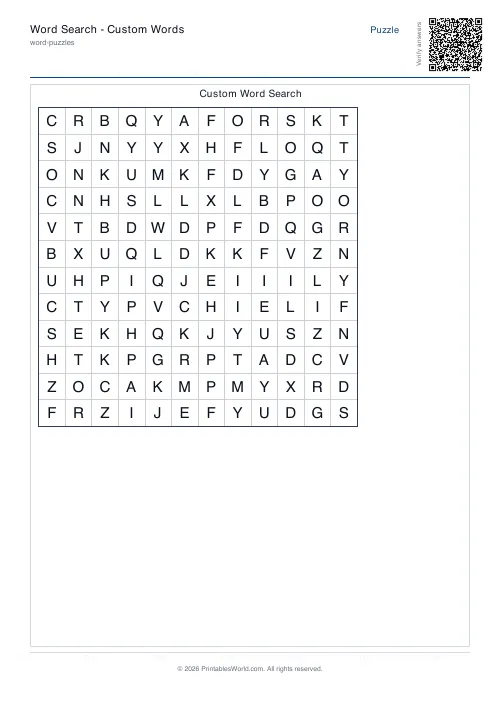
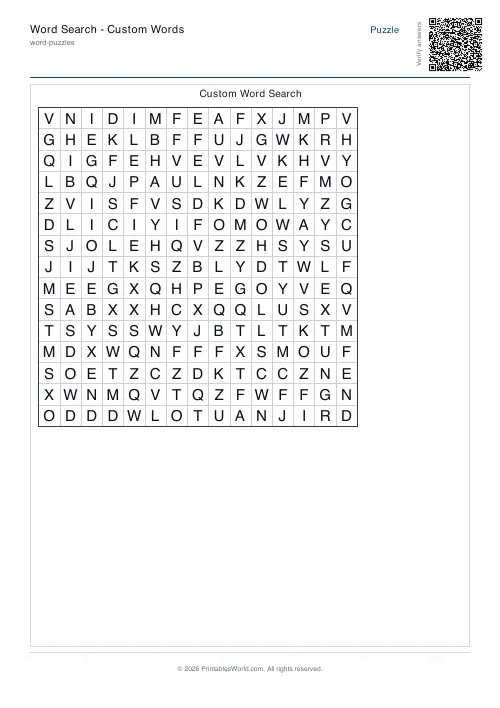
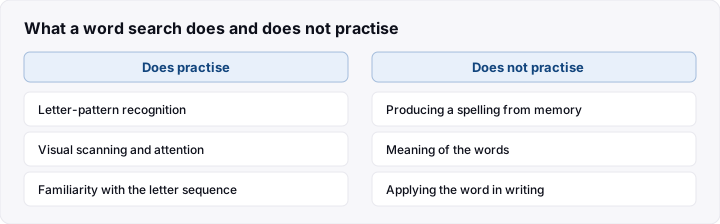
What do word searches actually practise?
A word search asks a child to scan a grid and match the shape of a target word, one letter at a time. That builds visual recognition and a feel for how a word sits on the page. What it never asks for is recall: the word is already printed in the grid, so the child is never made to produce the spelling from memory. Recognition and recall are different skills, and a spelling test measures the second one.
Why the research picture is mixed
Literacy researchers tend to converge on one idea: spelling improves most when a learner pulls a word out of memory and then checks it, rather than simply seeing it again. That is the principle behind retrieval practice, and it is why dictation and self-testing carry so much weight in the evidence.
Word searches sit outside that pattern. As a recognition task, the direct evidence that they raise spelling accuracy on their own is thin. That does not make them pointless. Plenty of teachers reach for them because children enjoy them and because they put letter patterns in front of young readers. The honest summary is that a search works best as a warm-up, paired with writing each word out without looking.
How to use word searches so they support spelling
Treat the puzzle as the opening move, not the whole lesson. A routine that works in plenty of classrooms:
- Find the words using the printed list, getting comfortable with each pattern.
- Cover the list so the spellings are no longer in view.
- Write from memory on a separate sheet, which forces recall.
- Check and correct, then rewrite any misses once or twice.
The cover and write steps are where the actual learning happens. They turn a recognition puzzle into retrieval practice.
A worked example: turning a spelling list into useful practice
Take a weekly list of ten words built around one pattern, the "ai" spelling for the long a sound: brain, train, paint, chain, faint, claim, trail, sprain, afraid, contain. On its own, a search of these ten is a five-minute recognition task. Paired with look, cover, write, check, it does considerably more.
Here is one way to run the week from a single printed sheet:
- Day one. The child finds all ten words, saying each aloud while tracing it.
- Day three. The word bank is folded under; the child writes all ten from memory, checks against the list, and circles any misses.
- Day four. Only the circled words are repeated: find, cover, write, check. A typical list leaves two or three to focus on.
The list stays at ten, the pattern stays consistent, and the search supports the recall work rather than standing in for it.
How to use the Word Search Generator
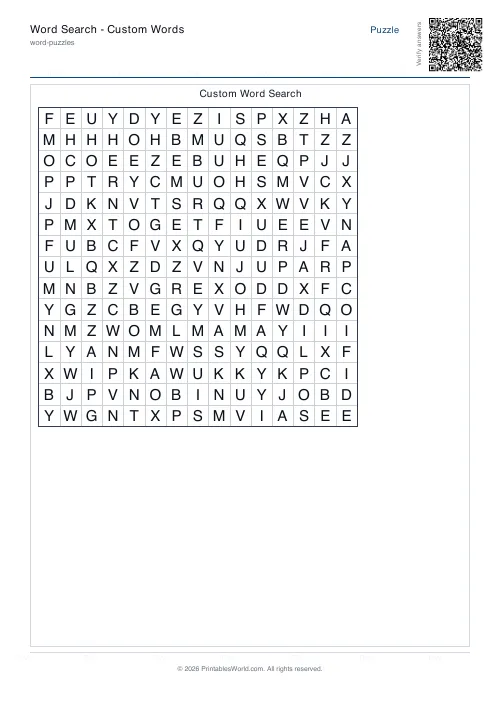
Building the grid by hand is slow going, which is exactly where a word search generator helps. Paste the ten spelling words and the tool lays out the grid for you. The settings worth knowing:
- Word list: paste your own words so the puzzle matches the test.
- Grid size and difficulty: a larger grid with diagonal or backwards placement suits older children; a smaller grid suits younger ones.
- Page size: prints cleanly on A4 or US Letter, so it works wherever you are.
- Answer key: an optional solution sheet lets an adult check at a glance.
The PDF downloads ready to print, with no account needed. To change up the format, browse more word puzzle makers.
When word searches help and when they don't
Younger children meeting a new pattern
For children around five to seven, a search built on a single pattern can be a gentle first encounter that builds confidence before any writing is asked of them.
Older children who need recall
By the later primary or elementary years, roughly nine and up, a search on its own offers little challenge. These learners gain more when it is paired with writing from memory or a quick self-test.
Reluctant or anxious spellers
A puzzle lowers the stakes for a child who finds spelling stressful, giving them a calm way to meet the words before the recall work begins.
Common mistakes to avoid
- Stopping at the search. If the child only finds the words and never writes them from memory, no recall practice happens.
- Overloading the list. A grid crammed with twenty words becomes a chore; eight to twelve focused words is plenty.
- Mixing unrelated patterns. A list that jumps between rules gives nothing clear to absorb; grouping by sound or rule helps.
- Using it as the only activity. A search supports spelling as part of a routine, not as a replacement for one.
Frequently asked questions
Do word searches help spelling, or only word recognition?
On their own, word searches mostly build recognition: the child matches the shape of a word that is already printed in the grid. That familiarity with letter patterns is useful, but it is not the same as recall, which is what a spelling test measures. To make a search support spelling, pair it with writing each word from memory and then checking it. So a search can help spelling, but it helps most as one part of a short routine rather than as a standalone task.
How can a word search support spelling practice at home?
Keep it short. Print a search of the week's list, let the child find every word, then fold the word bank away and ask them to write the words from memory. Check together, circle any misses, and repeat just those once or twice. Three short sessions across a week tend to work better than one long one, because spaced practice helps memory settle. A search is a calm, low pressure starting point, and the writing from memory stage is what turns that gentle start into real practice.
Are word searches suitable for children who find spelling hard?
They can be a kind entry point. A search lets a child who struggles meet the week's words without the pressure of producing a spelling straight away, which can lower anxiety and build confidence. It is worth being realistic, though: a puzzle is not a substitute for structured support, and it does not address any underlying difficulty on its own. If a child consistently struggles despite regular practice, a chat with their teacher about tailored help is sensible. Used alongside recall work, it remains one encouraging piece of the picture.
How many words should a spelling word search include?
For most children of primary or elementary age, eight to twelve words is comfortable, and the ten word example above fits neatly. Fewer than eight can feel too quick to be worthwhile, while more than about fifteen turns the search into a long hunt that tires the child before any writing happens. Grouping the words by a shared pattern, such as a common sound or ending, helps more than a random mix. For a longer list, split it across two smaller searches to keep each session short.
Sources and further reading
The evidence on spelling points towards retrieval and active practice rather than passive exposure. Word searches in particular have a thin direct evidence base, so it is reasonable to say they help with engagement and pattern familiarity while the recall activities do the heavy lifting. Two reputable starting points for the wider evidence:
- Education Endowment Foundation, reviews of literacy approaches and what the evidence supports.
- National Literacy Trust, a recognised charity guiding families and schools on literacy.
Before you print
So, do word searches help spelling? As a five-minute time-filler, not really. As the opening step in a look, cover, write, check routine, they can, by making letter patterns familiar before the recall work starts. The puzzle earns its keep when it leads into writing from memory and becomes part of a weekly rhythm. Print one from the free word search generator, add a cover and write stage, and the same sheet that once filled ten minutes starts to pull its weight. For classroom sets, the printable classroom activities pair neatly with it.
Related tools
Continue reading
Teaching & Classroom
How to make a custom spelling word search
Turn any spelling list into a printable class set in minutes. A practical guide to making a custom spelling word search, with a worked example and difficulty tips.
7 min read
Word Puzzles
Sight words: the complete teaching guide
Sight words are usually taught as words to memorise. Most of them are partly decodable, and treating them that way works better. Here is how, and how many to teach at once.
6 min read