Math & Numeracy
How to help a child who's stuck on times tables
By Jobi · Creator & Maintainer, PrintablesWorld · Updated 2026-07-30 · 7 min read
Picture a child who can rattle off the 2s and 5s in seconds, then freezes at 7 × 8. That one multiplication fact, 56, trips up more learners than almost any other, and the freeze usually has nothing to do with ability. This guide covers how to help child with times tables (also called multiplication facts) using short, regular practice and a free printable you can make in seconds with the multiplication table generator.
By the end you'll have a simple two week plan, a clear sense of which tables tend to cause trouble, and a five minute daily routine you can start today. Whatever school system you happen to be teaching within.
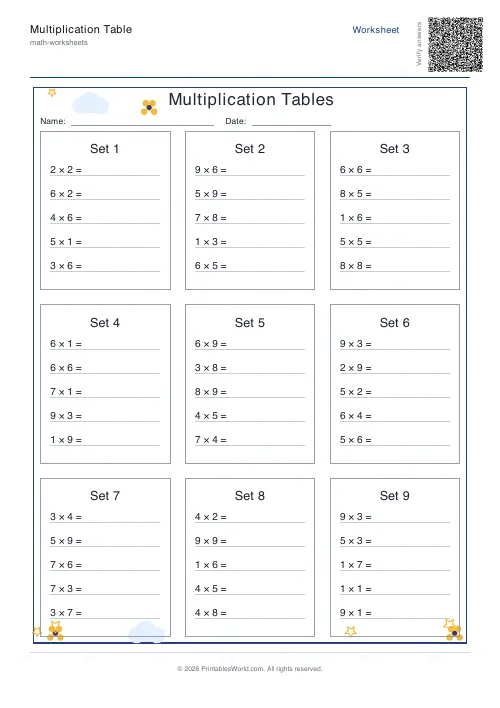
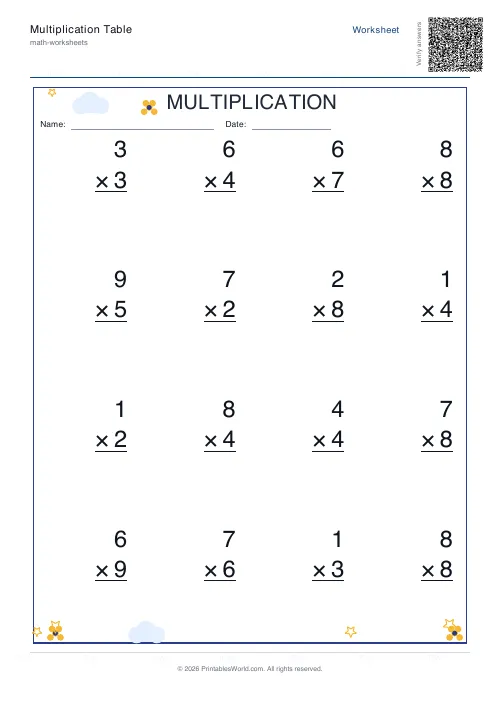
Why times tables can be a sticking point
A child can understand exactly what multiplication means and still struggle to recall the facts quickly. Knowing that 4 × 6 is "four groups of six" is a different skill from answering 24 in under a second. Quick recall leans on memory under a little pressure, and mixing every table together at once turns that pressure up. Most children hit a wall somewhere around the 6, 7, 8 and 12 tables, and that is completely normal.
Why short, regular practice helps
Many teachers find that five focused minutes a day works better than one long session once a week. Spreading practice out gives the brain repeated chances to retrieve a fact, and each time a child pulls the answer up successfully, the next attempt comes a little easier. Research summarised by the Education Endowment Foundation points to the value of regular, low stakes practice and quick recall of number facts. A pattern that holds up well across very different classrooms.
How to help child with times tables, step by step
A clear, repeatable sequence keeps practice calm and low pressure:
- Pick one table: start with a tricky one such as the 7s, not the whole grid.
- Print a reference copy: a clean single table the child can read and point to.
- Read it aloud together: say each fact two or three times.
- Recall a few facts: cover the answers and ask three or four at random.
- Fill a blank grid: the child writes the answers, then checks against the reference.
Keep each round short and stop while it still feels easy, so practice ends on a win rather than a sigh. To vary the routine, you can find printable flashcards and classroom activities that drill the same facts in a different format.
A worked two week times tables practice plan
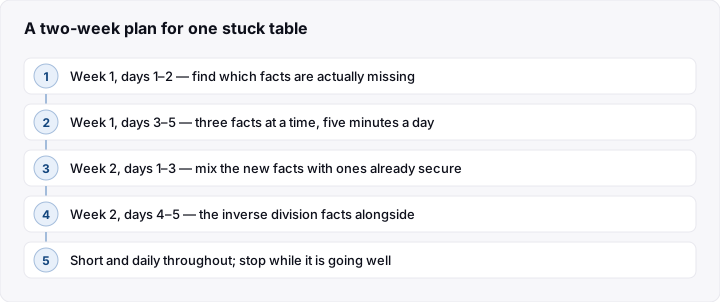
Here is a concrete plan that takes one table at a time. Week one is the 7s; week two is the 8s, which share the famously tricky 7 × 8 = 56.
Week 1 - the 7 times table
 Days 1-2: read 7x1 to 7x12 aloud; circle 7x6=42, 7x7=49, 7x8=56
 Days 3-4: recall 4 facts at random, then fill a blank 7s grid
 Day 5: fill the blank grid from memory; check with the answer key

Week 2 - the 8 times table
 Days 1-2: read 8x1 to 8x12 aloud; link 8x7=56 back to last week
 Days 3-4: recall 8x6=48, 8x8=64, 8x9=72; fill a blank 8s grid
 Day 5: mixed recall of 7s and 8s; fill both grids from memory
For each week, generate three versions: a full table to read from, a blank grid to fill in, and an answer key for checking.
How to use the multiplication table generator
The multiplication table generator lets you choose a single table or a full grid, set the range from 1 to 12, and pick a paper size, A4 or US Letter, so the printable fits whichever paper you have to hand. For practice, the two most useful options are the blank fill in version and the matching answer key, so a child can attempt a grid and you can check it together. The PDF prints clean and large, with no sign up.
Tackling the trickier tables
A handful of tables cause most of the trouble, so it pays to spend longer on them.
The 7 and 8 tables
These hold the facts learners miss most, with 7 × 8 = 56 the classic stumble. Slowing right down on just these two tables removes a surprisingly large share of errors.
The 12 times table
The 12s look daunting but split neatly: 12 × 6 is 10 × 6 plus 2 × 6, which is 60 plus 12, giving 72. Breaking a big fact into two easy ones takes the fear out of it.
When the order flips
Because 7 × 8 and 8 × 7 give the same 56, every fact learned counts twice. Which roughly halves the new ground to cover. For more drills, browse more printable math worksheets.
Common mistakes to avoid
- Practising every table at once: one table at a time keeps the load manageable.
- Long sessions: five calm minutes beats a tense half hour.
- Speed before accuracy: getting it right matters before getting it fast.
- Skipping the easy wins: the 2s, 5s and 10s build the confidence that carries a child into the harder tables.
Frequently asked questions
What age should a child know their times tables?
Most children meet times tables in the early years of school, often around ages five to seven, and build towards quick recall of all tables up to 12 by roughly ages eight to nine. These are general bands, not deadlines, and they vary between countries and between individual children. Some learners are fluent earlier, while others need more time and repetition. The useful focus is steady progress on one table at a time rather than a fixed date by which every fact must be mastered.
Which times tables are the hardest to learn?
The 6, 7, 8 and 12 tables tend to cause the most difficulty, because the facts are larger and the patterns are harder to spot than in the 2s, 5s and 10s. The single fact learners miss most often is 7 x 8 = 56. Because multiplication can be flipped, 8 x 7 gives the same answer, so learning one direction covers both. Focusing practice on these few tables often clears a large share of the errors without drilling the whole grid.
How long does it take to learn a times table?
There is no single figure worth trusting here. For most children a table yields to a week or two of five-minute daily practice, though the 7s and 8s often hold out longer because their facts have fewer patterns to lean on. Expect some backsliding. A fact that felt secure on Tuesday can wobble again the following week, and that is normal rather than a warning sign. Little and often beats one big session, every time.
Are printable times tables better than apps?
Both can help, and many families use a mix. Printables keep practice screen free and let a child write answers by hand, which some find supports memory. A blank grid also makes recall visible, so gaps are easy to spot and check against an answer key. Apps can add variety and instant feedback. There is no single right tool here; the steady habit of short, regular practice matters more than the format. A free printable simply removes any cost or sign up barrier.
Sources and further reading
This guide draws on recognised numeracy and education sources:
- Education Endowment Foundation. Improving Mathematics in Key Stages 2 and 3
- NRICH (University of Cambridge). Developing Number Fluency: What, Why and How
Before you print
Helping a child with times tables comes down to a few simple habits: pick one table, practise for a few calm minutes, and check the work against an answer key. The two week plan above shows how the 7s and 8s can move to quick recall, with 7 × 8 = 56 anchoring both weeks. When you're ready, set up your three printables with the printable multiplication table generator, one to read, one blank to fill, and one answer key, and start with whichever table causes the most sighs.
Related tools
Multiplication Table Generator
Create free printable multiplication tables in table or line-by-line format with custom ranges and themes.
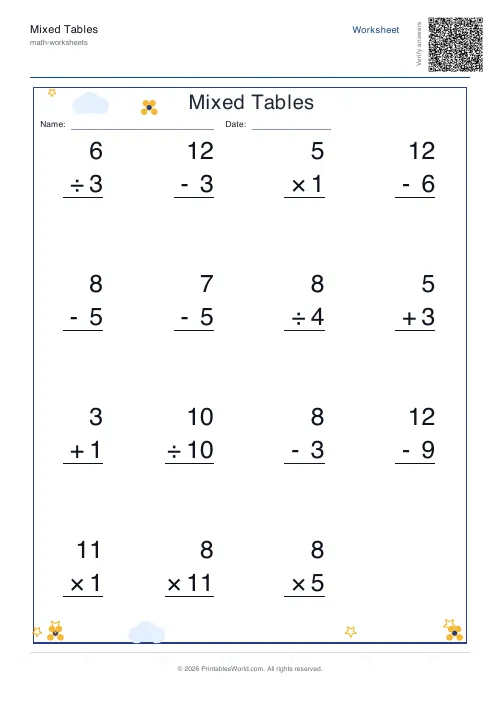
Mixed Tables Generator
Print mixed-operations worksheets combining addition, subtraction, multiplication and division on one page.
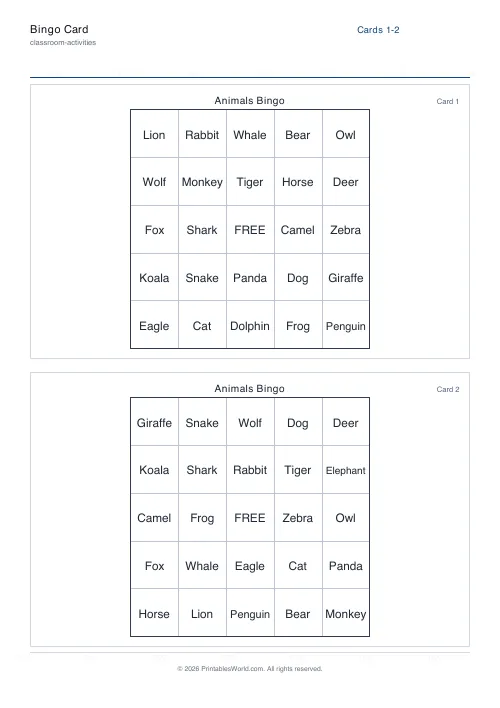
Bingo Card Generator
Generate unique printable bingo cards with custom words, FREE centre toggle, call sheet, and seeded shuffles.
Continue reading
Math Worksheets
Making maths fun: 15 ways to practise without tears
Maths tears are usually about difficulty, length or fear of being wrong, not about maths. Fifteen practical changes, grouped by which of those three problems they actually solve.
6 min read
Math Worksheets
Addition strategies: number lines, regrouping and more
Column addition is the destination, not the route. Here are the strategies that come before it, why each matters, and how to tell which one a child is actually using.
5 min read