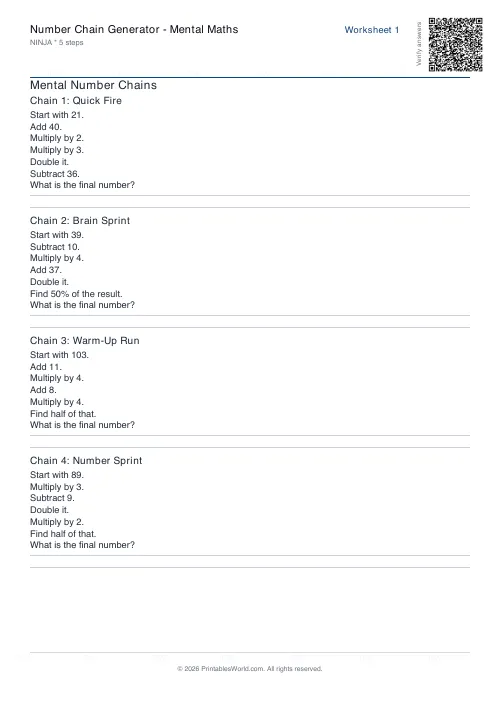
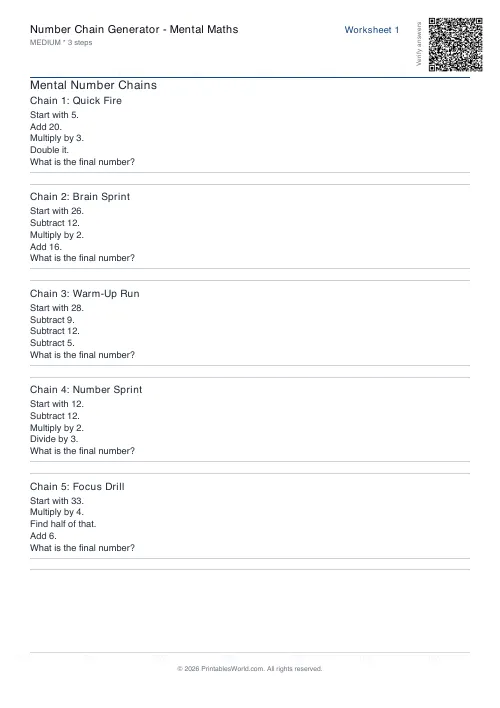
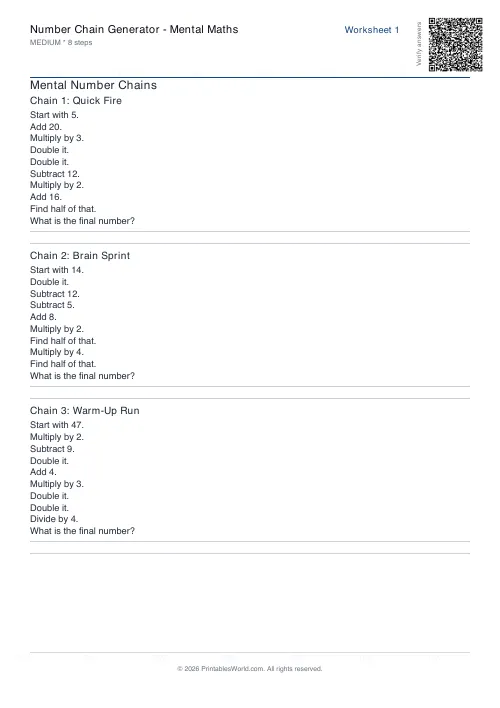
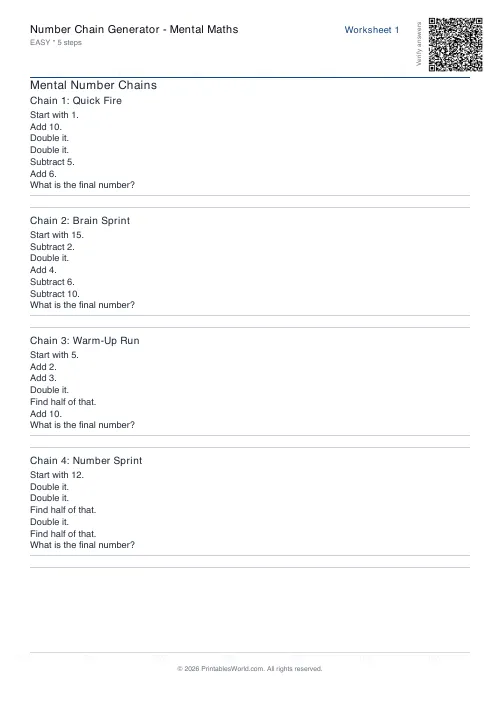
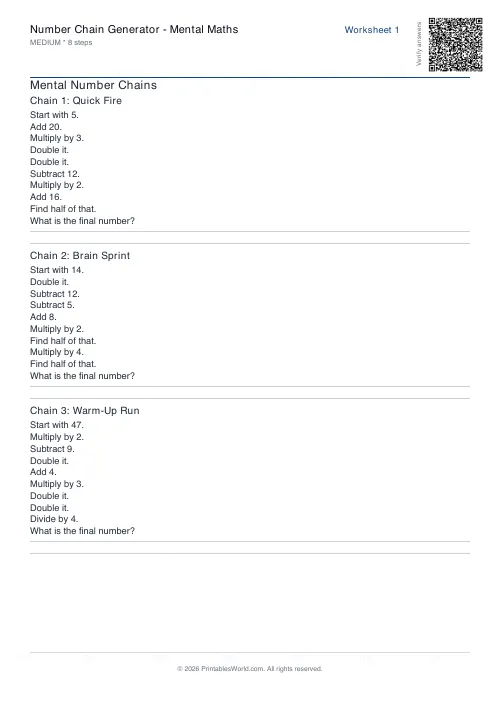
What this tool does
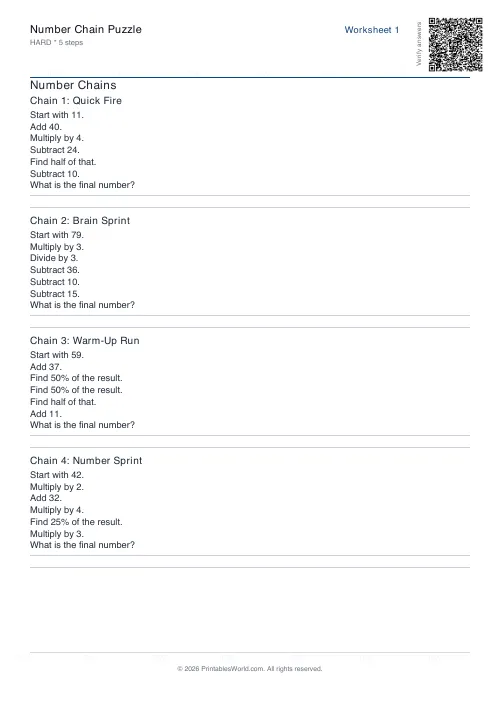
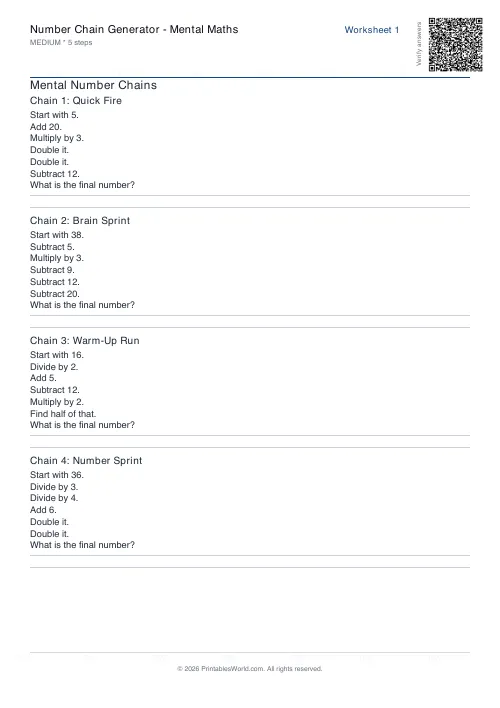
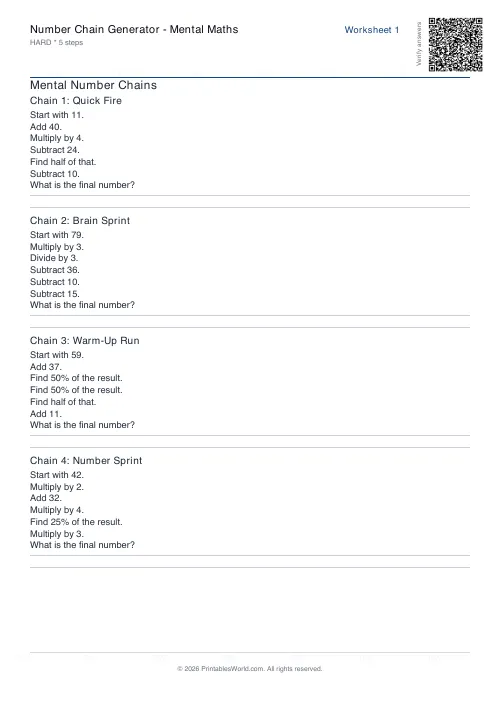
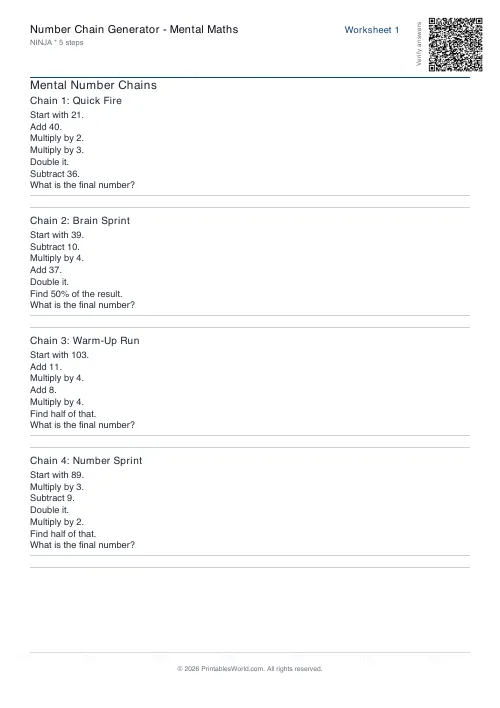
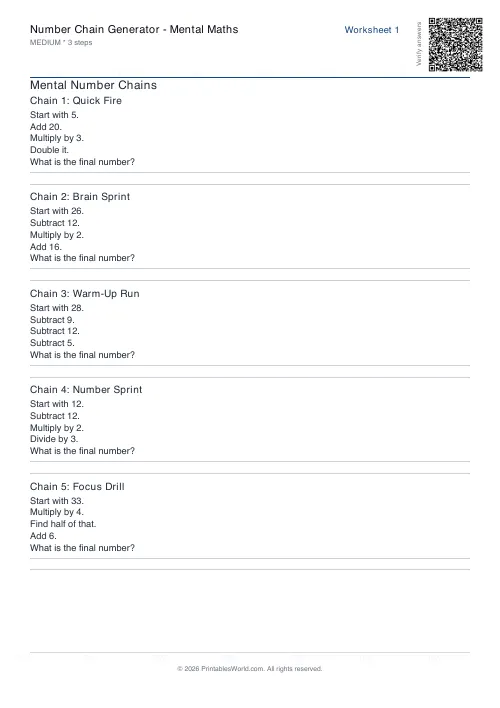
Mental-maths number chains. Start with a number, then run a sequence of steps in your head. Adding. Doubling. Halving, then a multiplication, then a division, then a square or a percentage. Write down only the final answer. Four difficulty bands from easy to ninja, three to eight steps per chain, four to twenty chains a sheet, several worksheets in one PDF, and an answer key that shows every intermediate value.
People also used
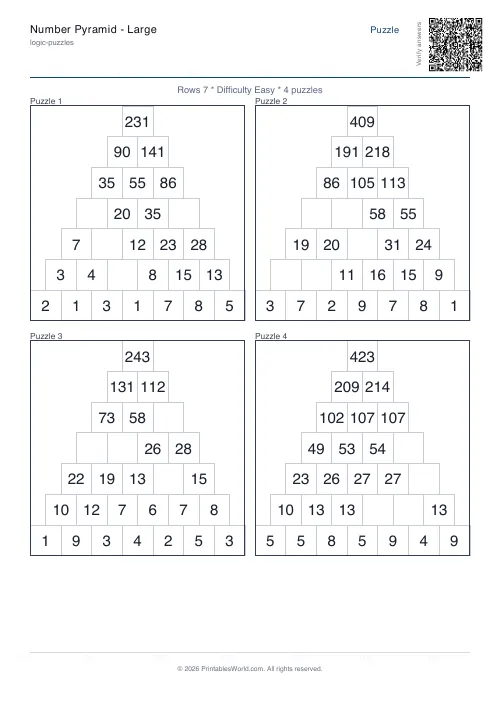
Number Pyramid Generator
Create printable addition pyramid puzzles with adjustable rows, difficulty, and optional answer keys.
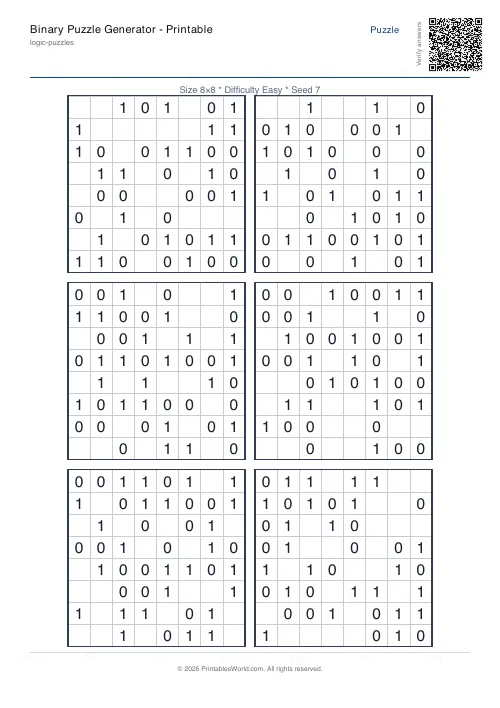
Binary Puzzle Generator: Printable
Create printable binary logic puzzles (Takuzu/Binairo) with customisable grid sizes and difficulty levels.
Sudoku Generator
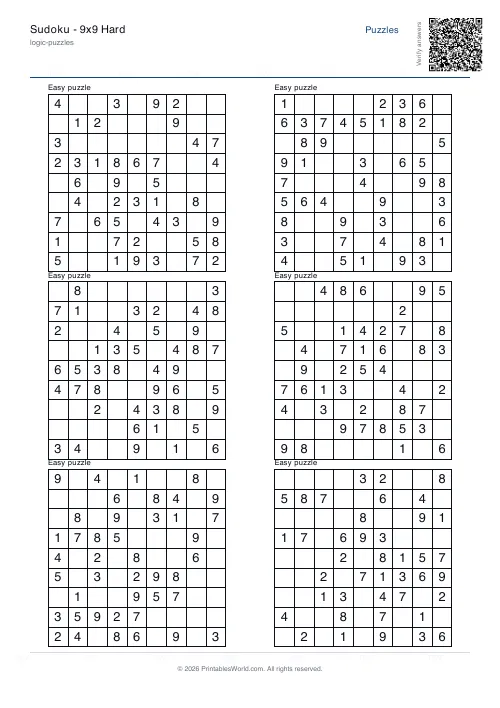
Generate printable Sudoku puzzles with six per page, multiple difficulty levels, and optional solutions.
Feedback
Spotted something off with this tool?
Hold the number in your head
Start with 12. Double it. Add 7. Halve that. Subtract 5.
Nothing gets written down until the end, which is the whole exercise. The arithmetic itself is easy; carrying a result from one step to the next without losing it is not, and that is a different skill from anything a column of sums assesses.
Chains run from three steps to eight. Four to twenty chains on a sheet, and you can ask for several worksheets at once so different groups get different sets out of one PDF.
The four bands
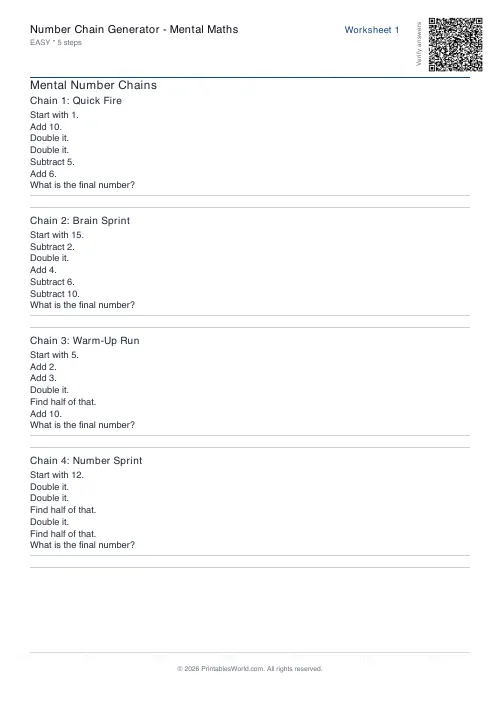
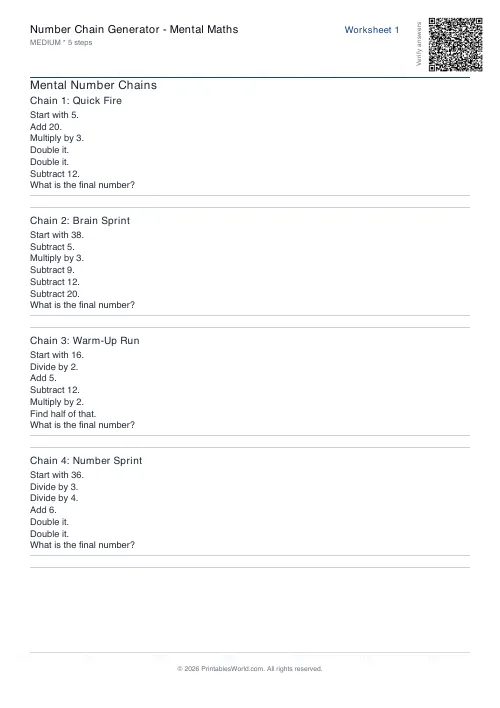
Easy stays with adding and subtracting, plus doubling and halving, all on small numbers. Medium brings in multiplying and dividing by single digits.
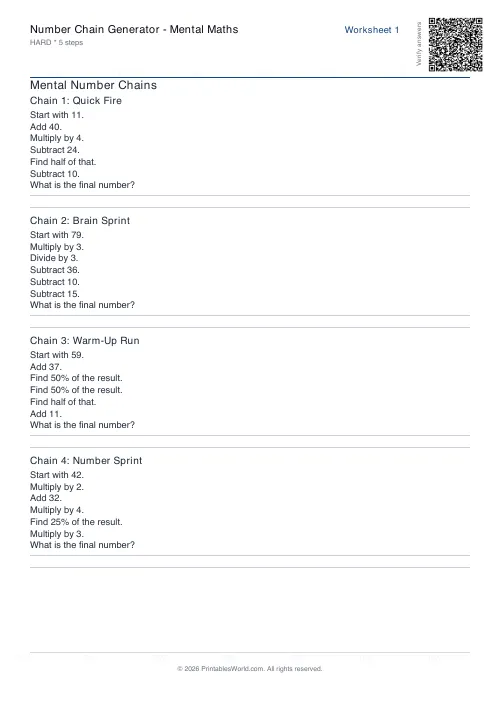
Hard widens the ranges and adds squaring and percentages, which is where the chain stops being arithmetic and starts being strategy: a child who knows that 25 per cent is halving twice is a long way ahead of one computing it properly. Ninja uses everything at awkward values, and it is genuinely hard for an adult.
The generator refuses steps that would produce a negative, a non-integer, or a number too big to hold, so a chain never becomes impossible by accident. Percentages and halving are the exceptions, where a decimal is sometimes the point.
Chain length matters more than difficulty
Three steps at ninja is a puzzle. Eight steps at easy is a memory test, and it will defeat children who can do every individual operation without hesitating.
That is worth knowing before you pitch a sheet. If the class is failing, look at the length before you look at the band, because working memory and arithmetic fluency are separate things and only one of them is being taught in the maths lesson.
Three to five steps is a warm-up. Seven or eight is a session in itself.
A Monday starter
Medium, six steps, four chains. Start with 18, double to 36, add 12 to get 48, divide by 4 for 12, subtract 7 for 5, multiply by 3 for 15, halve it to 7.5.
Children write 7.5 and nothing else. The answer key on the back page carries every intermediate value, which is what makes marking diagnostic rather than binary: when a child is wrong you can usually see which step they dropped, and it is nearly always the same step for the same child.
Next Monday, a fresh PDF with different starting values and a different sequence. Same format, no preparation.
Same seed, same sheet
Generation is seeded, so a given seed always produces the same chains. Print an in-class version and a matching homework version from one seed, or regenerate a lost worksheet weeks later.
Change nothing but the seed and you get an entirely different set at the same difficulty, which is how you make four versions for four groups in about a minute.
Limits
- Eight steps is the maximum. Longer chains stop measuring arithmetic and start measuring only memory.
- You cannot specify the operations yourself. The steps are drawn at random from the pool that the difficulty band allows.
- Static PDFs. Nothing here tracks a pupil across weeks.
FAQs
Quick answers
What difficulty level should I choose for Year 4 students?
Easy or Medium difficulty suits most Year 4 classes. Easy uses only addition, subtraction, doubling, and halving with numbers under 20. Medium introduces simple multiplication and division with slightly larger starting values. Try a sample of each and see which keeps your students challenged but not frustrated.
Can I print the answer key separately?
Yes. When you tick the answer-key option, solutions appear on separate pages at the end of the PDF. Print those pages on coloured paper or hold them back for teacher reference, while distributing only the question pages to students.
How many chains fit on one page?
The layout adapts to the number of chains you specify. Four to six chains per page is typical; more than that and the font shrinks to fit. If you need many chains, consider generating multiple worksheets instead of cramming them all onto one sheet.
Will the same settings always produce the same worksheet?
Yes, if you use the same seed value. The generator uses a seeded random algorithm, so entering identical difficulty, chain length, count, and seed will regenerate the exact same questions. Leave the seed blank (or change it) to get a fresh set of chains each time.
What operations appear at Ninja difficulty?
Ninja difficulty includes addition, subtraction, multiplication, division, squaring, doubling, halving, and percentage calculations, all with larger starting numbers (20–120). Expect steps like "Find 25% of that" or "Square it" mixed into the chain.
Can I customise the title on the worksheet?
Yes. The generator includes a title field where you can type any heading you like. "Monday Warm-Up," "Maths Challenge 3," "Homework Week 7," or your class name. That title appears at the top of every page in the PDF.
Do I need colour printing for these worksheets?
No. The worksheets are designed for black-and-white laser or inkjet printers. All text and layout elements work perfectly in greyscale, keeping your printing costs low.
Related tools
Further reading
Logic Puzzles
Kakuro, killer sudoku and other number puzzles explained
If sudoku has stopped being a challenge, these are the natural next steps. And unlike sudoku, most of them genuinely involve arithmetic.
5 min read
Puzzles & Brain Games
Sudoku for kids: which difficulty to start at, by age
A practical guide to picking the right sudoku difficulty for a child by age, with a copyable first session and free printable grids in seconds.
7 min read
Puzzles & Brain Games
Printable brain games for seniors: a free puzzle pack
A free printable puzzle pack for older adults, with a sample seven-day plan, large-print and easier-difficulty tips, and how to use the Logic Puzzles collection.
7 min read