What this tool does
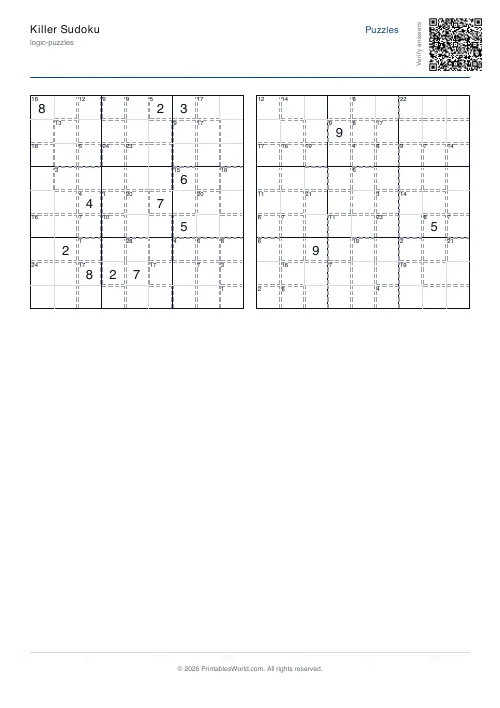
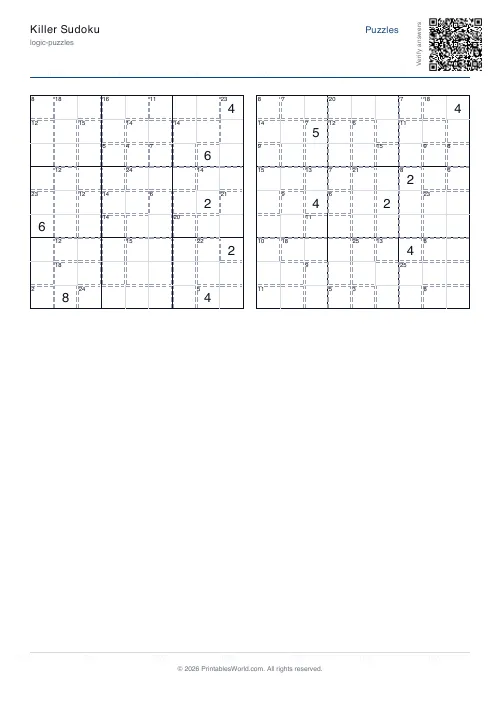
Killer sudoku: dashed cages with a sum in the corner instead of a grid full of starting digits. Rows, columns and boxes take 1 to 9, and a cage's cells add to its clue without repeating.
People also used
Feedback
Spotted something off with this tool?
Sums instead of givens
The usual sudoku rules apply: 1 to 9 once in every row, every column and every 3×3 box. On top of that the grid is divided into dashed cages, each carrying a small number in its corner. The cells in a cage must add to that number, and no digit may repeat inside a cage.
A typical board here has about 33 cages of one to four cells, and only four or five digits printed anywhere. Almost everything comes from the sums.
The rule of 45
The technique that makes killer sudoku tractable, and the first thing to teach anyone starting.
Every row, column and box contains 1 to 9, so each adds to 45. Take a box whose cages sit entirely inside it: add their clues, and the difference from 45 is the total of whatever cells are left over. One cell left over means you have just solved it outright.
The same works across two or three rows — two rows total 90, three total 135 — and cages that spill across a boundary are handled by subtracting the part you can account for. Most opening moves in a killer sudoku are a version of this.
Cage combinations worth memorising
Small cages with extreme sums are fully determined, and they are where a board opens.
Two cells summing to 3 must be 1 and 2. Summing to 4, they are 1 and 3. Seventeen is 8 and 9; sixteen is 7 and 9. Three cells summing to 6 are 1, 2 and 3; summing to 24 they are 7, 8 and 9. Four cells summing to 10 are 1, 2, 3 and 4.
Mark both or all three candidates in the cells and let the row, column and box rules pick the order. That single habit carries you through the first third of a board.
No repeats in a cage, even across a box boundary
The rule people miss. A cage that straddles two boxes still cannot repeat a digit, even though the two cells are in different boxes and different rows and would otherwise be free to match.
It is also the rule that makes long cages informative rather than useless: a five-cell cage summing to 15 has to be 1+2+3+4+5, because no other five distinct digits are that small.
How these are built
A completed sudoku grid is generated first, then cages are laid over it and their sums computed. The result is checked against a solver: if the cage layout on its own pins the answer, the board ships with no givens at all, and if it does not, the smallest set of digits needed to make it unique is revealed. Nothing that has more than one answer is printed.
That is why the number of printed digits varies from board to board. Four or five is typical; a board that needed none is a good one.
Adjustments
Puzzles per page and the solutions page, plus a seed. A4 or US Letter.
One to a page is worth it here. Killer sudoku needs room in the cells for candidate digits, and the cage sums are printed small in the corners — two to a page is readable, four is a strain.
Print at 100% on A4 or US Letter.
FAQs
Quick answers
How does Killer Sudoku differ from regular Sudoku?
Standard Sudoku gives you starting digits; Killer Sudoku gives you cages and the sum of each cage instead.
Are puzzles guaranteed unique?
In v1 the cage layout is derived from a real solved grid so a valid solution always exists; uniqueness is not strictly enforced.
How many puzzles per page?
One or two puzzles per page so the cage outlines stay legible.
Can I get the solutions?
Yes. Toggle the solutions option to add a second page with the completed grids.
Related tools
Sudoku Generator
Generate printable Sudoku puzzles with six per page, multiple difficulty levels, and optional solutions.
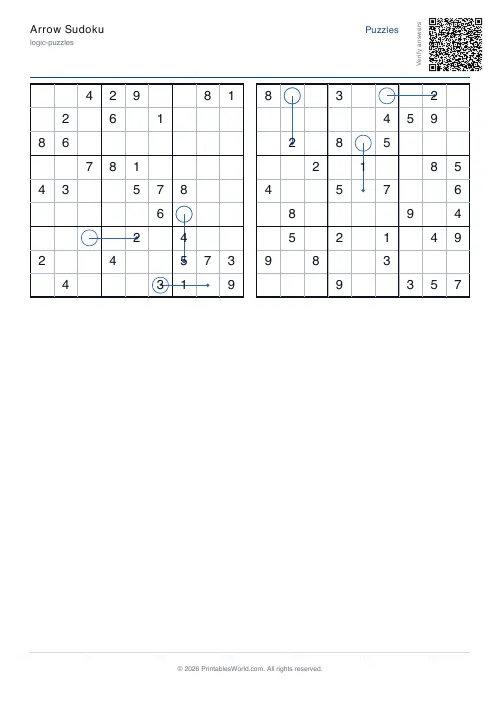
Arrow Sudoku
Sudoku variant where digits along arrows must sum to the circle digit.
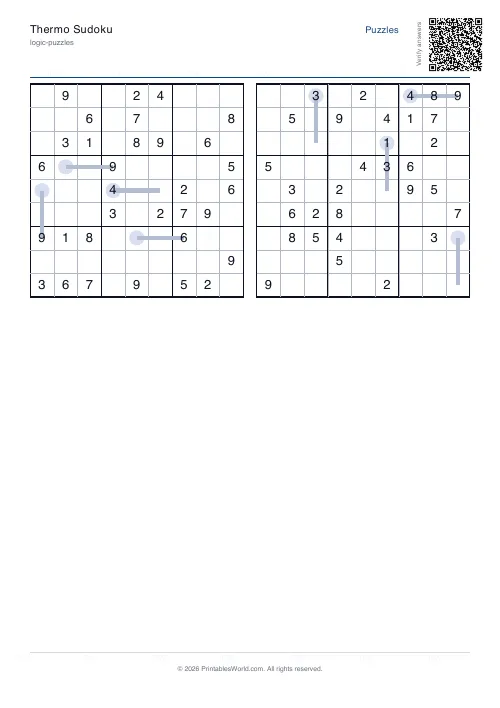
Thermo Sudoku
Digits along thermometer shapes must increase from bulb to tip.

Sudoku: 4x4 Easy
Simple 4x4 Sudoku for beginners and young children. Generates unique puzzles each time.
Further reading
Logic Puzzles
Kakuro, killer sudoku and other number puzzles explained
If sudoku has stopped being a challenge, these are the natural next steps. And unlike sudoku, most of them genuinely involve arithmetic.
5 min read
Logic Puzzles
How to solve Sudoku: a beginner's step-by-step guide
Four techniques, learned in order, solve almost every easy and medium Sudoku: scanning, the last free cell, pencil marks and naked pairs. Here is each one with a worked example.
6 min read
Puzzles & Brain Games
Sudoku for kids: which difficulty to start at, by age
A practical guide to picking the right sudoku difficulty for a child by age, with a copyable first session and free printable grids in seconds.
7 min read