What this tool does
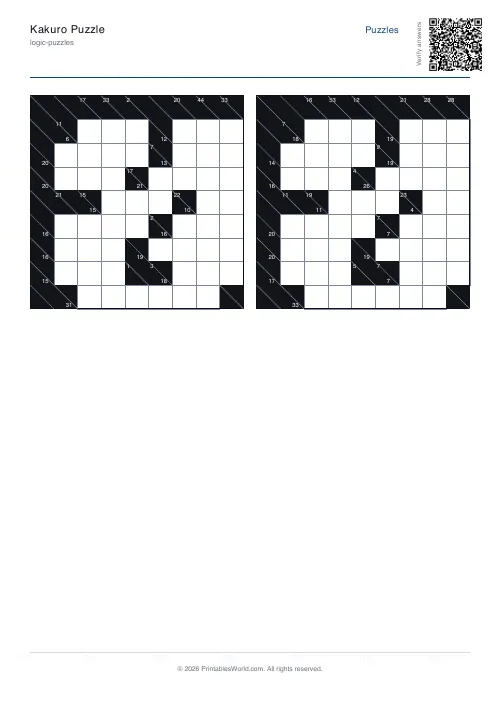
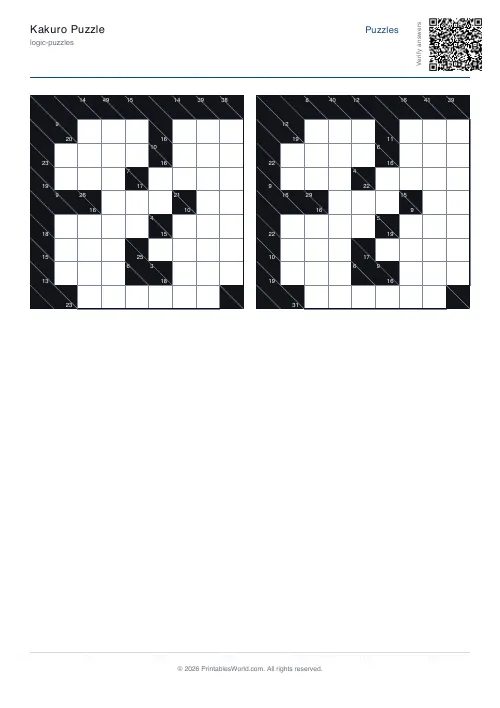
Kakuro, the cross-sum puzzle. Each white run holds distinct digits 1 to 9 adding to the clue in the black cell beside it. Runs are two to five cells long, up to four boards a page.
People also used
Feedback
Spotted something off with this tool?
A crossword where the answers are sums
Black cells carry clues, split by a diagonal: the number below the line is the total for the run of white cells to its right, the number above the line is the total for the run going down.
Fill each run with digits from 1 to 9. No digit may repeat inside a run, and the run has to add up to its clue exactly.
The whole puzzle is combinations
Kakuro looks like arithmetic and is really about which sets of digits can make a total.
Some clues have exactly one possible set, and those are where every solve starts. A run of two cells summing to 3 is 1 and 2, in some order. Two cells summing to 17 is 8 and 9. Three cells summing to 6 is 1, 2 and 3; summing to 24 it is 7, 8 and 9. Four cells summing to 10 is 1, 2, 3 and 4.
Find those first, mark both candidates in each cell, and let the crossing runs decide the order. That single technique gets you most of the way through a small board.
Every run here is two to five cells
Deliberately short. A two-cell run has at most a handful of possible pairs and often only one; an eight-cell run has so many combinations that it constrains almost nothing and turns the puzzle into arithmetic rather than deduction.
Short runs also mean more crossings per cell, which is where the actual reasoning happens.
Digits do not repeat in a run — but may repeat in a line
The rule catches out people arriving from sudoku. It is the run that must hold distinct digits, not the whole row.
A row split by a black cell into a two-cell run and a three-cell run can perfectly well have a 4 in each part. They are separate runs and the no-repeat rule applies inside each one independently.
One valid answer, not necessarily the only one
Worth being straight about. Every clue on these boards is achievable and the printed solution obeys every rule — both checked by construction. What is not yet checked is whether it is the only arrangement that does, and in practice most of these boards admit more than one.
So a solver whose grid satisfies every clue with distinct digits in each run has solved the puzzle, whatever the answer sheet says. This is being worked on, and it is the sort of limitation most printable puzzle sites do not mention.
Adjustments
Boards per page, from one to four, the solutions page, and a seed. A4 or US Letter.
One to a page prints large enough to write candidates in the corners of the cells, which you will want to do. Four to a page is a supply of quick puzzles rather than a comfortable solve.
Where it comes from
Kakuro is the Japanese name, from a contraction meaning cross-addition. In English it was published for decades as "cross sums" before Nikoli popularised the current name, and it predates the sudoku boom by a long way.
Print at 100% on A4 or US Letter.
FAQs
Quick answers
How is Kakuro different from Sudoku?
Kakuro has black "clue" cells whose numbers tell you the sum of the run of white cells next to them; digits 1-9 must be distinct in each run.
How big are the puzzles?
A fixed 9x9 board with mixed runs; v1 uses one template per board to keep the layout legible.
Are puzzles unique?
Not strictly in v1. Values are picked at random for each run, so multiple solutions can exist (the printed answer is one valid solution).
Can I print solutions?
Yes, toggle the solutions option for a second page with the filled-in grid.
Related tools
Further reading
Logic Puzzles
Kakuro, killer sudoku and other number puzzles explained
If sudoku has stopped being a challenge, these are the natural next steps. And unlike sudoku, most of them genuinely involve arithmetic.
5 min read
Logic Puzzles
The benefits of logic puzzles for developing brains
Logic puzzles teach deduction and persistence, which are worth having. The claim that they make children generally smarter is weaker than the marketing suggests.
5 min read
Puzzles & Brain Games
Printable brain games for seniors: a free puzzle pack
A free printable puzzle pack for older adults, with a sample seven-day plan, large-print and easier-difficulty tips, and how to use the Logic Puzzles collection.
7 min read