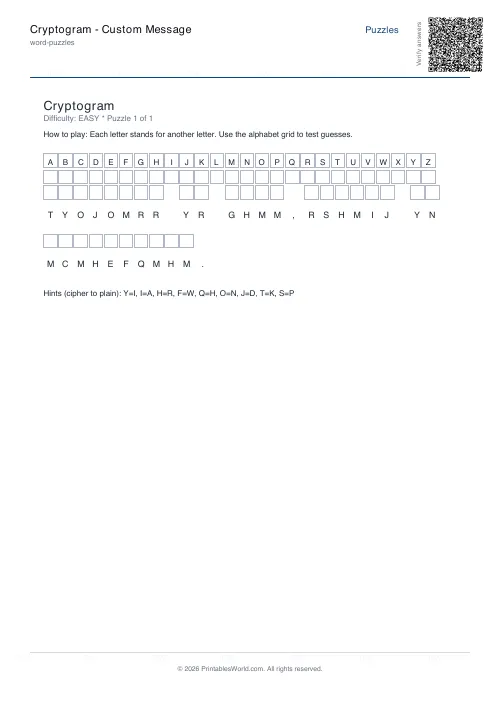
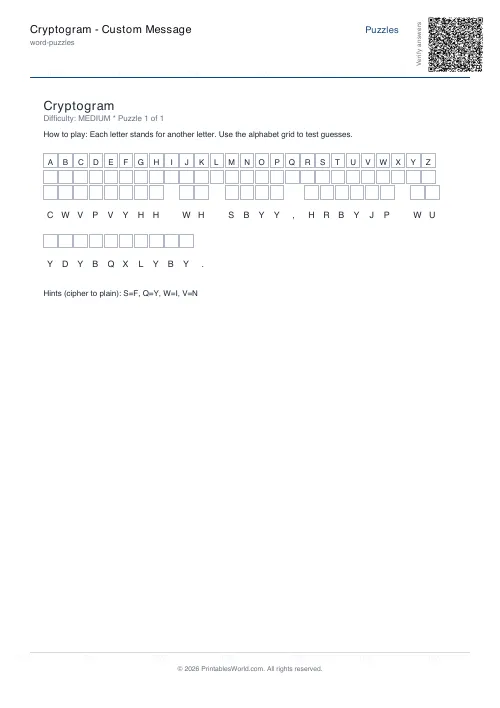
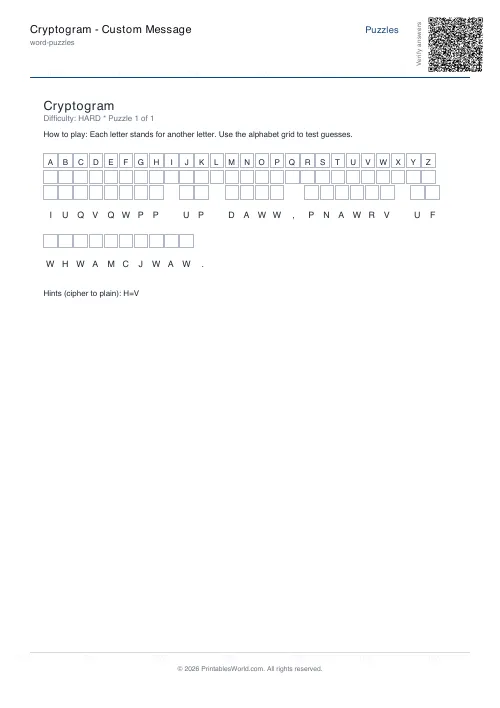
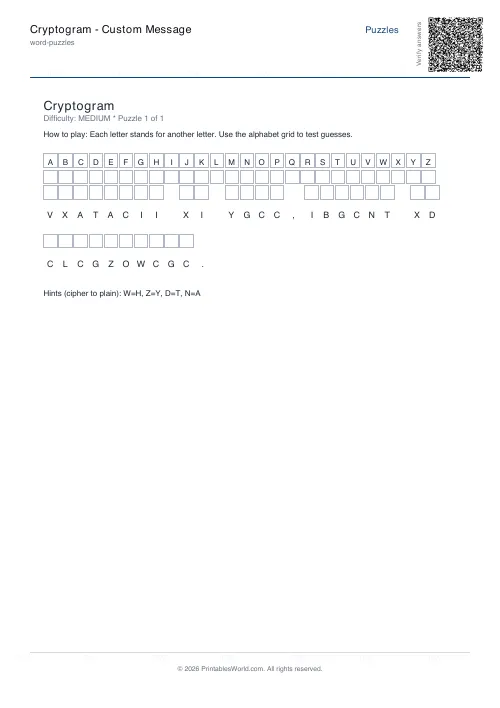
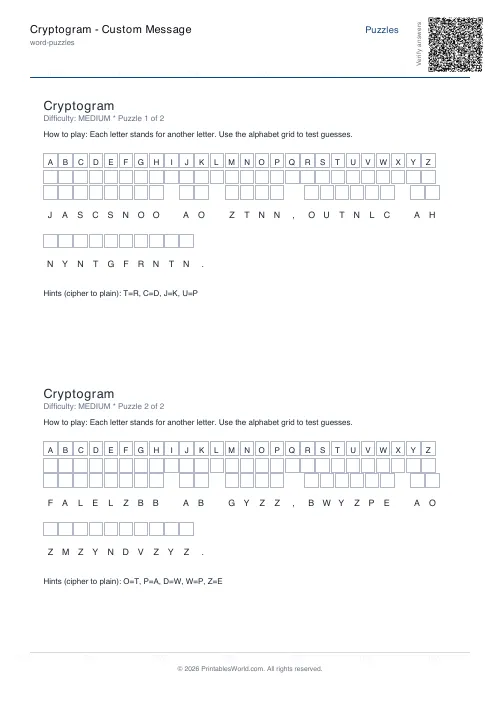
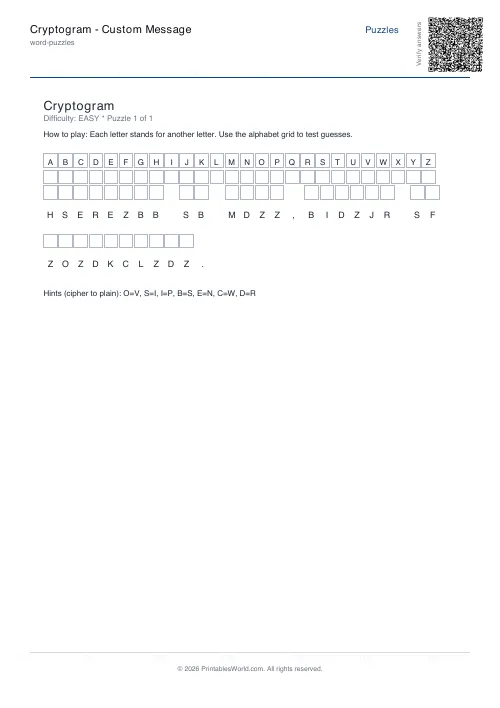
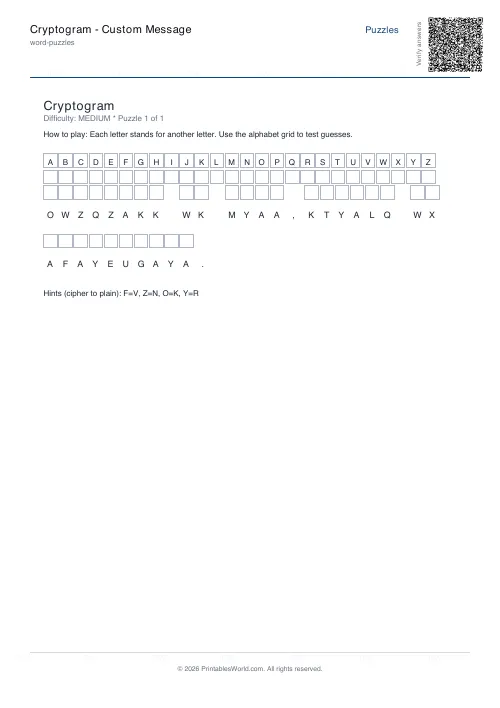
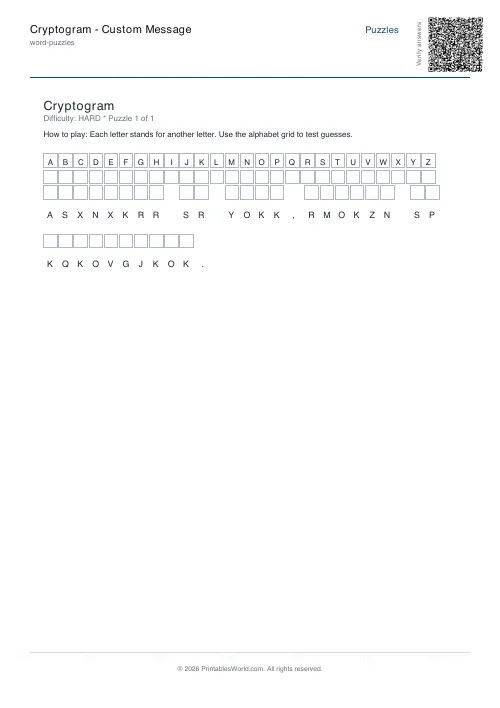
What this tool does
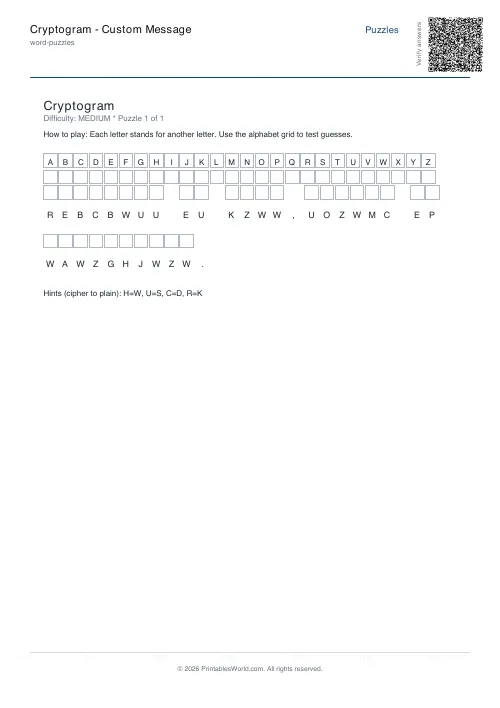
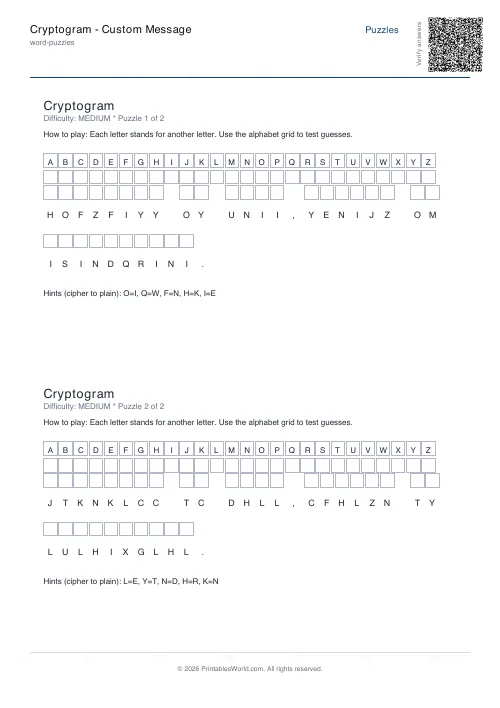
Turn your own message into a substitution cipher. Paste up to about 350 characters, choose how many starter letters to give away, and print with an answer key.
People also used
Cryptogram Generator: Printable PDF
Create printable cryptogram puzzles from famous quotes or your own text with customisable difficulty and hints.
Word Search: Custom Words
Enter your own word list and generate a printable word search.
Crossword Generator: Printable PDF
Custom word lists into printable crossword puzzles with numbered clues.
Feedback
Spotted something off with this tool?
Your message, enciphered
Every letter is swapped for a different one, consistently throughout, and the solver works out the mapping from the pattern. Type a quote, a motto, a birthday message or a clue for a treasure hunt, up to about 350 characters.
Spaces and punctuation stay where they are, which is what makes the puzzle solvable — word lengths and apostrophes are most of the evidence.
Difficulty is the number of letters given away
- Easy reveals six to ten letters, weighted towards the common ones. Enough to see several whole words at a glance and work outward from there.
- Medium reveals three to five. A foothold, and then real work.
- Hard reveals nothing, or almost nothing. You start from the structure alone.
The starter letters are chosen from the frequent ones on purpose. Being given a Q is nearly useless; being given an E unlocks the shape of the whole text.
How to solve one
Start with the one-letter words. In English they are almost always a or I, and getting one of them right usually confirms itself immediately.
Then look for the apostrophes. A letter after an apostrophe at the end of a word is s, t, re, ve, ll or d, and that is a very short list.
Then count. E is the most common letter in English by a distance, and the most frequent symbol in a text of any length is usually it. T, A, O, I and N follow.
Finally, look at three-letter words. The is the most common word in the language and its pattern is distinctive once you have a candidate for E.
Choosing text that works
Longer is easier, which is the opposite of what people expect. A hundred-character quote gives the solver enough repetition to count letters; a fifteen-character motto gives almost nothing and turns the puzzle into guesswork.
Ordinary words help. A text full of names and unusual vocabulary breaks the frequency logic, because the solver's instinct for what a word could be stops working.
Avoid numbers and unusual symbols — they do not encipher and they interrupt the pattern.
Where it earns its place
A cryptogram is a way to make somebody read a sentence slowly and carefully, which is otherwise difficult to arrange.
That makes it good for a message you want remembered: a class motto, a birthday note, the location of a hidden present. It also makes a decent introduction to frequency analysis, which is a real technique and the reason simple substitution ciphers stopped being used for anything serious several centuries ago.
The options
Your text, the difficulty, how many puzzles to print, and the answer key. A4 or US Letter.
Print at 100% on A4 or US Letter.
FAQs
Quick answers
What kind of message works best?
Short, punchy lines (a sentence or two, ideally under 350 characters). Letters become a substitution cipher; numbers and punctuation pass through.
How do hints work?
Toggle "Include starter hints" and the puzzle prints a few letter-pair clues to help solvers get started.
Can I print the solution?
Yes. Toggle "Include solution page" for the plaintext and "Include full answer key" for the substitution table.
Will the same seed produce the same cipher?
Yes. Reuse the seed plus the same text to regenerate the exact same puzzle.
Related tools
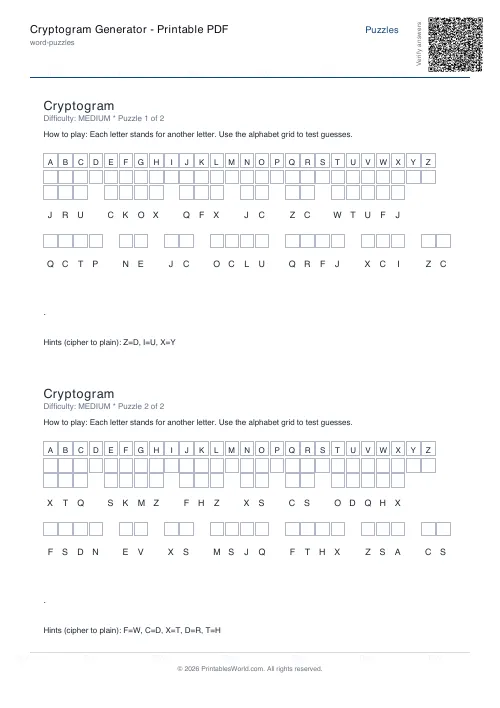
Cryptogram Generator: Printable PDF
Create printable cryptogram puzzles from famous quotes or your own text with customisable difficulty and hints.
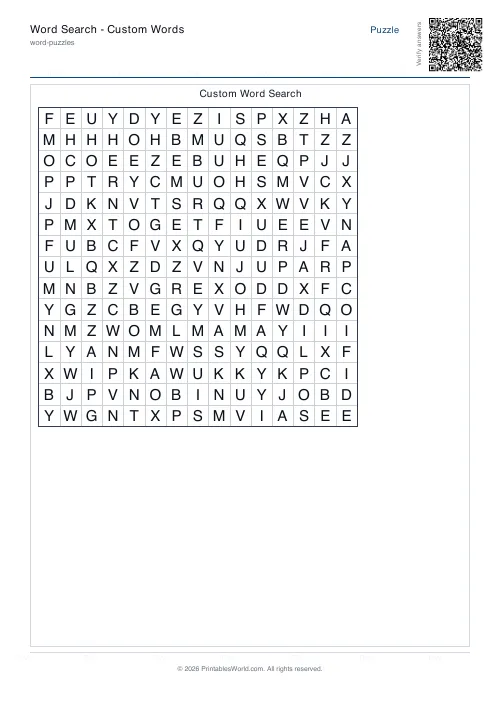
Word Search: Custom Words
Enter your own word list and generate a printable word search.
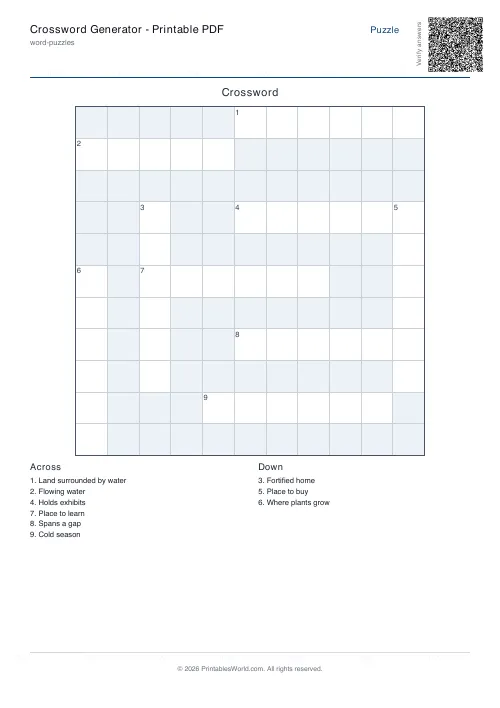
Crossword Generator: Printable PDF
Custom word lists into printable crossword puzzles with numbered clues.
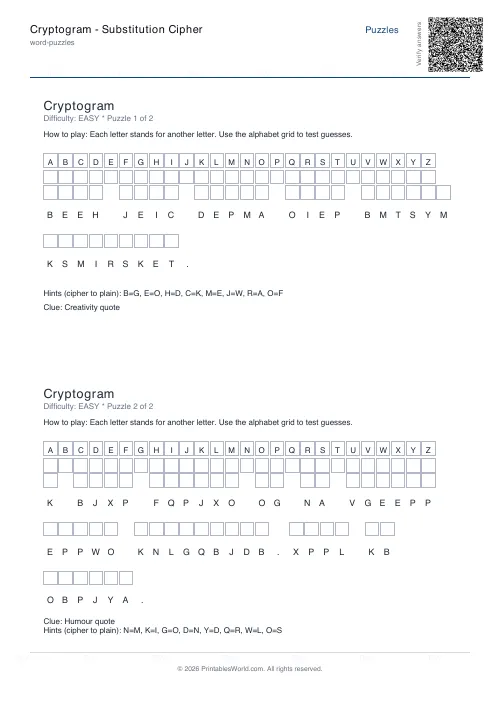
Cryptogram: Substitution Cipher
Random-quote substitution ciphers with optional hints and a solution page. A code-breaking sheet you can print without typing anything.
More like this
- Crossword Generator: Printable PDF
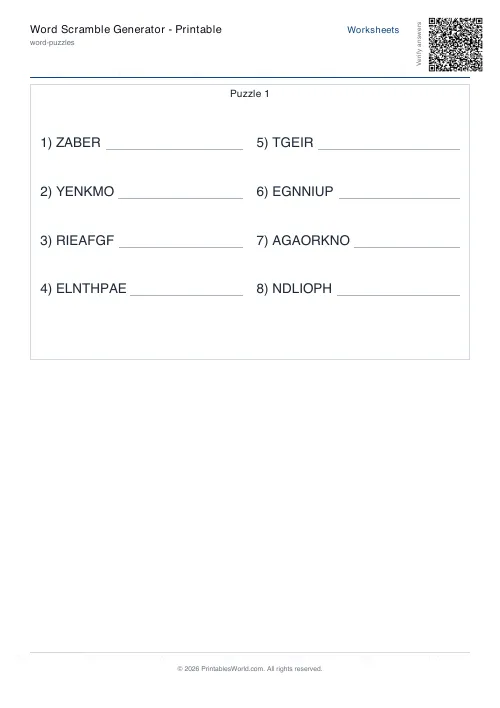 Word Scramble Generator: Printable
- Cryptogram Generator: Printable PDF
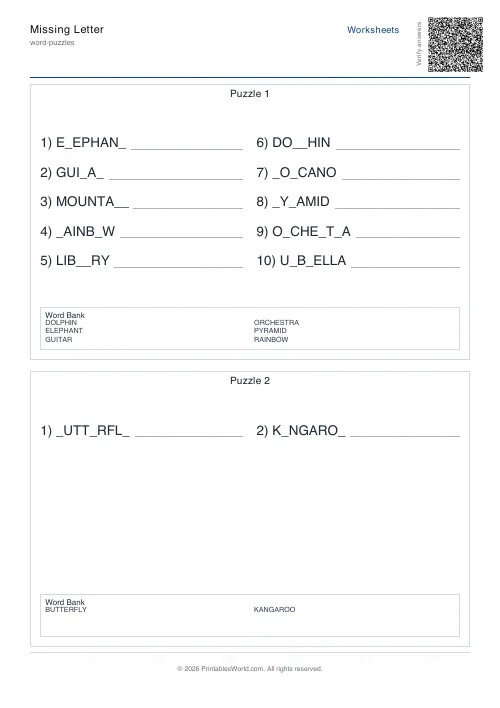 Missing Letter Generator
- Word Search: Custom Words
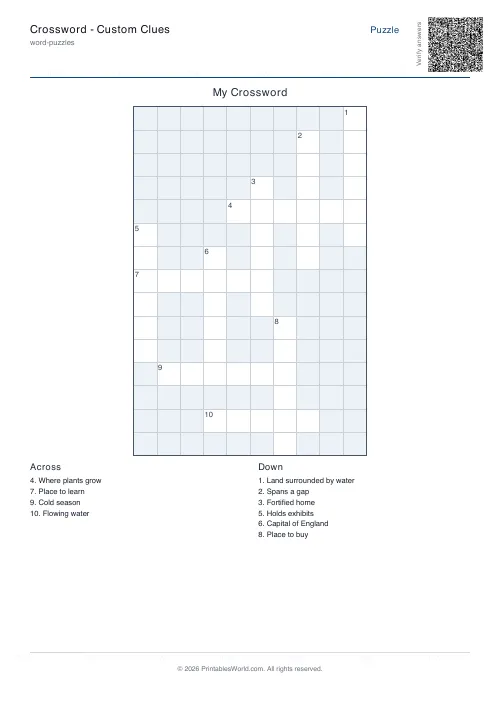 Crossword: Custom Clues
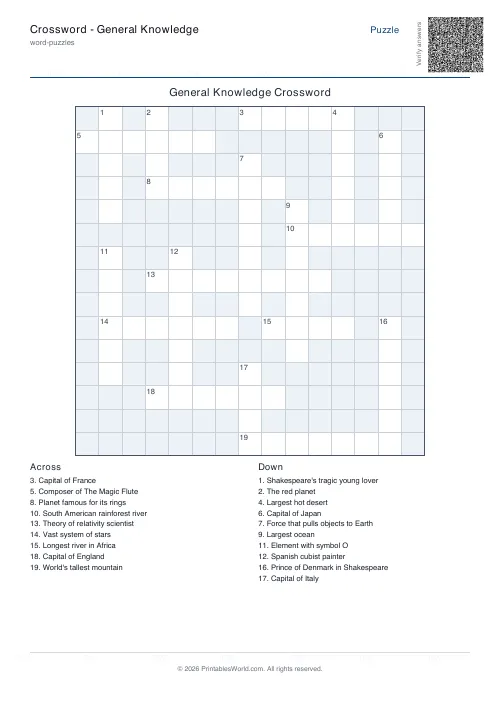 Crossword: General Knowledge
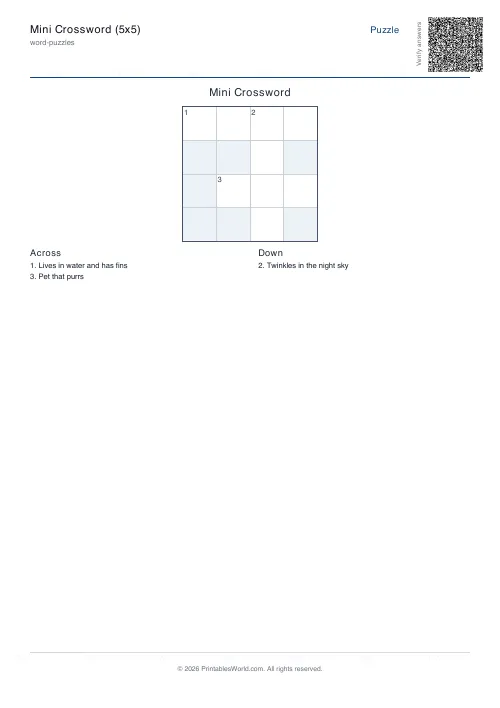 Mini Crossword
- Cryptogram: Substitution Cipher
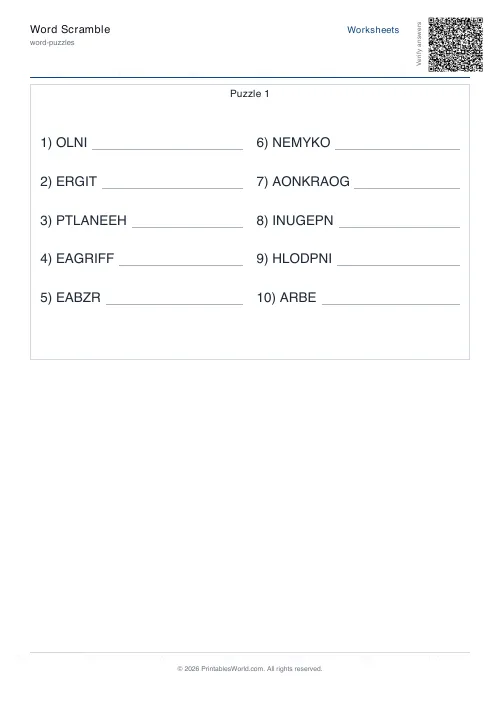 Word Scramble Generator
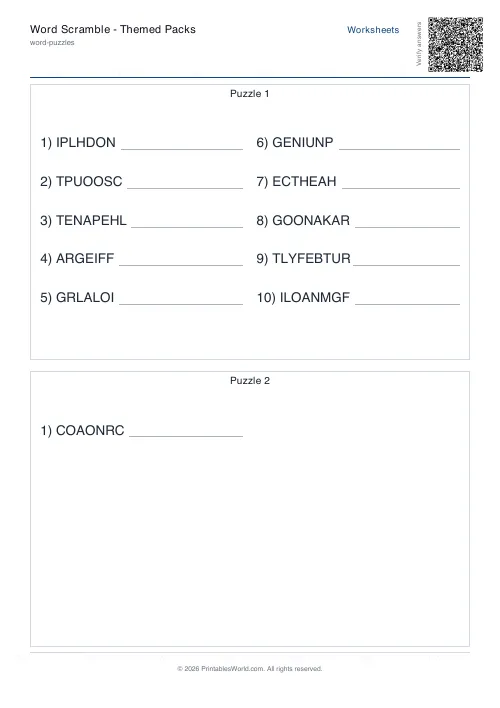 Word Scramble: Themed Packs
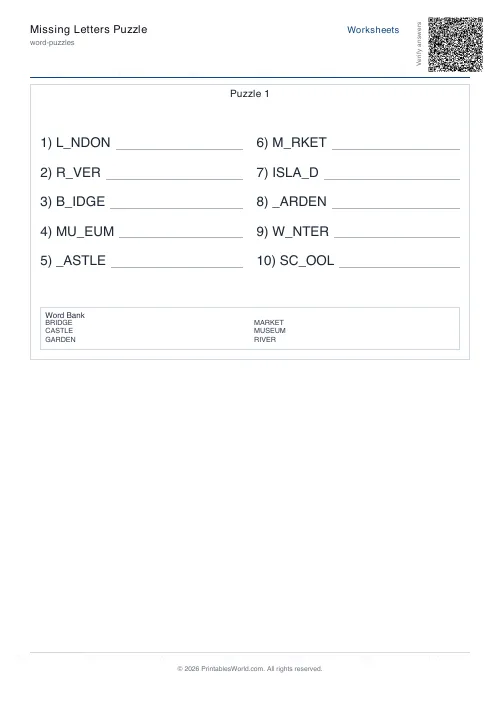 Missing Letters Puzzle
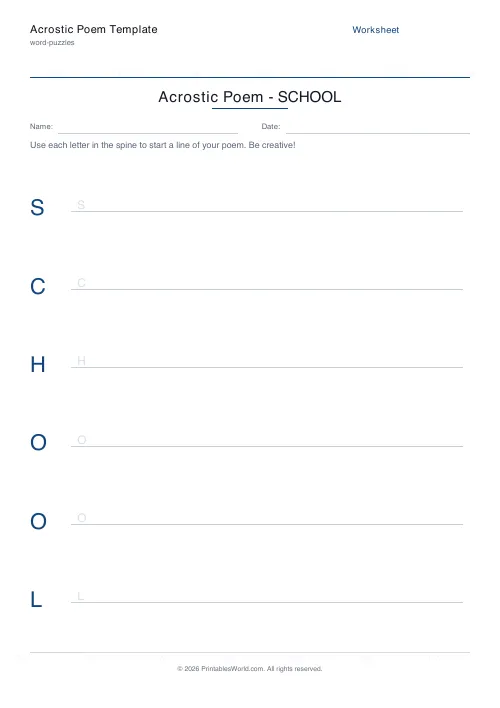 Acrostic Poem Template
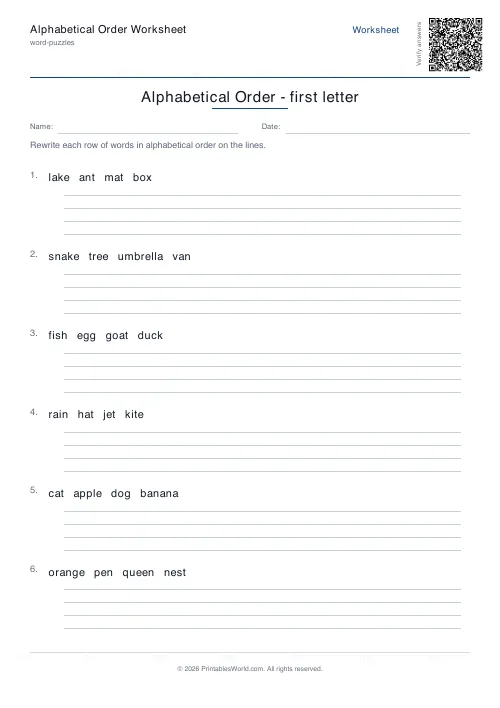 Alphabetical Order Worksheet