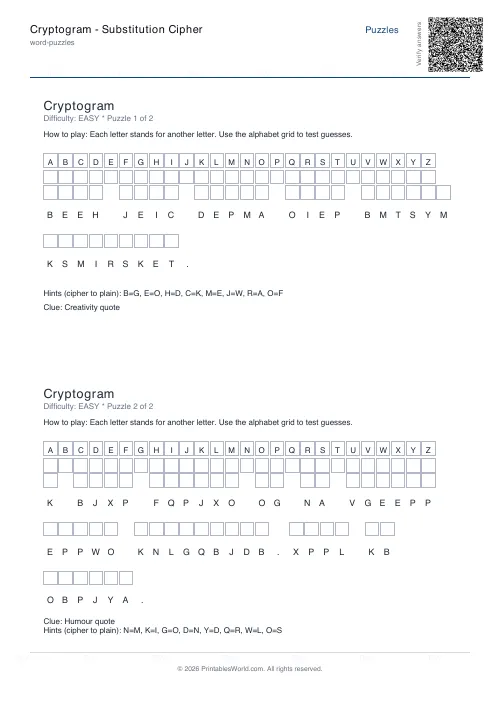
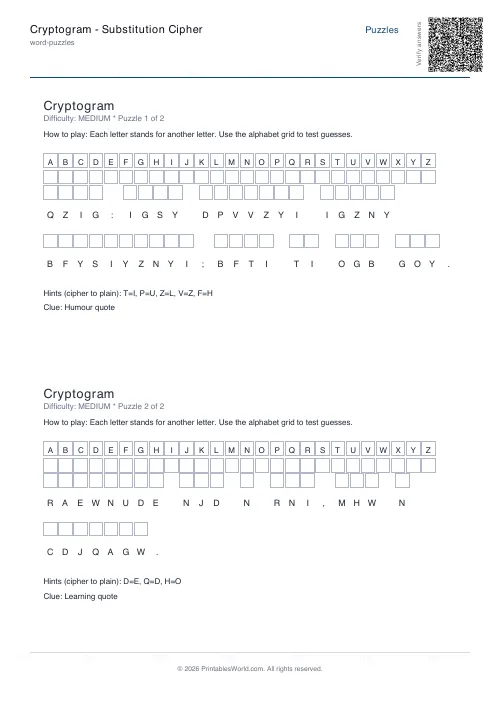
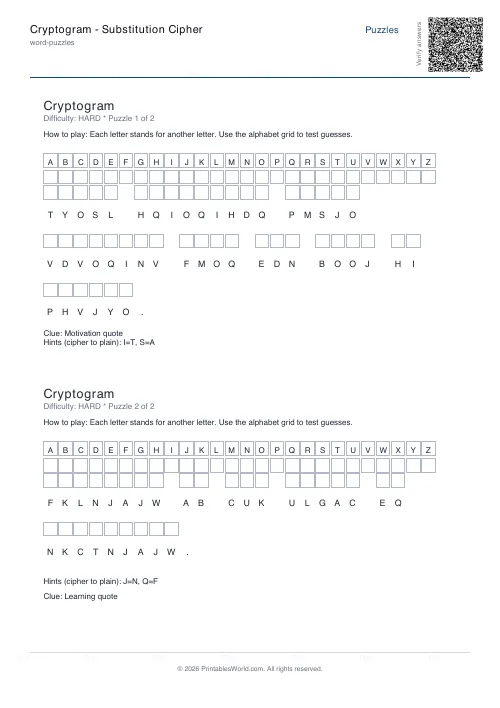
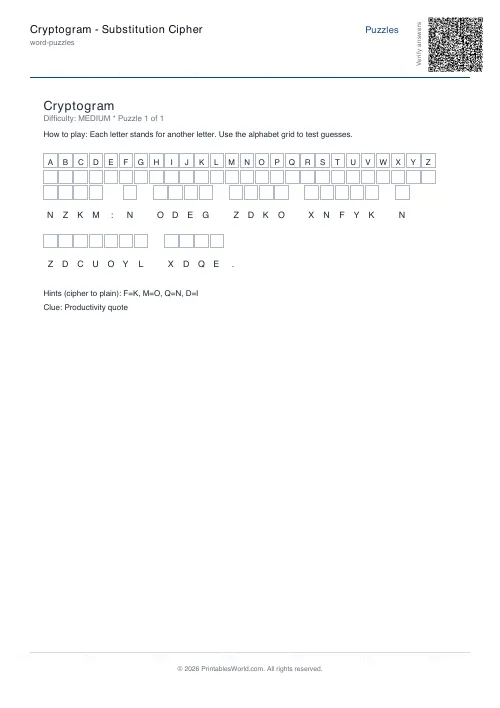
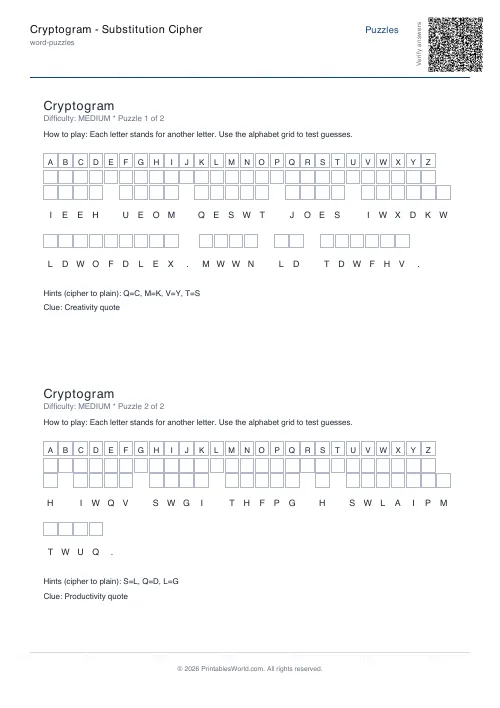
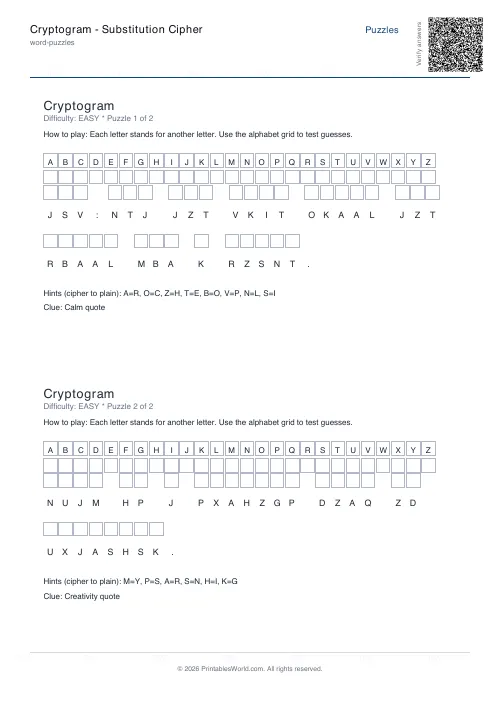
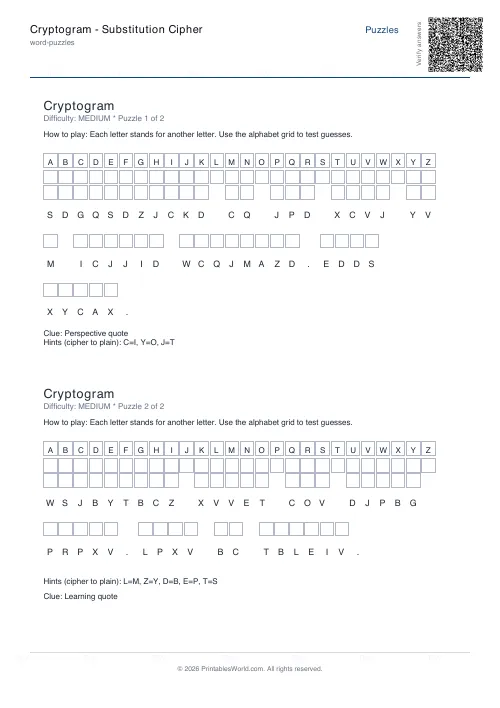
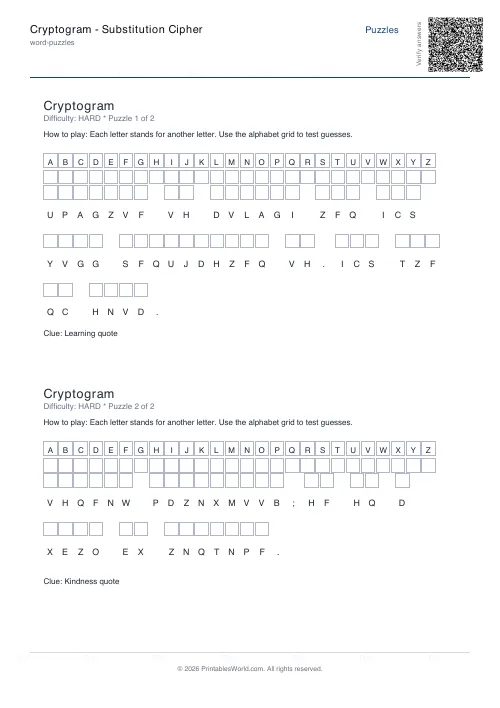
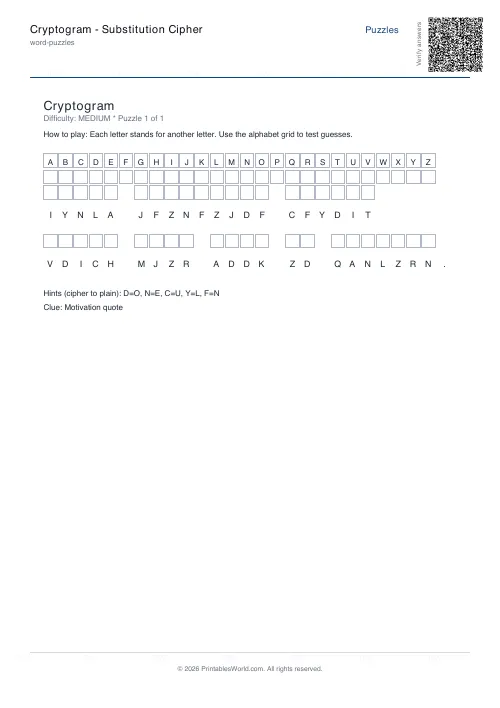
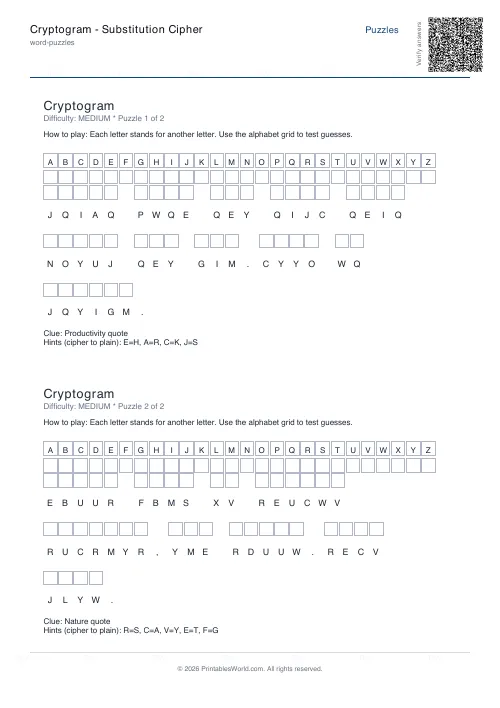
What this tool does
A printable substitution cipher drawn from a built-in quote library. Every plaintext letter is swapped for another, consistently, and the solver cracks it by pattern and frequency. Pick a category and a difficulty, choose whether to reveal starter letters, and download a sheet that carries two puzzles by default, with a how-to-play panel, a solution page and a full answer key.
People also used
Cryptogram Generator: Printable PDF
Create printable cryptogram puzzles from famous quotes or your own text with customisable difficulty and hints.
Cryptogram: Custom Message
Enter your own message and generate a printable cryptogram puzzle.
Word Search: Custom Words
Enter your own word list and generate a printable word search.
Feedback
Spotted something off with this tool?
Two puzzles, a quote library, ten seconds
Every letter of the message is swapped for a different letter, the same way every time. Nothing is added and nothing is removed, so the structure of the English underneath survives intact. That structure is exactly what a solver attacks.
The sheet draws from a categorised quote collection rather than asking you to type a message, and it prints two puzzles by default. The how-to-play panel, the solution page and the answer key are all on unless you turn them off.
How one is actually broken
There is a method, and teaching it in order is what turns this from guesswork into a lesson.
- One-letter words. A or I, almost without exception. Two candidates.
- Frequency. E is the commonest letter in English by a clear margin, then T, then A and O and I and N. Whatever symbol turns up most is probably E.
- Apostrophes. The letter after one is nearly always S or T. An apostrophe-T at the end of a word hands you T and, usually, the N before it.
- Doubled letters. LL and SS, EE and OO and TT. Between them they account for most of the doubles in ordinary English, so a repeated pair of symbols is worth five of these.
- THE. Commonest three-letter word in the language. Test any repeated three-symbol group as THE before anything else.
Longer is easier, which surprises people
Length is the main lever on difficulty and it runs the opposite way from most puzzles.
A long message gives frequency analysis enough data to be reliable. A short one might contain no E whatsoever, which defeats the standard opening move and leaves a solver with nothing. So a twenty-word quote is a gentler puzzle than a six-word one, and choosing a short sheet for a younger class is a mistake that looks like kindness.
Starter hints are the better differentiator. Revealing two or three letters lets a child who cannot get going make the first move themselves, which is the whole difference between a puzzle and a wall. Hints on for a mixed class, off for a puzzle group, solution page kept back either way.
The library, and when it is the wrong tool
Because the message comes from a quote collection, you can print a sheet in about ten seconds without deciding anything. For a club that meets weekly and gets through forty cryptograms a term, that matters enormously, because nobody wants to type forty quotes.
What you give up is control of the content. If the message has to be a specific one, a spelling list, a note to the class, a clue in a treasure hunt, this is not the tool and the custom version is.
It fits three subjects, not one
In maths it is frequency and probability. Count the symbols, tabulate them, compare against the known letter frequencies of English, and the class is doing data handling with a reason to bother.
In computing it is the first lesson in cryptography, and the obvious follow-up question, why is this so easy to break, leads directly into why modern encryption looks nothing like it.
In English it is spelling and letter patterns approached from an unfamiliar angle, which reaches children who have decided they are bad at spelling.
A workable single lesson: solve one together on the board using the five moves above, then a sheet with hints on for pairs, then a sheet with hints off for anyone who finishes early. One preparation, three sheets, and the class leaves with a method rather than a completed puzzle.
FAQs
Quick answers
What is a substitution cipher?
It is a code where every letter of the alphabet is consistently swapped with another letter. Once you crack one letter, every appearance of that letter in the puzzle is solved.
How does difficulty work?
Easy reveals more starter letter pairs, medium gives you a few, and hard barely any. The cipher itself is always a full A–Z substitution.
Can I print the answer key?
Yes. Toggle "Include full answer key" to add the complete plaintext-to-cipher table on the solution page.
Will the same seed produce the same cipher?
Yes. Reuse the seed plus the same settings to regenerate the exact same puzzle.
Related tools
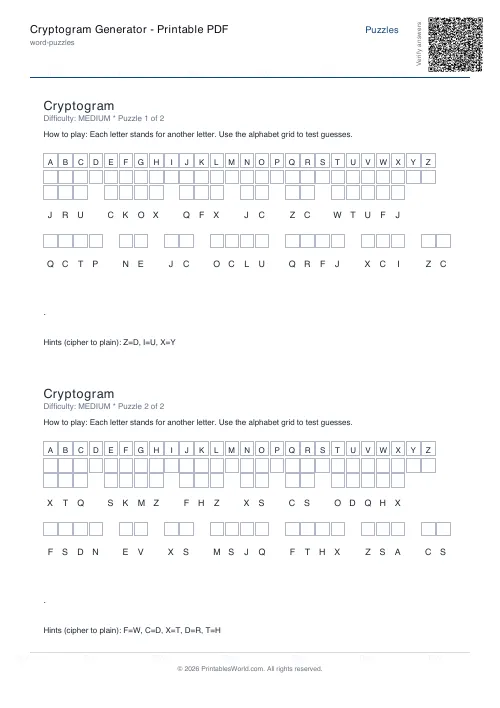
Cryptogram Generator: Printable PDF
Create printable cryptogram puzzles from famous quotes or your own text with customisable difficulty and hints.
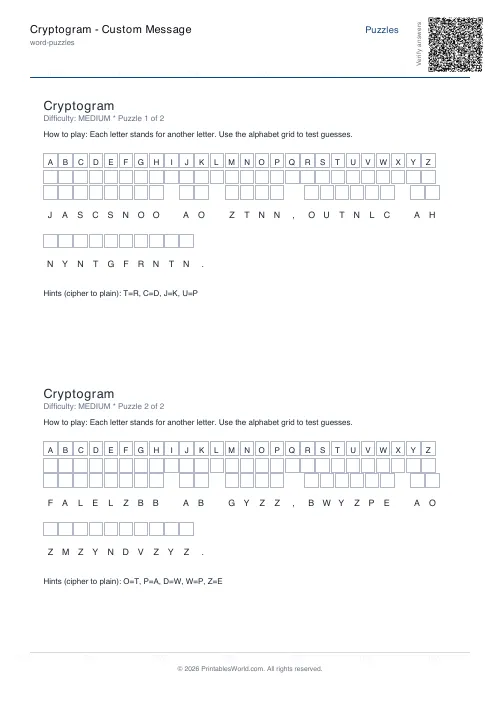
Cryptogram: Custom Message
Enter your own message and generate a printable cryptogram puzzle.
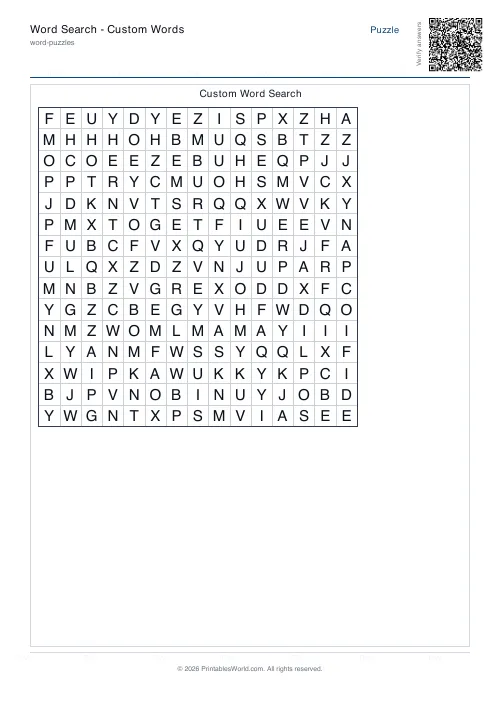
Word Search: Custom Words
Enter your own word list and generate a printable word search.
More like this
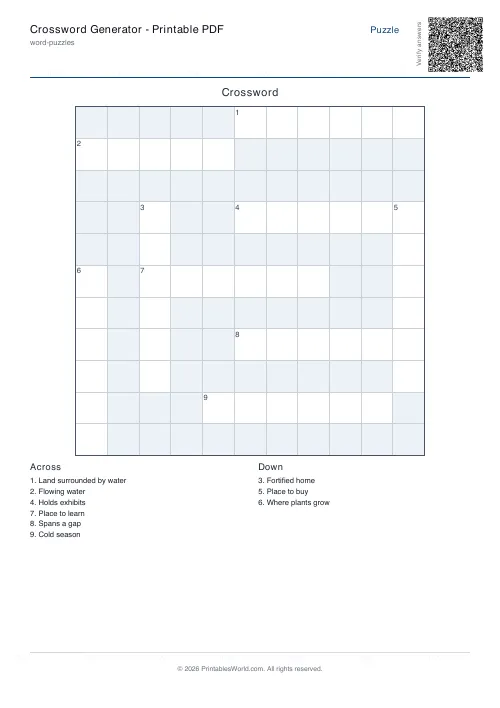 Crossword Generator: Printable PDF
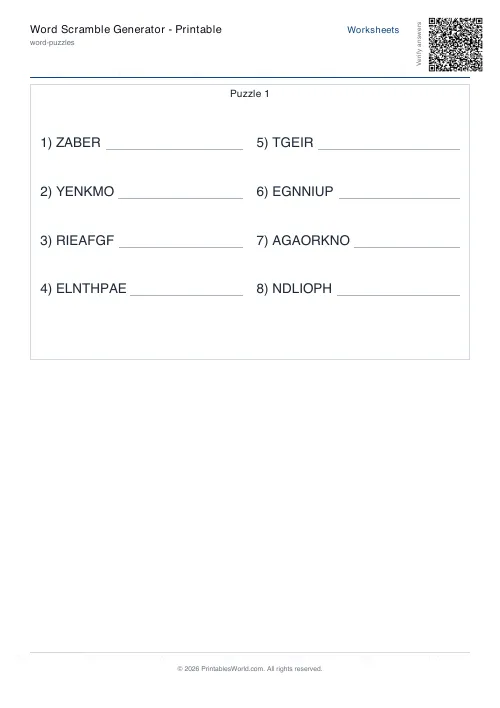 Word Scramble Generator: Printable
- Cryptogram Generator: Printable PDF
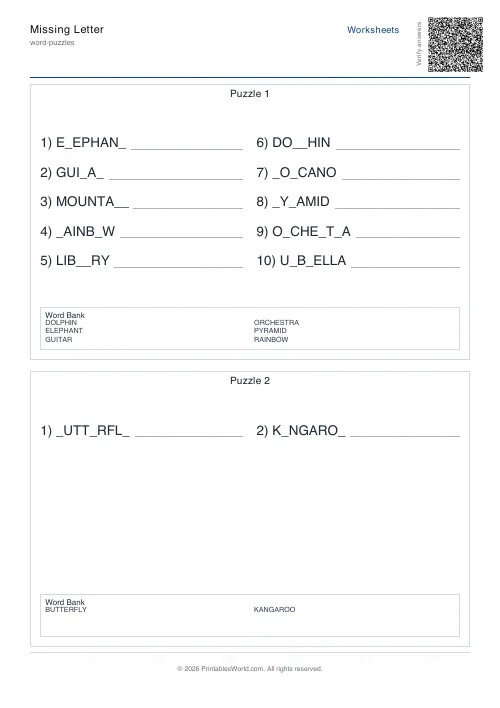 Missing Letter Generator
- Word Search: Custom Words
- Cryptogram: Custom Message
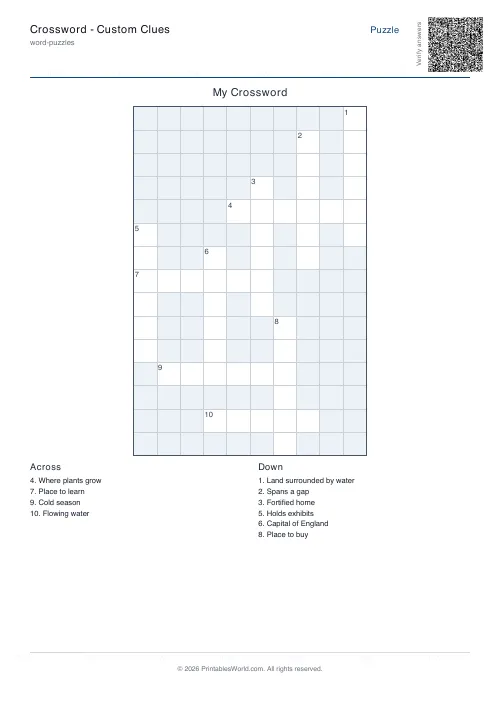 Crossword: Custom Clues
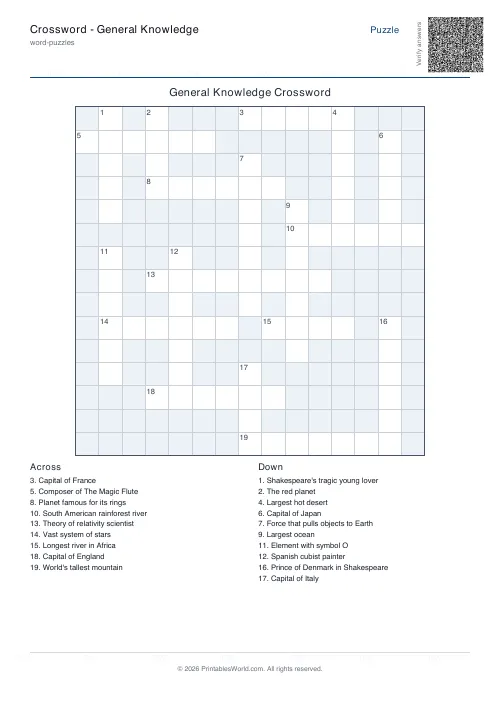 Crossword: General Knowledge
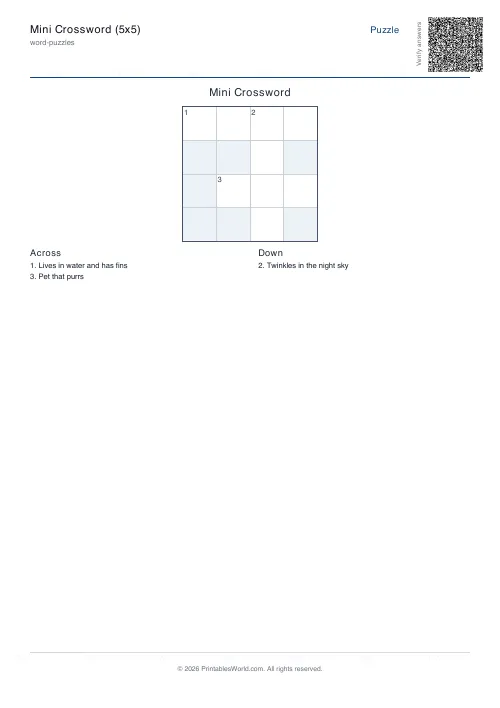 Mini Crossword
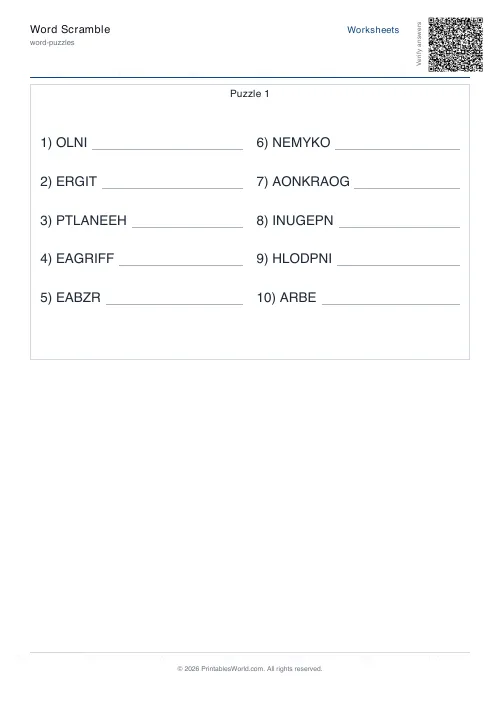 Word Scramble Generator
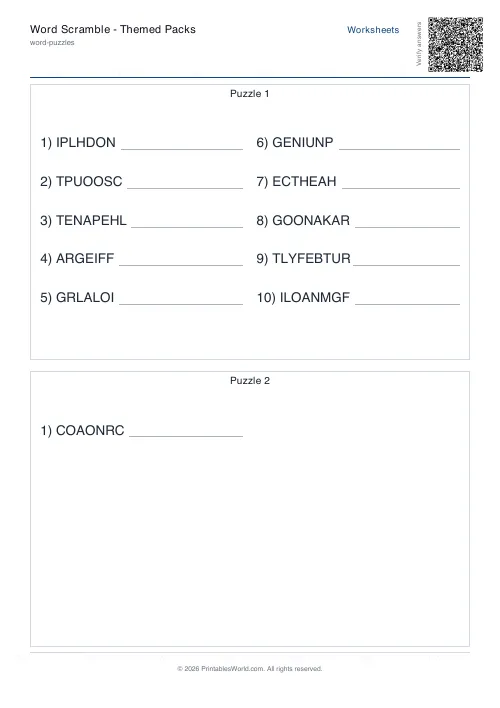 Word Scramble: Themed Packs
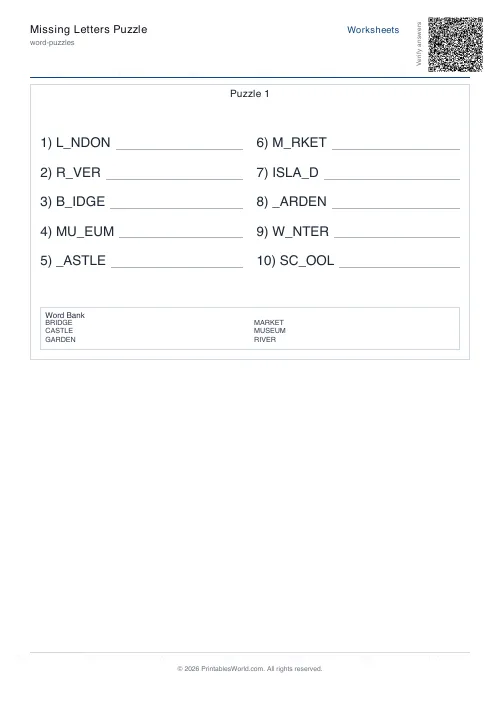 Missing Letters Puzzle
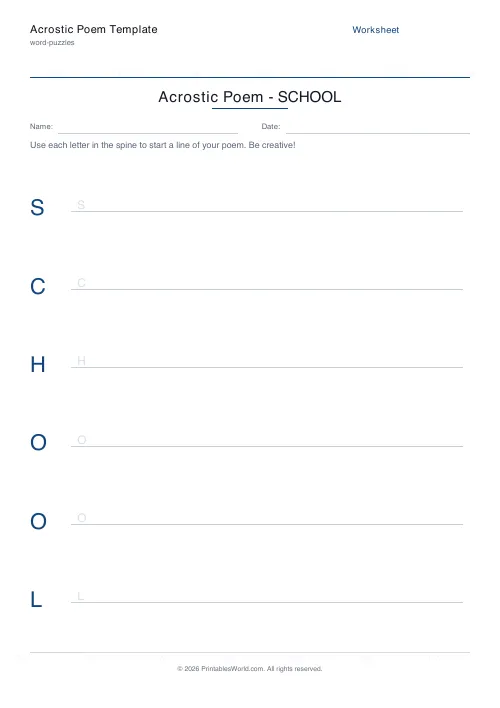 Acrostic Poem Template
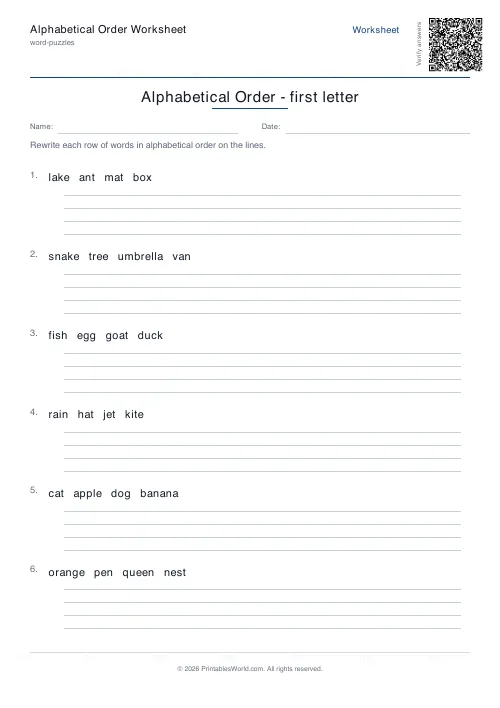 Alphabetical Order Worksheet