What this tool does
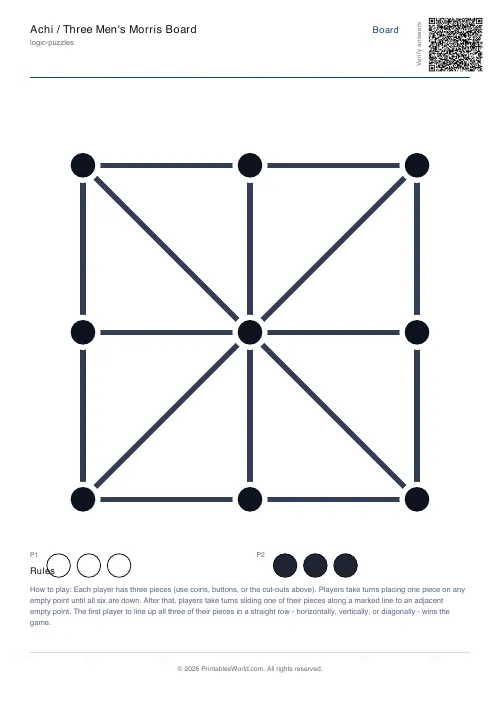
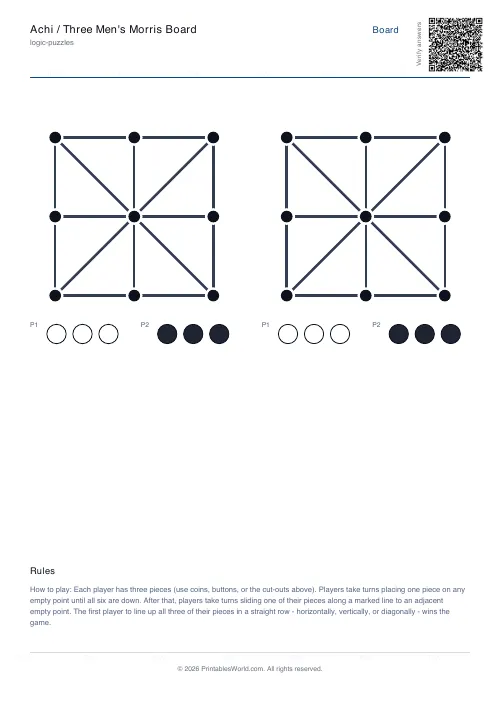
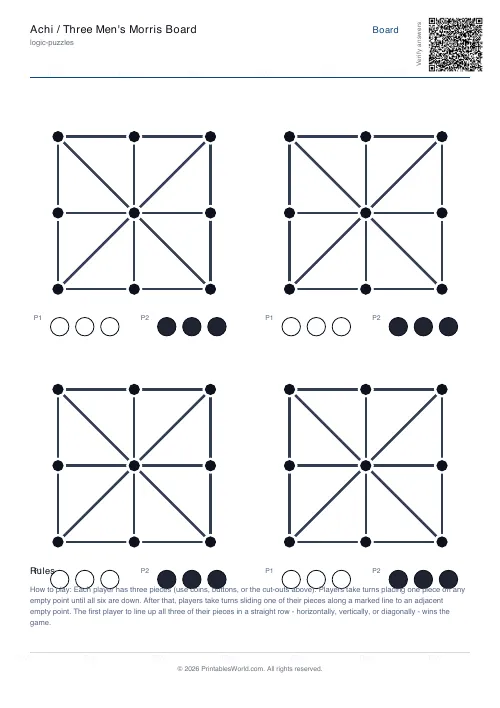
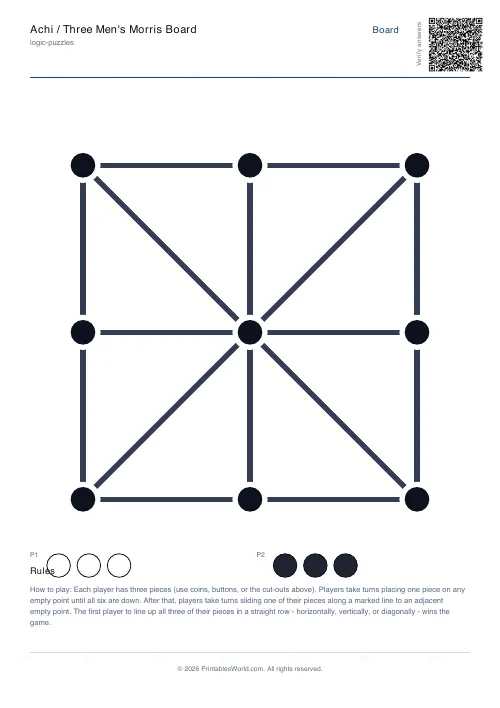
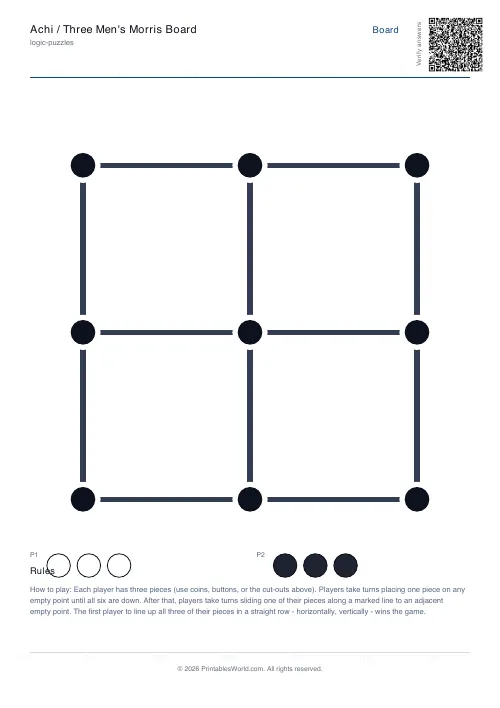
Ready-to-play Three Men's Morris boards, also known as Achi and as Tapatan. One, two or four boards to a page. Switch the centre diagonals on or off, add a short rules block under the board, and print a strip of cut-out coins so two players have pieces without hunting for buttons. Sized for A4 and US Letter from the shared branded template.
People also used
Magic Square: 3x3
Complete the 3x3 grid so all rows, columns, and diagonals sum equally.
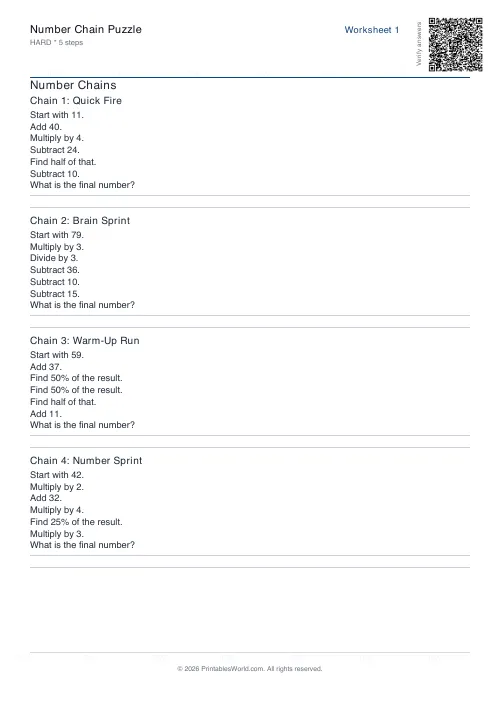
Number Chain Generator: Mental Maths
Print mental-maths number chains with custom difficulty, length and answer keys.
Binary Puzzle Generator: Printable
Create printable binary logic puzzles (Takuzu/Binairo) with customisable grid sizes and difficulty levels.
Feedback
Spotted something off with this tool?
Nine points, three pieces each, two minutes a game
Three Men's Morris is among the oldest board games anyone can name. Two players, three pieces apiece, and one goal: get your three in a line.
What makes it more than noughts-and-crosses is that the board fills up. Once all six pieces are down, nobody can place anything new, so play switches to sliding pieces along the drawn lines to adjacent empty points. That second phase is where the game actually lives, and it is why a draw is much rarer here than on a tic-tac-toe grid.
Print the board, find two sets of coins, play. No app, no account, no setup beyond a printer.
Achi, Tapatan, and the same nine points
The names are regional. Achi is Ghanaian. Tapatan is played in the Philippines. Three Men's Morris is the European label, and the morris family it belongs to runs all the way up to nine men's morris on a much bigger board.
Rules vary slightly from place to place, but every version uses three pieces a side and a placing phase followed by a sliding phase, so one printed board serves all of them. Turn the centre diagonals on and you have the classic Achi and Tapatan lattice. Turn them off and you get the plain square-and-cross variant, which is a slower, more defensive game because there are fewer lines to make and fewer to block.
How to play it
Each player takes three pieces. Coins, buttons, or the cut-outs printed under the board.
Take turns placing one piece at a time on any empty point until all six are down. Then take turns sliding a single piece along a marked line to an adjacent empty point, one step, never jumping. The first player to get their three onto one straight line wins, whether that line runs across the board, down it, or corner to corner when the diagonals are drawn.
One piece of strategy is worth telling a child before their first game: take the centre. More lines pass through it than through any other point, and a player who holds it is involved in almost every threat on the board.
One board or four
A single board fills the page and is the version to print for a display or for small hands. Two to a sheet halves your paper. Four is a class set in one press, and the boards are still comfortably large enough to play on with 2p coins.
The rules block under the board is on by default and it earns its place: a pair of children can be playing without an adult explaining anything. The cut-out coins are on too, three per player, which removes the only remaining excuse for not starting.
Where these get used
Classrooms
A wet break, a maths logic station, or a lesson on ancient games. The printed rules mean you hand out sheets rather than run a briefing.
Families
Keep a couple folded in a bag. A game lasts about two minutes, it teaches blocking and thinking a move ahead, and it works at a restaurant table where a phone would not be welcome.
Folk-game collectors
A consistent, tidy board for the whole Achi and Tapatan cluster without hand-drawing the lattice every time.
What it will not do
This prints blank boards. It is not a game you can play on screen, it does not track moves, and it will not tell you who won.
There is also nothing random about the output, so there is no seed and no answer key: every board of a given setting is identical to every other, which is exactly what you want from a board and not at all what you want from a puzzle. Colours follow the shared brand template and cannot be changed per sheet.
FAQs
Quick answers
Is Achi the same as Three Men's Morris?
They are part of the same family and use the same nine-point board. Achi (Ghana), Tapatan (Philippines), and Three Men's Morris (Europe) all give each player three pieces and use a placing phase followed by a sliding phase. This tool prints the shared board, so you can play any of them on it.
What is the difference between the diagonal and plain boards?
Turning diagonals on draws the two lines through the centre, giving the classic Achi/Tapatan board where pieces can also win and move diagonally. Turning them off prints the plain square-and-cross board, where only horizontal and vertical lines count.
Do I need separate counters to play?
No. Leave the cut-out pieces option on and the PDF prints three coins for each player beneath the board. Cut them out and you are ready to play, or use coins and buttons if you prefer.
Can I print this on US Letter paper?
Yes. The layout adjusts automatically for both A4 and US Letter, scaling margins and board placement so the board prints cleanly without clipping or manual rescaling.
Related tools
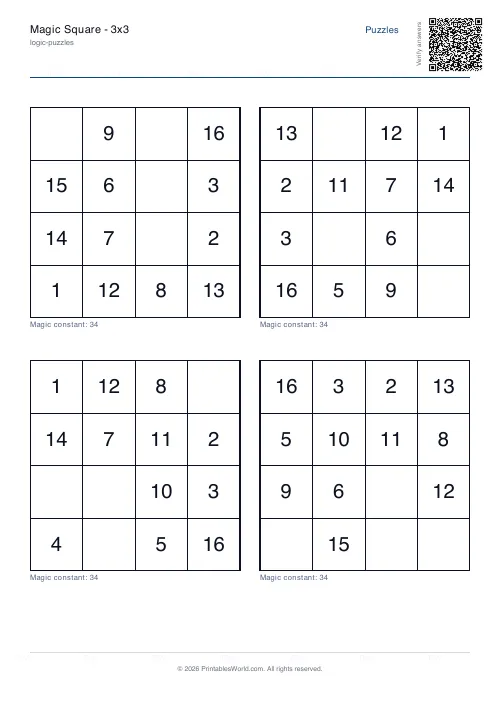
Magic Square: 3x3
Complete the 3x3 grid so all rows, columns, and diagonals sum equally.
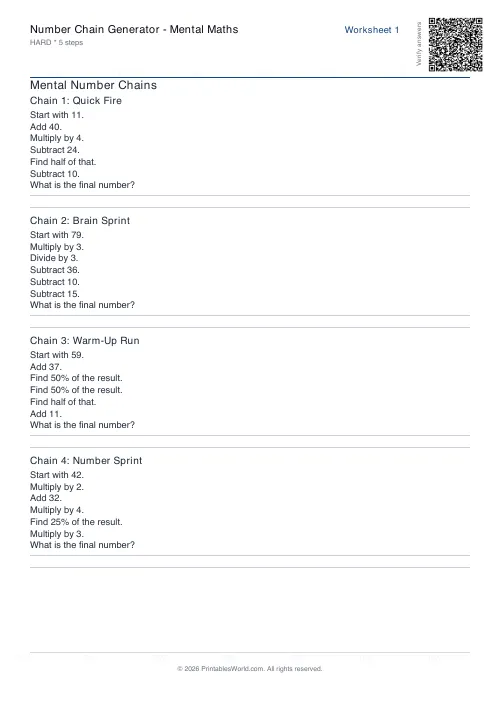
Number Chain Generator: Mental Maths
Print mental-maths number chains with custom difficulty, length and answer keys.
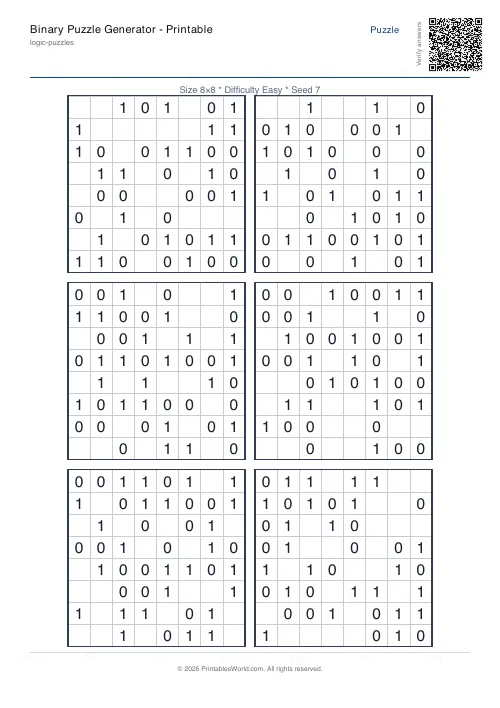
Binary Puzzle Generator: Printable
Create printable binary logic puzzles (Takuzu/Binairo) with customisable grid sizes and difficulty levels.