What this tool does
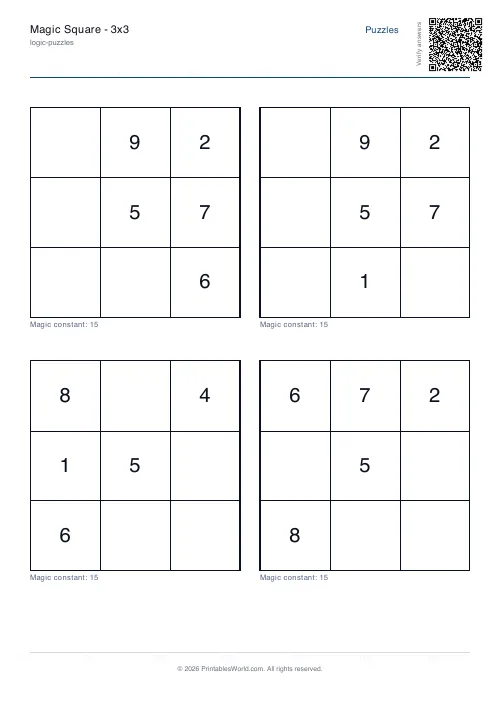
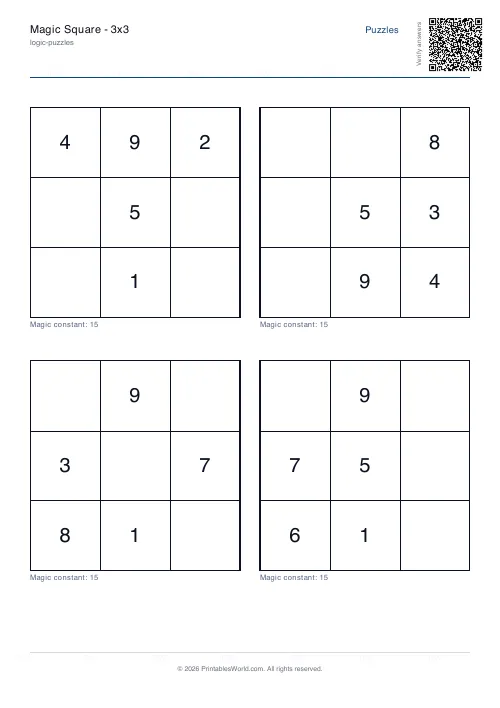
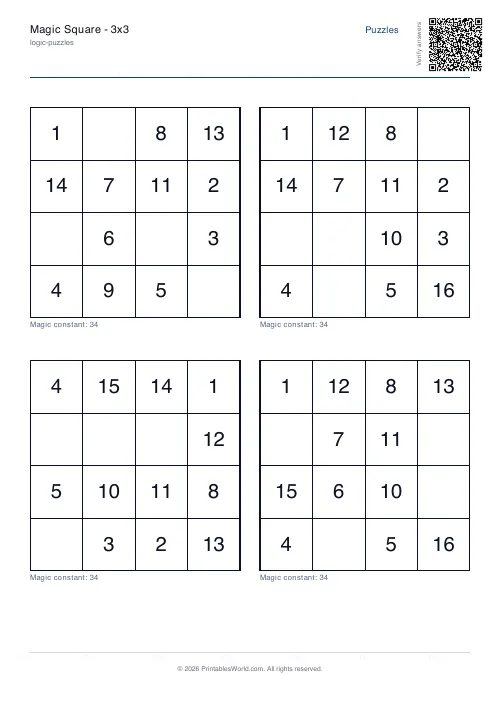
3×3 magic squares built from the Lo Shu square, rotated or reflected at random. Some cells are blanked; fill them so every row, column and both diagonals total 15. Up to eight squares a page.
People also used
Feedback
Spotted something off with this tool?
3×3 magic squares, and only one way to finish each one
Nine cells, the numbers 1 to 9, and every row, every column and both diagonals adding to 15. Some cells are printed and the rest are blank.
Fifteen is not a design choice. The numbers 1 to 9 total 45, three rows share that total, so each row must be 45 ÷ 3 = 15. Worth deriving with a class before the first square, because it turns the target from a number to remember into a number they worked out.
There is essentially one 3×3 magic square
This is the fact that makes the puzzle solvable by reasoning rather than by search. Using 1 to 9, exactly one arrangement works — the Lo Shu square — and every other version of it is that same square rotated or flipped.
Each puzzle here starts from Lo Shu with a random rotation and a possible reflection, so the eight squares on a page look different and are the same underneath. A solver who has done a few starts to recognise the structure, which is not cheating; it is the insight.
The centre is always 5. The corners are always even. The edges are always odd. Any one of those three facts unlocks most squares immediately, and finding them is the actual lesson.
Blanks, and the guarantee behind them
Cells are removed one at a time, and after each removal the square is re-solved. If two valid completions become possible, the number goes back.
That check is not decoration. Blank seven of nine cells at random and roughly half the resulting squares have more than one right answer, while the sheet still prints a single key — a child who found the other valid answer would be marked wrong. Here they cannot be.
Ask for more blanks than the square can carry and you get the most it can, rather than an ambiguous puzzle.
Setting the sheet up
Squares per page from 1 to 8, how many cells to blank, the solutions page on or off, and a seed. Paper size A4 or US Letter.
Four blanks is a gentle introduction. Six or seven is a proper puzzle for someone who has already met a few.
Where it earns its place
It is addition practice with a reason to add. A child working a magic square does dozens of small sums without being asked to do a single one, and every sum has a consequence they care about, which is the difference between this and a column of exercises.
It also introduces constrained reasoning early. The move that solves a magic square — this cell is forced, because the row already has two numbers — is the same move that solves sudoku, and meeting it at nine cells is easier than meeting it at eighty-one.
Print at 100% on A4 or US Letter.
FAQs
Quick answers
What is the magic constant?
For the standard 1-9 Lo Shu square it is 15; offsets shift the constant accordingly.
How many blanks?
Default 4 of 9 cells; tweak for easier or harder grids.
Are answers included?
Yes. Toggle the solutions option for a separate page.
Want bigger?
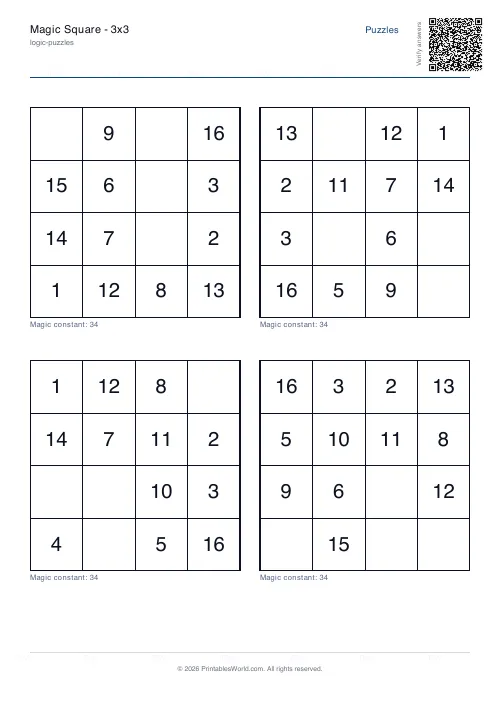
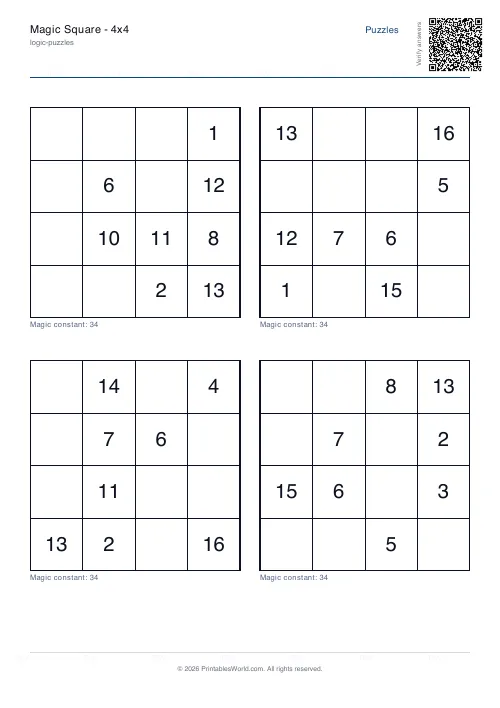
Try the 4x4 magic square variant for a magic constant of 34.
Related tools
Further reading