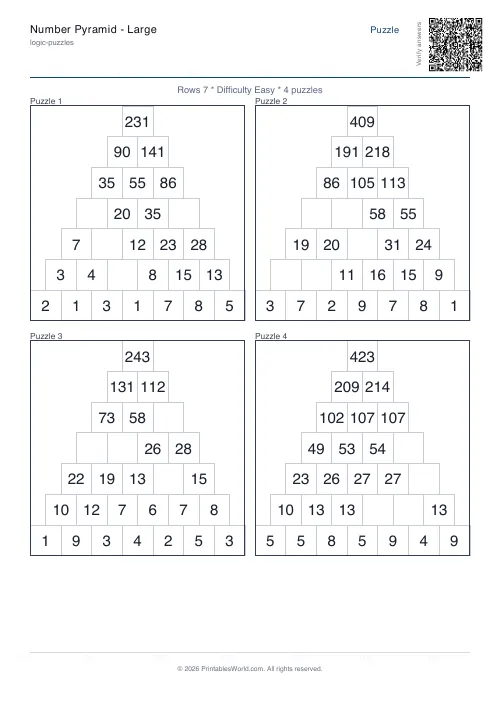
What this tool does
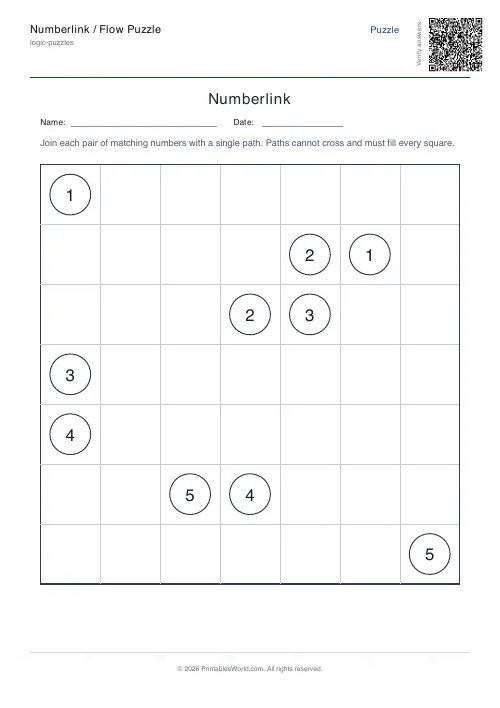
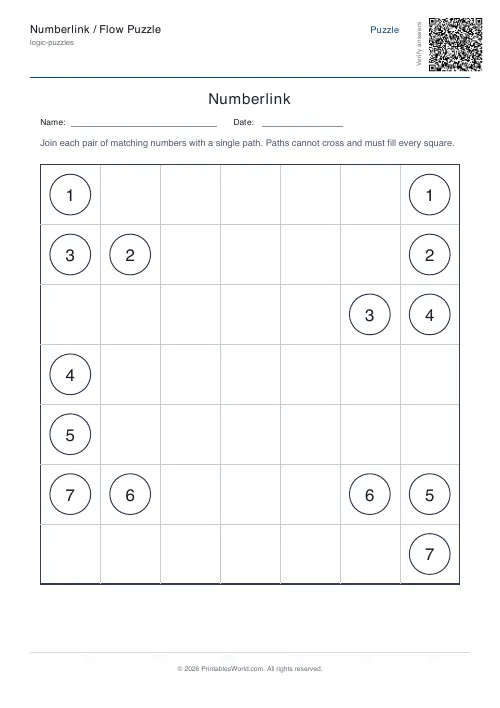
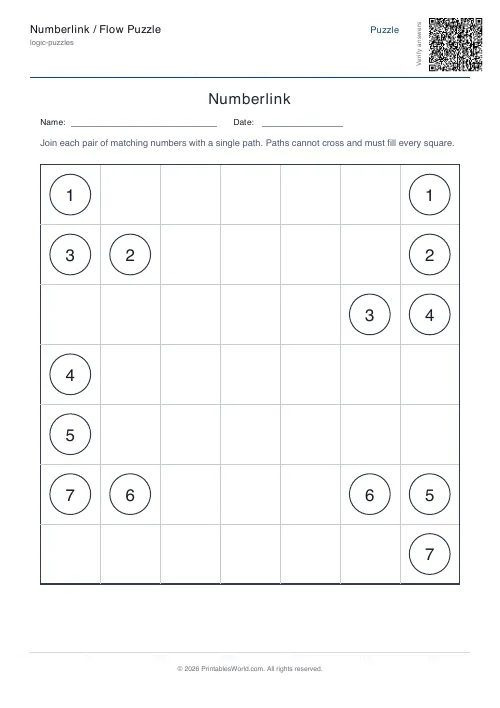
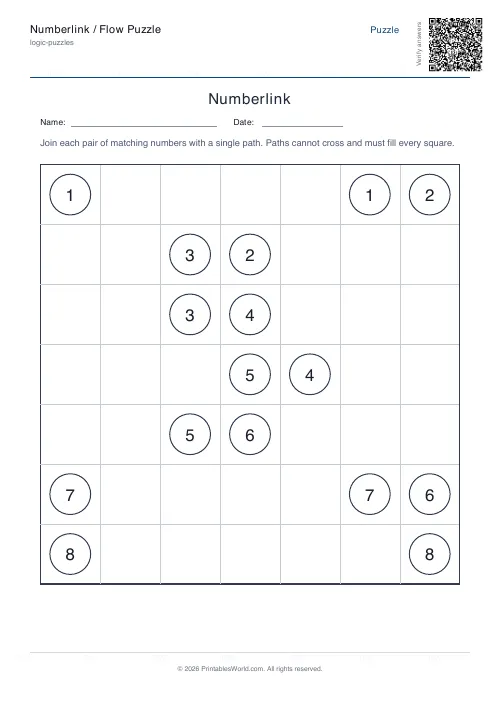
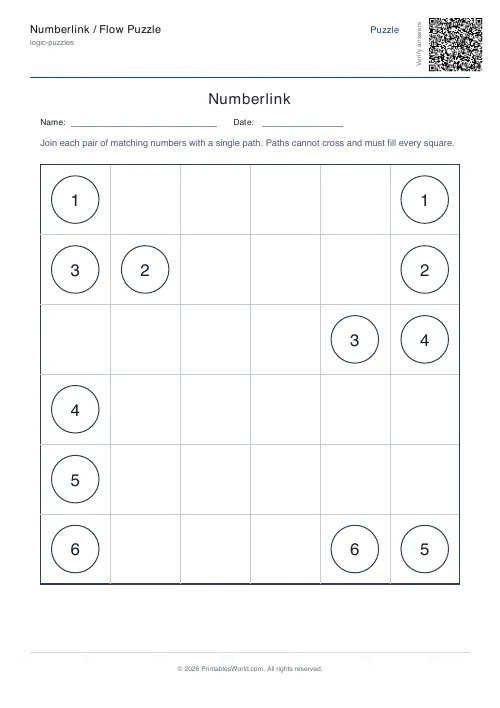
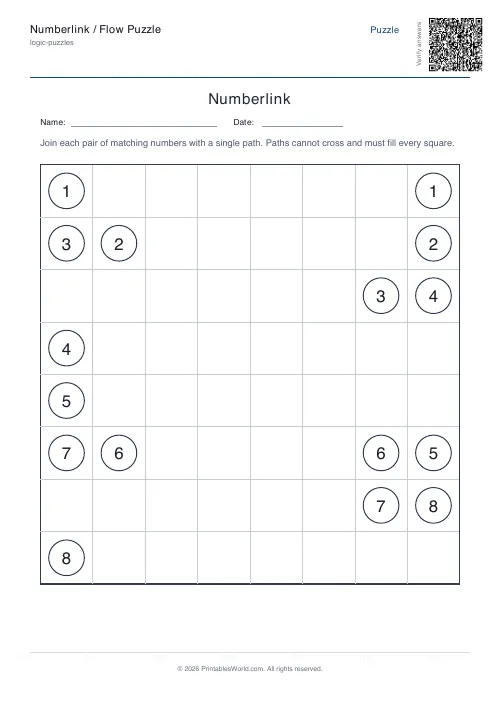
Printable Numberlink, sold commercially as Flow. Pairs of matching numbers sit on a grid and each pair must be joined by a single path, with no path crossing another and every square used exactly once. Grids from 5×5 to 9×9, a difficulty setting that changes how many pairs appear, a seed for reproducing a board, and an optional colour-coded answer key.
People also used
Sudoku Generator
Generate printable Sudoku puzzles with six per page, multiple difficulty levels, and optional solutions.
Binary Puzzle Generator: Printable
Create printable binary logic puzzles (Takuzu/Binairo) with customisable grid sizes and difficulty levels.
Maze Generator: Printable PDF
Generate printable maze PDFs with custom grid size, difficulty, and layout. Perfect, braided, or room-based.
Feedback
Spotted something off with this tool?
Join the pairs, fill the board
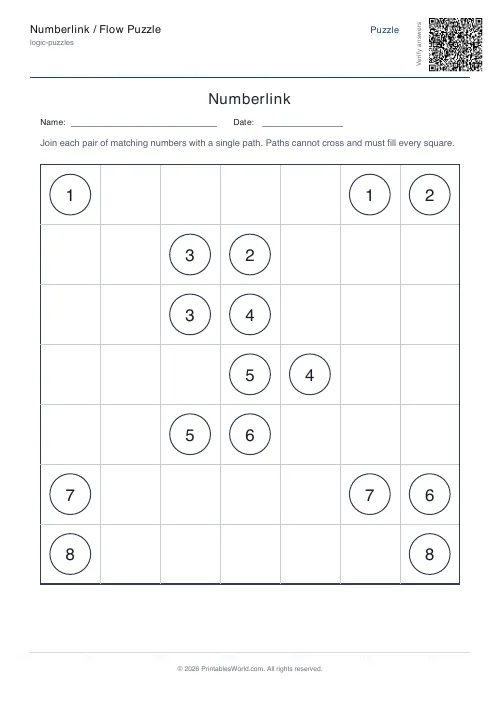
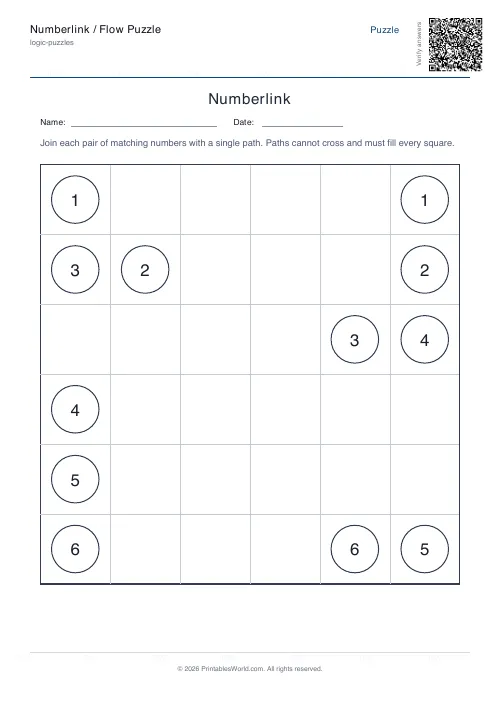
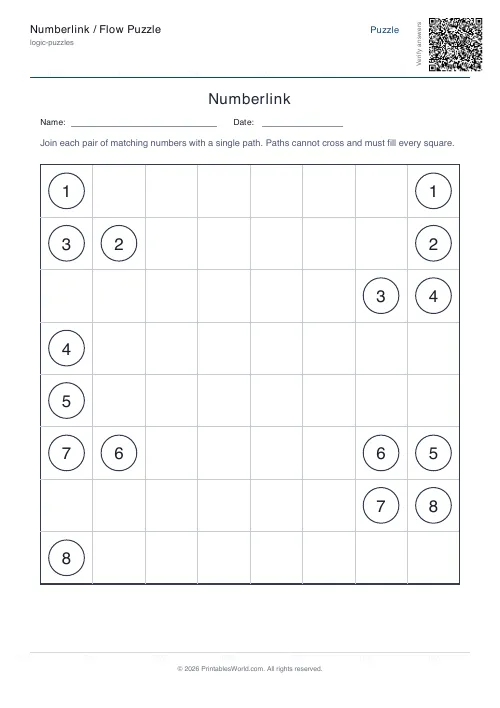
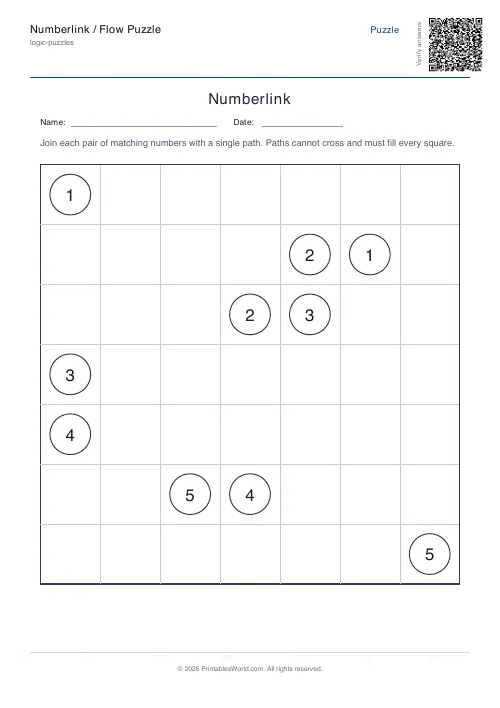
Two 1s, two 2s, two 3s, scattered on a grid. Draw one unbroken path between each matching pair.
Two constraints make it a puzzle rather than a doodle. Paths may not cross or share a square, and in the standard version every square on the board must end up covered by exactly one path. That second rule is what gives Numberlink its tight, no-loose-ends quality: if you have squares left over at the end, some route needs to take a longer way round.
Every board is generated from a complete valid solution first, so the endpoints you are looking at can always be joined exactly as intended.
The rules, stated fully
- One path per pair. Each numbered endpoint joins to the cell carrying the same number, with a single unbroken line and nothing else.
- Edges only. Never on a diagonal.
- No sharing. Two paths may not occupy the same square, and no path may cross itself.
- Fill everything. Every square on the board ends up covered by exactly one path, and a finished grid has no empty cells left anywhere in it.
How to solve one
Corners first. A number in a corner has only two ways out, so the first few steps of its path decide themselves, and tracing those forced moves carves up the easy regions before you have made a single choice.
Then look for pinch points. A line of empty squares squeezed between two finished paths has to belong to whichever pair can still legally reach it, and often only one can.
The habit that separates good solvers from frustrated ones is checking the fill rule constantly. If completing a path would seal off a square that no other route could ever reach, that path is wrong, however neat it looks. Think of the board as a budget: every square gets spent exactly once, so a route that hugs a wall too tightly starves its neighbour. The elegant solution is very often the curviest one.
Size and difficulty pull in different directions
Grid size runs 5×5 to 9×9, six by default. A 5×5 is a couple of minutes. A 9×9 needs genuine forward planning.
Difficulty changes how many numbered pairs are on the board, and the effect is not what people expect. Fewer pairs means long, sweeping routes with plenty of room, which is easier. More pairs breaks the board into short interlocking journeys that are much harder to fit together without one blocking another.
So a small grid on easy is the right start for a young child, and a large grid on hard is a proper sit-down for somebody who wants one.
Printing a set
Set the size and difficulty and the preview updates as you go. Generate New reshuffles; a typed seed brings the same board back, which is what you want when the whole class needs identical grids to talk about afterwards.
The answer key adds a second page with every pair joined in colour, so marking is a glance rather than a trace. Name and date fields for class sets. A4 or US Letter.
FAQs
Quick answers
What is the difference between Numberlink and Flow?
They are the same puzzle. Flow is the popular app name for Numberlink: connect each pair of matching numbers (or colours) with a path that does not cross any other, filling the whole grid.
Does every puzzle have a solution?
Yes. Each puzzle is constructed from a complete, valid solution first, then the endpoints are shown to you. The answer key reproduces exactly that solution, so it always works.
Can paths go diagonally?
No. Paths move only up, down, left and right between neighbouring squares. Diagonal moves are not allowed, which keeps the routing crisp and the fill rule meaningful.
How do I make the puzzle harder?
Increase the grid size and choose the hard difficulty. Larger grids with more numbered pairs create shorter, interlocking paths that are harder to fit together without crossing.
Related tools
Sudoku Generator
Generate printable Sudoku puzzles with six per page, multiple difficulty levels, and optional solutions.
Binary Puzzle Generator: Printable
Create printable binary logic puzzles (Takuzu/Binairo) with customisable grid sizes and difficulty levels.
Maze Generator: Printable PDF
Generate printable maze PDFs with custom grid size, difficulty, and layout. Perfect, braided, or room-based.
Hashi (Bridges) Puzzle
Connect the numbered islands with bridges.
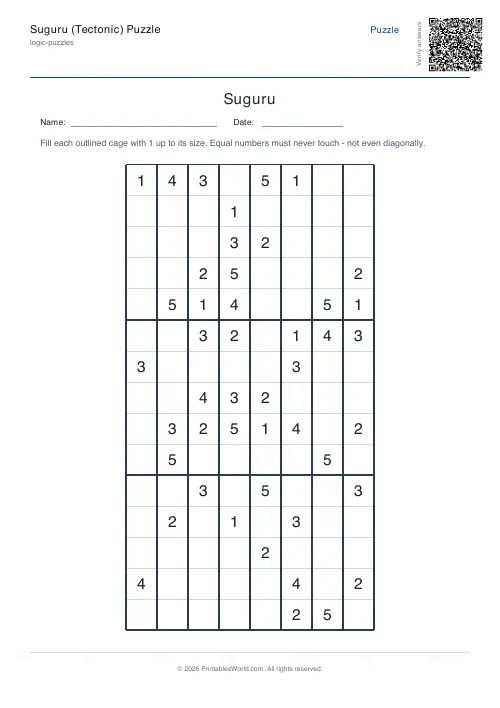
Suguru (Tectonic) Puzzle
Fill the cages so equal numbers never touch.
Further reading
Logic Puzzles
The benefits of logic puzzles for developing brains
Logic puzzles teach deduction and persistence, which are worth having. The claim that they make children generally smarter is weaker than the marketing suggests.
5 min read
Logic Puzzles
Kakuro, killer sudoku and other number puzzles explained
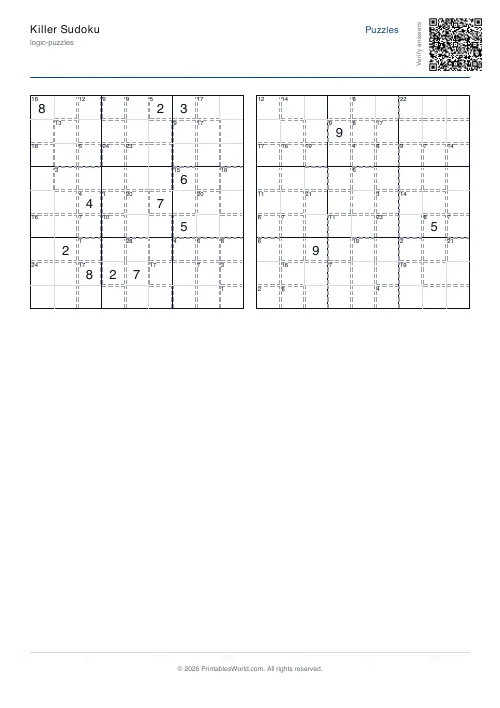
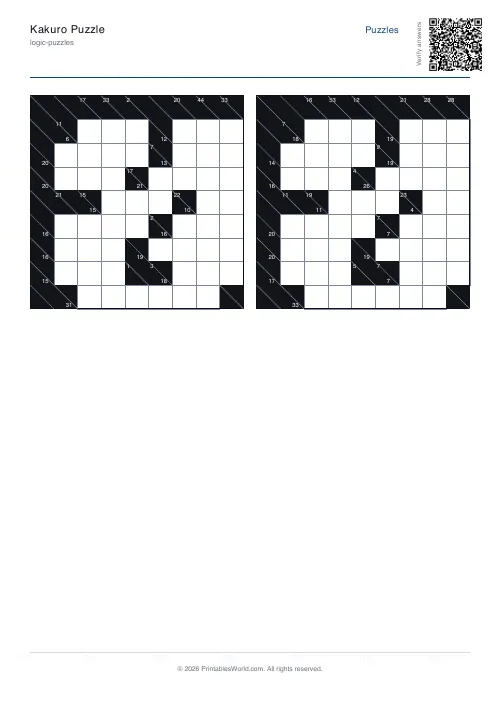
If sudoku has stopped being a challenge, these are the natural next steps. And unlike sudoku, most of them genuinely involve arithmetic.
5 min read
Puzzles & Brain Games
Printable brain games for seniors: a free puzzle pack
A free printable puzzle pack for older adults, with a sample seven-day plan, large-print and easier-difficulty tips, and how to use the Logic Puzzles collection.
7 min read