What this tool does
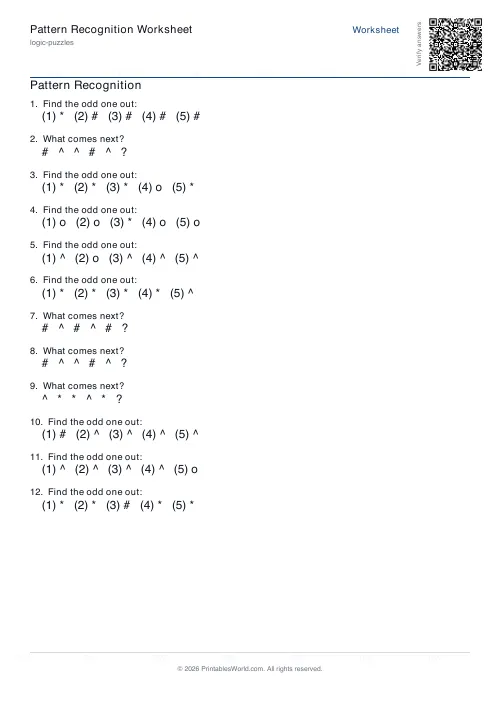
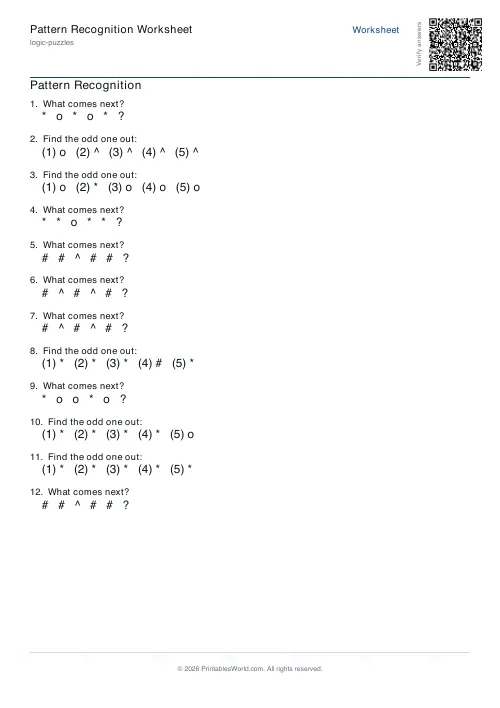
Visual reasoning worksheets built from five shape glyphs. Items alternate between continue-the-pattern sequences and odd-one-out spotters. Six to 20 items a sheet, with an optional answer page.
People also used
Feedback
Spotted something off with this tool?
Shape-pattern worksheets for pre-readers and early reasoners
Every item is built from five shapes and nothing else: a circle, a square, a triangle, a diamond, a star. No words. No numbers. Nothing a child has to read before they can start.
That is the reason the sheet works with a four-year-old and with a child learning English at the same time as everything else. The task is visible in the row itself.
Two kinds of item
Continue the pattern. Five shapes are shown and the sixth is a question mark. The patterns are simple repeats built from a pair of shapes: alternating, or two-then-one, or one-then-two. Short cycles on purpose — the skill being practised is noticing that a cycle exists, not decoding a long one.
Odd one out. A row of five, four alike and one not, the intruder dropped in at a random position. The answer is its position number. Trivial, mostly. Then the intruder lands at position 1, and a child who has learned to scan left to right has to override the assumption that whatever came first defines the rule.
The two types are mixed on the sheet, which keeps attention up. A page of twelve identical-format questions is a page a child stops reading by question four.
How many items, and a note on repeats
Between 6 and 20, defaulting to 12.
Be aware that the sequence items are drawn from a small pool: four shape pairs crossed with three patterns is twelve distinct sequences in total. On a 20-item sheet you will see repeats. The odd-one-out items have a much larger pool, so they vary freely. For a young child this is rarely a problem — recognising the same pattern a second time is practice, not a flaw — but it is worth knowing before you print a stack for a whole class.
The answer page
Turn the toggle on and each item's answer is listed with the rule spelled out: the shape that comes next, or the position of the intruder.
What this actually trains
Two separate things, which is why both item types are on the same sheet.
Continuing a pattern is prediction. A child holds a cycle in mind and projects it forward, which is the same mental move as counting on, as reading a number sequence, and eventually as following any rule at all. Odd-one-out is the opposite. It asks a child to notice that something breaks a rule instead of confirming it, and children are markedly worse at that. A sheet carrying only the first kind returns a comfortable result that means less than it looks like it means.
Print at 100% on A4 or US Letter. The glyphs are drawn large enough to be pointed at by a small finger.
FAQs
Quick answers
Who is this for?
Children age 5+ practising visual reasoning, and older learners warming up for IQ-style problems.
What shapes are used?
Simple Unicode glyphs: ●, ■, ▲, ◆, ★. They print cleanly without needing custom fonts.
How many items per worksheet?
Default 12; up to 20 fit comfortably on a page.
Are answers included?
Yes. Toggle the solutions option for a second page.
Related tools
Further reading