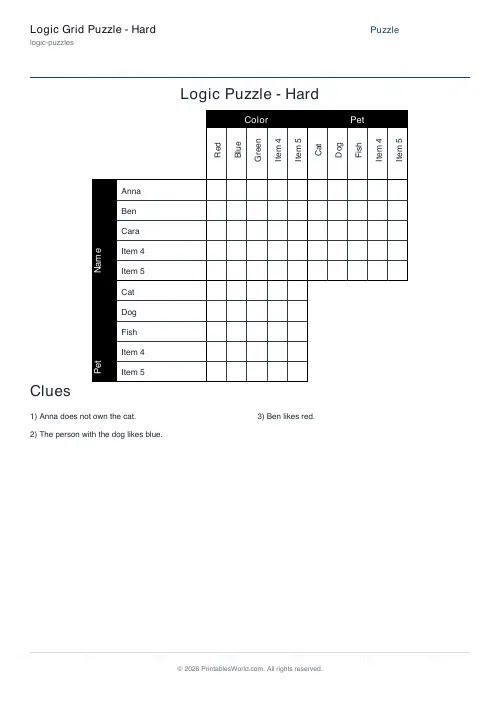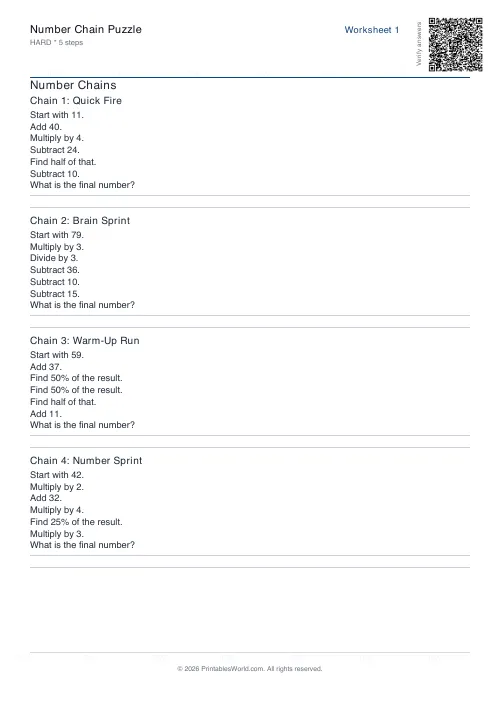
What this tool does
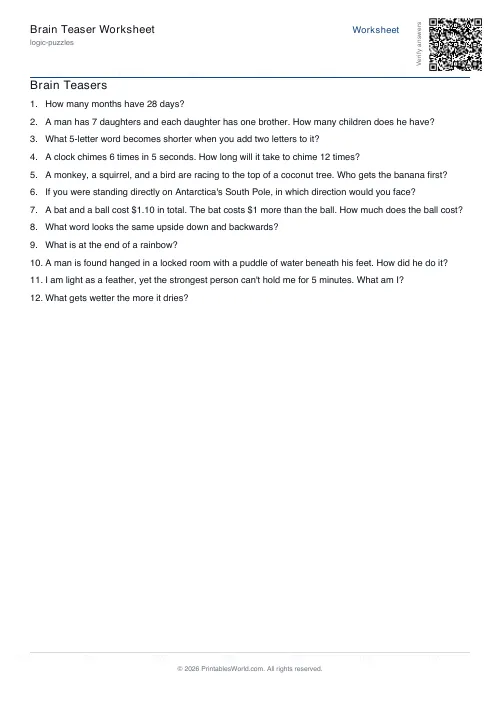
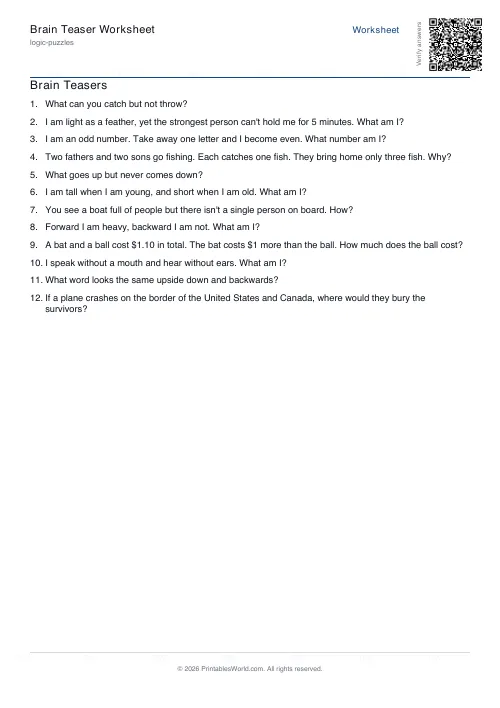
A sheet of brain teasers pulled at random from a bank of 51 classic and original puzzles, with the answers on their own page.
People also used
Feedback
Spotted something off with this tool?
Fifty-one teasers, shuffled
Riddles, wordplay, short logic puzzles — drawn at random and numbered down the page. Answers print on a separate sheet, so the questions can go out on their own.
Choose how many to print. Twelve is the default and a reasonable session; the whole bank on one download is a supply to draw on rather than a single sitting.
What is in the bank
Three broad kinds, mixed together rather than grouped.
Logic. "A man has seven daughters and each daughter has one brother. How many children does he have?" — solvable by noticing the brother is shared, and the answer is eight rather than fourteen.
Wordplay. "I am an odd number. Take away one letter and I become even." That is seven, losing its s. These reward reading the question as words rather than as a problem.
Classic riddles. "What has hands but cannot clap?" The ones everyone half-remembers.
They are not a maths worksheet
Almost none of these needs arithmetic, and the ones that look like they do usually do not.
What they need is re-reading. Nearly every teaser here works by leading you into a reasonable assumption the question never actually made, and the solve arrives when you spot the word you skimmed. That is a real reading skill. It transfers directly to exam questions and to any document somebody wants you to sign.
Which is why the best use is out loud with a group. One person reading, everyone else arguing, and the reader saying "read it again" rather than giving the answer.
Holding the answer sheet back
The single most common way to waste this printable is to staple the answers to the questions.
The value is entirely in being stuck. A teaser you struggled with for four minutes and then solved is memorable; the same teaser read alongside its answer is a fact you forget by lunchtime. Keep the answer page yourself and give it out at the end, if at all.
Where they fit
Form time. The last ten minutes of a lesson. A long car journey, where one person reading from a sheet keeps a whole car occupied. A staff meeting that needs a warm-up. A wet break.
They also work as a settling activity precisely because they are short — there is nothing to set up and nothing left half-finished when the bell goes.
Things you can change
How many teasers, the answers page on or off, and a seed to reproduce a set. A4 or US Letter.
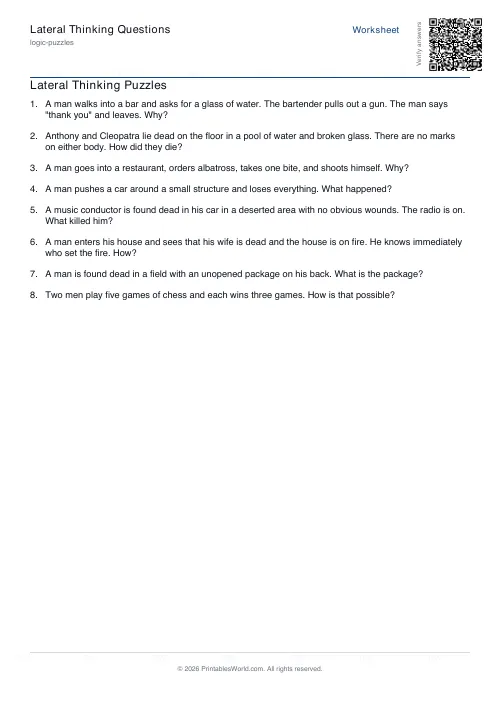
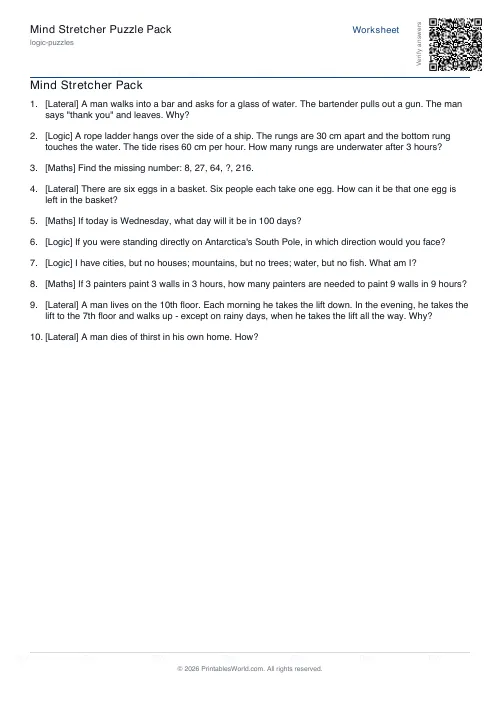
For a longer mixed pack with lateral thinking scenarios and quick maths alongside these, the mind stretcher draws from all three libraries at once.
FAQs
Quick answers
How big is the puzzle library?
Over 50 curated brain teasers ship with the engine; each worksheet picks a fresh subset.
Are these family-friendly?
Yes. All teasers are general-audience and suitable from age 8+.
Is the answer key included?
Yes. Toggle the answer-key option for a separate page.
Can I get the same set twice?
Yes. Set the seed field to a fixed value to reproduce the same selection.
Related tools
Further reading
Puzzles & Brain Games
Printable brain games for seniors: a free puzzle pack
A free printable puzzle pack for older adults, with a sample seven-day plan, large-print and easier-difficulty tips, and how to use the Logic Puzzles collection.
7 min read
Logic Puzzles
The benefits of logic puzzles for developing brains
Logic puzzles teach deduction and persistence, which are worth having. The claim that they make children generally smarter is weaker than the marketing suggests.
5 min read
Puzzles & Brain Games
Sudoku for kids: which difficulty to start at, by age
A practical guide to picking the right sudoku difficulty for a child by age, with a copyable first session and free printable grids in seconds.
7 min read