What this tool does
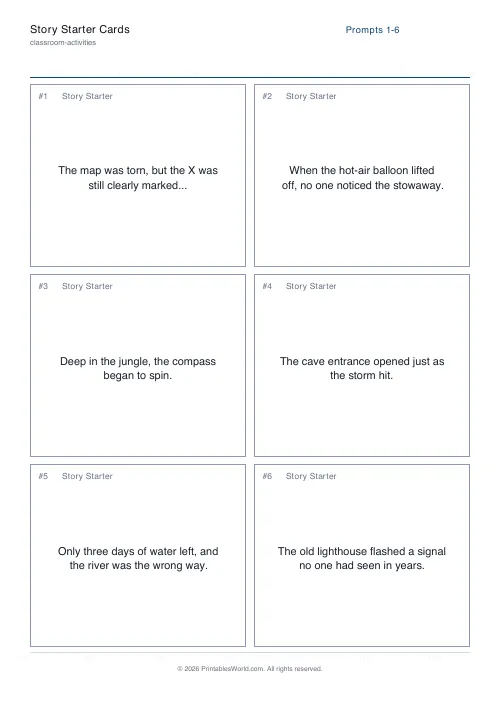
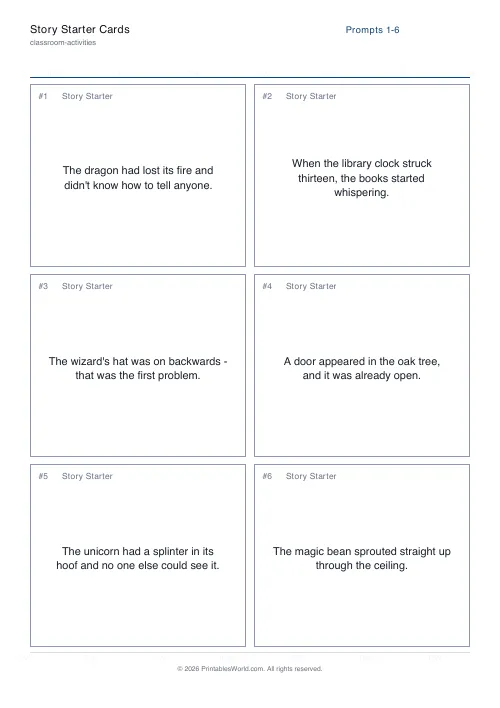
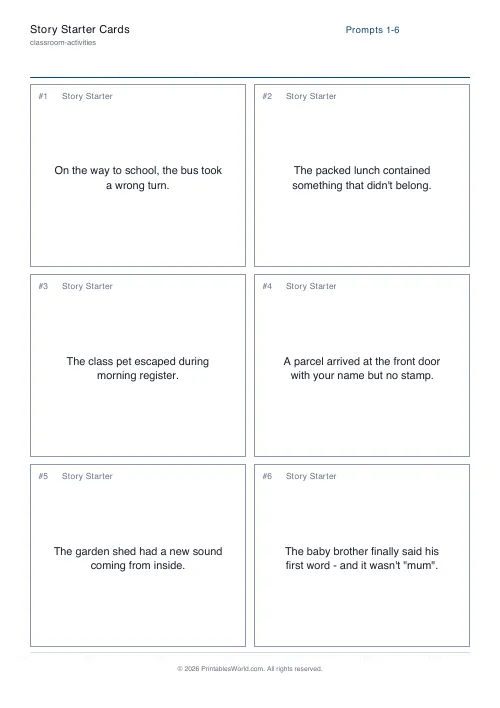
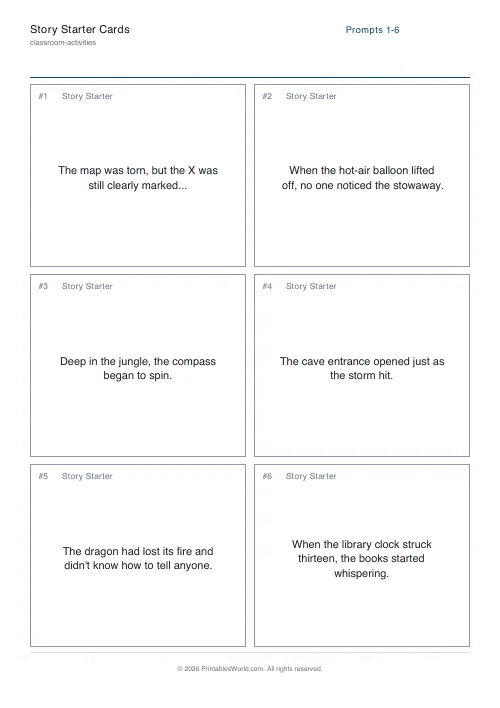
One-sentence writing prompts on cut-out cards, six to a page. Choose adventure, fantasy, everyday or a mixed set, and up to 60 cards.
People also used
Feedback
Spotted something off with this tool?
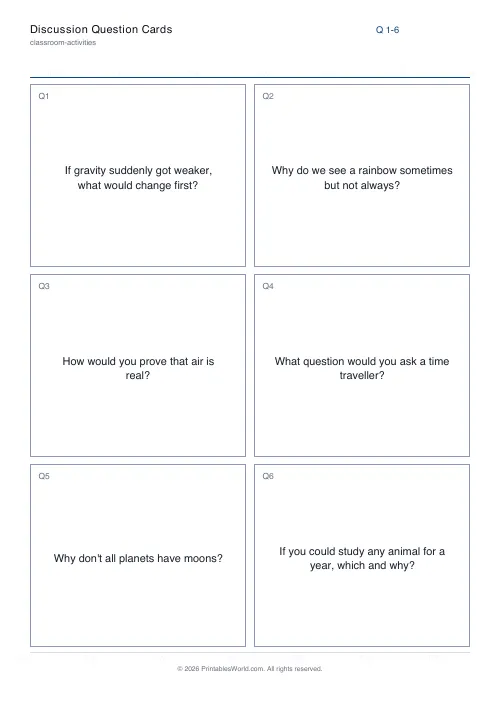
One prompt per card, six cards a page
Each card carries a single sentence designed to be picked up and written from immediately. Print, cut, and put them in a tub.
Four themes: adventure, fantasy, everyday, or a mixed set that takes four prompts from each. Twelve prompts per theme, and asking for more than twelve cards cycles through them again — which is what you want when a class of thirty needs one each and duplicates are fine.
Why a single sentence
Because the blank page is the problem, and a long prompt replaces it with a comprehension exercise.
A prompt that runs to a paragraph has already made the decisions — who, where, what is at stake — and leaves the writer filling in around somebody else's story. One sentence gives a starting position and nothing else, which is the smallest push that works.
The everyday theme is the underrated one
Adventure and fantasy prompts get picked first and produce the most enthusiastic writing, which is genuinely valuable for a reluctant writer.
They also produce a lot of dragons. Everyday prompts — a surprise at breakfast, something found on the way to school — are harder, because the writer cannot lean on the genre and has to make an ordinary situation interesting. That is closer to what most writing actually demands, and it is where a class that has been writing about pirates for a term should go next.
Running it
Draw at random rather than choosing. Half the benefit of a prompt is that it was not selected — a child who picks their own card will pick the one closest to what they were going to write anyway.
Set a time rather than a length. Ten minutes of writing produces more than "write half a page", which turns into a word-count exercise with large handwriting.
And let them ignore the prompt after the first sentence. It is a starting pistol, not a specification, and a story that runs away from its card is the ideal outcome.
Other uses for the same cards
Speaking practice, where the card is talked from rather than written from. Two cards at once, with the challenge of using both. A card drawn at the start of a lesson and written from for five minutes, every day, which is one of the more reliable ways to make writing routine rather than an event.
On the form
A title, the theme, and how many cards (1 to 60). A4 or US Letter.
Print on card if the set is going in a tub for the year. Print at 100% so the cards cut evenly.
FAQs
Quick answers
Are the prompts suitable for all ages?
Prompts are written to work from about age seven upward. Younger children can dictate a response; older writers can take the sentence in any direction they like.
How many prompts are available per theme?
Twelve prompts per theme. Setting a larger count will repeat prompts in order so you can issue spares.
Can I use these for homework?
Absolutely. Send home a pair of cards and ask for a paragraph on each.
Is there a way to skip or replace a prompt?
Not inside the PDF, but you can reprint with a different theme or simply cross out any card you want to replace.
Related tools
Further reading
Classroom Activities
Escape room activities for the classroom: a how-to
A classroom escape room is a sequence of puzzles with a story on top. The design decision that matters most is whether groups work through them in order or all at once.
5 min read
Classroom Activities
Bingo in the classroom: 10 subjects, one game
Bingo works in almost every subject because the mechanic never changes. Only the call does. Ten variations, and the one rule that turns it from a filler into retrieval practice.
4 min read
Classroom Activities
Back-to-school printables every teacher needs
Sorted by when you will actually need them: the two things to print before the children arrive, the week-one set, and the routines worth establishing while everyone is still compliant.
5 min read