Classroom Activities
Domino Cards
Printable double-six, double-nine, or double-twelve dominoes.
Last updated:
What this tool does
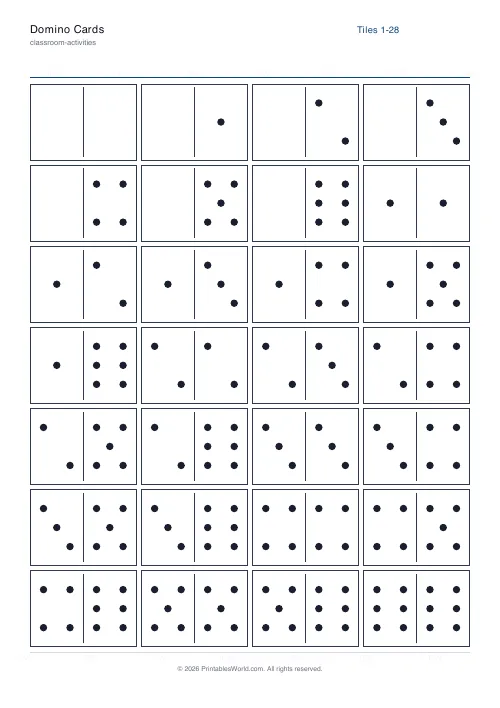
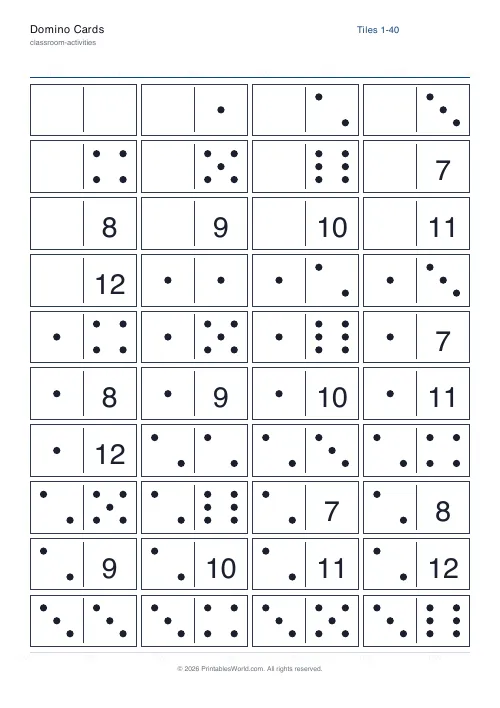
Generates the full unique set of domino tiles (28 for double-six, 55 for double-nine, 91 for double-twelve) with standard pip patterns for 0–6 and numeric fallbacks for higher values. Print, cut, and play.
Settings
Domino tiles
28 unique tiles ready to print and cut.
Tile set
Paper size
Preview
Sample tiles
People also used
Create Printable Dominoes for Classroom Games and Maths Practice
Download a full set of printable domino tiles — double-six, double-nine, or double-twelve — ready to print, cut, and play.
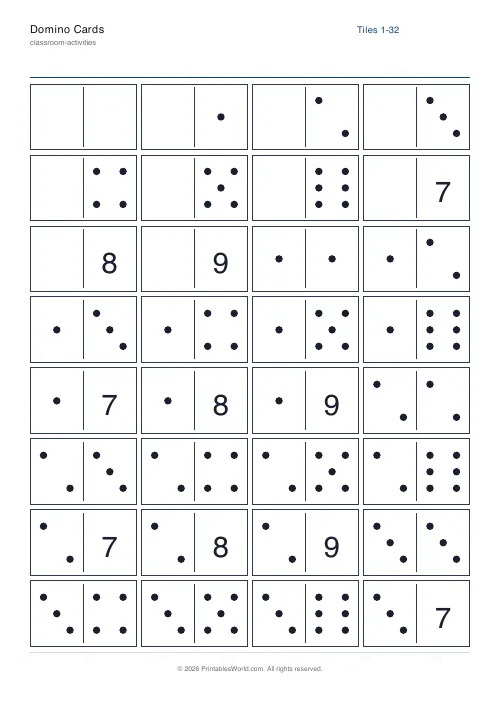
The domino cards tool generates the complete unique set of tiles for the chosen maximum pip value (28 for double-six, 55 for double-nine, 91 for double-twelve), laid out on A4 or US Letter PDF pages for easy cutting. Pip patterns follow the standard arrangement for values 0–6; higher values print the numeral so both halves of a tile are unambiguous.
This tool is built for teachers, homeschool parents, and tutors who want a reliable maths manipulative for addition, comparison, pattern recognition, and classic dominoes gameplay.
Why use this domino generator?
Dominoes are one of the most versatile maths manipulatives in a primary classroom. They combine subitising, addition, comparison, and strategy in a single object, and the game rules are simple enough for Early Years while staying interesting for adults. Use them for:
- addition and number-bond practice
- fractions and equivalence work (each tile reads as a fraction)
- pattern recognition and subitising
- classic dominoes and train games
- maths warm-ups and starter tasks
- take-home maths kits
- wet-break and cover-lesson activities
A printable set means every pupil or small group can have their own tiles without buying multiple shop-bought sets.
What you can customise
The generator focuses on the choice of set size and prints everything else to a consistent template. You can choose:
- Maximum pip value: 6 (28 tiles), 9 (55 tiles), or 12 (91 tiles)
- Worksheet title: a heading across the top of each page
- Paper size: A4 or US Letter PDF output
All tiles print at a consistent size so they shuffle and stack neatly once cut.
Notes and limitations
- Pip patterns for 7–12 are not universally standardised, so the engine prints the numeral to keep the value clear.
- Double-twelve produces 91 tiles and spreads across several pages — allow a few minutes of cutting time.
- Tile corners are square by default; round them with a corner cutter if you want a shop-bought feel.
- Printed output is best on 160–250 gsm card for sturdy tiles.
Who these dominoes are for
Printable dominoes suit every stage from Early Years to GCSE revision.
Parents
Print a double-six set for family game nights and early maths practice at home.
Teachers
Produce class sets of dominoes for maths rotations, without the cost of buying multiple plastic boxes.
Homeschool families
Use dominoes as a daily number-talk prop — pick a tile, say the two numbers, and ask how many dots in total.
Tutors
Use dominoes for fact fluency, comparison, and probability work in one-to-one sessions.
Set size options
Double-six (28 tiles)
The classic set. Best for Early Years, family games, and standard dominoes rules. Pip patterns are fully traditional.
Double-nine (55 tiles)
A larger set for train-style games and more advanced maths work. Values 7–9 print as numerals. Best for Key Stage 2 and older players.
Double-twelve (91 tiles)
The largest standard set. Values 7–12 print as numerals. Best for serious domino games, for classes of four or more players, and for advanced maths practice with larger numbers.
How to use the tool
- Choose the maximum pip value (6, 9, or 12).
- Give the set a title if you want one.
- Choose A4 or US Letter as your paper size.
- Click Generate.
- Preview the sample page.
- Download the PDF, print on card, and cut along the tile borders.
Worked example
Suppose you are setting up an addition rotation for a Year 2 class. Choose double-six, title the set "Addition Dominoes", and print one set per pair on 200 gsm card.
Each pair draws a tile, reads the two halves, and writes the sum on their whiteboard. Pupils practise rapid addition, pattern recognition, and turn-taking — all from one sheet of dominoes.
Methodology
The engine enumerates every unique tile for the chosen maximum value (all pairs (a,b) where a ≤ b). For pip values 0–6 it draws the traditional dot pattern; for higher values it draws the numeral centred on that half. Tiles are laid out in a grid on each page, with a light border to cut along, and spread across additional pages automatically for larger sets. Branding, watermark, and footer elements come from the shared PDF template.
Helpful preset ideas
- Double-six for Early Years and family games
- Double-nine for Key Stage 2 maths rotations
- Double-twelve for advanced players and large groups
- Print two double-six sets on card for four-player classroom games
- Laminate before cutting for a set that lasts several years
Best ways to use printable dominoes
- Print on 160–250 gsm card for sturdy, long-lasting tiles.
- Laminate sheets before cutting to add further durability.
- Use a sharp guillotine or a ruler and craft knife for clean edges.
- Store each set in a labelled ziplock bag or fabric pouch.
- Combine with printable dice and flashcards for a full maths-games kit.
Designed for A4 and US Letter printing
Tiles print at a consistent ratio on both A4 and US Letter — US Letter fits a little differently on the page, but individual tile size stays large enough for comfortable play. Choose whichever paper size matches your printer.
Related classroom activity printables
You may also find these related classroom templates useful:
FAQs
Quick answers
How many tiles come out of the generator?
Double-six is 28 unique tiles, double-nine is 55, double-twelve is 91 — the same counts as commercial sets.
Why are 7+ shown as numbers, not pips?
Seven or more pips don’t have a universally agreed standard pattern, so the engine prints the numeral to keep both halves unambiguous.
Is this good for maths practice?
Yes — dominoes are a classic tool for addition, comparison, and pattern recognition with early learners.
What card stock should I use?
Any 160–250 gsm card gives sturdy tiles; use a sharp guillotine or ruler-and-blade for clean edges.
Related tools