What this tool does
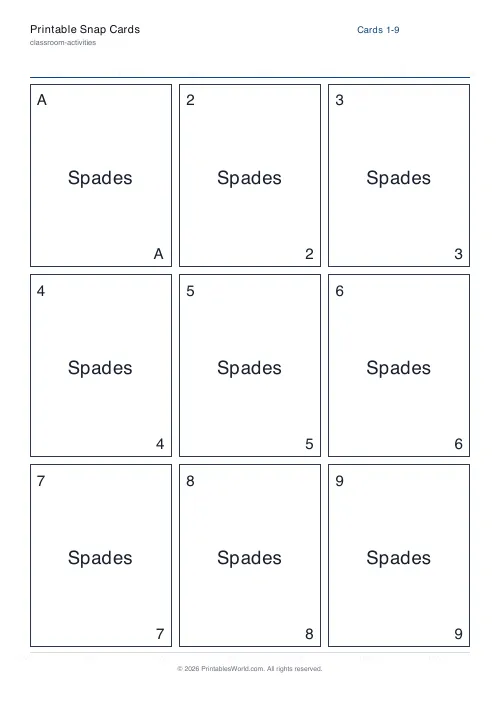
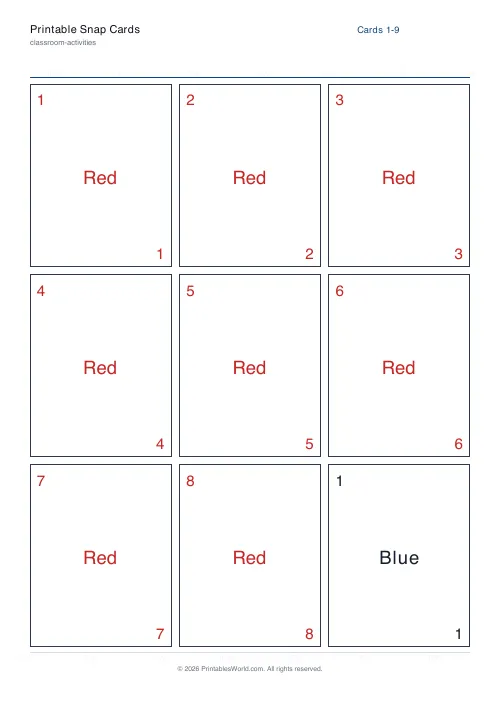
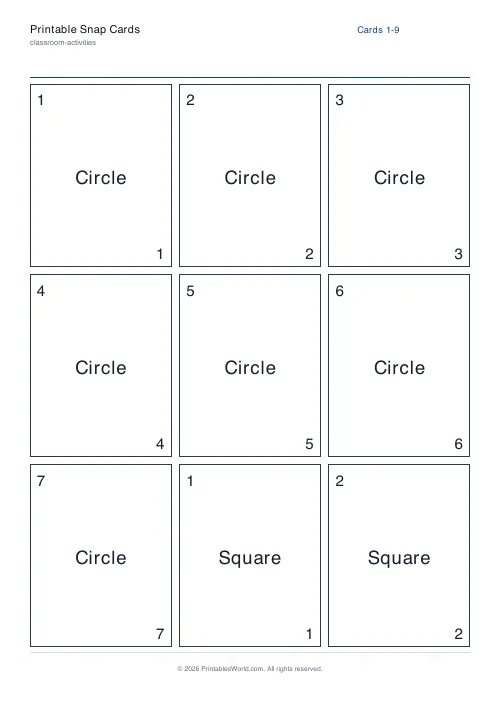
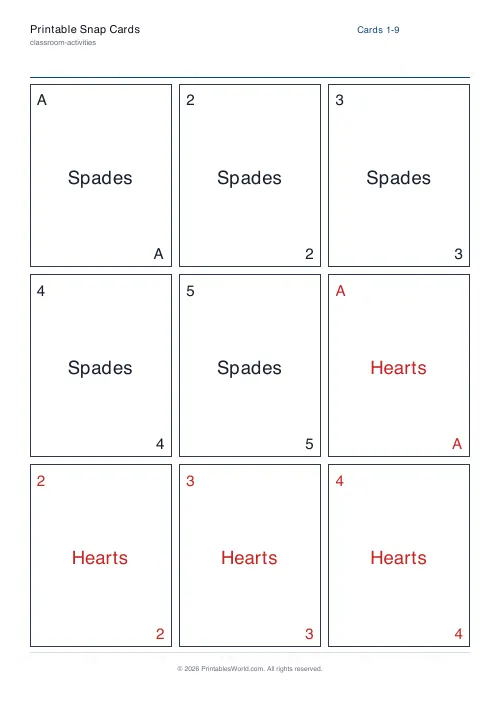
A printable Snap deck of 20, 40 or 52 cards, in the classic four suits, in plain colours, or in shapes for children who do not know the suits yet.
People also used
Feedback
Spotted something off with this tool?
Three decks, one game
Standard prints the four familiar suits. Colours drops them for plain blocks of colour. Shapes uses simple shapes instead.
Deck size is 20, 40 or 52.
Which deck for which child
Snap is a matching game, and the only thing that matters is how quickly a player can tell two cards apart.
Colours is the easiest and the right choice for a three-year-old: the match is visible from across the table and needs no counting, no reading and no knowledge of suits. Shapes is a step up, because circle and hexagon take longer to distinguish than red and blue.
Standard is the hardest of the three and the one that transfers — a child who plays with real suits and numbers is learning a deck they will use for every other card game.
Deck size changes the pace
At twenty cards the matches come up constantly and a round lasts about a minute. That is right for a young child, whose attention will not survive a long game and who needs the win to actually arrive.
Fifty-two is a proper deck and a proper game. Forty sits in between and is the default.
Start shorter than you think. A game that ends while everyone still wants to play is a game that gets played again.
What Snap is actually training
Visual discrimination and reaction time, mostly. Also turn-taking, and the surprisingly hard skill of watching somebody else's action closely enough to respond to it.
It is one of the few games where a four-year-old can genuinely beat an adult, because the adult's advantages — strategy, arithmetic, vocabulary — are all irrelevant. That matters more than it sounds for a child who usually loses.
House rules worth agreeing first
What counts as a match: same rank only, same suit only, or same colour. With a young child, same colour makes the game much faster and much easier.
And what happens on a wrong call. The traditional penalty is giving a card away, which is fair and is also how a small child ends up with no cards and in tears. Consider making it free.
Printing
Card, or paper glued to card. On plain paper the face shows through from the back under a bright light, which children spot immediately and use without mentioning it.
Print at 100% so every card is the same size. A deck with one slightly larger card has a marked card in it.
Round the corners with scissors if the deck is going to be shuffled often — square corners bend first and then the card is identifiable from the back.
FAQs
Quick answers
Can I use this deck for other card games?
The 52-card standard deck works for Snap, Memory, Old Maid, and simple matching games. The colour and shape decks are especially good with very young players.
Do hearts and diamonds print red?
Yes. Red suits are printed in red ink so they’re quick to spot when the deck is in play.
Why does my printer show suit names instead of symbols?
The engine spells out the suit name so it prints reliably on every device. For picture-suit decks, print on coloured card to reinforce the distinction.
How big are the finished cards?
Nine cards per page on A4 or Letter gives roughly standard playing-card size once cut.
Related tools