What this tool does
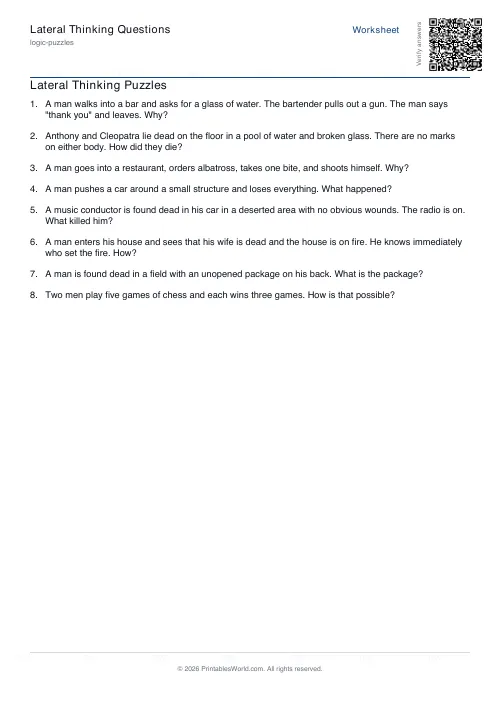
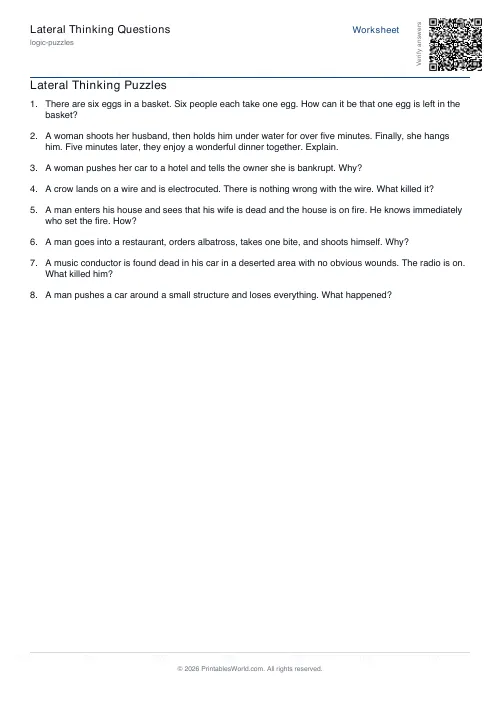
Situation puzzles: a strange scenario, and an explanation that only makes sense once you spot the assumption you made. Four to twenty-six per sheet, answers on a separate page.
People also used
Feedback
Spotted something off with this tool?
Situation puzzles, four to twenty-six a sheet
A man pushes his car to a hotel and tells the owner he is bankrupt. A woman is found dead in a field with an unopened package beside her. Each puzzle is a scenario that seems impossible until you work out the one assumption you made without noticing.
Twenty-six curated scenarios, shuffled, with the answers printed on their own page so the sheet can be handed out without them.
These are not really a worksheet
Handed to a child alone with a pencil, one of these is just frustrating. Nothing to work with. No clue set, no procedure, no way of telling whether you are getting warm.
They are a conversation format. The traditional way to run them is that one person knows the answer and everyone else asks yes-or-no questions until the picture assembles — and the questioning is the whole activity, not the answer. Print the sheet as a supply of scenarios for whoever is running it, not as an exercise to be completed.
Why the assumption is always the point
Every one of these works the same way. The scenario is stated in ordinary words, and the listener fills in details nobody said: that the man was driving the car, that the hotel was a building, that the woman died of something.
No solution here involves new information. Every one involves removing a detail the listener supplied themselves. That is the transferable part, and it is worth saying out loud after two or three puzzles, because a group that never hears it experiences the whole set as trick questions rather than as a demonstration of how much of what they "know" they quietly made up.
Running them with a group
Yes-or-no questions only, and answer honestly. "Irrelevant" is a legitimate third answer and saves a lot of time.
Give the group a nudge when they stall for more than a couple of minutes. The satisfaction is in the assembling, and a group that has been stuck for ten minutes has stopped enjoying it and started resenting the person holding the answer.
Some setups are grim. The genre runs to bodies in fields. Read them before handing the sheet to a young class.
Adjustments
How many puzzles, from 4 up to all 26, the answers page on or off, and a seed to reproduce a set. A4 or US Letter.
Six is right for a car journey or a form time. Twenty-six is the whole library, which will not fit in one sitting with a group that is enjoying it.
Where they fit
Form time, a long journey, a wet break, the last ten minutes of a session where nobody is going to start anything new. Also the wind-down at the end of an escape-room activity, where a group is already in the right frame of mind.
Print at 100% on A4 or US Letter, and keep the answer page yourself.
FAQs
Quick answers
What is a lateral thinking puzzle?
A short, often surprising scenario where the obvious explanation is wrong; the solver asks yes/no questions or thinks creatively to find the real cause.
Are these original?
Many are classics from the lateral thinking tradition; the curated list bundles 25+ items.
Are they suitable for kids?
Most are appropriate for age 10+, though a few involve plot twists like illness or accidents.
Can I print without the answers?
Yes. Toggle the answer-key option off.
Related tools
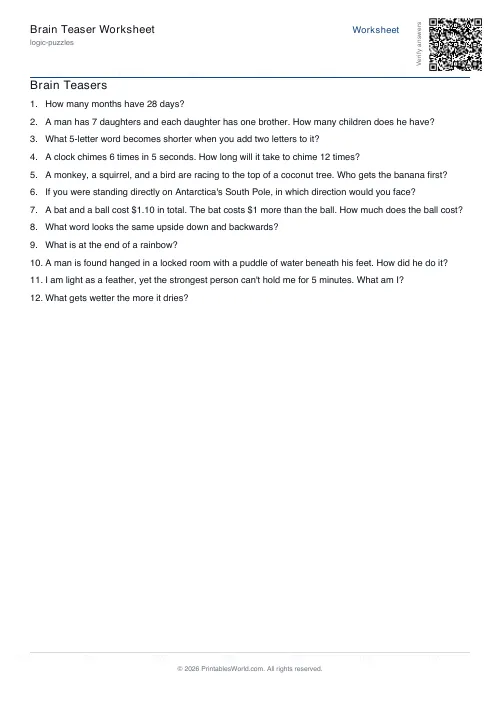
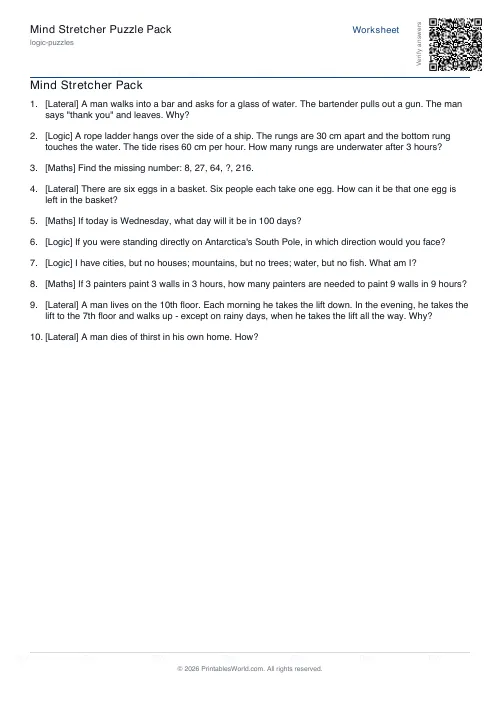
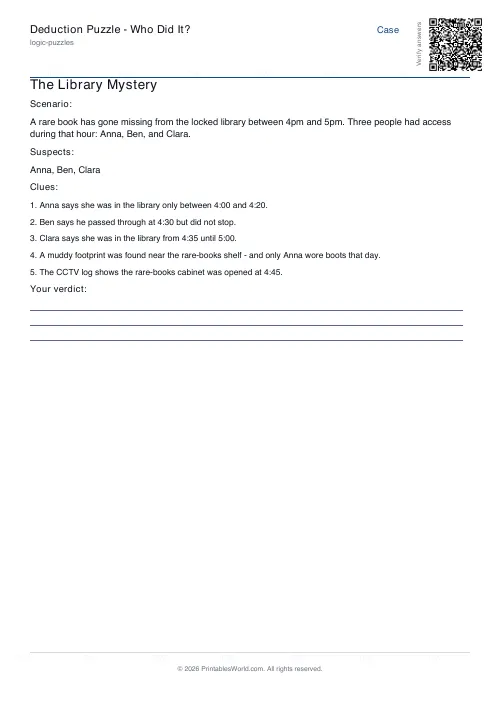
Further reading
Logic Puzzles
The benefits of logic puzzles for developing brains
Logic puzzles teach deduction and persistence, which are worth having. The claim that they make children generally smarter is weaker than the marketing suggests.
5 min read
Puzzles & Brain Games
Printable brain games for seniors: a free puzzle pack
A free printable puzzle pack for older adults, with a sample seven-day plan, large-print and easier-difficulty tips, and how to use the Logic Puzzles collection.
7 min read
Logic Puzzles
Kakuro, killer sudoku and other number puzzles explained
If sudoku has stopped being a challenge, these are the natural next steps. And unlike sudoku, most of them genuinely involve arithmetic.
5 min read