What this tool does
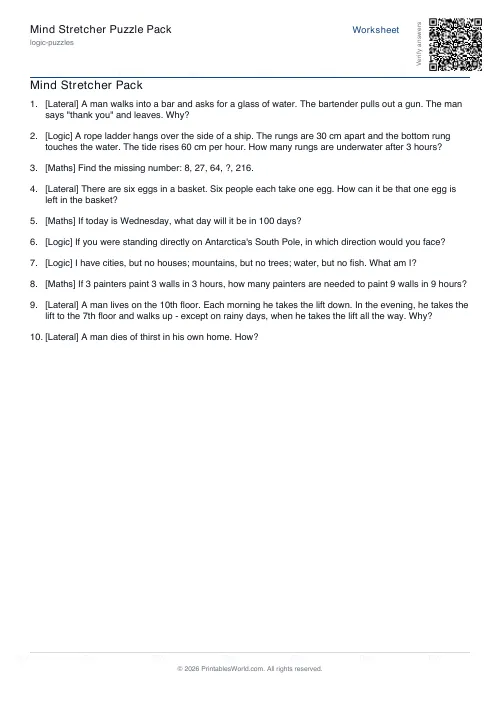
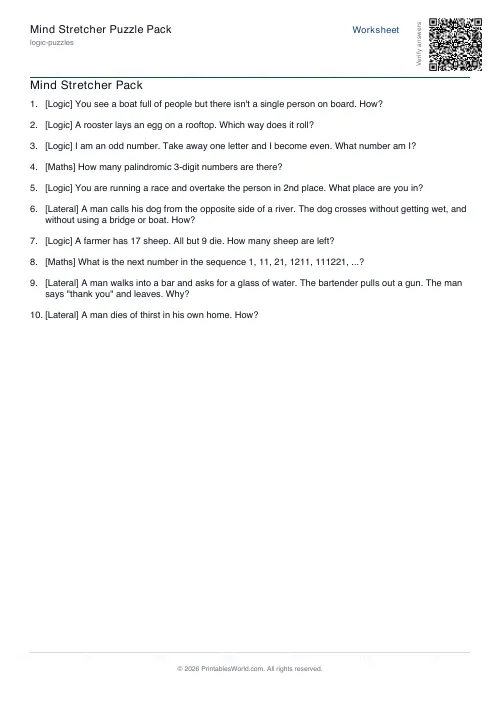
A mixed pack of fifty curated brain teasers, lateral thinking scenarios and quick maths problems, each labelled by type. Six to fifty on a sheet, answers on their own page.
People also used
Feedback
Spotted something off with this tool?
Three kinds of thinking on one sheet
The pack draws from three libraries and labels every item so you can see which is which: 25 logic teasers, 15 lateral thinking scenarios, and 10 quick maths problems. Fifty in total, shuffled, six to fifty per sheet.
The mixing is the point. A page of one type becomes a procedure — you learn the trick and apply it — and a page that switches type every question does not let you.
What each type asks for
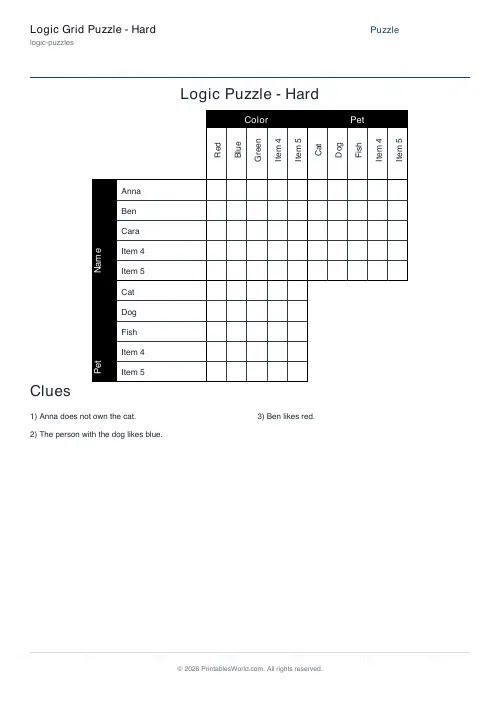
[Logic] items have a definite chain of reasoning. "A man has 7 daughters and each daughter has one brother; how many children?" is solved by noticing the brother is shared. Careful reading, then arithmetic.
[Lateral] items need an assumption dropped rather than a deduction made. These are the hardest to do alone and the best to discuss.
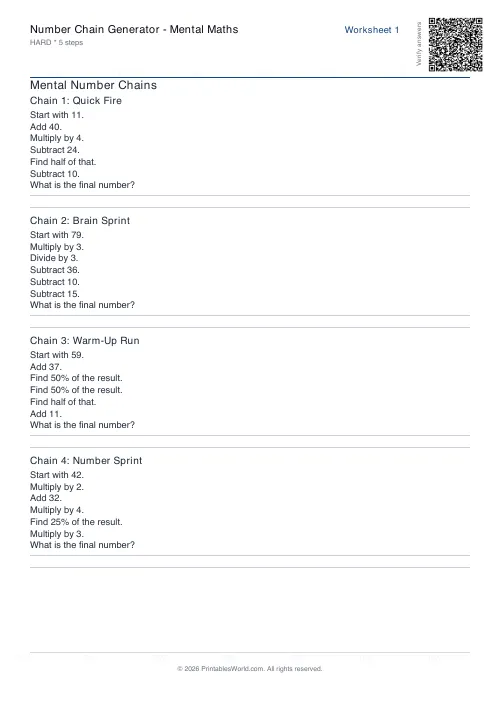
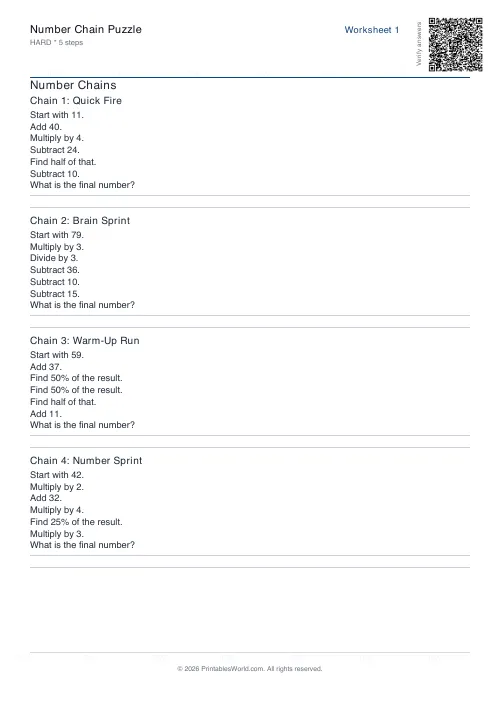
[Maths] items are short and precise. The smallest number divisible by everything from 1 to 10. How many rectangles in a 3×3 grid. What day it is in 100 days' time. Each has one right answer and a satisfying method.
The maths items are worth the sheet on their own
They are the kind of question that looks like a trick and is not.
"If 3 painters paint 3 walls in 3 hours, how many painters paint 9 walls in 9 hours?" catches almost everybody at 9, and the answer is 3. "How many rectangles are in a 3×3 grid of cells?" is 36, and the elegant route — choose two of the four vertical lines and two of the four horizontal — is a better introduction to combinations than any textbook definition. Getting these wrong is the useful part; the method is what you keep.
Who it is for
The stated audience is extension work for a pupil who finishes early, and it does that job. It has two other uses that are at least as good.
A mixed pack is a fair way to find out what someone is actually good at, because the three types are close to independent. A pupil who is quiet in maths lessons and demolishes the lateral items has told you something useful about themselves.
It is also a decent staffroom or dinner-table sheet. None of these is aimed particularly at children.
The controls
Item count from 6 to 50, the answers page on or off, and a seed. A4 or US Letter.
Ten is a session. Fifty is the whole library on one download, which is better used as a supply to draw on than as a single sitting.
Running it
Do not hand out the answers. Half the value of a puzzle like this is the twenty minutes of being stuck, and a sheet with the answers attached converts that into a reading exercise.
Print at 100% on A4 or US Letter.
FAQs
Quick answers
What kinds of puzzles are in here?
A mix of logic teasers, lateral-thinking situations, and quick maths stretchers.
How many items per worksheet?
Default 10; up to 18 fit on a page.
Is the answer key included?
Yes. Toggle the answer-key option for a separate page.
Can I get the same set twice?
Yes. Set the seed to a fixed value for repeatable selections.
Related tools
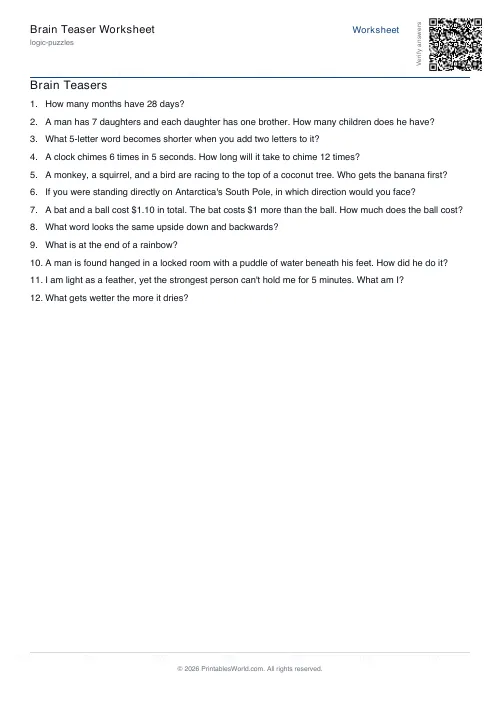
Brain Teaser Worksheet
Collection of classic and original brain teasers. Varying difficulty.
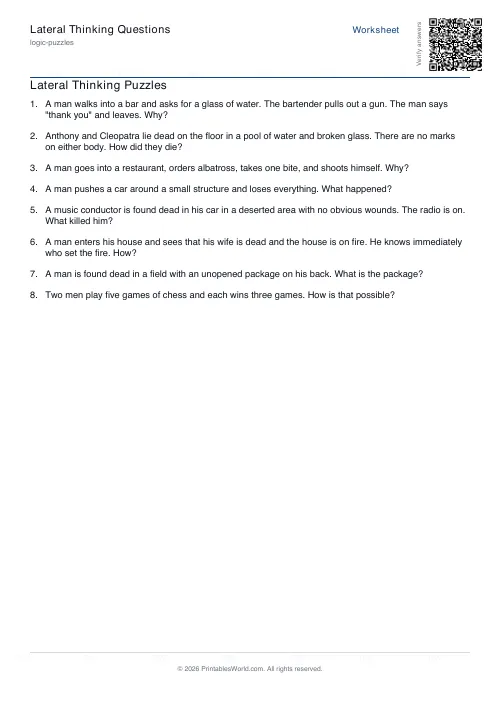
Lateral Thinking Questions
Situation puzzles and lateral thinking scenarios for group discussion.
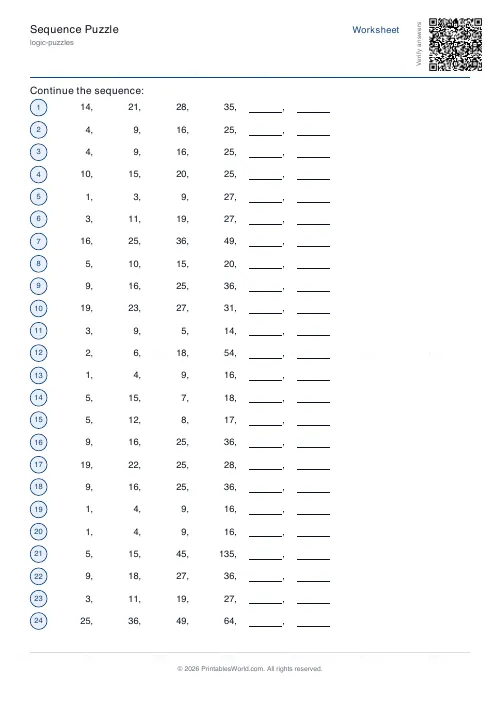
Sequence Puzzle
Continue number and shape sequences. Simple to algebraic nth-term level.
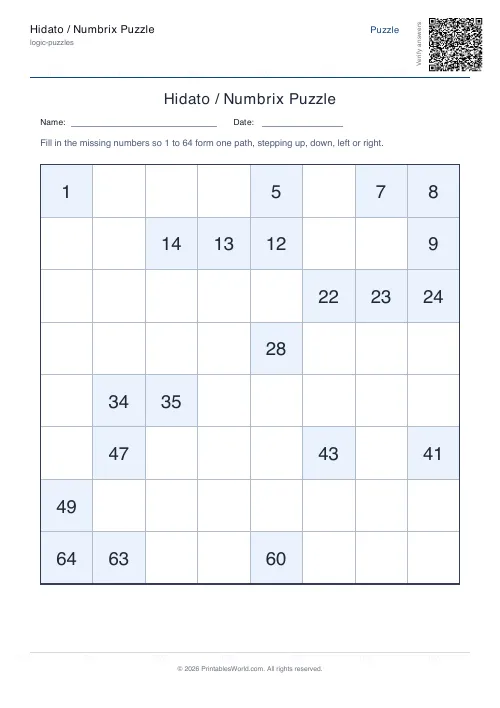
Hidato / Numbrix Puzzle
Join the numbers into one continuous path.
Further reading
Puzzles & Brain Games
Printable brain games for seniors: a free puzzle pack
A free printable puzzle pack for older adults, with a sample seven-day plan, large-print and easier-difficulty tips, and how to use the Logic Puzzles collection.
7 min read
Logic Puzzles
The benefits of logic puzzles for developing brains
Logic puzzles teach deduction and persistence, which are worth having. The claim that they make children generally smarter is weaker than the marketing suggests.
5 min read
Logic Puzzles
Kakuro, killer sudoku and other number puzzles explained
If sudoku has stopped being a challenge, these are the natural next steps. And unlike sudoku, most of them genuinely involve arithmetic.
5 min read