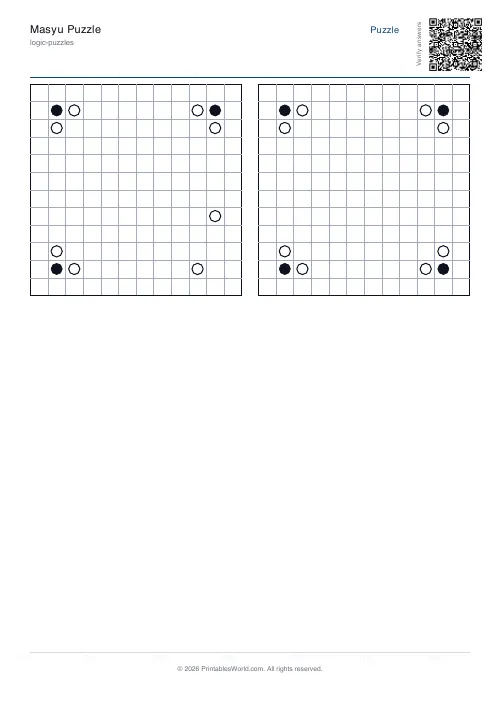
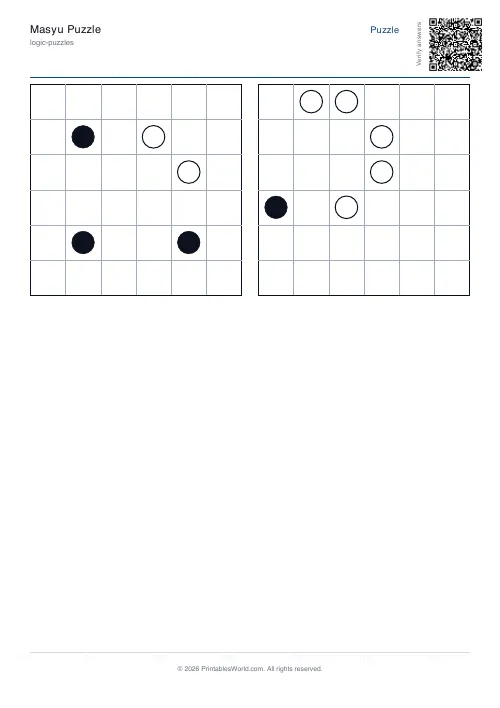
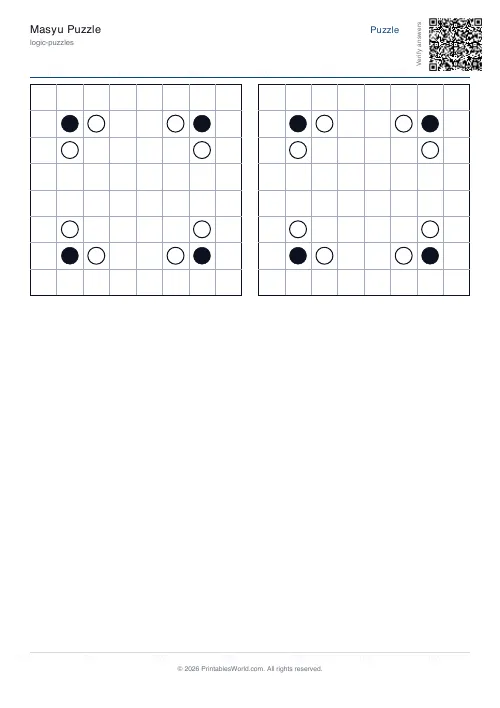
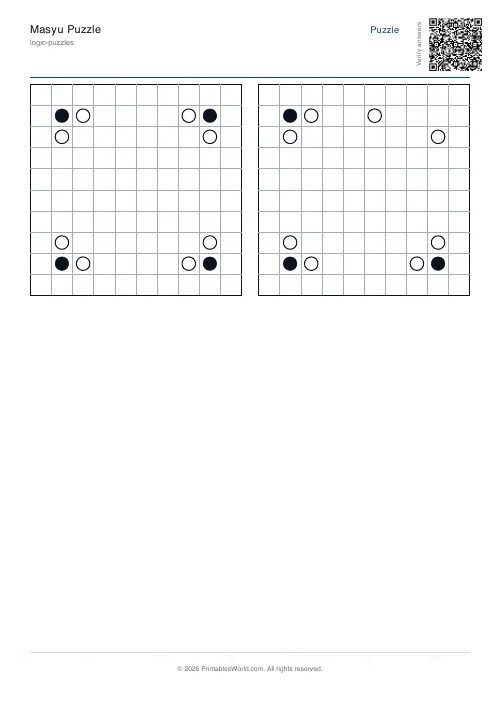
What this tool does
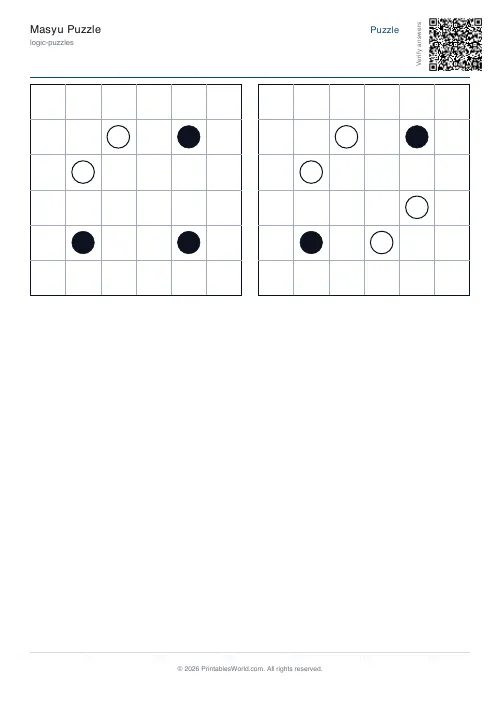
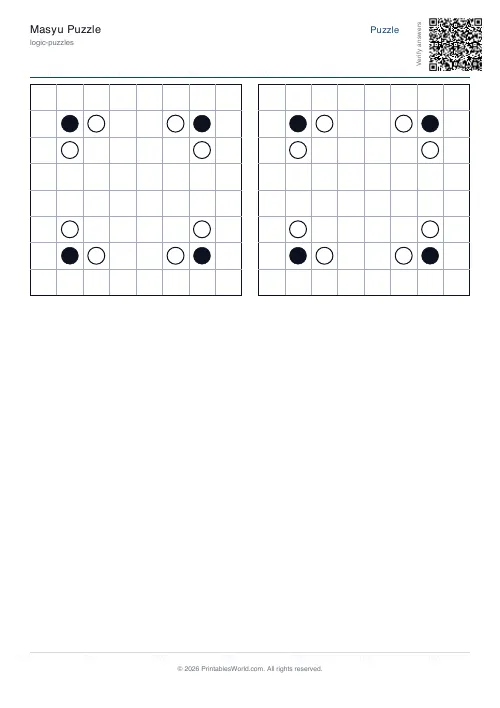
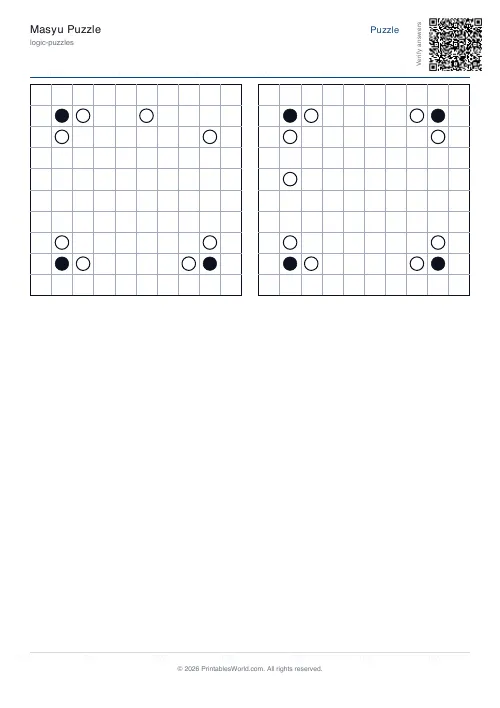
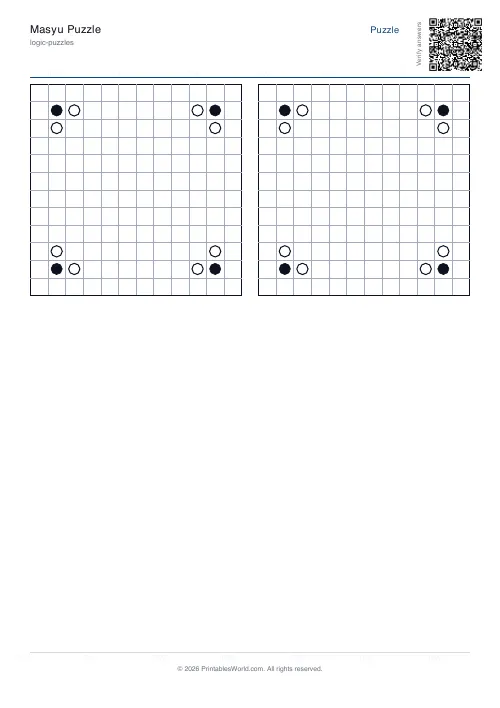
Masyu, the pearl loop puzzle. Draw one closed loop through every circle: turn at each black pearl, run straight through each white one. Grids of 6, 8, 10 or 12, one to four puzzles a page.
People also used
Feedback
Spotted something off with this tool?
Masyu: one loop, two kinds of pearl
Draw a single closed loop that runs horizontally and vertically through the grid, never crossing or branching, and passes through every circle on the board. Two rules govern the circles.
- Black pearl — the loop must turn here, and must go straight for at least one cell on both sides of the turn.
- White pearl — the loop must pass straight through, and must turn immediately before or immediately after (or both).
Cells with no circle are unconstrained. The loop may run through them or miss them entirely, which is the part beginners find hardest to accept: not every cell is used.
The two rules do most of the work for you
A black pearl on an edge is nearly solved before you start. It has to turn, and it needs a straight cell either side, so the directions available to it are immediately limited — on a corner cell there is exactly one possibility.
Two white pearls adjacent in a line are also strongly constrained, because the loop runs straight through both and has to turn just outside the pair.
The standard opening is to mark every forced segment from the edge pearls first, then join what those force. Almost every Masyu opens up from its boundary inward.
How these are built, and where the guarantee stops
A closed loop is generated first, then every legal pearl position on it is computed, then pearls are removed one at a time with the puzzle re-solved after each removal — a removal is kept only while exactly one loop still satisfies the clues.
That gate runs at 6×6. Above that the verifier becomes too slow to run for every puzzle, so larger grids ship with the full set of legal pearls revealed and no single-answer guarantee: the printed solution is definitely a valid loop, and on a bigger board another loop may satisfy the same pearls. If you are marking someone else's work at 8×8 or larger, check their loop against the rules rather than against the answer sheet.
Six by six is the size to use for anything competitive or assessed. The larger grids are for a solver who wants a longer, more relaxed sit.
The options
Grid size 6, 8, 10 or 12. Puzzles per page from 1 to 4. Solutions page on or off, and a seed to reproduce an exact sheet. A4 or US Letter.
Notation that helps
Mark segments you know with a firm line and mark cells you have ruled out with a small dot or cross. Masyu is unusual among loop puzzles in how much the negative information matters — knowing the loop does not enter a cell often forces its neighbours more strongly than knowing it does.
Work in pencil. A loop puzzle rewards backing out of a branch cleanly, and ink does not allow it.
Where it comes from
Masyu was published by the Japanese puzzle house Nikoli, the same publisher that popularised Sudoku and Slitherlink. The name means "evil influence"; it started life as "Shinju no Kubikazari", a pearl necklace, which describes the finished loop better.
Print at 100% on A4 or US Letter.
FAQs
Quick answers
How does the loop work?
A single closed loop that never crosses itself. At black circles it must turn 90°. At white circles it goes straight through, then must turn at one of the next two cells.
Are puzzles guaranteed unique?
No. V1 places circles randomly without verifying a unique solution. The "hint" page sketches one possible loop.
How many puzzles per page?
Two grids per page.
Want a similar challenge?
Try Slitherlink. Also a single-loop puzzle but with number clues.
Related tools
Slitherlink Puzzle
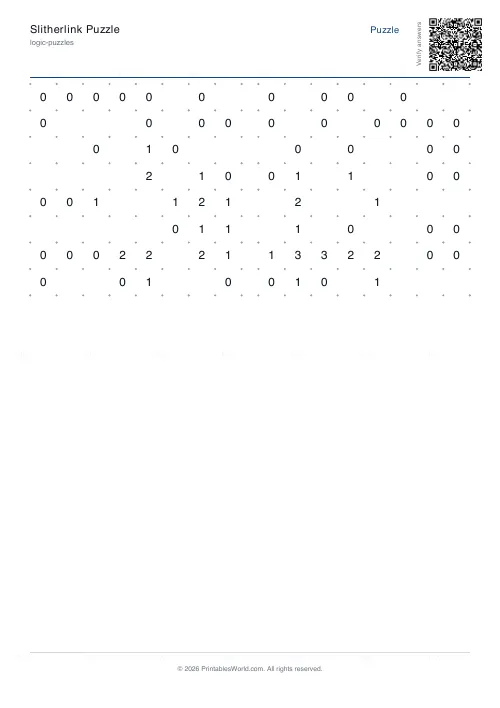
Draw a single closed loop along grid lines using number clues.
Hitori Puzzle
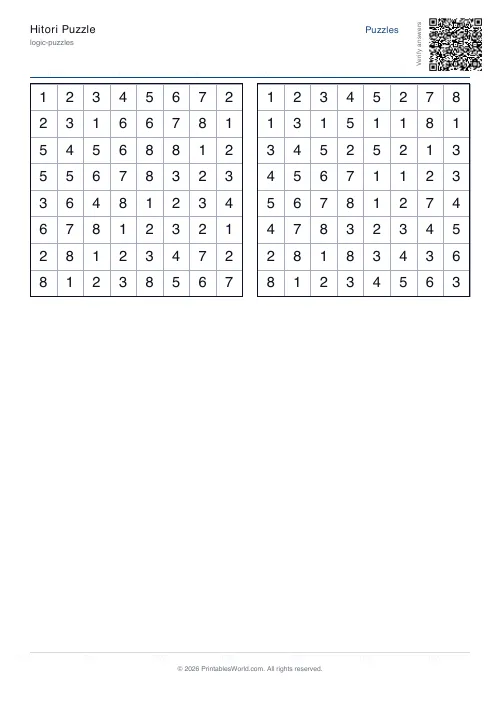
Shade cells so no number appears twice in any row or column.
Sudoku Generator
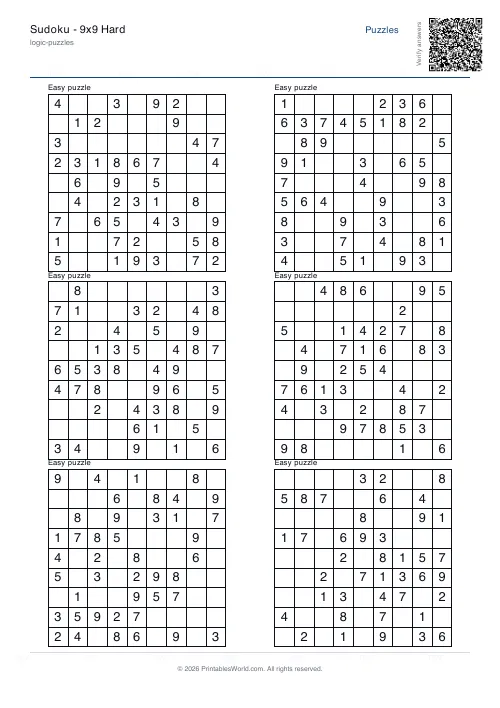
Generate printable Sudoku puzzles with six per page, multiple difficulty levels, and optional solutions.
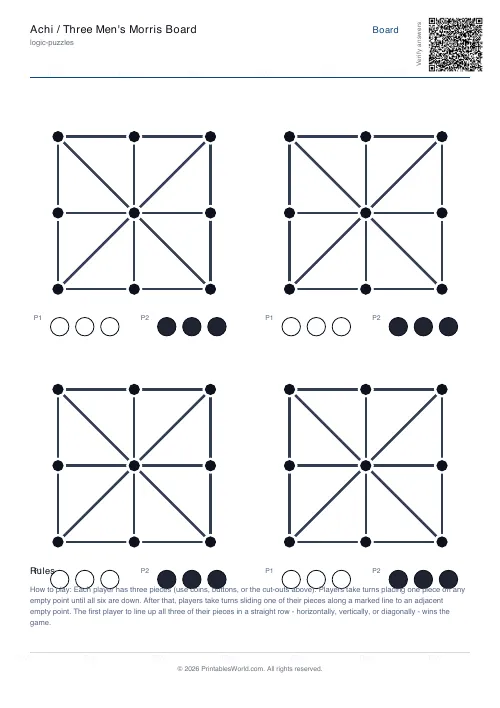
Achi / Three Men's Morris Board
Print a clean, branded Three Men's Morris (Achi) board with optional rules and cut-out pieces for two players.
Further reading
Logic Puzzles
The benefits of logic puzzles for developing brains
Logic puzzles teach deduction and persistence, which are worth having. The claim that they make children generally smarter is weaker than the marketing suggests.
5 min read
Puzzles & Brain Games
Printable brain games for seniors: a free puzzle pack
A free printable puzzle pack for older adults, with a sample seven-day plan, large-print and easier-difficulty tips, and how to use the Logic Puzzles collection.
7 min read
Logic Puzzles
Kakuro, killer sudoku and other number puzzles explained
If sudoku has stopped being a challenge, these are the natural next steps. And unlike sudoku, most of them genuinely involve arithmetic.
5 min read