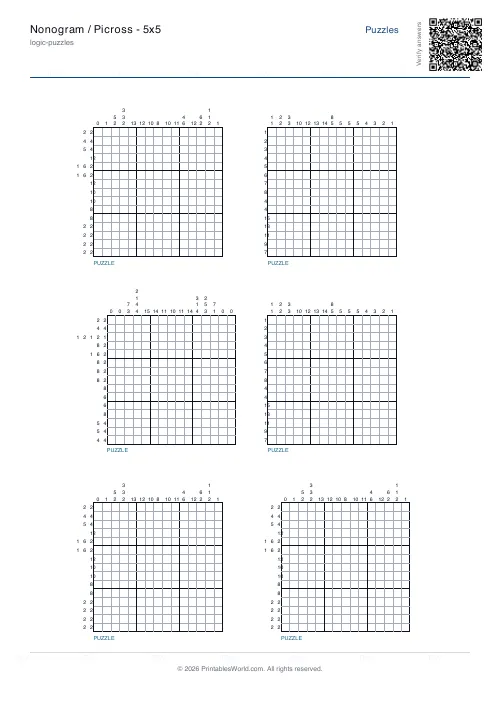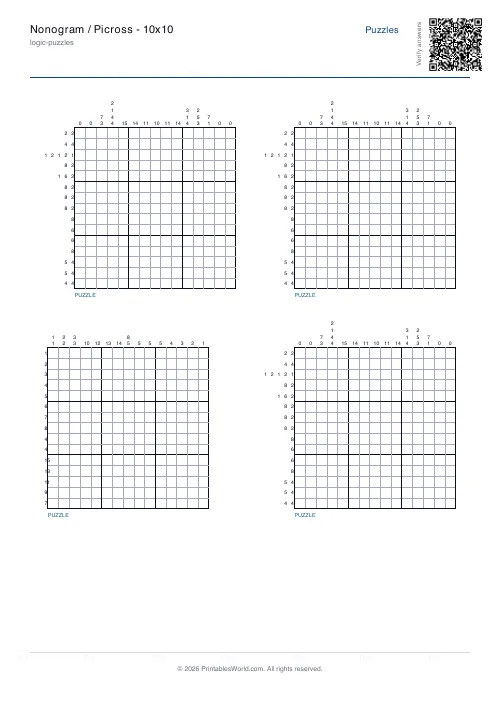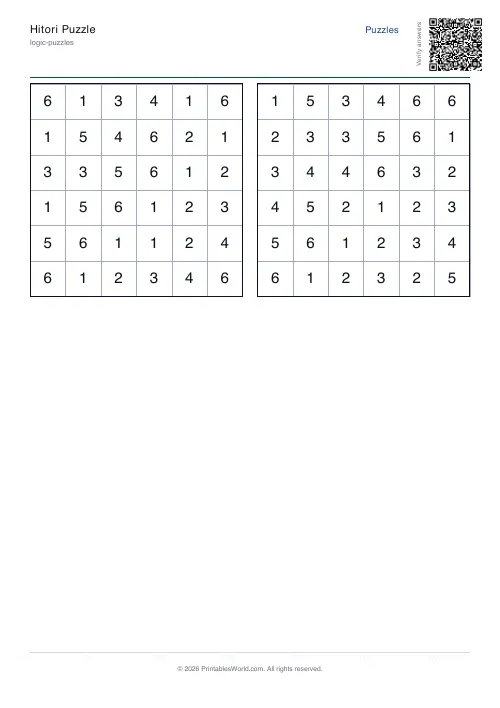
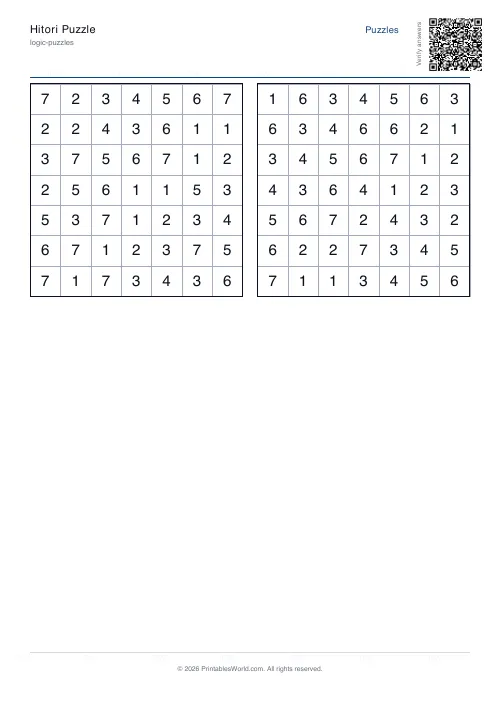
What this tool does
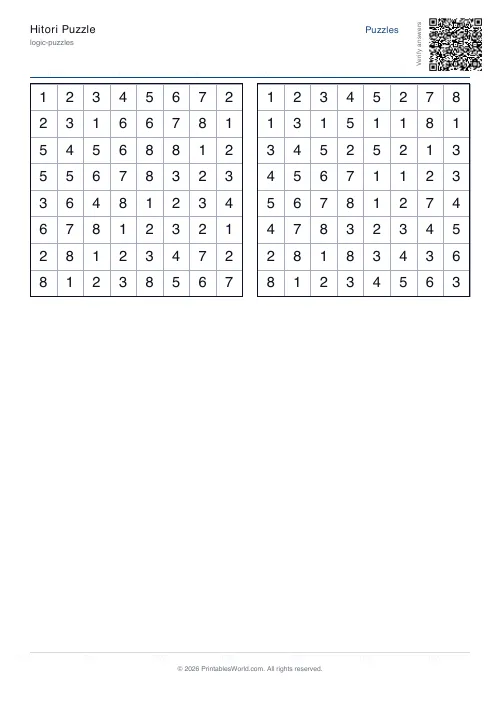
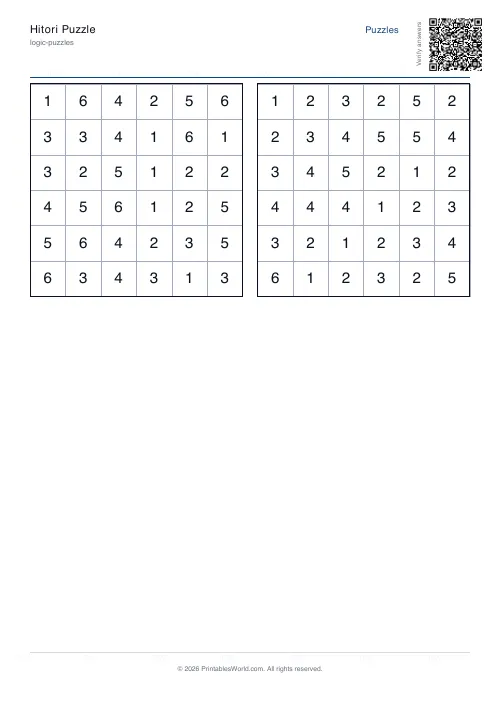
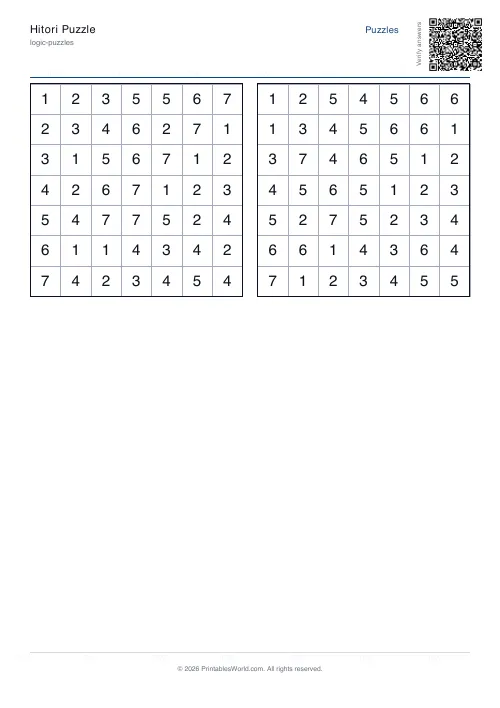
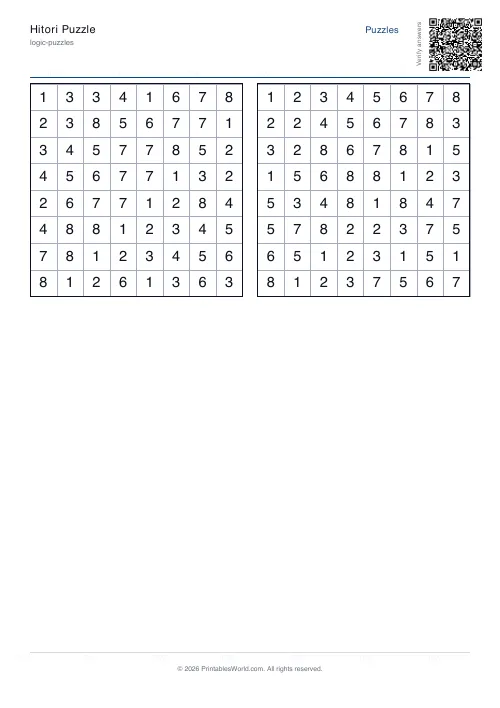
Hitori: shade cells so no row or column repeats a digit among the unshaded ones, no two shaded cells touch, and the unshaded cells stay in one connected piece. Grids 5×5 to 8×8, up to four a page.
People also used
Feedback
Spotted something off with this tool?
Three rules, and they pull against each other
Every cell holds a digit. Shade some of them so that:
- no digit appears twice in any row or column among the cells left unshaded;
- no two shaded cells are orthogonally adjacent;
- every unshaded cell is reachable from every other by moving through unshaded cells.
The first rule tells you what needs shading. The second and third tell you what cannot be. Almost every deduction in the puzzle comes from the collision between them.
The techniques worth knowing
Three in a line. Three of the same digit in a row means the middle one stays — shading it would leave the other two both unshaded and duplicated, and shading both outer ones is fine, so the middle is white.
A pair with a single. Two adjacent identical digits force the matching cell elsewhere in that line to be shaded, because the adjacent pair cannot both go.
Corners and isolation. Shading a cell that would cut off a corner of white cells breaks the connectivity rule, and that alone resolves a great many otherwise ambiguous pairs. Check it constantly — connectivity is the rule people forget and it does more work than the other two combined.
One valid answer, not the only one
Worth being straight about. The printed solution satisfies every rule — that is checked by construction — but the grids here are not currently verified to have exactly one answer, and in practice most of them admit more than one valid shading.
So mark against the rules rather than against the answer sheet. If a solver's board has no repeated digit in any line, no two shaded cells touching, and all the white cells joined up, they have solved it, whatever the back page says.
This is a real limitation and it is being worked on. It is the sort of thing most printable puzzle sites do not tell you.
Grid size
Five to eight cells square, with up to four puzzles a page.
Five is a warm-up. Six is the default and about ten minutes. Eight is a long solve, mostly because the connectivity checking grows faster than the grid does — each new shaded cell has to be tested against a larger white region.
Marking as you go
Use two marks, not one. A dot for "definitely stays white" is as valuable as a shading for "definitely black", and solvers who only mark the black cells lose track of what they have already ruled out.
Pencil, lightly. Hitori punishes premature commitment more than most grid puzzles, because a wrong shading propagates through the connectivity rule and the contradiction can surface a long way from the mistake.
Where it comes from
Hitori was published by Nikoli, the Japanese puzzle house behind Sudoku and Slitherlink. The name is short for a phrase meaning roughly "let me be alone" — which describes the unshaded digits, each left as the only one of its kind in its row and column.
Print at 100% on A4 or US Letter.
FAQs
Quick answers
What are the rules?
Shade cells so each row and column has no repeated unshaded digits, no two shaded cells touch orthogonally, and all unshaded cells form a single connected region.
Are puzzles guaranteed unique?
In v1 we generate boards greedily. There may be multiple valid shadings, the printed solution is one valid answer.
How many per page?
Two grids per page so the digits stay readable.
What sizes are supported?
6, 7 or 8 cells per side.
Related tools
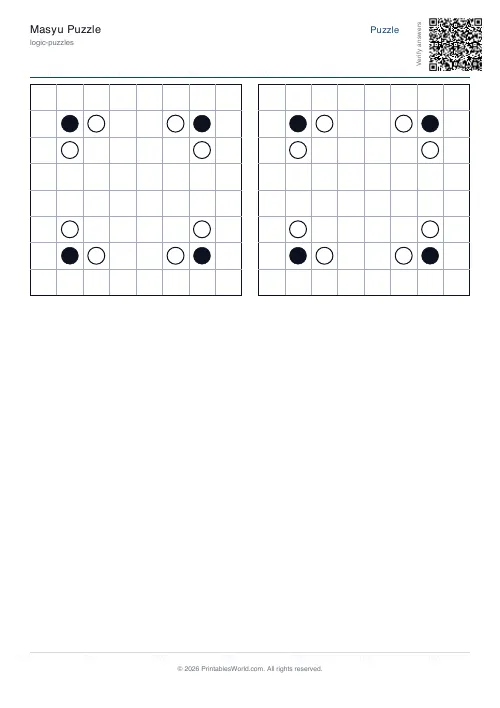
Masyu Puzzle
Draw a loop through black and white circles following specific rules.
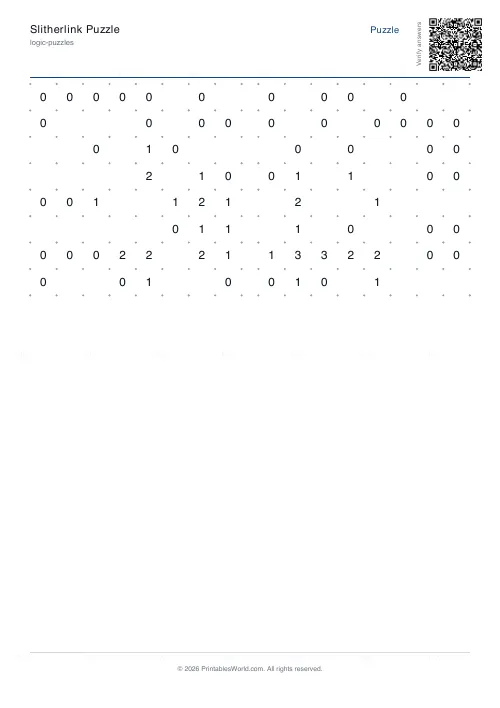
Slitherlink Puzzle
Draw a single closed loop along grid lines using number clues.
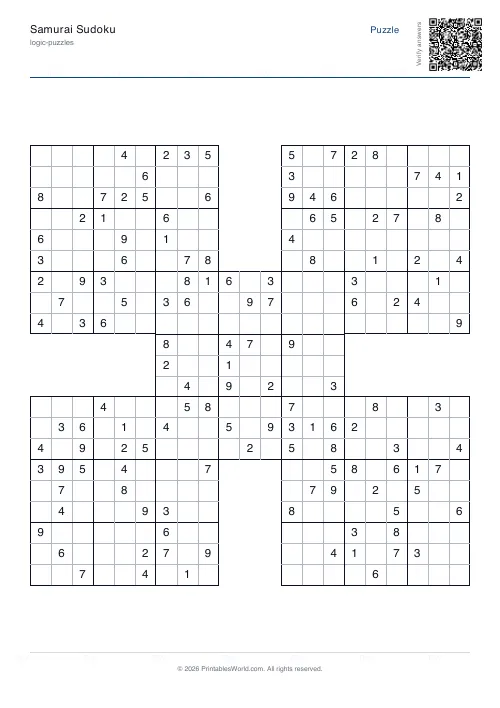
Samurai Sudoku
Five overlapping 9x9 Sudoku grids sharing corner regions.
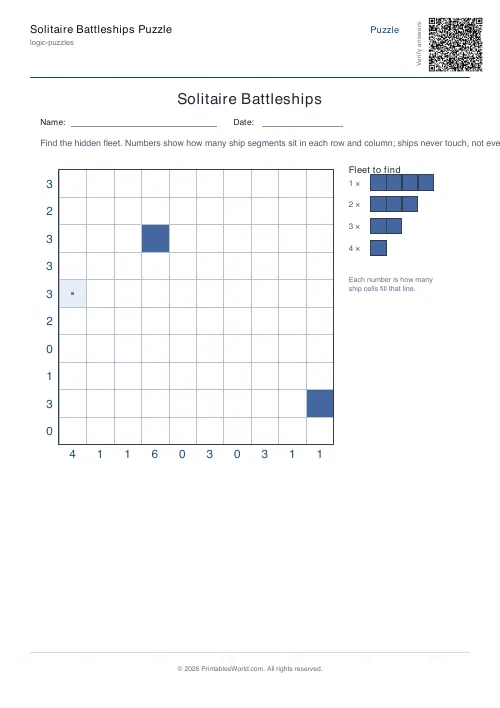
Solitaire Battleships Puzzle
Find the hidden fleet from the row and column clues.
Further reading
Logic Puzzles
The benefits of logic puzzles for developing brains
Logic puzzles teach deduction and persistence, which are worth having. The claim that they make children generally smarter is weaker than the marketing suggests.
5 min read
Logic Puzzles
Kakuro, killer sudoku and other number puzzles explained
If sudoku has stopped being a challenge, these are the natural next steps. And unlike sudoku, most of them genuinely involve arithmetic.
5 min read
Puzzles & Brain Games
Printable brain games for seniors: a free puzzle pack
A free printable puzzle pack for older adults, with a sample seven-day plan, large-print and easier-difficulty tips, and how to use the Logic Puzzles collection.
7 min read