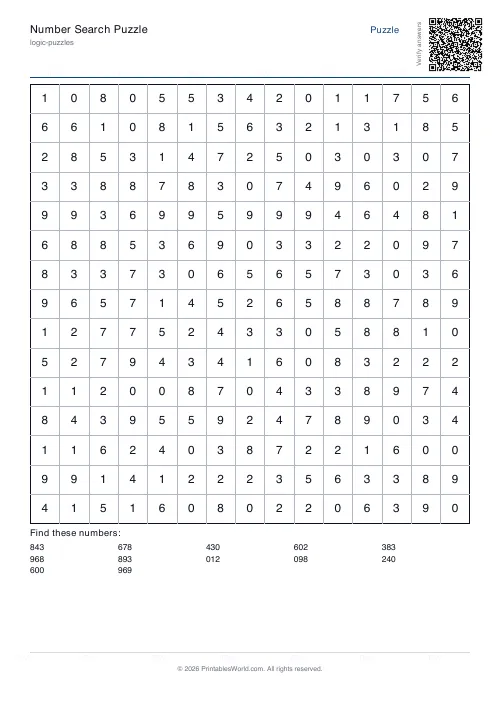
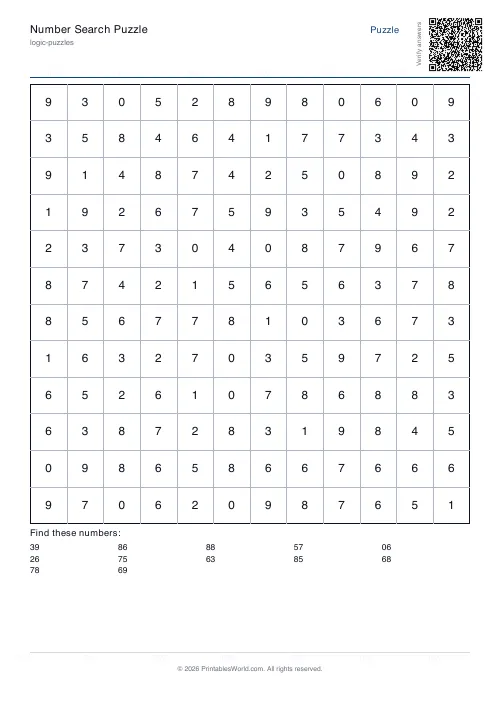
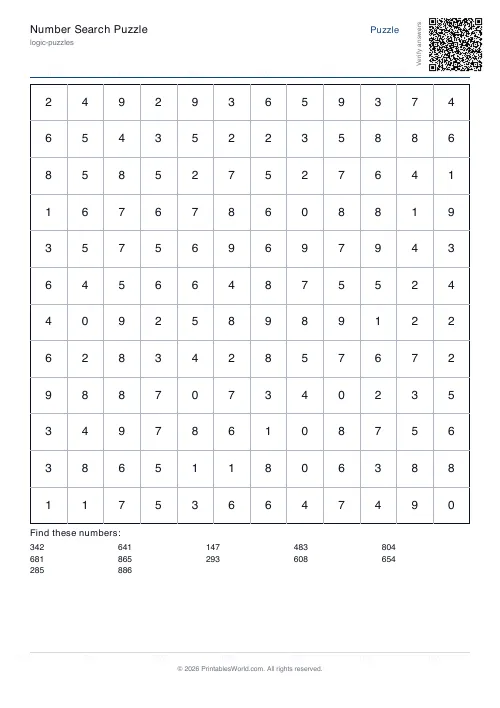
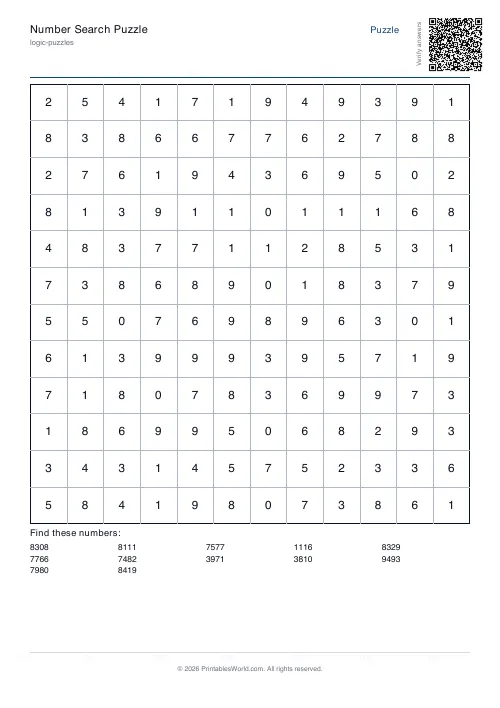
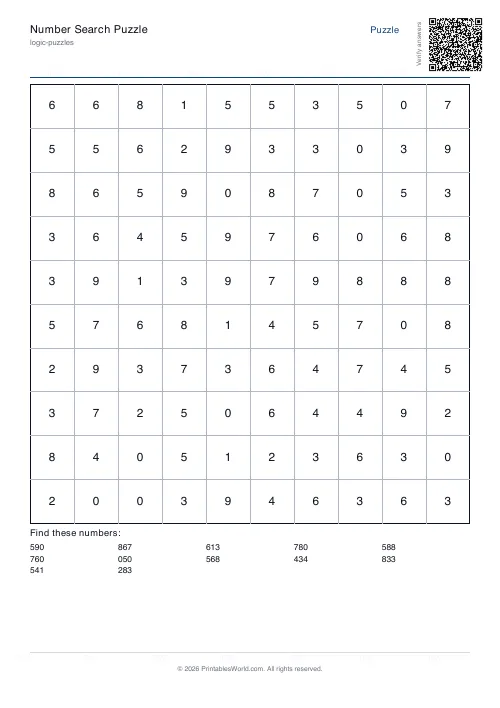
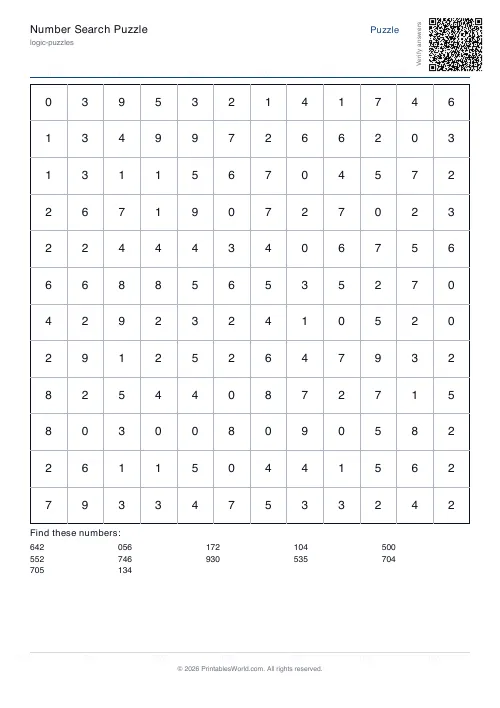
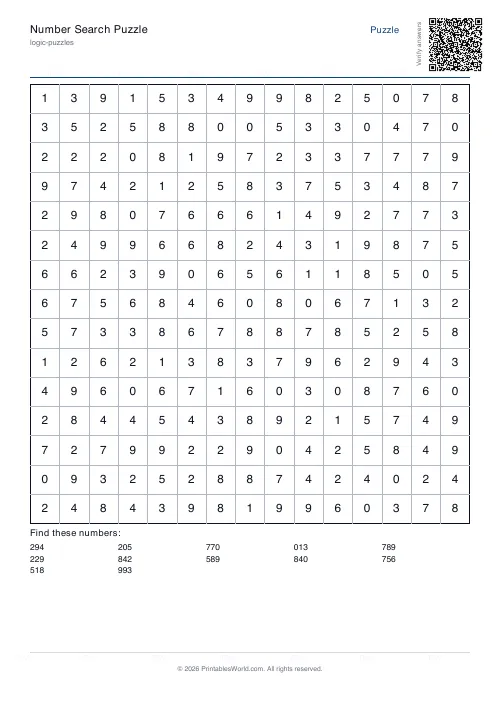
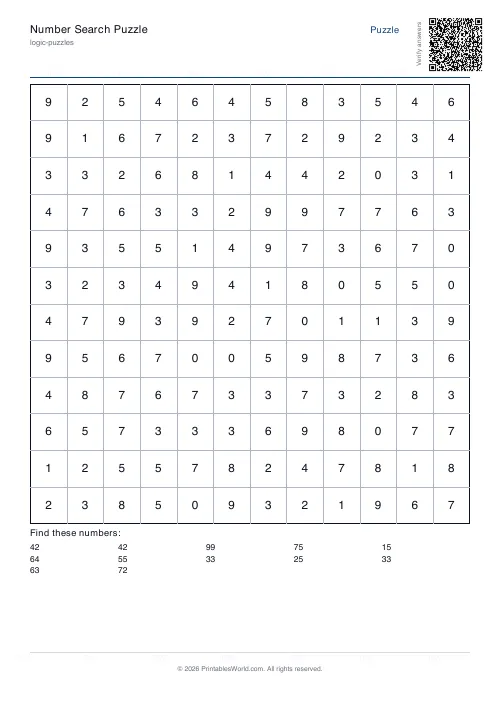
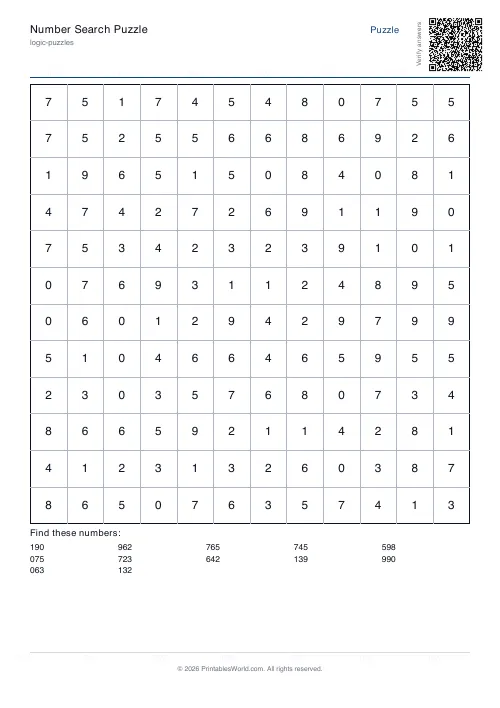
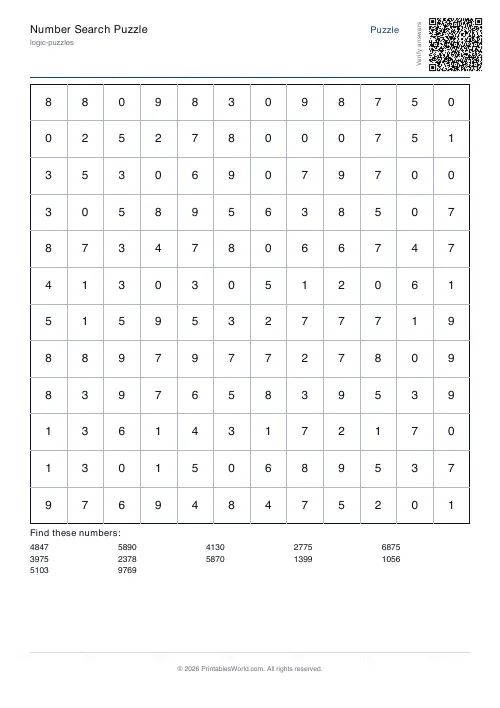
What this tool does
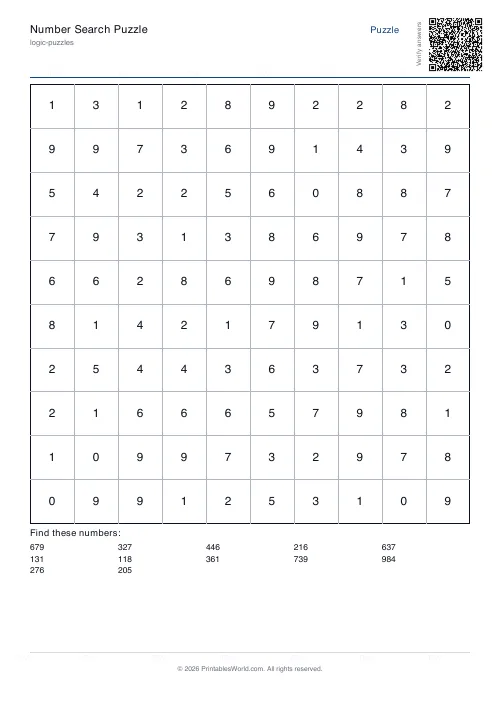
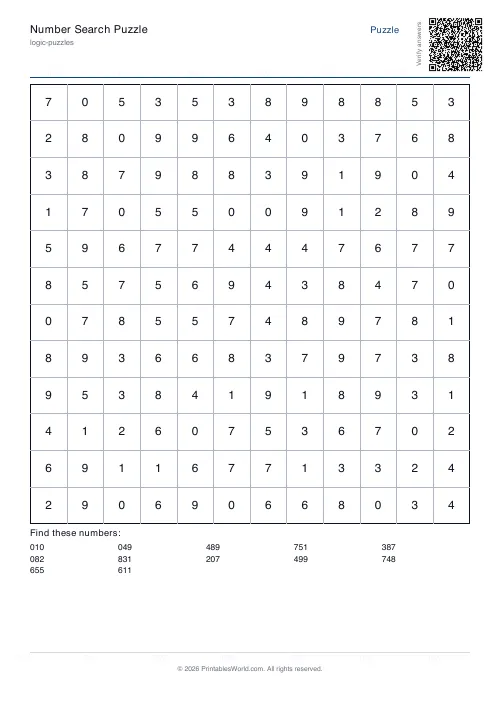
A word search made of digits. Multi-digit numbers hide in a grid of random digits, running in any of eight directions including backwards and diagonally. Grid 8 to 20, numbers 2 to 6 digits long, 6 to 20 of them.
People also used
Word Search: Custom Words
Enter your own word list and generate a printable word search.
Cryptogram Generator: Printable PDF
Create printable cryptogram puzzles from famous quotes or your own text with customisable difficulty and hints.
Sequence Puzzle
Continue number and shape sequences. Simple to algebraic nth-term level.
Feedback
Spotted something off with this tool?
Number search: the same hunt, without the words
A grid packed with the digits 0 to 9, and a list of multi-digit numbers hidden in it. Find each one and ring it.
Numbers run in all eight directions: left to right, right to left, top to bottom, bottom to top, and along all four diagonals. Backwards and upward placements are included by default, which is what stops the puzzle collapsing into a left-to-right scan.
Why digits are harder than words
In a word search you are not really reading the grid. You are looking for shapes your eye already knows — a double letter, an unusual pair, the silhouette of a word you have seen ten thousand times — and that is why a fluent reader can find CAT without checking a single letter.
Digits give you none of that. Every digit looks like every other digit, no combination is more familiar than another, and there is no orthographic pattern to lean on. So the search becomes genuinely systematic: you find the first digit, then check its eight neighbours, then follow. Slower, more deliberate, and a good deal more like actual visual search than a word grid is.
Which is why it works for a child who cannot yet read.
The three settings
- Grid size, 8 to 20 cells square. Twelve is the default. At 20 you have 400 digits on the page and a properly long hunt.
- Digits per number, 2 to 6. This is the difficulty dial and it works backwards from what you might expect: short numbers are harder. A two-digit target has hundreds of near-matches in a random grid, whereas a six-digit run is almost unmistakable once you find its start.
- How many to hide, 6 to 20.
The three interact. Twenty six-digit numbers will not fit comfortably in an 8×8 grid, and asking for that combination gets you a crowded grid with numbers overlapping heavily. If you want a dense puzzle, raise the grid size along with the count.
The solution page
Turn solutions on and a second page marks where each number starts and ends, so checking a finished sheet takes seconds instead of a second search.
Good uses
Digit recognition for a child learning their numbers. A waiting room. A long flight. Vision-therapy style visual-tracking practice, where the point is the systematic scan rather than the answer.
It is also a fair way to make a phone number, a birthday or a house number into a puzzle, though you cannot choose the hidden numbers here — they are generated at random. Print at 100% on A4 or US Letter.
FAQs
Quick answers
How is this different from a word search?
It uses digits 0-9 instead of letters; everything else (placement, listing, solution highlighting) is the same.
What number lengths are supported?
Numbers can be 2-6 digits long; 3 is the friendly default.
How many to find per puzzle?
Default 12 numbers per puzzle.
Is there a solution page?
Yes. Toggle the solutions option to mark each number on a second copy of the grid.
Related tools
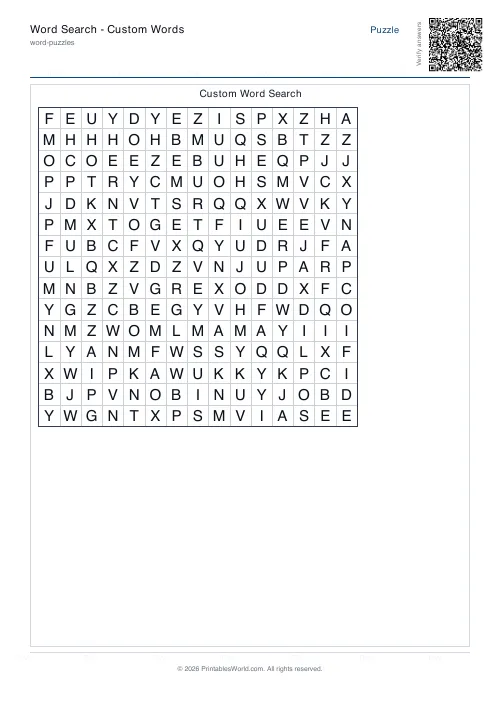
Word Search: Custom Words
Enter your own word list and generate a printable word search.
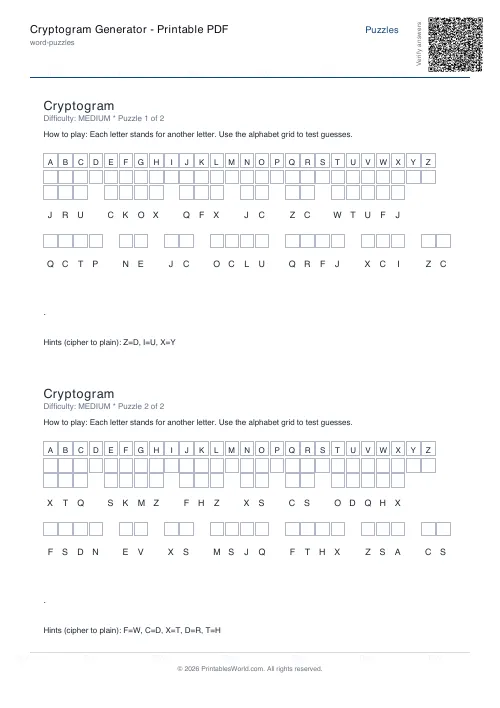
Cryptogram Generator: Printable PDF
Create printable cryptogram puzzles from famous quotes or your own text with customisable difficulty and hints.
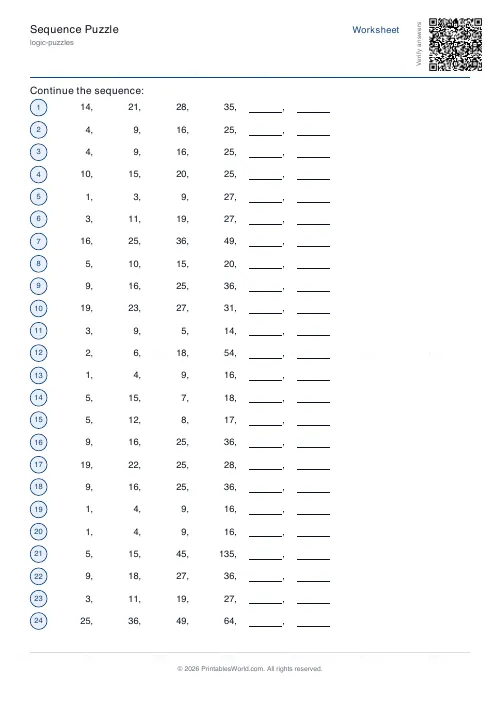
Sequence Puzzle
Continue number and shape sequences. Simple to algebraic nth-term level.
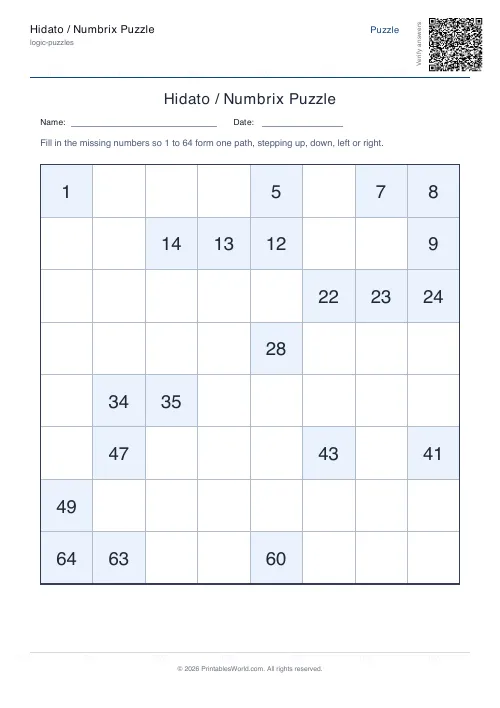
Hidato / Numbrix Puzzle
Join the numbers into one continuous path.
Further reading
Logic Puzzles
Kakuro, killer sudoku and other number puzzles explained
If sudoku has stopped being a challenge, these are the natural next steps. And unlike sudoku, most of them genuinely involve arithmetic.
5 min read
Logic Puzzles
The benefits of logic puzzles for developing brains
Logic puzzles teach deduction and persistence, which are worth having. The claim that they make children generally smarter is weaker than the marketing suggests.
5 min read
Puzzles & Brain Games
Printable brain games for seniors: a free puzzle pack
A free printable puzzle pack for older adults, with a sample seven-day plan, large-print and easier-difficulty tips, and how to use the Logic Puzzles collection.
7 min read