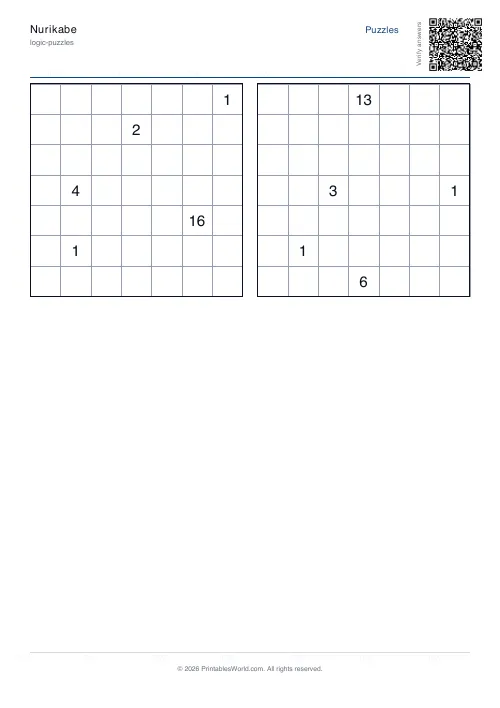
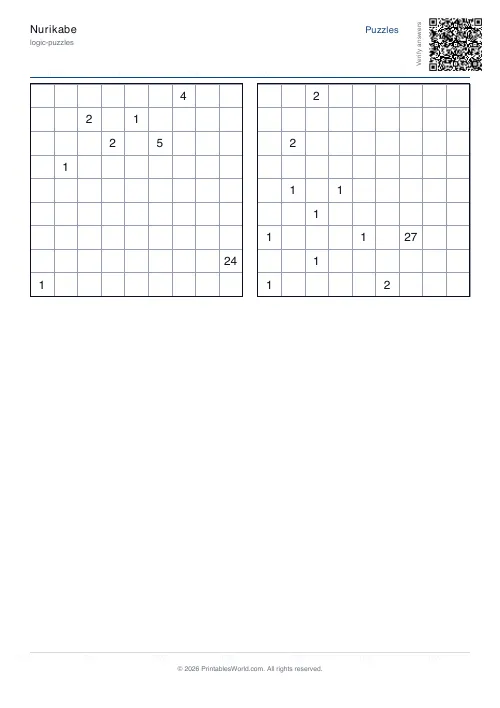
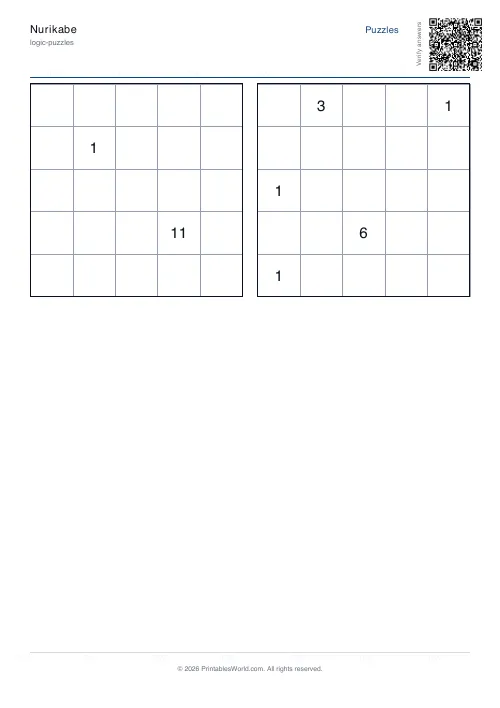
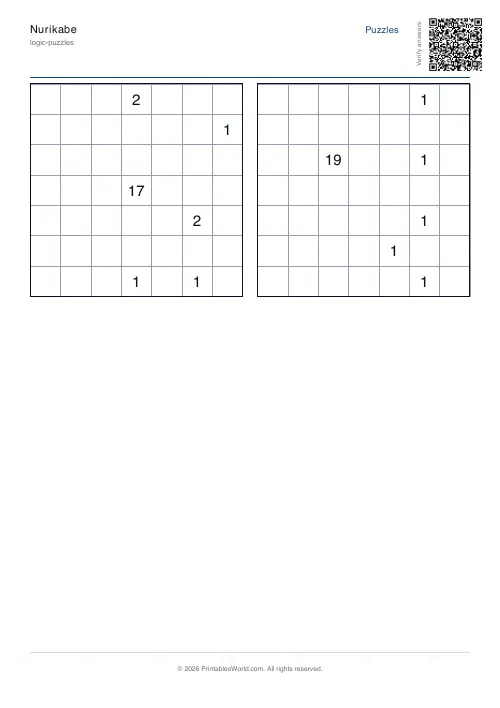
What this tool does
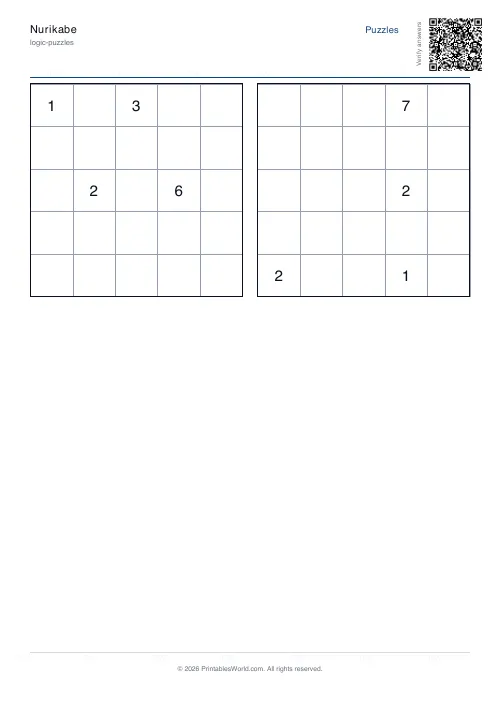
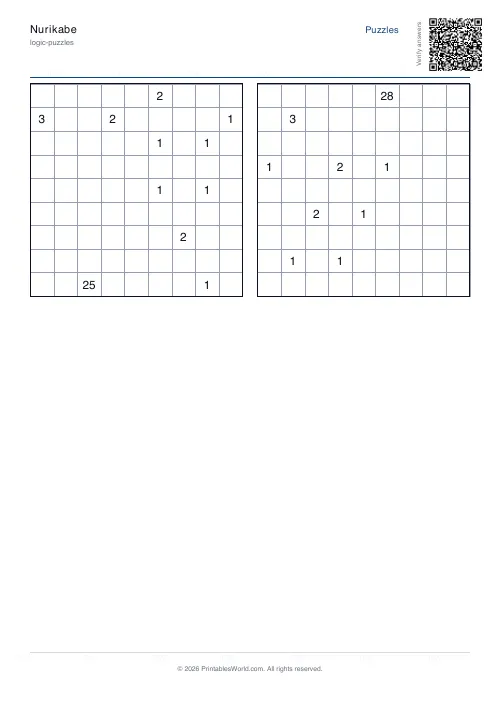
Nurikabe: each number is an island of that many white cells, and everything else becomes one connected sea with no 2×2 block of water anywhere. Grids from 5×5 to 10×10, up to four a page.
People also used
Feedback
Spotted something off with this tool?
Four rules, and the last one does the work
- Every numbered cell sits in a white island of exactly that many cells.
- Each island carries one number, so no white cell is left over.
- Islands never touch orthogonally. There is always sea between them.
- The sea forms a single connected region, and nowhere in it may four shaded cells meet in a 2×2 block.
The no-pools rule is the one that turns this from a filling exercise into a puzzle. It looks like a technicality and it is the source of most deductions on the board.
How a solve actually goes
Start with the 1s. An island of one cell is complete already, so every cell orthogonally adjacent to a 1 is sea. That is four free cells for no thought at all.
Then look between numbers. Any cell orthogonally adjacent to two different numbers must be sea, because a white cell there would join two islands.
Then work the pools. Whenever three cells of a 2×2 square are sea, the fourth must be white — and a white cell has to belong to some island, which usually tells you which one and forces a chain of further cells.
Finally, count. When an island has reached its number it is finished, and every cell around it is sea. Beginners forget to close islands off and end up with two candidates merging.
The sea has to stay joined up
The rule people apply last and should apply constantly.
A shaded cell that would cut the sea into two pieces cannot be shaded, and a white region that would wall off a pocket of sea cannot be white. On a 9×9 board this resolves as many cells as the counting does, and solvers who ignore it get a long way in and then discover the whole corner is wrong.
One valid answer, not necessarily the only one
Being straight about the limitation. The printed solution always satisfies every rule — the sea is built connected and pool-free by construction, and that was checked across eighty boards at every size — but these grids are not yet verified to have exactly one answer.
Mark against the rules rather than the answer sheet. A board where every island matches its number, no islands touch, and the sea is connected and pool-free is solved.
Size
Five to ten cells square, and up to four puzzles a page.
Five is a couple of minutes. Seven is the default. Ten is a long sitting, and the difficulty grows faster than the cell count does, because the connectivity and pool rules both reach further on a bigger board.
Notation
Shade the sea and dot the white cells. Marking only the sea leaves you unable to tell "known white" from "not looked at yet", which is exactly the distinction the counting rule depends on.
Pencil. Nurikabe punishes a wrong shading badly, because the error propagates through the connectivity rule and surfaces somewhere else entirely.
Print at 100% on A4 or US Letter.
FAQs
Quick answers
What are the rules of Nurikabe?
Each number marks a white island of that many cells, islands never touch orthogonally, all black cells form one connected sea, and the sea may never contain a 2x2 block.
Are the puzzles guaranteed to have a unique solution?
In v1 boards are generated greedily, so some may admit more than one valid shading. The printed solution is always one valid answer.
How many puzzles fit on a page?
Up to two grids per page so every clue stays large and readable.
What grid sizes are supported?
5x5, 7x7 and 9x9 cells per side.
Related tools
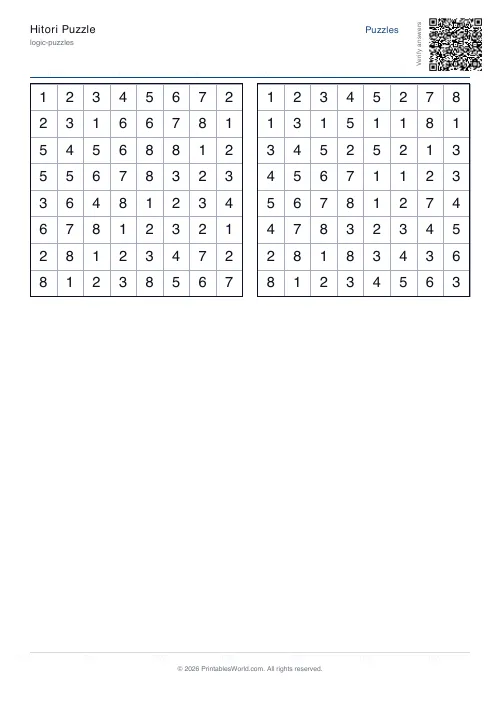
Hitori Puzzle
Shade cells so no number appears twice in any row or column.
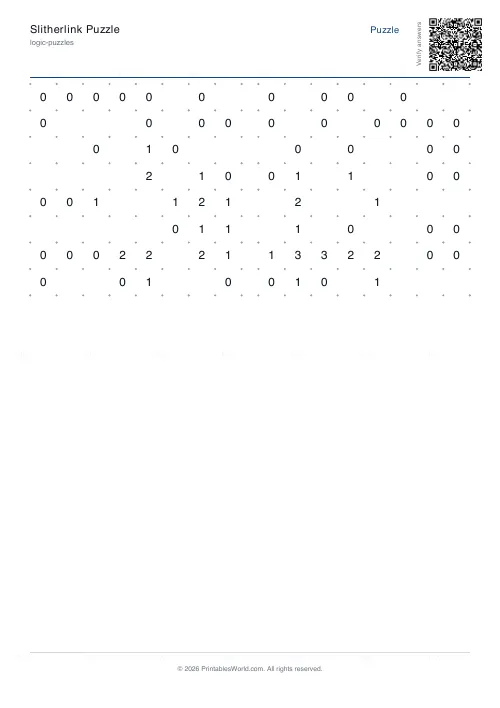
Slitherlink Puzzle
Draw a single closed loop along grid lines using number clues.
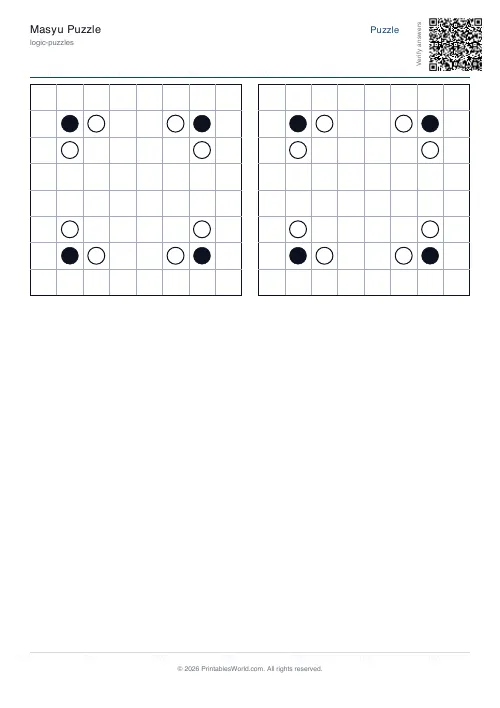
Masyu Puzzle
Draw a loop through black and white circles following specific rules.
Sudoku Generator
Generate printable Sudoku puzzles with six per page, multiple difficulty levels, and optional solutions.
Further reading