What this tool does
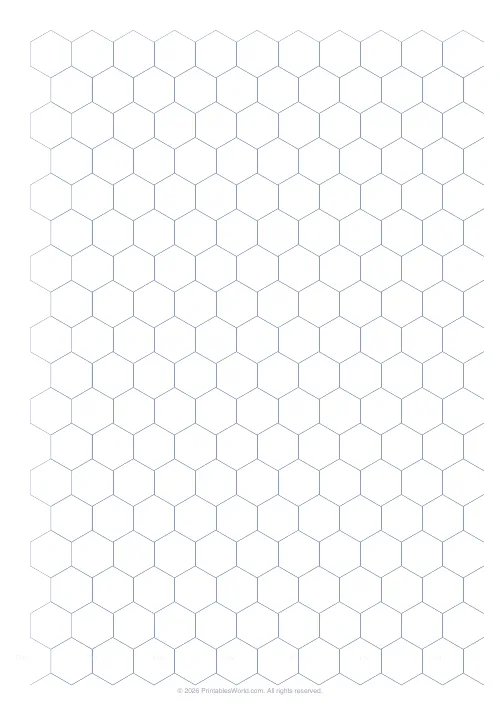
Flat-top hexagons at a 10 mm edge, for English paper piecing, quilt layout and hexie templates.
People also used
Feedback
Spotted something off with this tool?
Hexagons, flat side up
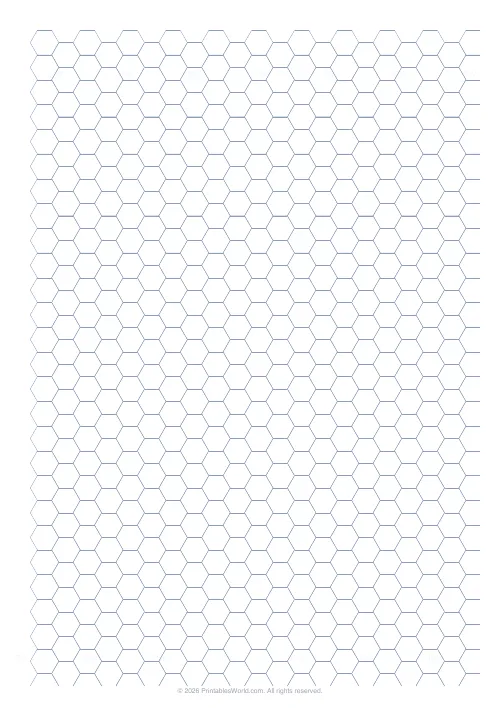
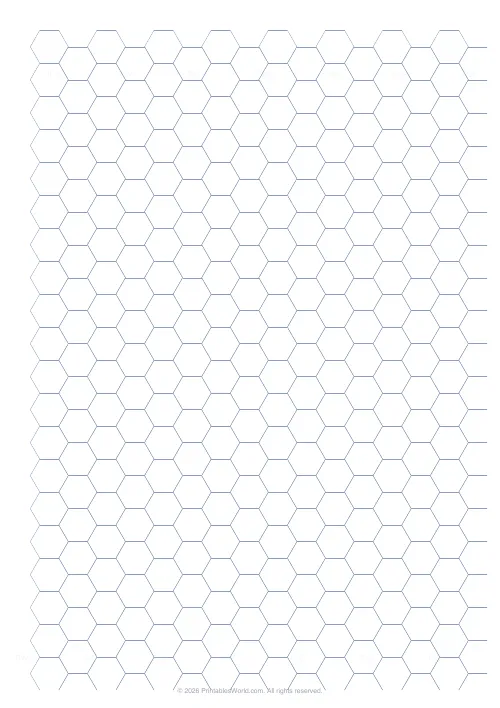
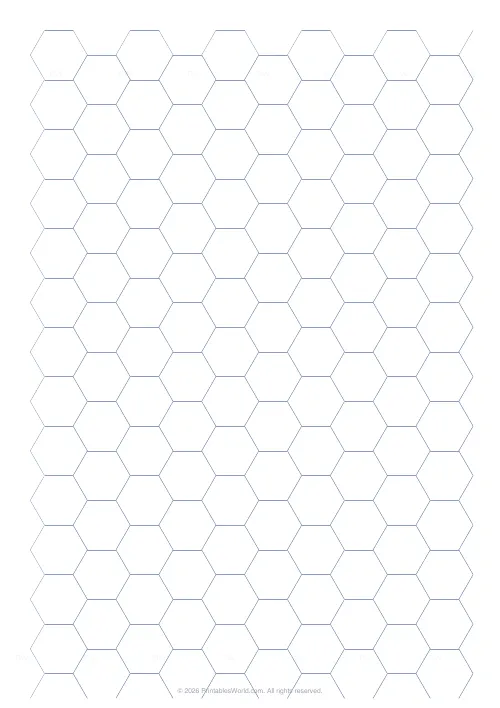
Regular hexagons at a 10 mm edge, printed flat-top. They sit on a flat side and the columns run straight down the page.
That orientation is the usual one for quilting, because the rows nest and a whole quilt top can then be planned column by column, from one edge across to the other, without ever having to hold the offset in your head.
English paper piecing
The oldest use, and still the commonest. Cut a hexagon from stiff paper, tack fabric round it, whip-stitch the tacked hexies together edge to edge, and pull the papers out at the end.
This sheet does two jobs. On ordinary paper it is a layout, somewhere to plan a colour arrangement before you cut a single piece of fabric. On card it is the templates themselves — cut along the lines and you have a stack of identical papers, and that stack has to be accurate or nothing lies flat.
Edge length is not width
Quilters usually size a hexagon by its edge, and 10 mm here means the edge, not the distance across.
A hexagon with a 10 mm edge measures 20 mm point to point and about 17.3 mm across the flats. Worth knowing before you order fabric. Ordering to the wrong measurement is the kind of mistake that only shows itself once everything has been cut.
Classic hexie sizes in the English tradition come in inches — half, three-quarter, one — and every one of those is an edge measurement too. A 12 mm edge is close to the half inch.
Grandmother's Flower Garden
Seven hexagons: one centre, six around it. That rosette is the pattern that carried hexagon quilting through the 1930s, and it is still the best first project anyone can pick, because it teaches you the join without committing you to a bedspread.
Plan the rosettes here first. Colour the centres one way and the petals another, and the arrangement solves itself long before any tacking starts.
Other things it suits
Hex maps for tabletop games. Chemistry students drawing benzene rings and carbon chains. Beadwork on a hexagonal grid, and tiling and tessellation work in maths lessons, where the hexagon is one of only three regular shapes that tile the plane on their own.
For pointy-top hexagons, or a different edge length, use the hex grid paper generator, which exposes both.
Print at 100% on A4, US Letter or US Legal — a template printed at 96% is a template that will not match your neighbour's.
FAQs
Quick answers
How is this different from regular hex grid paper?
It uses flat-top, equal hexagons sized for quilt layout planning rather than the pointy-top game grid, so one grid hexagon maps to one fabric hexie.
Does one paper hexagon equal my fabric hexie size?
Use it by count, not cutting size: one hexagon on the sheet represents one hexie in your quilt. Cut fabric at your chosen finished side length (often 1/2", 3/4", or 1").
Can I plan a Grandmother's Flower Garden quilt on it?
Yes. Build rosettes outward in rings of 6, 12, and 18 hexagons around each centre, and colour the grid to preview the layout.
Will it print on US Letter?
Yes. A4, US Letter, and US Legal are all supported. Print at 100% scale for accurate sizing.
Related tools
Further reading
Printable Paper
Graph paper sizes: which grid for which task
What graph paper sizes and grid spacings mean, how to match a grid to maths, art or design, and how to set it all in the free graph paper generator.
7 min read
Printable Paper
Bullet journalling with dot grid paper: a starter guide
The bullet journal was designed to be fast, not beautiful. Here is the original system, why dot grid suits it better than lines or blank, and the four pages you actually need.
5 min read
Printable Paper
The best note-taking paper for students (Cornell, grid, lined)
The paper you take notes on quietly decides how you review them. Here is what each format is actually for, and which subjects each suits.
4 min read