What this tool does
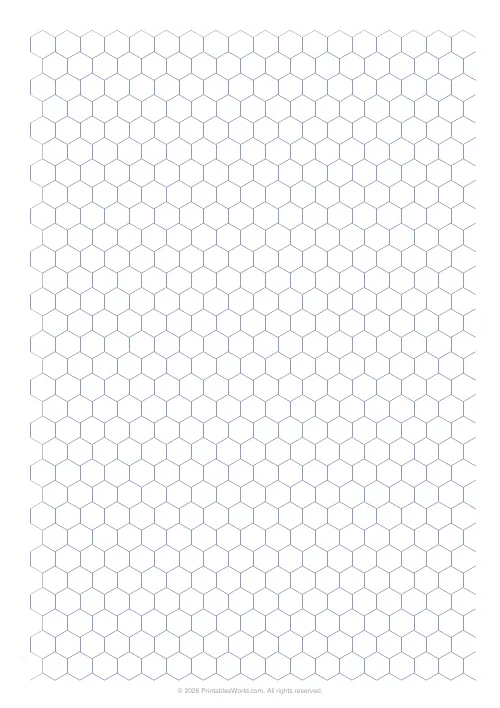
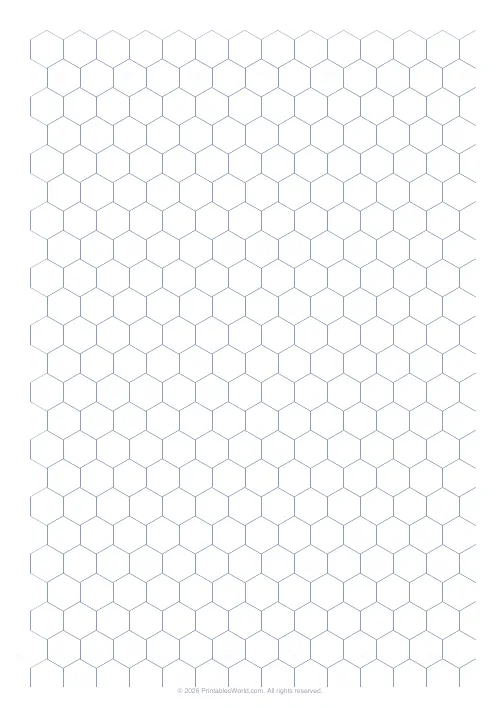
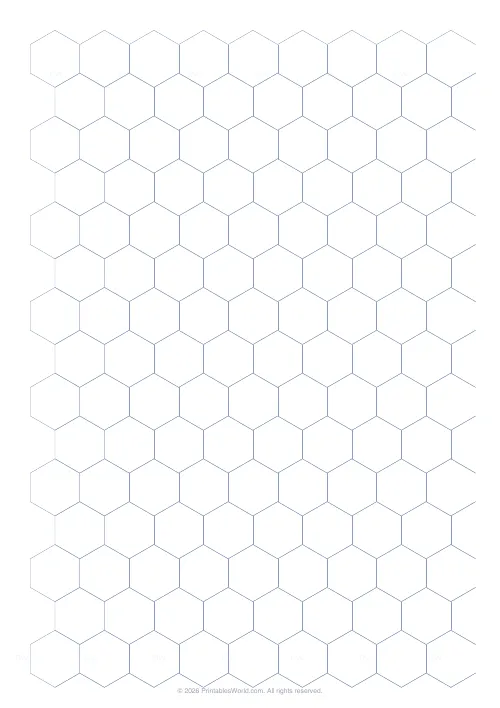
A pointy-top hexagonal grid, at 6, 8 or 10 mm edges, for board game design, hex-and-counter wargames and role-playing maps.
People also used
Feedback
Spotted something off with this tool?
Hexagons, point upward
A tessellating hex grid with the edge length set at 6, 8 or 10 millimetres. Pointy-top by default; a flat-top orientation is available.
Why games use hexagons and not squares
Because of what a diagonal costs.
On a square grid every cell has eight neighbours, and four of them are diagonal. A diagonal step covers about 1.41 times the distance of an orthogonal one, so either movement is unfair or the rules have to fudge it — which is why so many square-grid games count a diagonal as one and a half, or alternate one and two.
A hex has six neighbours and every one of them is the same distance away. No diagonals, no fudge, and movement over open ground behaves the same in every direction. That is the whole reason hex-and-counter wargames adopted it in the 1960s and never went back.
Pointy-top or flat-top
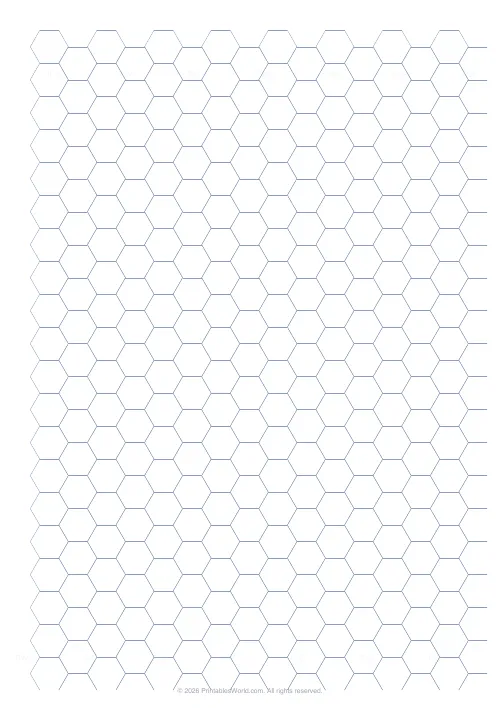
Pointy-top hexes form clean vertical columns and ragged rows. Flat-top does the reverse.
The choice matters for how you number the map and for which direction reads as "straight ahead". Most hex wargames and most RPG maps use pointy-top, which is why it is the default here. Flat-top suits a layout where horizontal rows need to line up, and it is what the quilting version of this sheet uses.
Numbering a map
Do it before you draw anything. Retrofitting coordinates onto a finished map is miserable.
The convention in hex wargames is a four-digit reference: column then row, so 0714 is column 7, row 14. Number the columns along the top and the rows down one side, and every hex on the sheet has an address you can write in a rulebook.
Scale is a decision, not a default
Write down what one hex represents before the first pencil mark. Ten metres, a hundred, a mile, a day's march.
It determines everything else — movement rates, ranges, how much terrain fits — and a map drawn without deciding tends to end up with a scale that contradicts itself between one corner and the other.
Beyond games
Hexagons tessellate perfectly, which is why they turn up in honeycomb, basalt columns and floor tiles. The grid works for tiling patterns, mosaic design, hexagonal beadwork and any maths lesson on tessellation.
Print at 100% on A4, US Letter or US Legal. Scaling changes the edge length, and on a map where a hex is a unit of distance that is not a cosmetic problem.
FAQs
Quick answers
What is "hex edge"?
The length of one straight side of the hexagon. The flat-to-flat width is √3 × edge.
Are hexes flat-top or pointy-top?
Pointy-top. The classic orientation for hex board games and tactical maps.
Why hex paper?
Hexes give six neighbours per cell at equal distances, which is ideal for movement and area effects in games.
Will it print on US Letter?
Yes. A4, US Letter, and US Legal are all supported.
Related tools
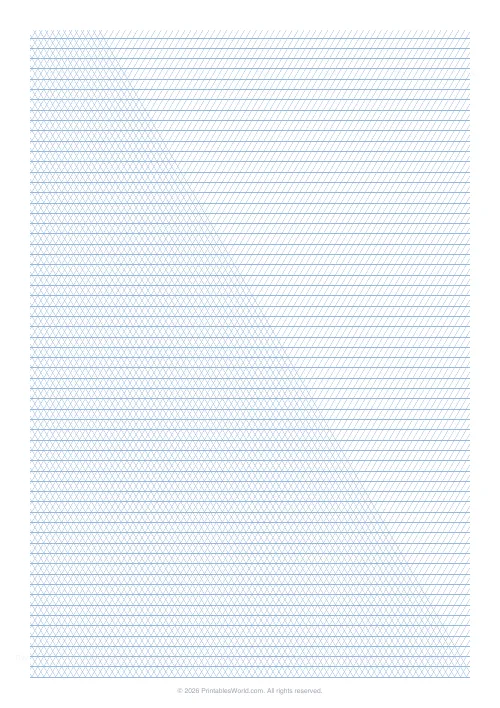
Isometric Grid Paper
Triangular line grid at 30°/60° for isometric drawing.
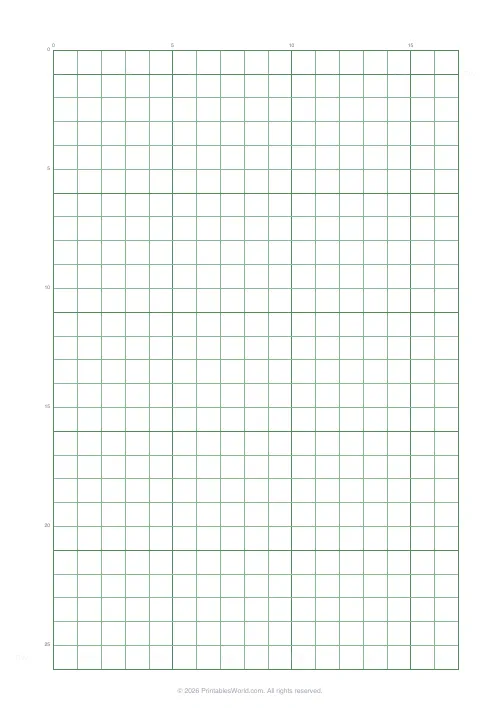
Map Grid Paper
Numbered grid paper for hand-drawn maps and orienteering.
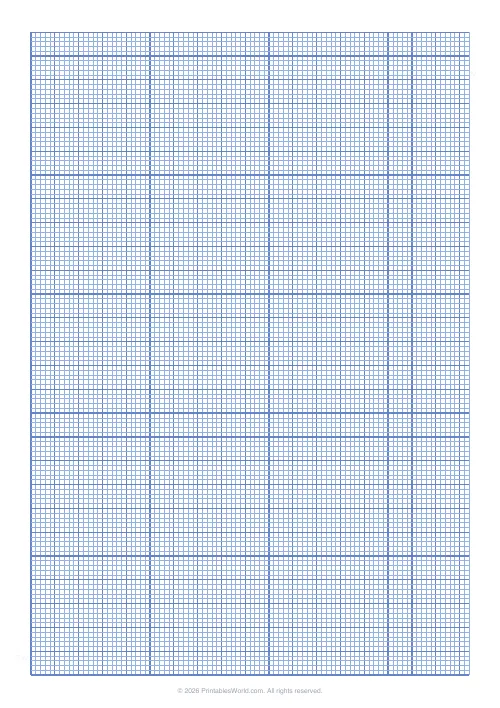
Graph Paper Generator
Create custom graph paper PDFs with square or rectangular grids, dot styles, and axis numbering.
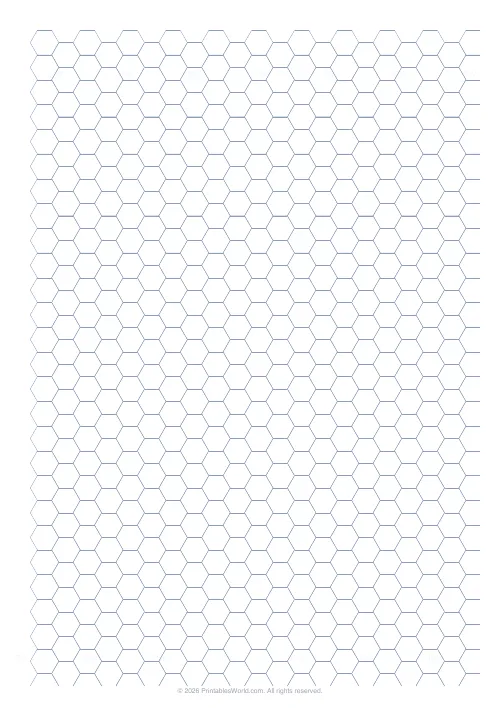
Hexagonal Quilting Graph Paper
Repeating hexagon grid for quilt design, English paper piecing, and patchwork planning.
Further reading
Printable Paper
Graph paper sizes: which grid for which task
What graph paper sizes and grid spacings mean, how to match a grid to maths, art or design, and how to set it all in the free graph paper generator.
7 min read
Printable Paper
Bullet journalling with dot grid paper: a starter guide
The bullet journal was designed to be fast, not beautiful. Here is the original system, why dot grid suits it better than lines or blank, and the four pages you actually need.
5 min read
Printable Paper
The best note-taking paper for students (Cornell, grid, lined)
The paper you take notes on quietly decides how you review them. Here is what each format is actually for, and which subjects each suits.
4 min read