What this tool does
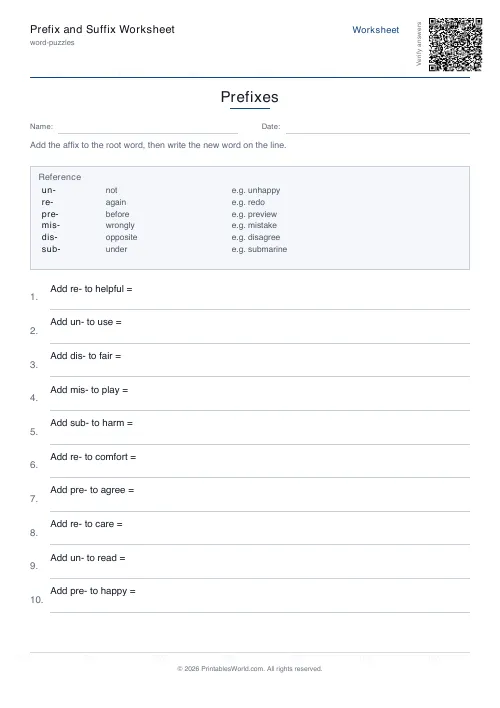
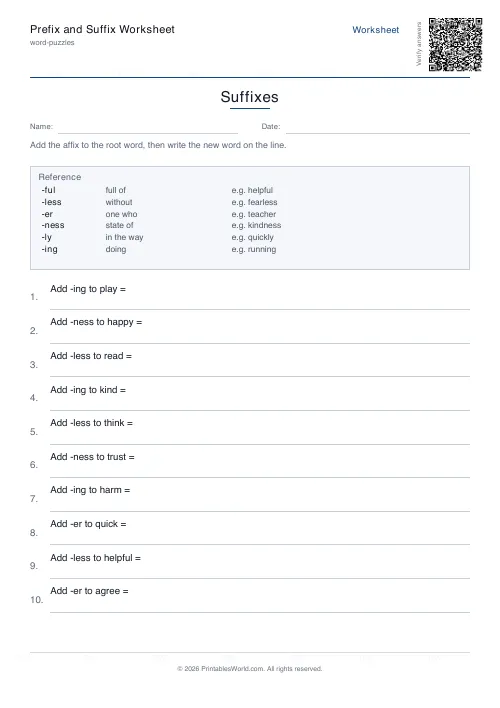
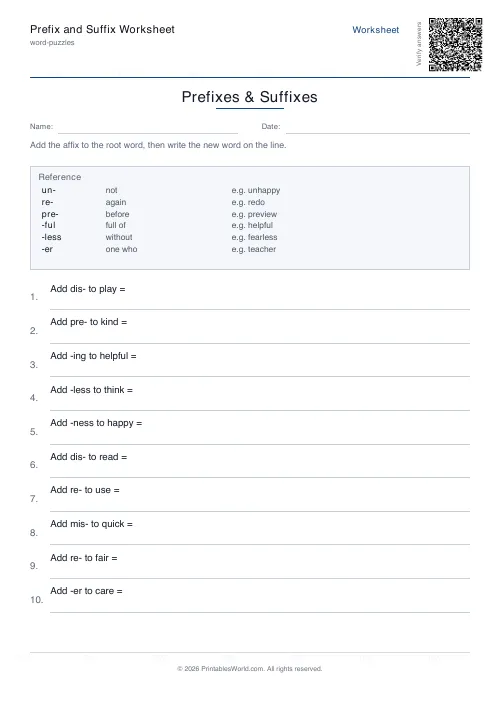
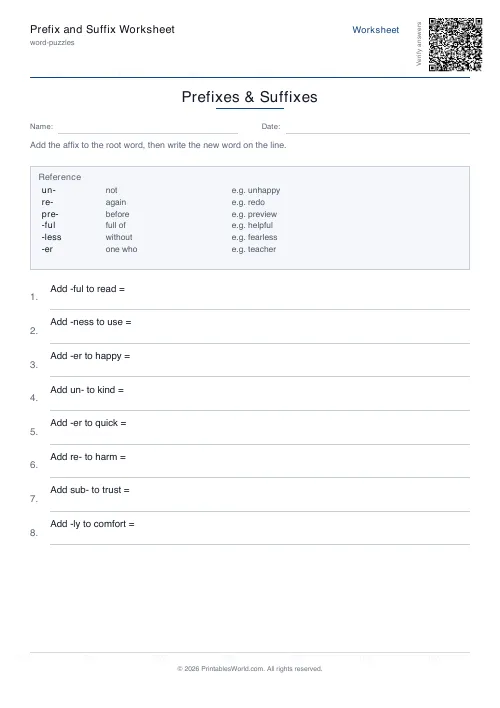
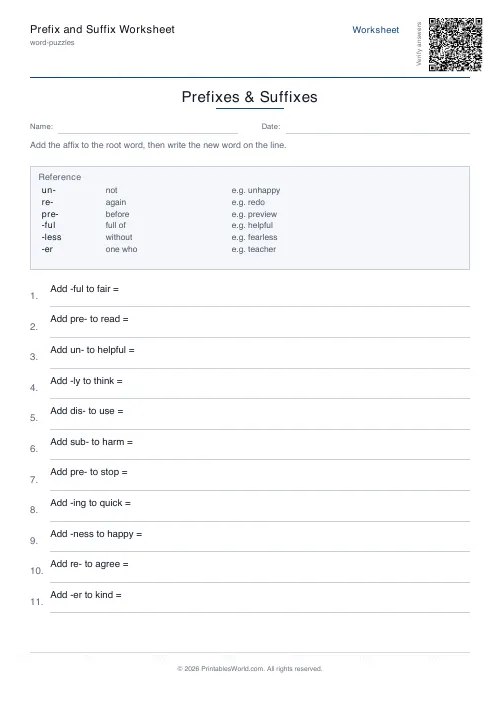
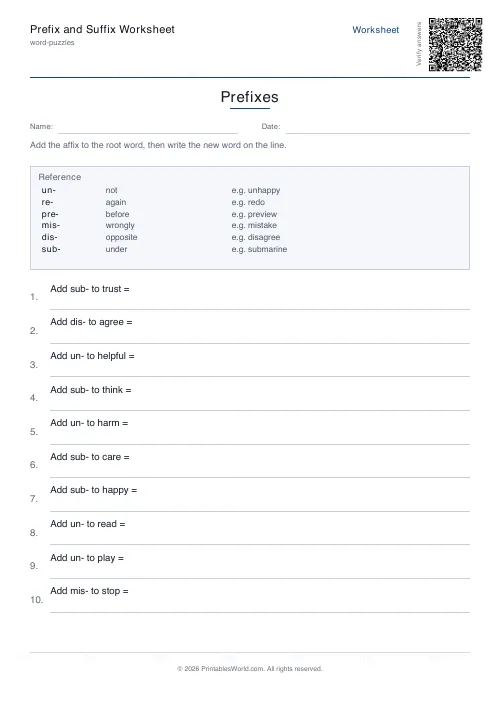
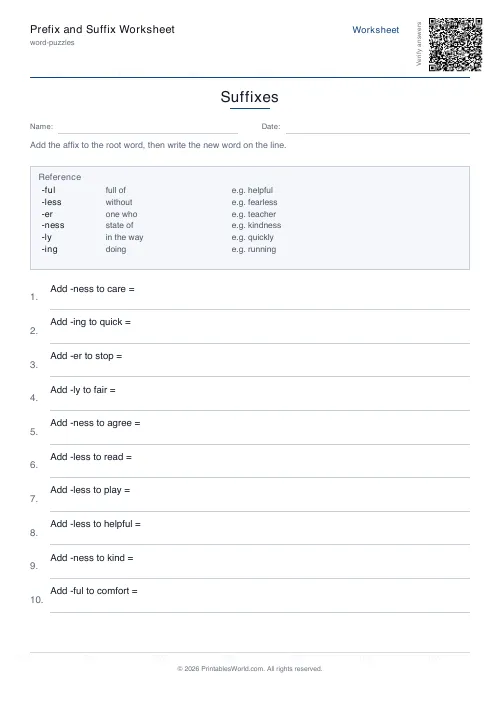
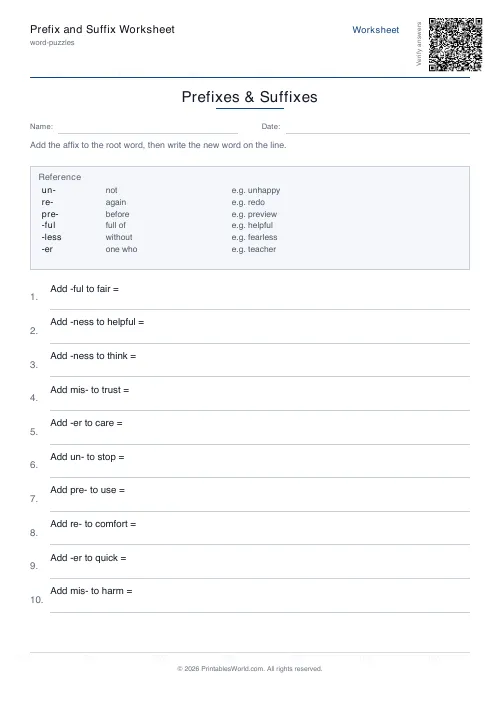
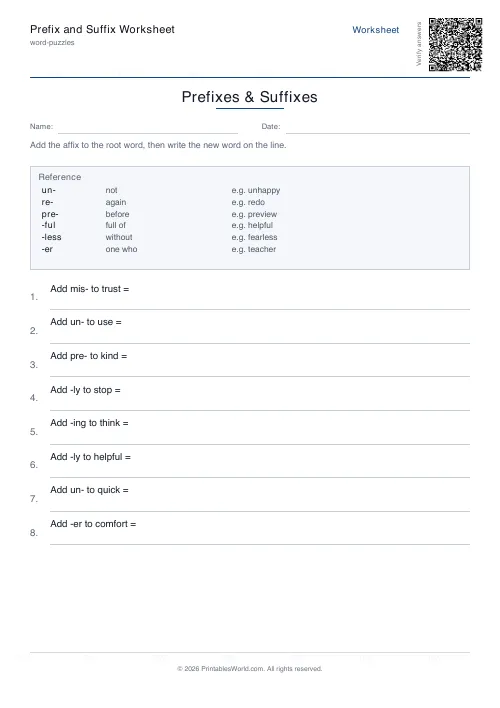
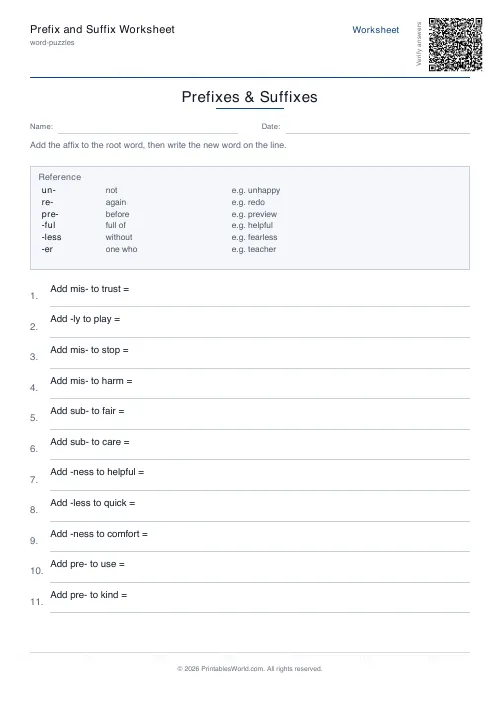
Build-the-word practice with six prefixes and six suffixes. A reference table of affixes and their meanings prints at the top, then 6 to 14 problems ask for the combined word. Prefix only, suffix only, or both. Answer key optional.
People also used
Feedback
Spotted something off with this tool?
Prefix and suffix worksheets that only ask for real words
The sheet opens with a small reference table — the affix, what it means, and an example — and then asks the child to build words: Add un- to kind = ___.
Six prefixes (un-, re-, pre-, mis-, dis-, sub-) and six suffixes (-ful, -less, -er, -ness, -ly, -ing), all common enough that a Key Stage 2 pupil will meet them in ordinary reading rather than only on a worksheet.
Every combination on the sheet is a real word
This sounds like it should go without saying. It does not: a generator that picks a root and an affix independently will cheerfully print "stopful", "playness" and "subhappy", and that is worse than useless on a sheet whose entire purpose is teaching which affixes attach to which words.
So the problems here come from a fixed list of genuine combinations rather than from a random pairing. Every answer is a word.
They are also all straight joins: kind + ness gives kindness, help + ful gives helpful, and nothing on the sheet needs a spelling rule the reference table does not explain. That deliberately keeps happy → happiness and run → running off the page. Those changes are worth teaching, and they are a separate lesson from what an affix means — putting them on the same sheet means a pupil who understands the meaning perfectly still gets the answer marked wrong.
Modes
Prefix only asks what happens at the front of a word. This is the easier half, because a prefix changes meaning and leaves the word class alone: unkind is still an adjective.
Suffix only is the more interesting half. A suffix usually changes what kind of word it is — teach is a verb, teacher is a person; kind is an adjective, kindness is a thing — and noticing that shift is the beginning of grammar as a subject.
Both mixes them, which suits revision more than first teaching.
What the form offers
Six to fourteen problems a sheet. A title, optional Name and Date fields, and an optional answer key on its own page. Paper size A4 or US Letter.
Each root appears at most once per sheet, so a page of fourteen problems is fourteen different words.
Why morphology is worth the lesson time
Because it multiplies vocabulary rather than adding to it. A child who knows care and knows what -ful and -less do has four words, not one, and the fourth arrives free.
It is also the most reliable route into a word nobody has taught them. Meeting "unhelpful" in a book, a pupil who can see un- + help + -ful does not need to be told what it means, and that habit compounds across every subject where the vocabulary gets technical.
Extending the sheet
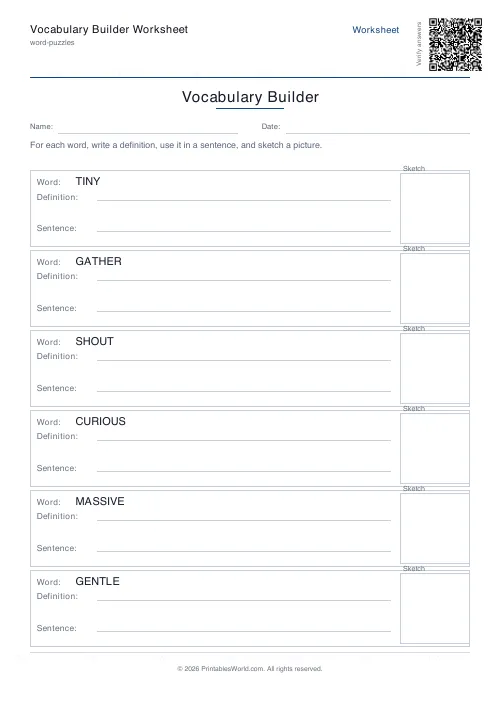
After the blanks are filled, the useful next question is verbal: use each new word in a sentence, out loud. It catches the pupil who has assembled "misplace" correctly without any idea what it means, which the worksheet alone cannot detect.
Print at 100% on A4 or US Letter.
FAQs
Quick answers
What is a prefix? What is a suffix?
A prefix attaches to the start of a word (un + happy = unhappy). A suffix attaches to the end (help + ful = helpful). Both change the word's meaning.
Which affixes does the worksheet cover?
A small starter set: un-, re-, pre-, mis-, dis-, sub- and -ful, -less, -er, -ness, -ly, -ing.
Can I switch modes?
Yes. Choose prefix only, suffix only, or both for a mixed sheet.
Are answers included?
Yes. Toggle the answer-key option for a second page that lists each completed word.
Related tools
Further reading
Word Puzzles
Prefixes and suffixes: a simple teaching guide
Learning that "un-" means not unlocks hundreds of words at once. Here are the affixes worth teaching first and the three spelling rules that cause most errors.
5 min read
Word Puzzles
Sight words: the complete teaching guide
Sight words are usually taught as words to memorise. Most of them are partly decodable, and treating them that way works better. Here is how, and how many to teach at once.
6 min read
Word Puzzles
Fun ways to build vocabulary in kids
Children learn most words by meeting them repeatedly in context, not by memorising lists. Here is what that means practically, and where word lists still earn their place.
5 min read
More like this
 Crossword Generator: Printable PDF
 Word Scramble Generator: Printable
 Cryptogram Generator: Printable PDF
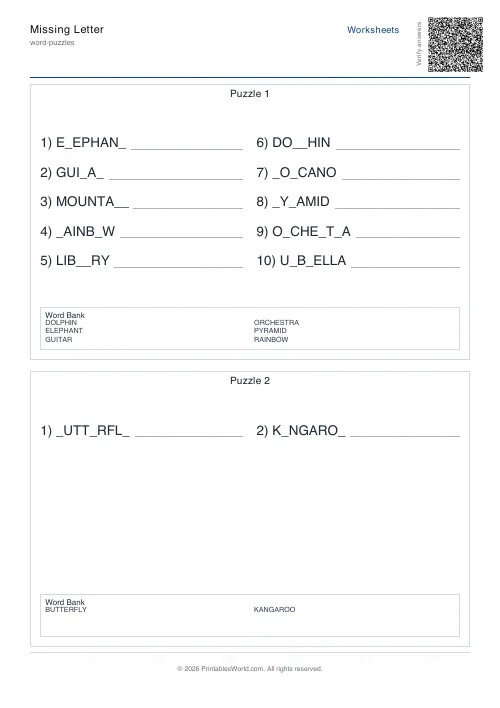 Missing Letter Generator
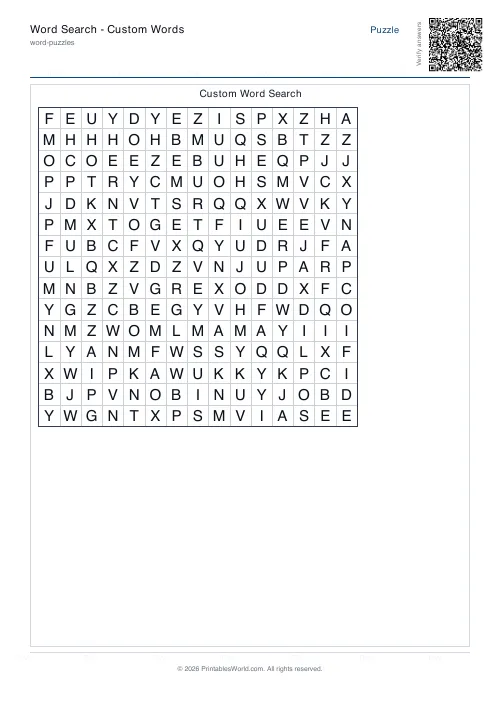 Word Search: Custom Words
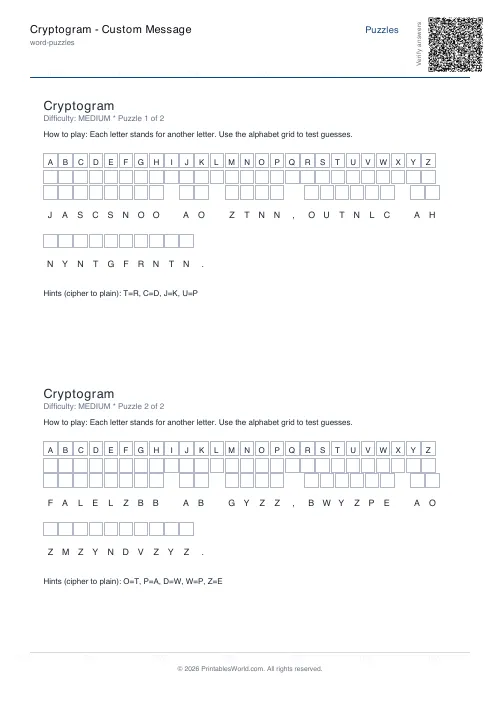 Cryptogram: Custom Message
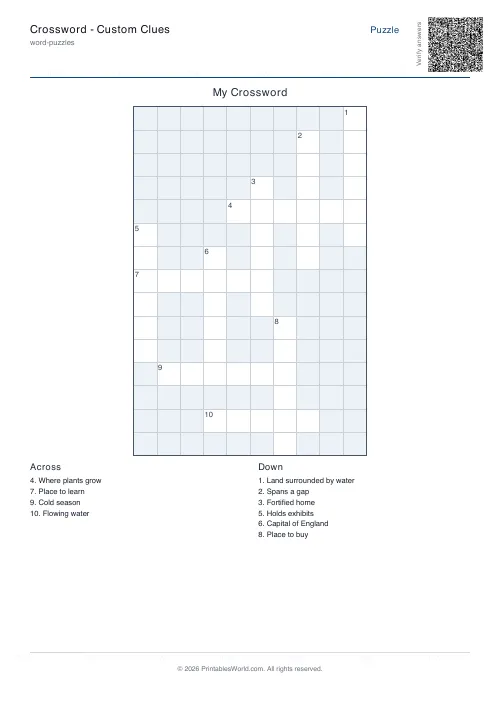 Crossword: Custom Clues
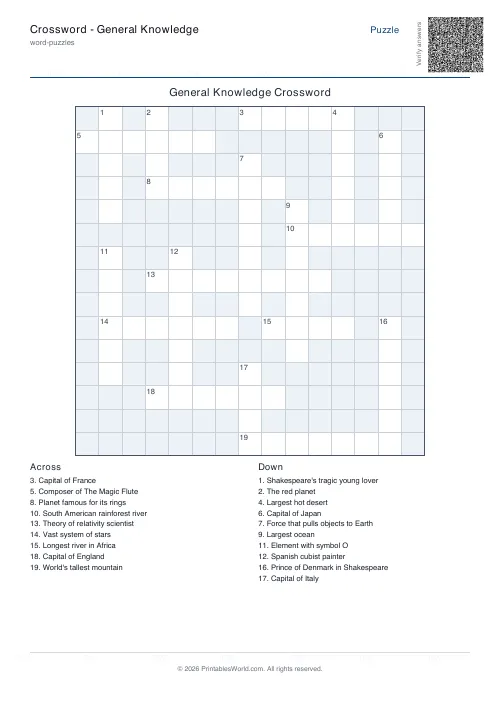 Crossword: General Knowledge
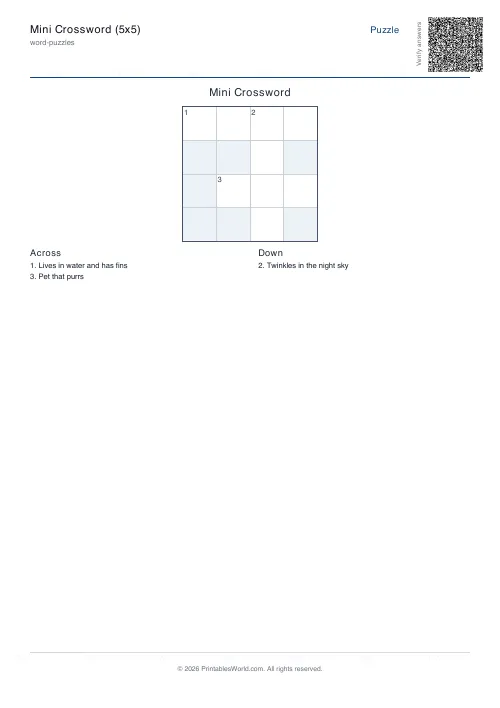 Mini Crossword
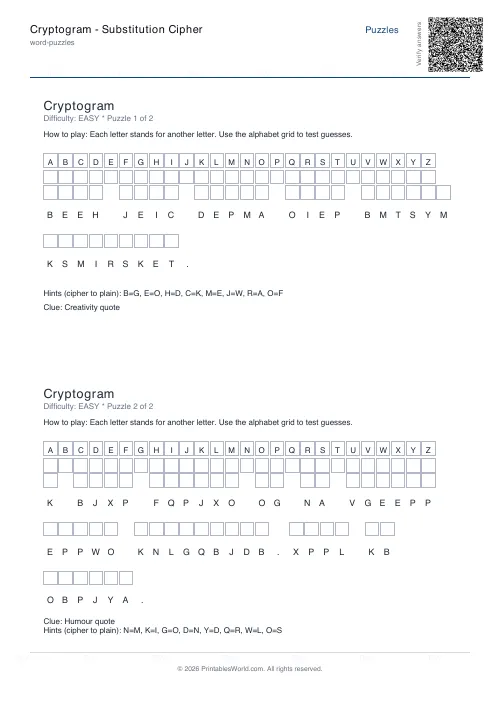 Cryptogram: Substitution Cipher
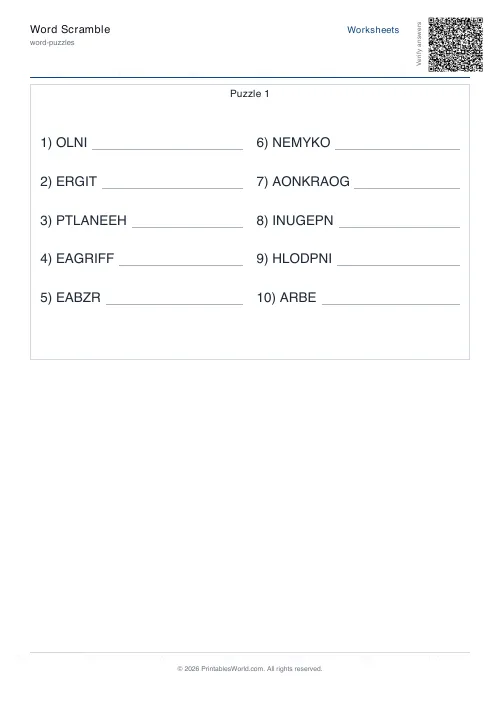 Word Scramble Generator
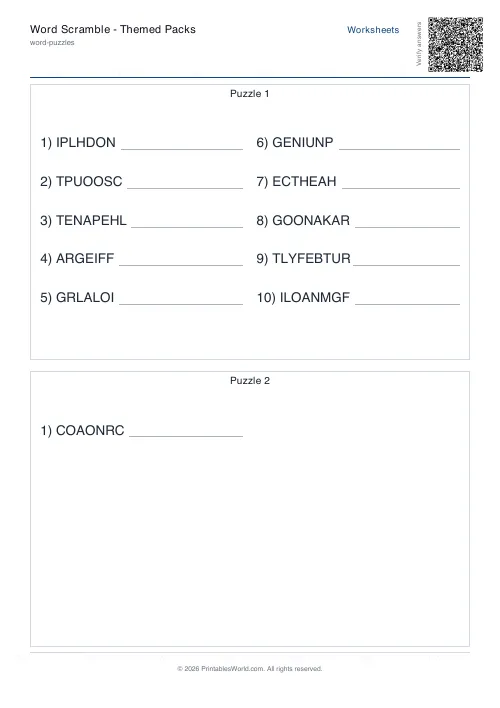 Word Scramble: Themed Packs
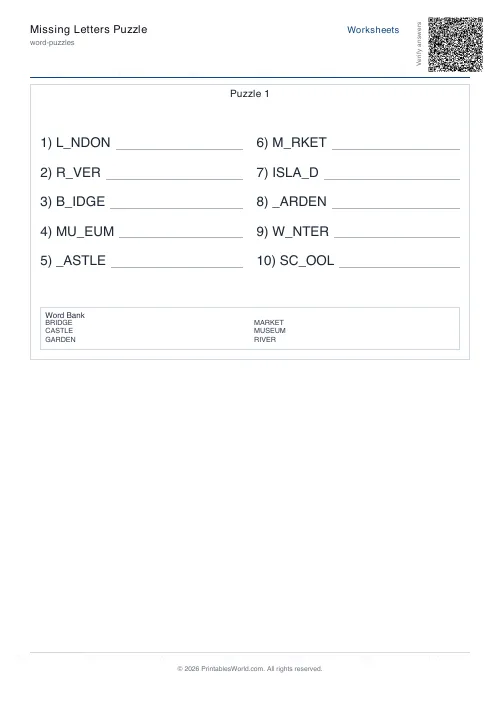 Missing Letters Puzzle
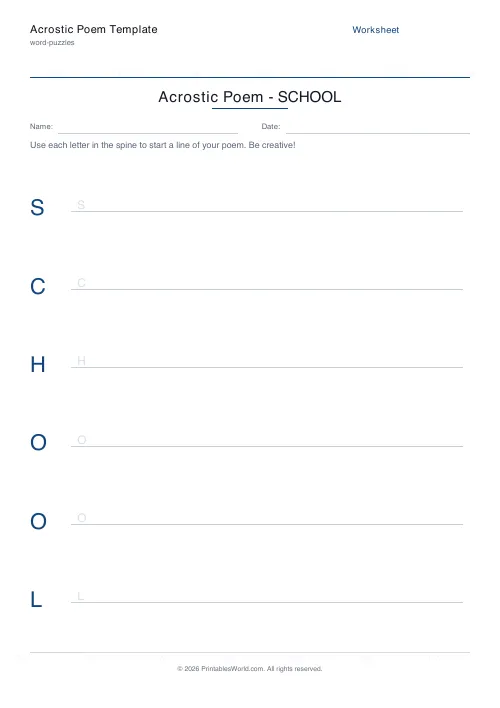 Acrostic Poem Template