What this tool does
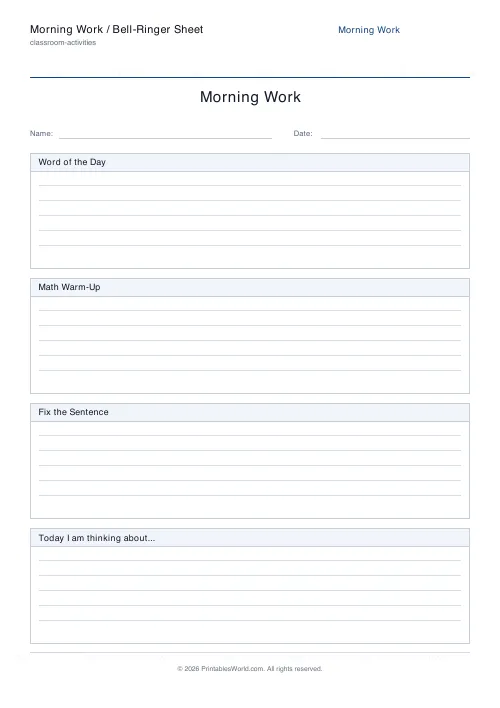
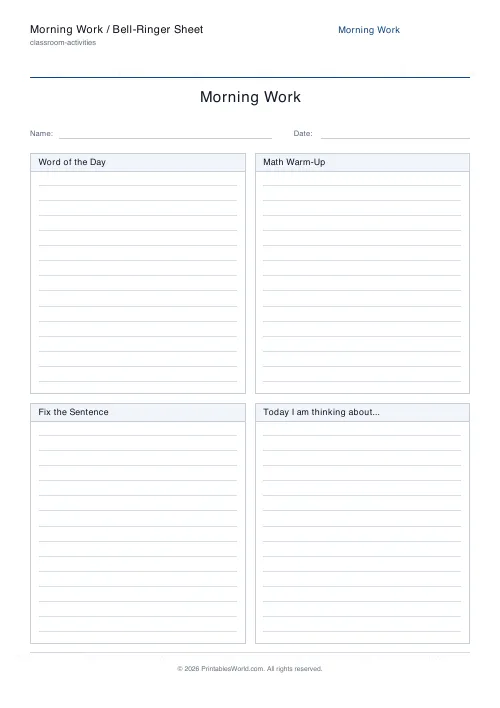
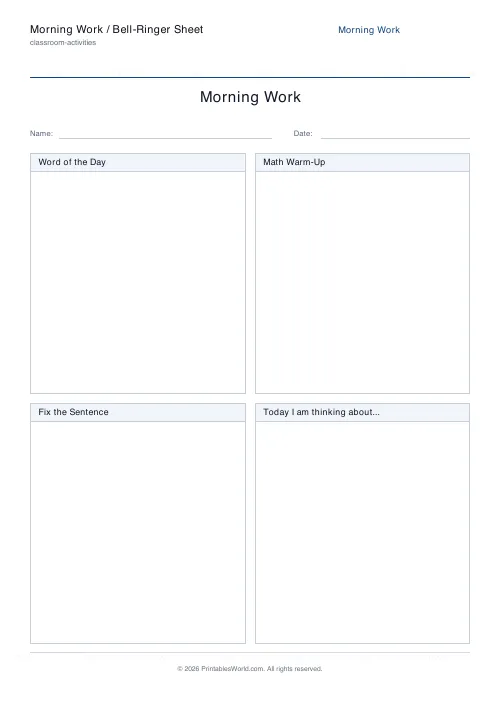
A bell-ringer sheet: name and date at the top, then two to eight titled prompt boxes with ruled writing lines. You supply the box headings.
People also used
Feedback
Spotted something off with this tool?
Boxes with your headings in them
Name and date across the top, then a grid of prompt boxes in one or two columns. Each box carries its heading and faint ruled lines underneath, and you can turn the lines off for anything that wants free space.
Two to eight boxes. The defaults — Word of the Day, Math Warm-Up, Fix the Sentence, and a thinking prompt — are a starting point rather than a fixed set.
What a bell-ringer is for
The first five minutes of a lesson are lost minutes. Coats, bags, latecomers, the register, somebody's lost pencil case.
A sheet already on the desk turns that gap into work. Children who arrive know what to do without being told; children who arrive late slot in without the whole class stopping; and the teacher gets five minutes of hands free for everything that has to be dealt with before teaching can start. It is one of the very few classroom-management tricks that costs nothing and works on the first morning.
Keep the tasks small
Every box should be finishable in about two minutes without any teaching.
That constraint is what makes it work independently. New material needs explaining, which defeats the point; consolidation does not. So: a spelling to correct, four calculations of a type they already know, a definition, a sentence to punctuate, one question with no right answer. Anything a child can begin without putting a hand up.
Some headings that work
Word of the day, with a space to use it in a sentence. Fix the sentence, with capitals and punctuation missing. Four quick calculations. What is the pattern. Odd one out. A journal prompt. Yesterday's lesson in one sentence, which doubles as a retrieval exercise and tells you more about what landed than a test would.
Rotate a small set week by week. The routine is doing the work here, not the novelty, and a class that has to read new instructions every morning has lost the advantage the sheet was for.
Marking
Do not mark them.
Go through the answers aloud in ninety seconds, let the children mark their own, and move on. Collecting thirty of these a day is unsustainable by half-term, and the moment it becomes unsustainable it stops happening — which is a far worse outcome than the imperfect self-marking.
Beyond school
Homeschooling families use the same sheet to start the day at the table. It also works as a holiday-morning warm-up, where fifteen minutes of something structured makes the rest of the day noticeably easier.
FAQs
Quick answers
How many prompt boxes can I add?
Up to eight. Enter one heading per line in the settings panel; the grid resizes the boxes automatically to fill the page.
Does the sheet include Name and Date fields?
Yes. Every page has labelled Name and Date lines at the top so pupils can identify their work.
Can I turn off the writing lines?
Yes. Use the writing-lines toggle to print blank boxes instead of faintly ruled ones.
Is there an answer key?
No. Morning work is a blank template that pupils complete themselves, so only the student version is printed.
Related tools
Exit Ticket Generator
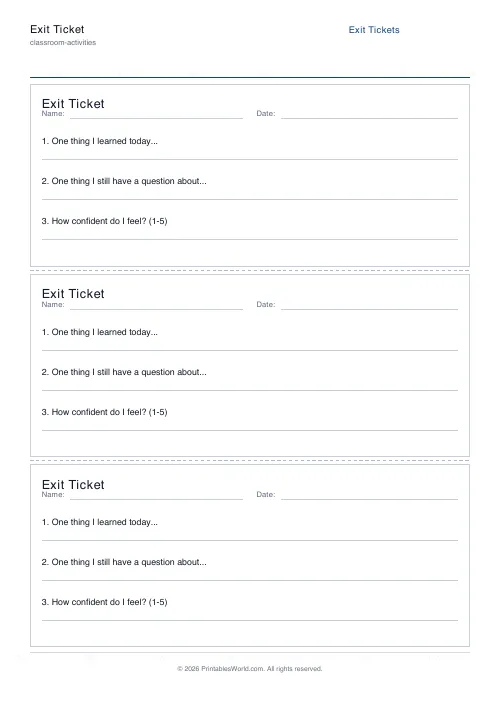
Three exit tickets per A4 page for quick end-of-lesson reflection.
Observation Sheet
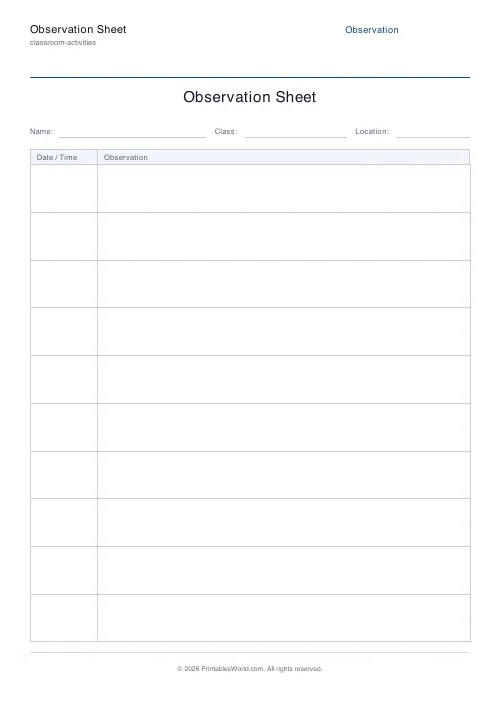
Generic ruled observation template. Date and observation rows for any subject.
Data Collection Table
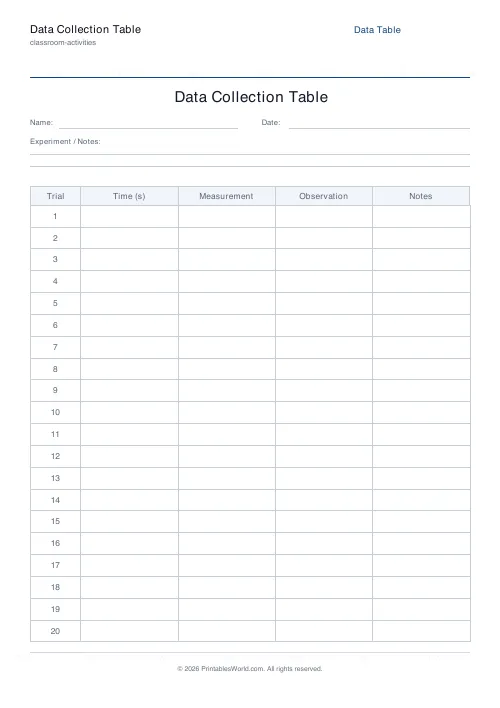
Blank data table with configurable rows, columns and header labels.
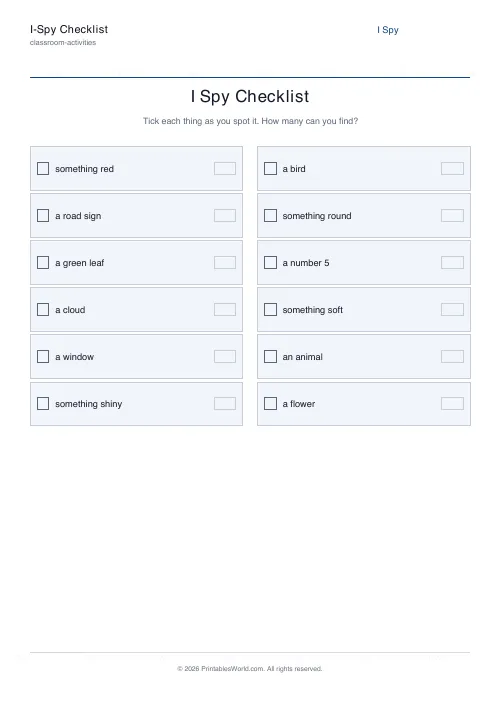
I-Spy Checklist Generator
Build a printable I-spy checklist. Your own list of things to find, with tick boxes and a count box.
Further reading
Classroom Activities
Positive reinforcement in the classroom: charts that work
Reward charts work when they name a specific behaviour and fade over time. They backfire when they rank children publicly. Here is the difference in practice.
5 min read
Classroom Activities
How to make learning stations work in any classroom
Stations fail for two predictable reasons: the independent tasks are not truly independent, and the timing is wrong. Both are fixable before the lesson starts.
5 min read
Classroom Activities
How to run a classroom economy (free printables)
A classroom economy teaches money, work and choice at once. But it collapses if the maths is wrong. Here is how to set the numbers, and the four pitfalls to avoid.
5 min read