What this tool does
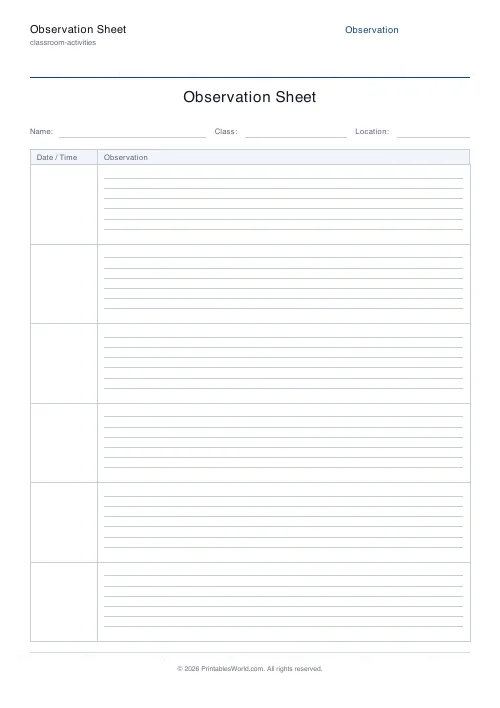
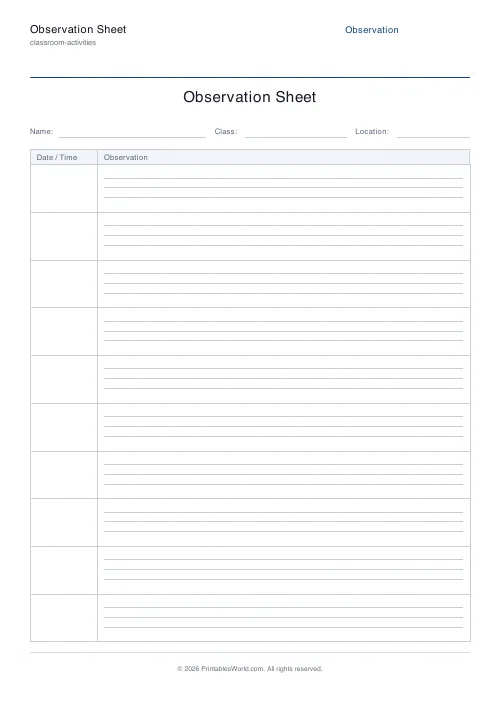
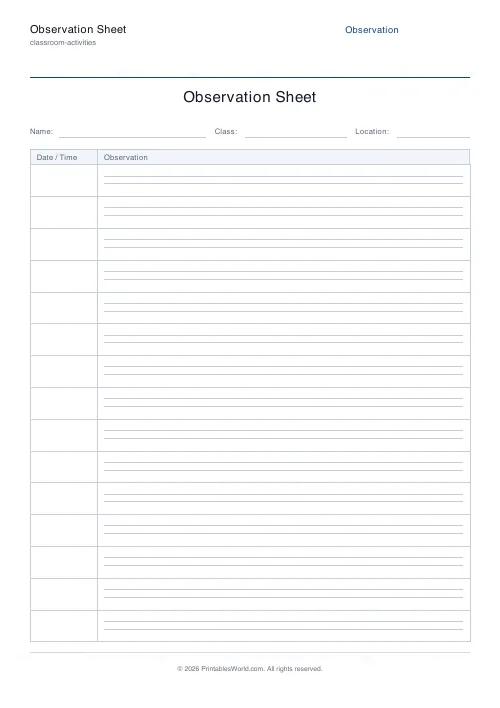
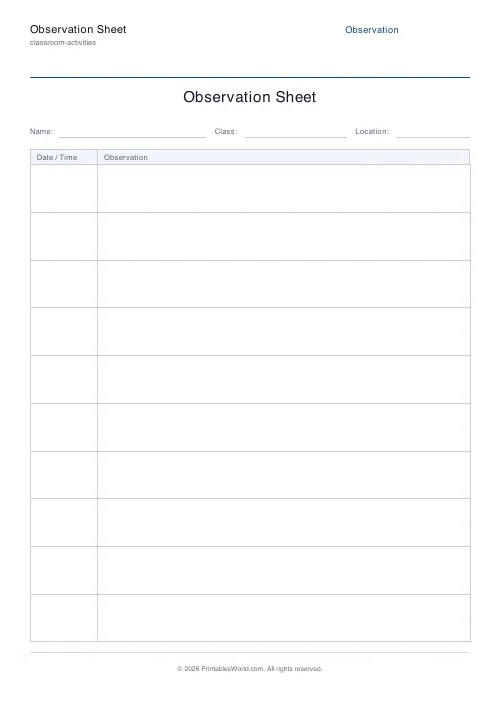
A two-column recording sheet: Date and Time on the left, Observation on the right. Eight to sixteen rows, with faint ruled lines inside each row that can be switched off.
People also used
Feedback
Spotted something off with this tool?
A recording sheet with the time column already there
Two columns. Date and time on the left, the observation on the right, repeated down the page for as many rows as you ask for. Faint ruled lines inside each row keep handwriting straight. Switch them off if the row is going to hold a sketch.
Eight to sixteen rows. The title is yours to set.
The time column is doing real work
It is the part people leave off a hand-drawn sheet and the part that turns a list of notes into data.
An observation with no time on it cannot be sequenced, cannot be spaced, cannot be compared against anybody else's. "The bud opened" is an anecdote. "The bud opened between 09:40 and 10:15" is a measurement. No child adds the time voluntarily, which is precisely why the column is printed rather than left to them.
Observation and interpretation are different things
The single most common problem with a filled-in observation sheet is that the right-hand column contains conclusions.
"The snail was hungry" is not an observation. "The snail moved towards the lettuce and stayed there for four minutes" is, and it is the sentence from which somebody else could reach their own conclusion. Teaching that distinction is most of the value of the sheet, and it transfers well beyond science.
A rule that works with a class: if you did not see it or measure it, it does not go in this column.
Turning the ruled lines off
Do it when the observations will be drawn rather than written. Nature study, cloud watching, anything where a sketch says more than a sentence — the faint rules get in the way of a pencil drawing and cannot be erased.
Leave them on for anything written. Younger handwriting drifts off a blank row inside six words.
Before you print
Title, row count from 8 to 16, and the ruled lines on or off. A4 or US Letter.
Fewer rows means taller rows. Sixteen suits quick timed entries; eight gives room for a proper paragraph or a drawing in each one.
Where it gets used
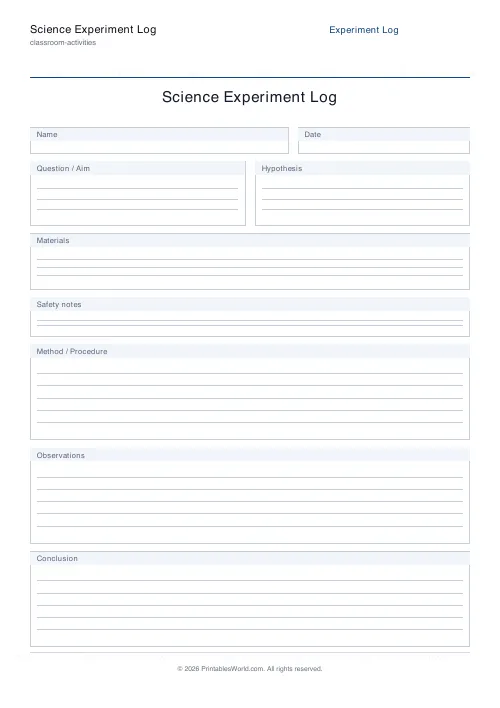
Science lessons, obviously, where it pairs with the experiment log: the log holds the method and the conclusion, this holds what was actually seen while it was happening.
It also does bird-watching, plant growth over weeks, weather records, behaviour tracking, and a field trip where notes have to be taken standing up. That last one is why the rows are generous — handwriting on a clipboard in the wind needs the space.
Print at 100% on A4 or US Letter.
FAQs
Quick answers
How many rows can I have?
Between 8 and 16 rows on a single page. Fewer rows give more space per observation; more rows are great for frequent short entries.
What are the ruled lines for?
They help younger students keep handwriting tidy inside each observation row. Turn them off for older students or for sketch-heavy observations.
Is this just for science?
No. It's a generic two-column template. Use it for nature walks, experiment notes, classroom behaviour logs, growing plants, reading logs. Anything that needs dated observations.
Can I print it on US Letter paper?
Yes. Pick US Letter or A4 before exporting; the rows scale automatically to fill the page neatly.
Related tools
Further reading
Classroom Activities
Bingo in the classroom: 10 subjects, one game
Bingo works in almost every subject because the mechanic never changes. Only the call does. Ten variations, and the one rule that turns it from a filler into retrieval practice.
4 min read
Classroom Activities
How to make learning stations work in any classroom
Stations fail for two predictable reasons: the independent tasks are not truly independent, and the timing is wrong. Both are fixable before the lesson starts.
5 min read
Teaching & Classroom
How to make a custom spelling word search
Turn any spelling list into a printable class set in minutes. A practical guide to making a custom spelling word search, with a worked example and difficulty tips.
7 min read