What this tool does
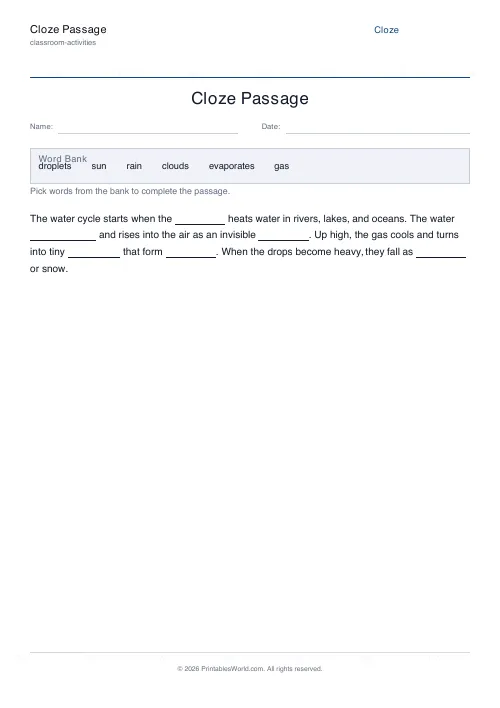
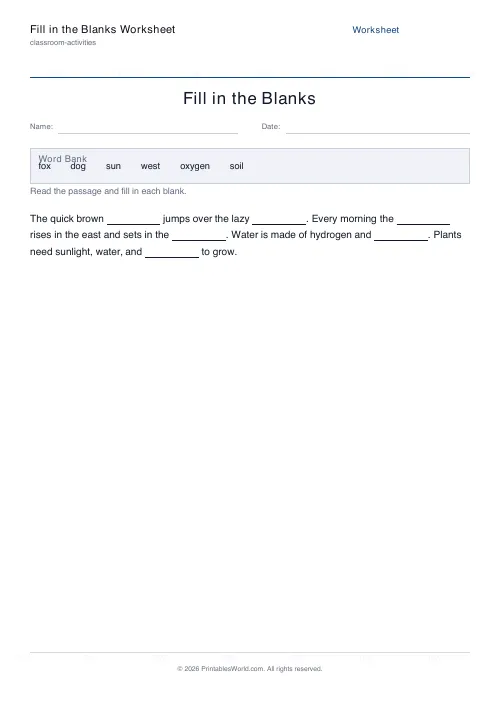
Write a passage and put square brackets round every word you want removed. The sheet prints it with blanks sized to the missing words and builds the word bank for you, shuffled.
People also used
Feedback
Spotted something off with this tool?
Bracket the words, get the worksheet
Type your passage and put [square brackets] around any word that should become a gap. The sheet prints the text with a blank at each one, sized to match the word that was removed, and collects those words into a bank at the top of the page.
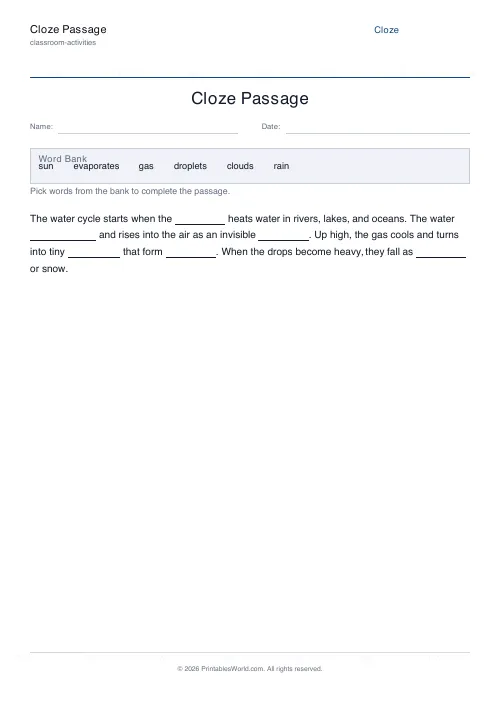
The bank is shuffled by default, which is the setting you want — an unshuffled bank lists the answers in the order they appear and the exercise solves itself.
The bracket syntax is the point
Writing the passage complete and then marking what to remove means you never have to count blanks, match them to a list, or discover after printing that the bank and the gaps have drifted apart.
It also means the same passage can be re-gapped in seconds. Move the brackets to a different set of words and you have a second, harder version of the same text for the following week.
Choosing which words to bracket
The content words. The terms you taught, the ones that carry the meaning of the sentence.
The default passage on this page shows the pattern: sun, evaporates, gas, droplets, clouds, rain — the vocabulary of the water cycle, in a passage that still reads as a passage with them missing. Bracket the and and instead and you have a reading-fluency test wearing a science lesson's clothes.
Leave enough context. A sentence with one word missing can be worked out; a sentence with four cannot, and a child who cannot make progress on a sentence stops reading it and starts pattern-matching the bank.
Two versions of the same sheet
Because the bank is generated from the passage, you can produce a harder version simply by not handing it out — print the sheet, cut the bank off the top, and the exercise becomes recall instead of matching.
Run the supported version first and the unsupported one later on the same passage. The gap between the two scores is a much better measure of what stuck than either score on its own.
What is under your control
A title, the passage, the shuffle toggle, a seed, and the Name and Date header. A4 or US Letter.
The seed matters if you want the same shuffled bank twice — a reprint with a different seed reorders it, which is fine for two children sitting together and a nuisance if you meant to reproduce a sheet exactly.
Where it is worth the effort
Any subject with vocabulary to learn. A gapped summary of a topic is one of the fastest revision formats to make and among the most useful, because the child has to reconstruct the explanation rather than recognise it.
It also works well as a listening exercise: hand out the gapped version, read the complete passage aloud once, and let them fill it in.
Print at 100% on A4 or US Letter.
FAQs
Quick answers
How do I mark the words to remove?
Put square brackets around any word (for example, [rain]). Every bracketed word is pulled out of the passage and added to the word bank.
Is the word bank shuffled?
Yes by default. Turn the shuffle toggle off to keep the words in the order they appear in the passage, or set a seed to reproduce the same shuffle later.
How is a cloze passage different from fill-in-the-blanks?
Cloze passages remove full words by marker (e.g. [gas]) and auto-size each blank to match the answer. Fill-in-the-blanks uses ___ markers and a user-supplied word bank.
Can I print an answer key?
Not directly from this sheet. Keep the original passage (with brackets) as your key.
Related tools
Further reading
Teaching & Classroom
How to make a custom spelling word search
Turn any spelling list into a printable class set in minutes. A practical guide to making a custom spelling word search, with a worked example and difficulty tips.
7 min read
Classroom Activities
Back-to-school printables every teacher needs
Sorted by when you will actually need them: the two things to print before the children arrive, the week-one set, and the routines worth establishing while everyone is still compliant.
5 min read
Classroom Activities
Escape room activities for the classroom: a how-to
A classroom escape room is a sequence of puzzles with a story on top. The design decision that matters most is whether groups work through them in order or all at once.
5 min read