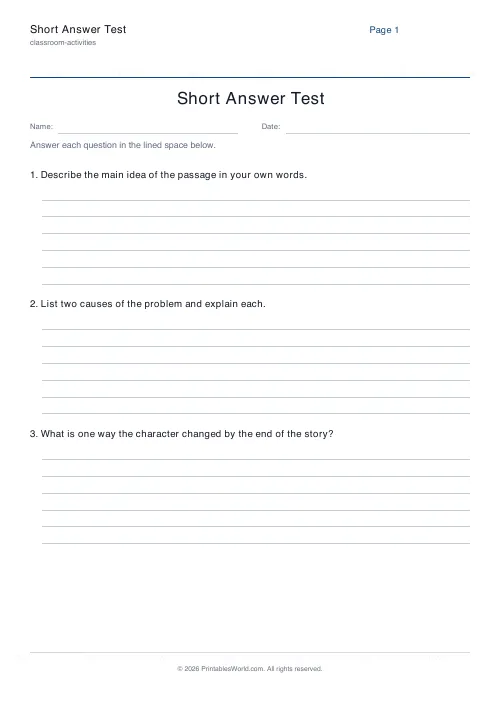
What this tool does
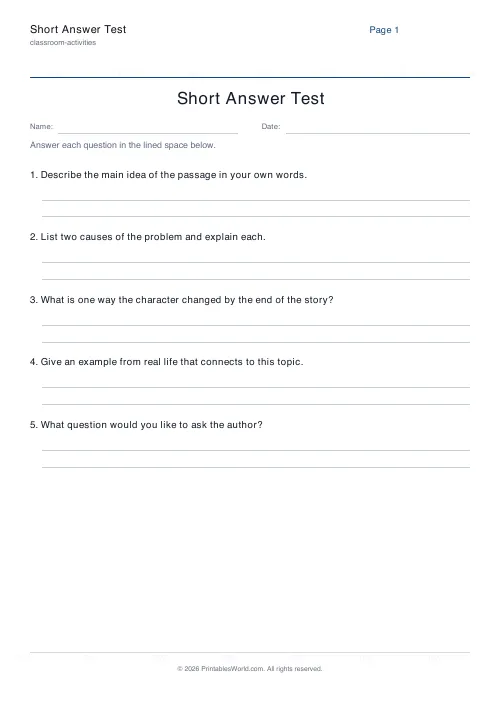
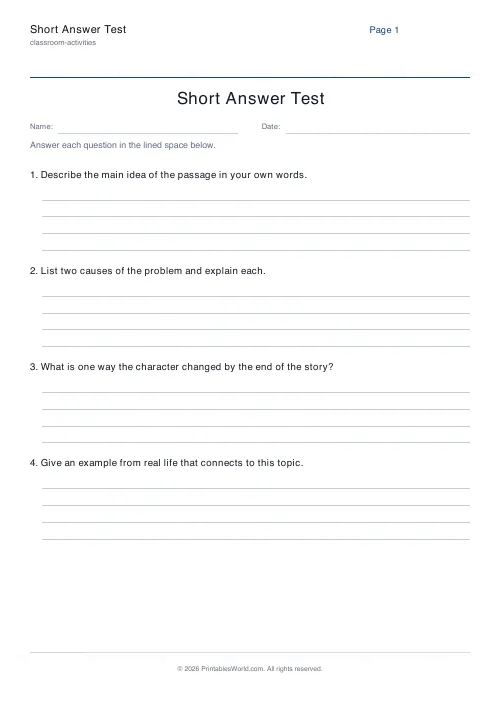
A short-answer paper: your questions, each followed by 2 to 8 ruled response lines. The line count is the same for every question, so the space you give matches the answer you expect.
People also used
Feedback
Spotted something off with this tool?
Your questions, with the right amount of room underneath
Type in the questions and choose how many ruled lines follow each one. The sheet prints them numbered, evenly spaced, with a title and an optional Name and Date header.
Two to eight lines per answer. That is the only formatting decision the tool asks you to make, and it turns out to be the one that matters.
The line count is not cosmetic
Children read the space as an instruction, and they are right to. Two lines means a sentence. Eight lines means a paragraph and probably an example.
So a mismatch causes trouble in both directions. Ask for an explanation on two lines and you get an under-developed answer that you then mark down, having asked for it. Give eight lines to a question with a one-sentence answer and you get padding — the same point restated three ways — which is a habit that is genuinely hard to break once a child has learned that filling the space is what scoring well looks like.
Set the count to the answer you actually want, and say so out loud as well.
Where the fixed count bites
Every question on a sheet gets the same number of lines. That is fine for a set of similar questions and awkward for a paper that mixes one-word recall with an extended explanation.
The workaround is to print two sheets: a short-line sheet for the recall questions and a long-line sheet for the extended ones. It is also better assessment practice, since it stops a pupil spending their time budget on the wrong questions.
Writing the questions
Short-answer papers live or die on the verb. "List" and "describe" and "explain" and "compare" ask for four different things and deserve four different amounts of space, and children are much better at answering them than at guessing which one you meant.
Avoid questions that can be answered yes or no unless the follow-up is built in. "Was the experiment fair?" gets you a word. "Was the experiment fair, and what would you change?" gets you the reasoning you were actually after.
What the generator asks for
Title, the question list, lines per answer from 2 to 8, and the Name and Date header on or off. Paper size A4 or US Letter.
Questions that run long wrap onto a second line and the layout accommodates them, so there is no need to keep them short for the sake of the page.
Other uses
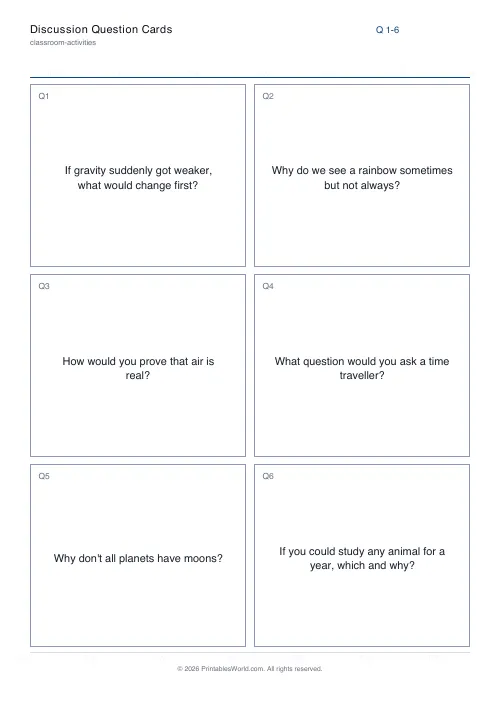
It is a general-purpose response sheet. Interview questions, a homework reflection, a set of research prompts, the questions a class prepared for a visitor.
Print at 100% on A4 or US Letter.
FAQs
Quick answers
How many lines can I give per answer?
Between 2 and 8 ruled lines. More lines means fewer questions per page; pages overflow automatically.
Can questions wrap across lines?
Yes. Long questions wrap naturally and the response lines always follow the last wrapped line.
Does the generator make multiple pages?
Yes. When a question does not fit on the current page, the generator starts a new one and keeps going.
Is there a Name and Date field?
Yes. Toggle it on or off. When on, it prints once at the top of the first page.
Related tools
Quiz Template Generator
Blank numbered quiz template with configurable question count and answer-line style.
Multiple Choice Quiz Generator
Print MCQ sheets with four A/B/C/D options per question.
Exit Ticket Generator
Three exit tickets per A4 page for quick end-of-lesson reflection.
Party Banner / Bunting Generator
Type a phrase, get one big letter per flag. A birthday or celebration banner you can print and string up the same afternoon.
Further reading
Classroom Activities
Bingo in the classroom: 10 subjects, one game
Bingo works in almost every subject because the mechanic never changes. Only the call does. Ten variations, and the one rule that turns it from a filler into retrieval practice.
4 min read
Classroom Activities
Back-to-school printables every teacher needs
Sorted by when you will actually need them: the two things to print before the children arrive, the week-one set, and the routines worth establishing while everyone is still compliant.
5 min read