What this tool does
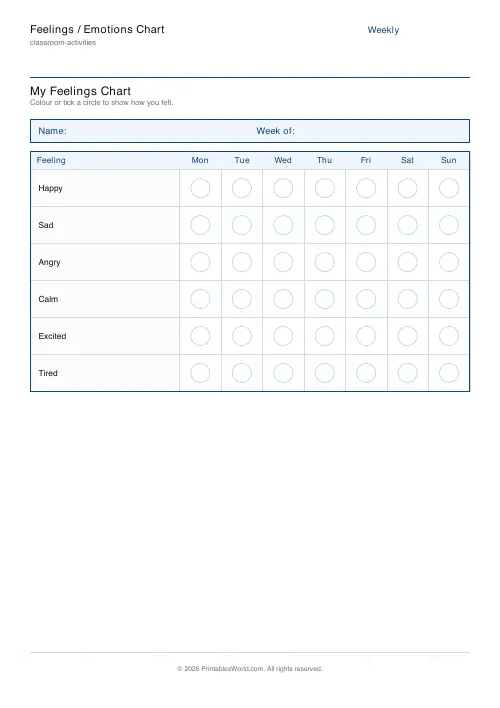
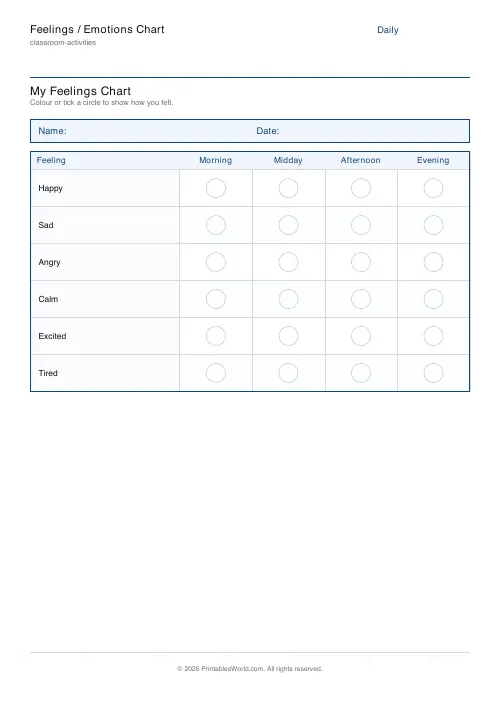
A feelings grid to mark each day or each part of the day. Four to ten feelings you name yourself, in a daily layout with time slots or a weekly one.
People also used
Behavior Chart for Kids (Daily / Weekly)
Printable daily or weekly behavior chart for children. Behaviors and goals down the side, days or time slots across the top.
All About Me Worksheet
A back-to-school fill-in sheet for every pupil.
Self-Assessment Rubric
Four criteria, four levels. A printable rubric students fill in themselves.
Feedback
Spotted something off with this tool?
Feelings down the side, time across the top
Choose a weekly layout with the seven days across, or a daily one running through time slots from morning to evening. Four to ten feelings, all named by you. Six come pre-filled: Happy, Sad, Angry, then Calm, Excited, Tired.
Add the child's name and print.
Naming a feeling is most of the skill
A child who can say "I am frustrated" is doing something different from one who can only act frustrated, and the gap between those two is where a great deal of difficult behaviour lives.
Emotional vocabulary is learned rather than innate, and it is learned by having words offered at the moment the feeling is happening. A printed chart does that: the words are on the page, so the child chooses from a list instead of searching for a word they may not have.
Which is also why the feelings on the chart should be words you actually use at home. Replace any that do not sound like your family.
Daily or weekly changes what it shows
The daily layout, with slots through the day, shows when. A child who is fine at breakfast and angry every afternoon has a pattern with a cause — tiredness, hunger, a particular lesson — and the cause is findable because the chart says which part of the day it is.
The weekly layout shows which days. A run of hard Mondays is worth investigating in a way that one hard Monday is not.
Start weekly, and switch to daily if a difficult day needs unpicking.
Do not use it as a behaviour chart
The important distinction, and it is easy to blur. A feelings chart records what a child felt; it must not reward some feelings and penalise others.
The moment "angry" becomes a bad mark on a chart, a child stops recording anger and starts recording what will be approved of, and the chart is now measuring compliance. Every feeling on it should be equally allowed to be circled, including on a day when the behaviour that came with it was not allowed.
Feelings and behaviour are separate conversations. The behaviour chart is the other one.
What to do with a completed week
Look at it together, without a verdict attached. "Lots of tired this week" is an observation a child can respond to; "you have been very angry" is an accusation, and they will hear it as one.
Ask what was happening on the strongest days. That question is the whole value of the sheet, and it is a much easier question to ask with a page of marks in front of you than out of nowhere.
Settings: title, child's name, mode, feeling count (4 to 10) and your feelings list. A4 or US Letter at 100%.
FAQs
Quick answers
What is the difference between the daily and weekly chart?
The weekly chart has seven columns (Monday to Sunday) for tracking feelings across a week. The daily chart has four time-slot columns (Morning, Midday, Afternoon, Evening) so a child can check in several times in a single day.
How many feelings should I list?
Pick 4 to 10. For younger children, a short list of basic feelings like happy, sad, angry and calm works best; older children can manage a longer, more nuanced list.
Does the chart have cartoon faces?
No. It is a clean grid with soft circles and your own feeling words, so it suits any age and any classroom style. Children colour, tick or sticker the circle that matches their mood.
Can I make one per child?
Yes. Change the name and feelings list and generate a separate PDF for each child. The design stays consistent across siblings or classmates.
Related tools
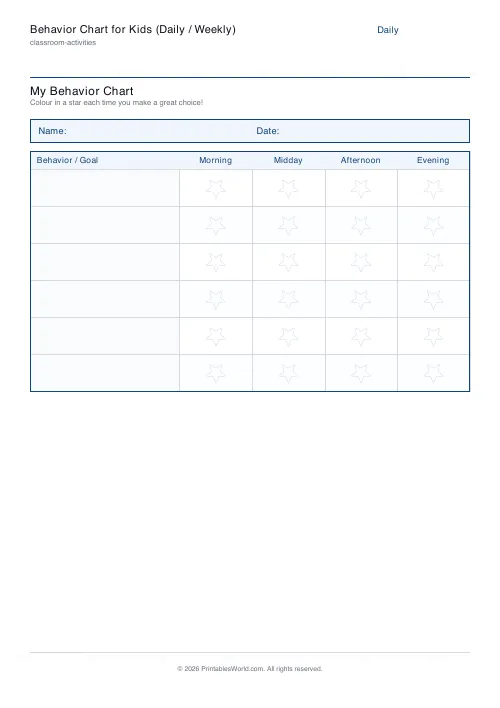
Behavior Chart for Kids (Daily / Weekly)
Printable daily or weekly behavior chart for children. Behaviors and goals down the side, days or time slots across the top.
All About Me Worksheet
A back-to-school fill-in sheet for every pupil.
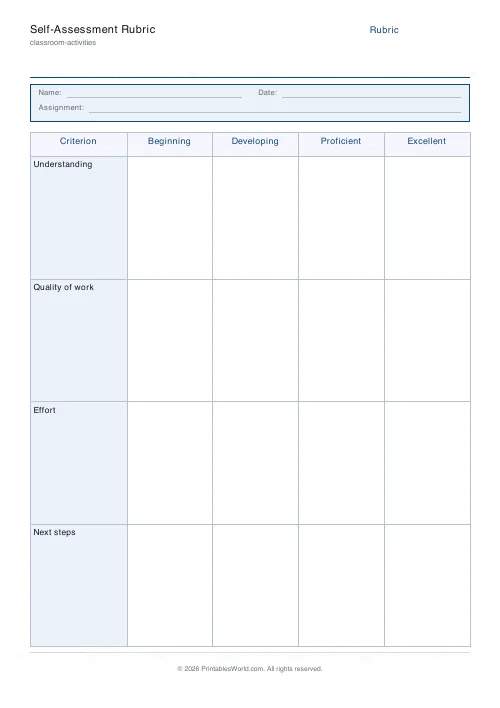
Self-Assessment Rubric
Four criteria, four levels. A printable rubric students fill in themselves.
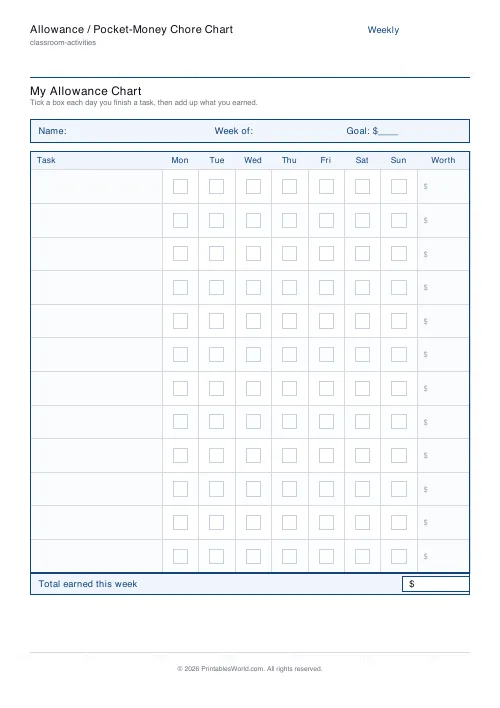
Allowance / Pocket-Money Chore Chart
Printable allowance chart. Tasks × 7 days of tick boxes, a money column and a weekly total.
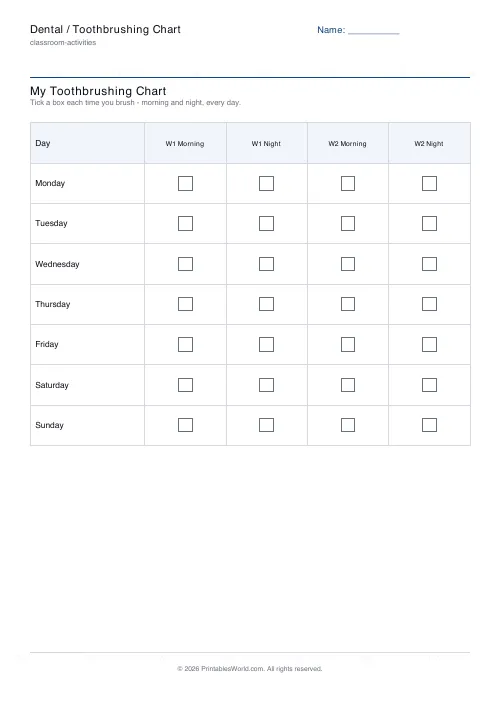
Dental / Toothbrushing Chart
Printable toothbrushing chart with morning and night tick boxes for every day of the week.
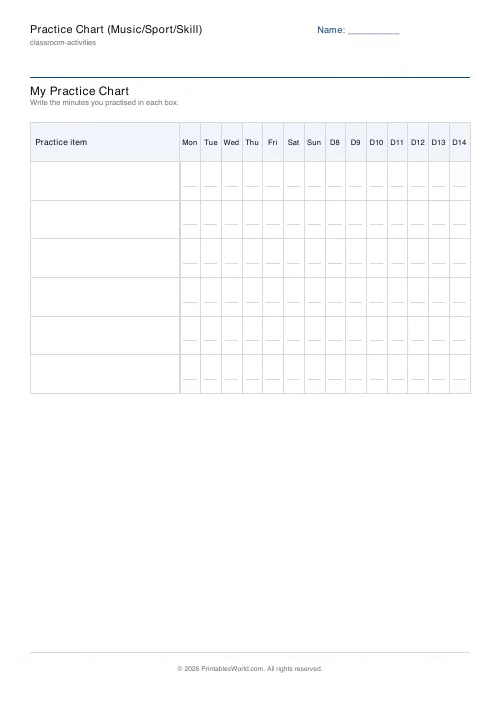
Practice Chart (Music/Sport/Skill)
Printable practice chart for music, sport and any skill. Items down the side, days across the top, a minutes box in every cell.
Further reading
Classroom Activities
Positive reinforcement in the classroom: charts that work
Reward charts work when they name a specific behaviour and fade over time. They backfire when they rank children publicly. Here is the difference in practice.
5 min read
Classroom Activities
Back-to-school printables every teacher needs
Sorted by when you will actually need them: the two things to print before the children arrive, the week-one set, and the routines worth establishing while everyone is still compliant.
5 min read
Classroom Activities
Escape room activities for the classroom: a how-to
A classroom escape room is a sequence of puzzles with a story on top. The design decision that matters most is whether groups work through them in order or all at once.
5 min read