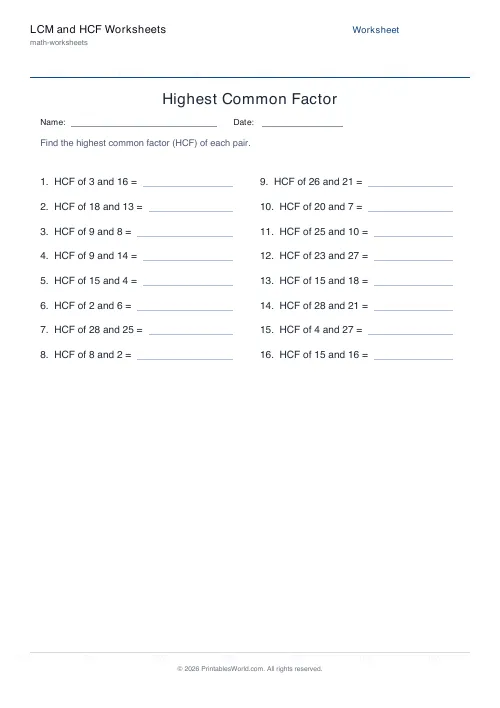
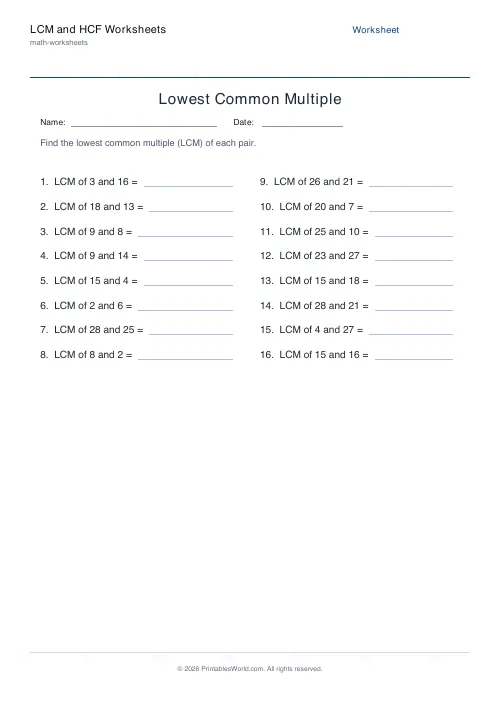
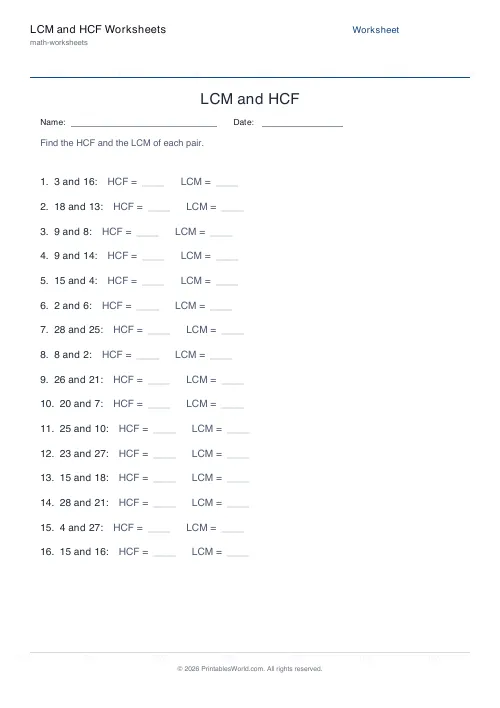
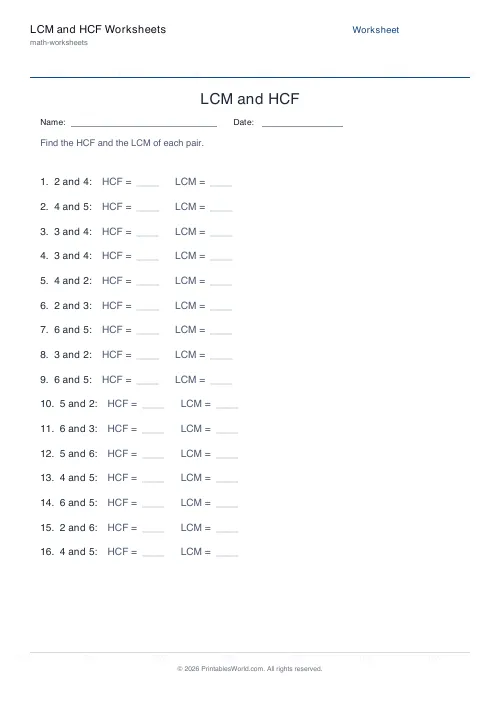
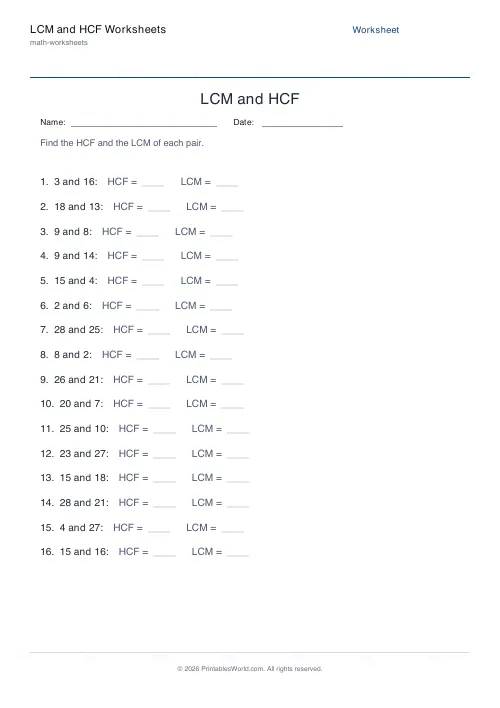
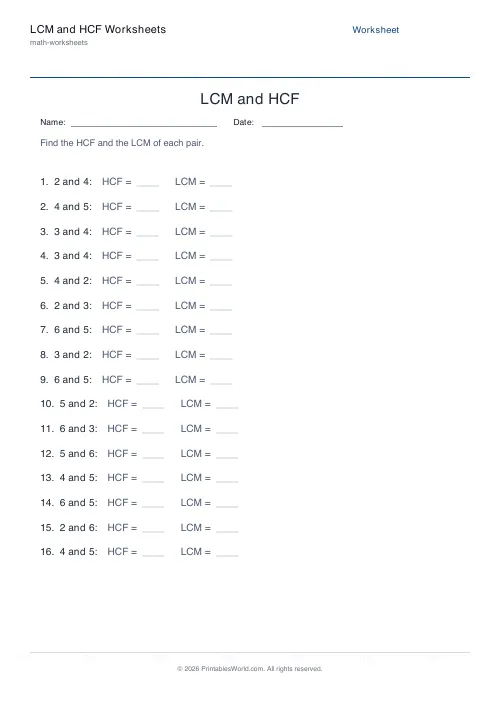
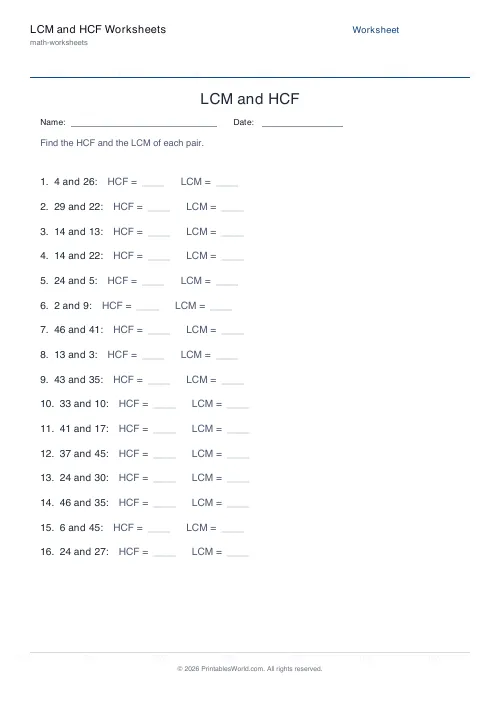
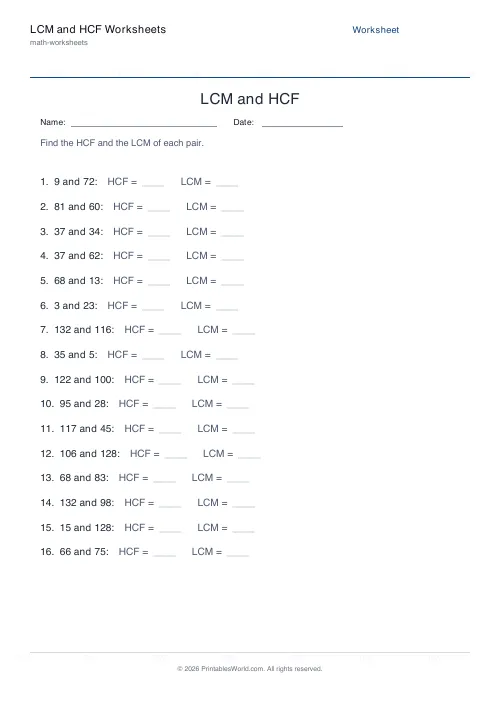
What this tool does
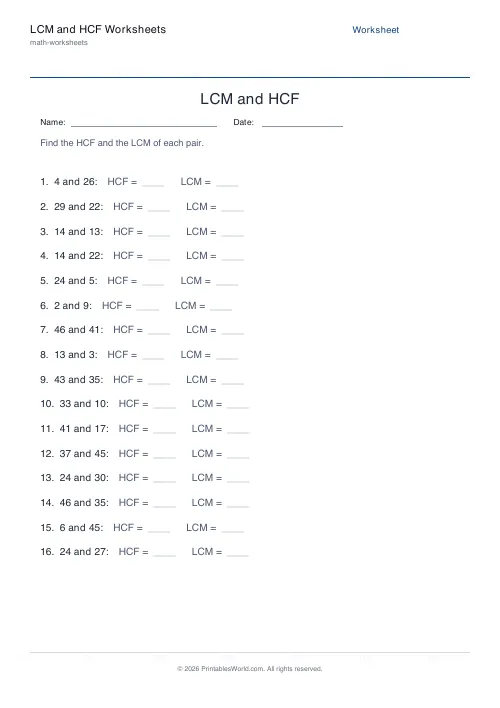
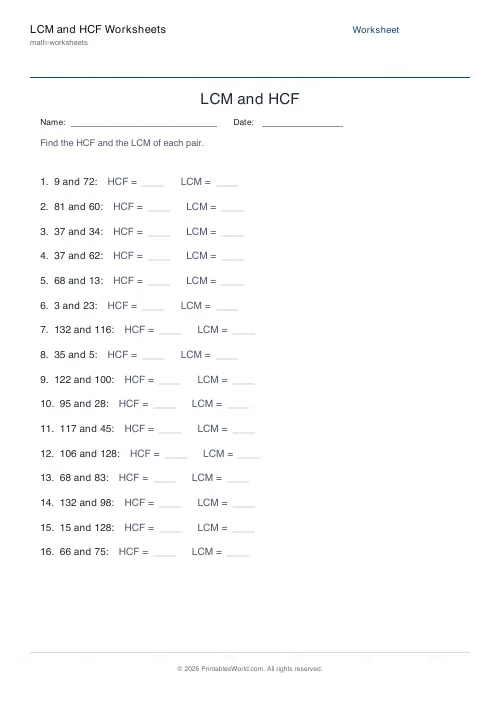
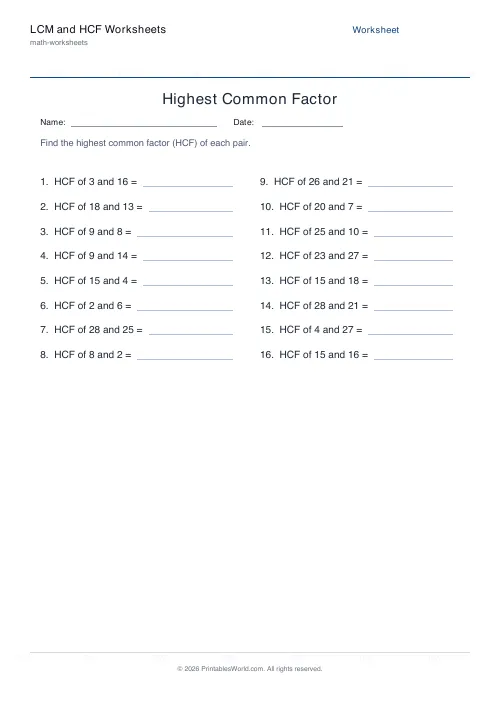
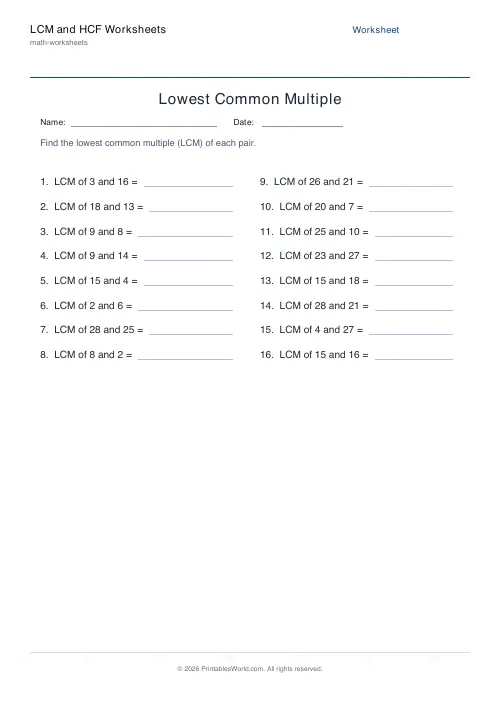
Practice rows asking for the HCF of a number pair, the LCM, or both. Set the question count and the ceiling; answer key optional.
People also used
Factors & Multiples Worksheets
Generate printable worksheets for factors, multiples, HCF and LCM practice with custom ranges and answer keys.
Prime Numbers Worksheets Generator
Generate worksheets to identify primes, factorise numbers, or list primes in a range.
Simplifying Fractions Worksheets
Reduce fractions to their lowest terms.
Feedback
Spotted something off with this tool?
Three modes
Rows of number pairs. You choose what gets asked — the highest common factor, the lowest common multiple, or both of them for every pair on the sheet.
Set how many questions and how large the numbers go, with an answer key if you want one.
Which is which
The names get confused constantly, and the fix is to notice that each one tells you where to look.
The highest common factor is a factor, so it is smaller than both numbers — the biggest thing that divides into both. The lowest common multiple is a multiple, so it is at least as big as the larger number — the smallest thing they both divide into.
A pupil who answers 48 for the HCF of 12 and 16 has not made an arithmetic error. They have solved the wrong problem, and telling them to check their working will not help.
Listing works, then stops working
For small pairs, write out the factors of each and take the biggest appearing in both. Perfectly sound. It collapses somewhere around 36 and 48.
Prime factorisation is what scales. Break both numbers down, then for the HCF take the primes common to both at the lowest power, and for the LCM take every prime that appears at the highest power. Same decomposition, two different readings of it.
One check catches everything
HCF × LCM equals the product of the two numbers. Always.
For 12 and 18: HCF 6, LCM 36, and 6 × 36 = 216 = 12 × 18. A pupil who has found both can verify both in a single multiplication, which turns this from a topic with no feedback into one where they know immediately whether they are right.
Where it is actually needed
Fractions, mostly. Pupils rarely make the connection unprompted.
Simplifying a fraction means dividing top and bottom by their HCF. Adding fractions means finding a common denominator, which is the LCM. A child who finds fraction arithmetic mysterious very often just has not been told that these are the same two operations under different names.
Beyond that: sharing into equal groups, working out when two repeating events coincide, and every buses-leaving-the-station question ever set.
Setting the ceiling
Keep it modest while the method is being learnt. The reasoning is the point, and large numbers simply move the obstacle to the arithmetic.
Related: prime numbers for the factorisation this depends on, and factors and multiples.
FAQs
Quick answers
What is the difference between HCF and LCM?
The HCF (highest common factor) is the largest number that divides into both numbers; the LCM (lowest common multiple) is the smallest number both divide into. For 12 and 18, the HCF is 6 and the LCM is 36.
Is there a quick way to check my answers?
Yes. For any pair of numbers, the HCF multiplied by the LCM equals the product of the two numbers. If that holds, your answers are consistent.
Can I practise just one of them?
Yes. Choose HCF only, LCM only, or both. The 'both' mode asks for the HCF and LCM of each pair on one line.
What number range should I use?
Start with numbers up to 20–30 for an introduction. Increase the maximum for harder problems that benefit from prime factorisation.
Related tools
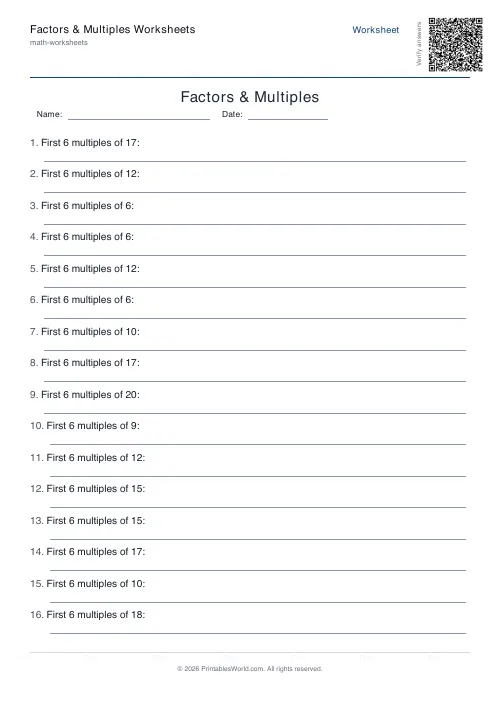
Factors & Multiples Worksheets
Generate printable worksheets for factors, multiples, HCF and LCM practice with custom ranges and answer keys.
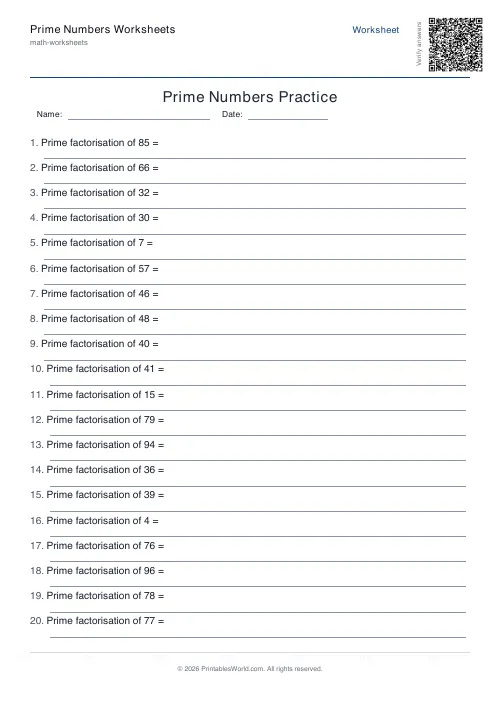
Prime Numbers Worksheets Generator
Generate worksheets to identify primes, factorise numbers, or list primes in a range.
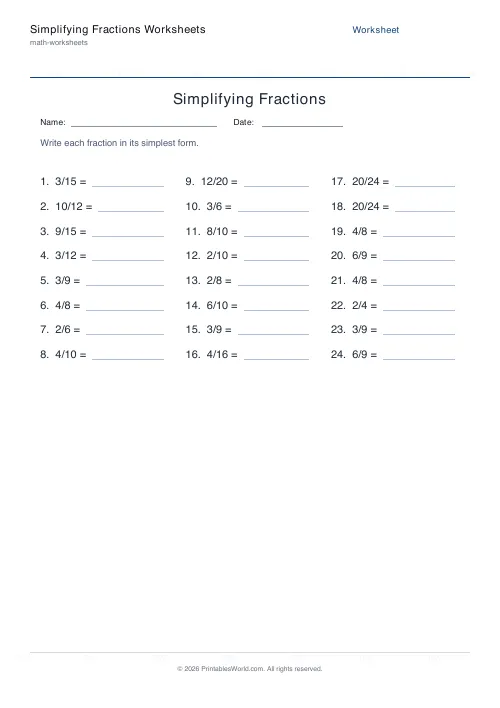
Simplifying Fractions Worksheets
Reduce fractions to their lowest terms.
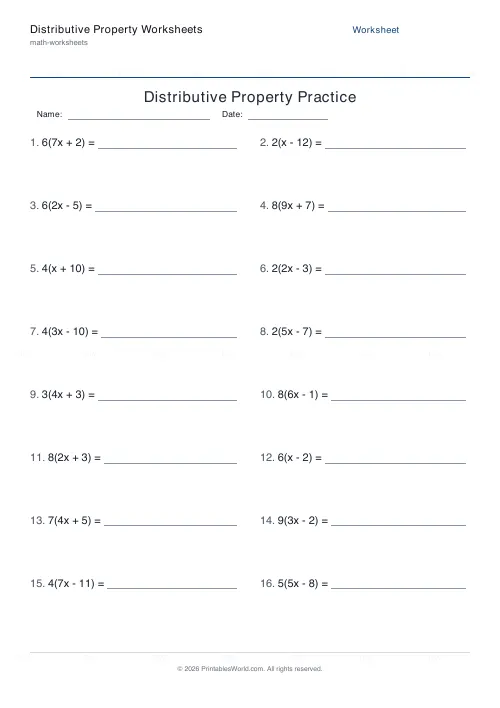
Distributive Property Worksheets
Generate worksheets that expand brackets like a(b ± c) or factor out a common factor from ab ± ac.
More like this
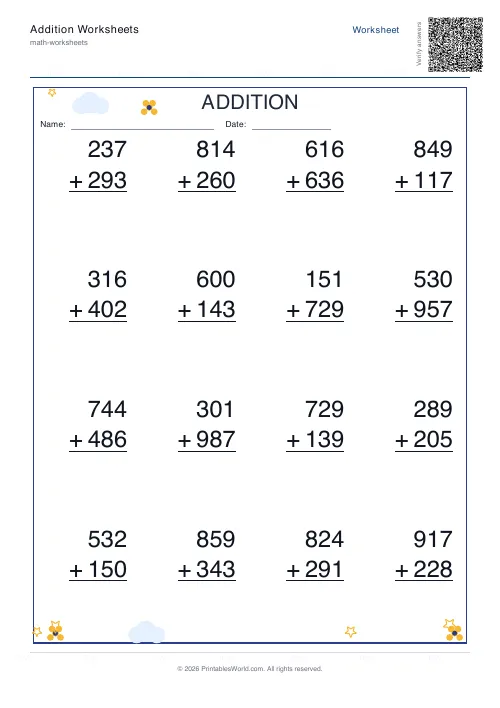 Addition Worksheets Generator
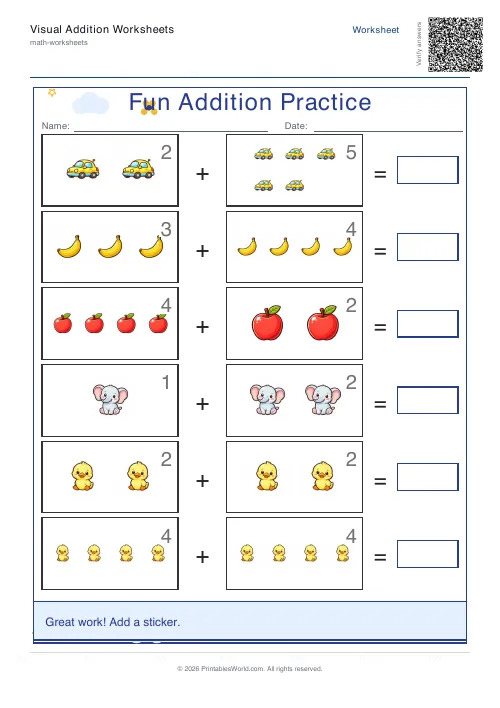 Visual Addition Worksheets Generator
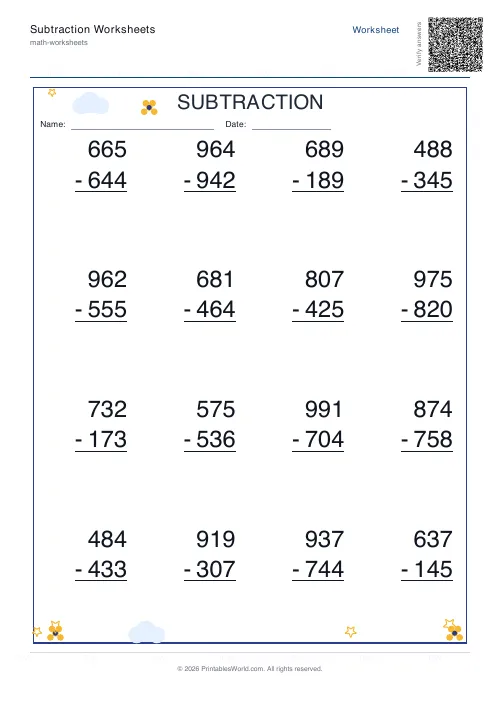 Subtraction Worksheets Generator
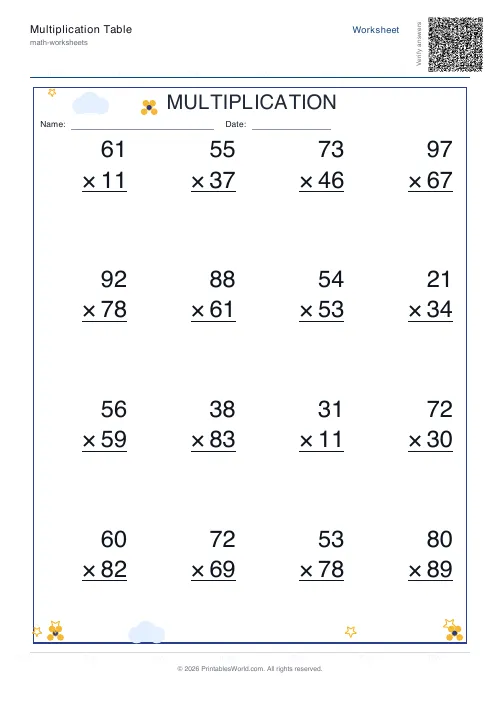 Multiplication Table Generator
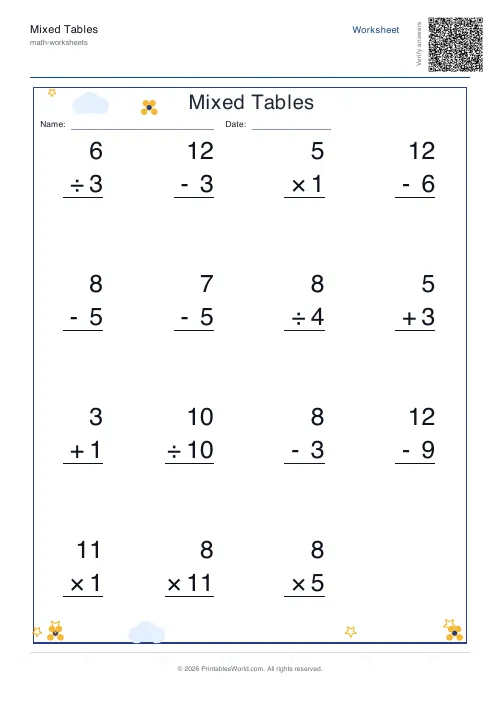 Mixed Tables Generator
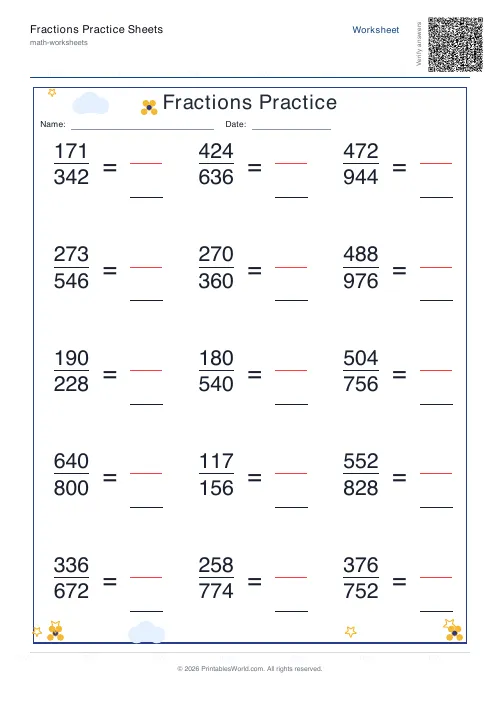 Fractions Practice Sheets Generator
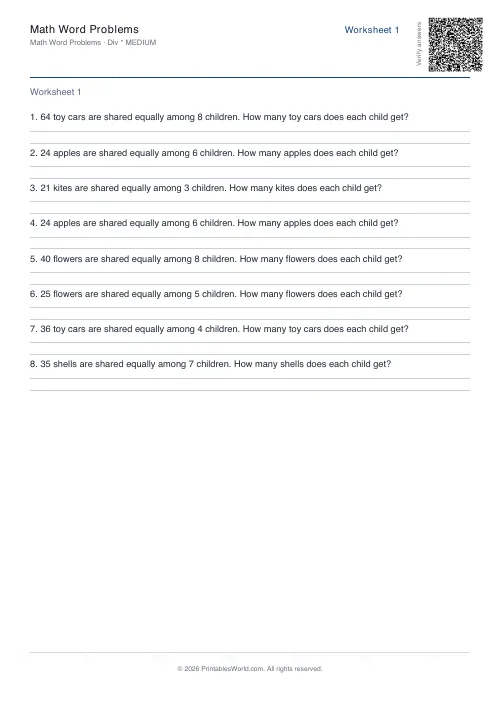 Math Word Problems Generator
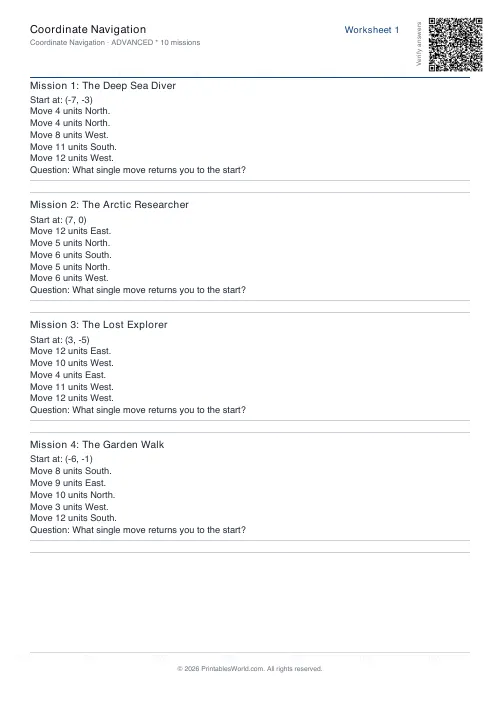 Coordinate Navigation Generator
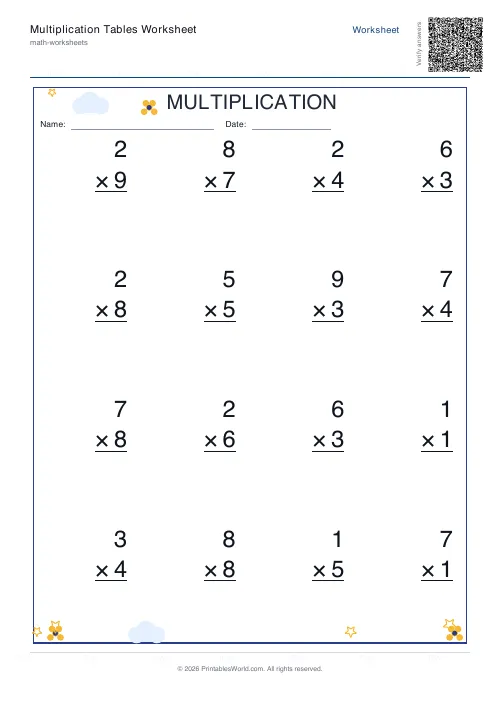 Multiplication Tables Worksheet
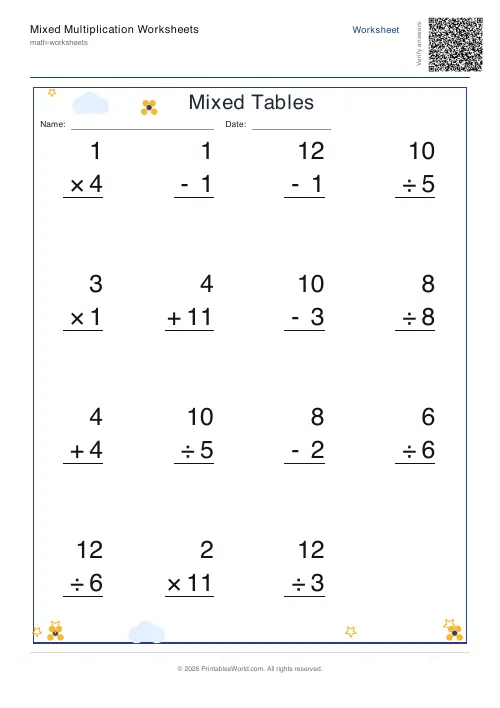 Mixed Multiplication Worksheets
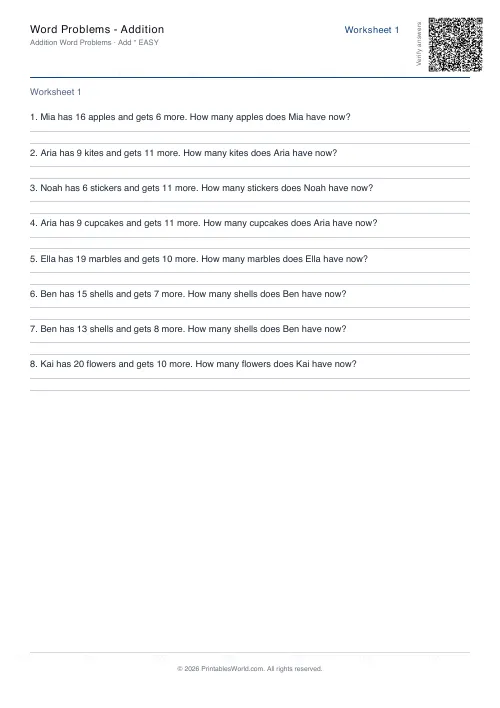 Word Problems: Addition
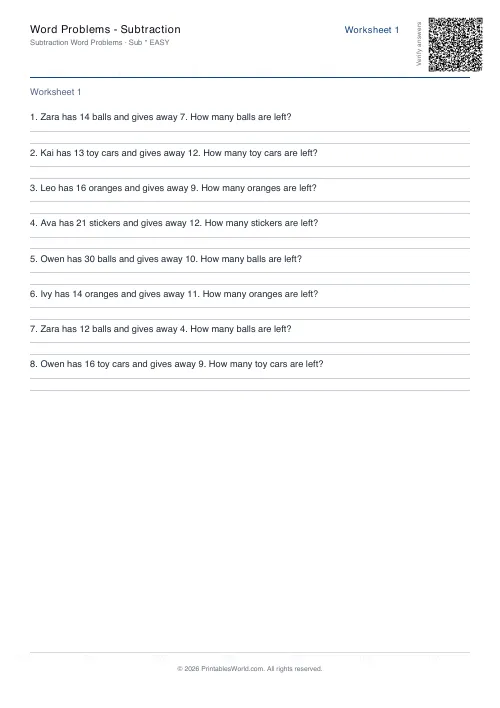 Word Problems: Subtraction
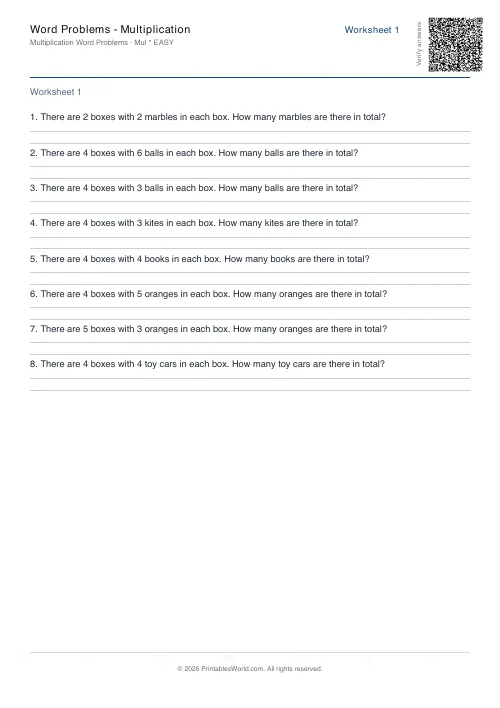 Word Problems: Multiplication
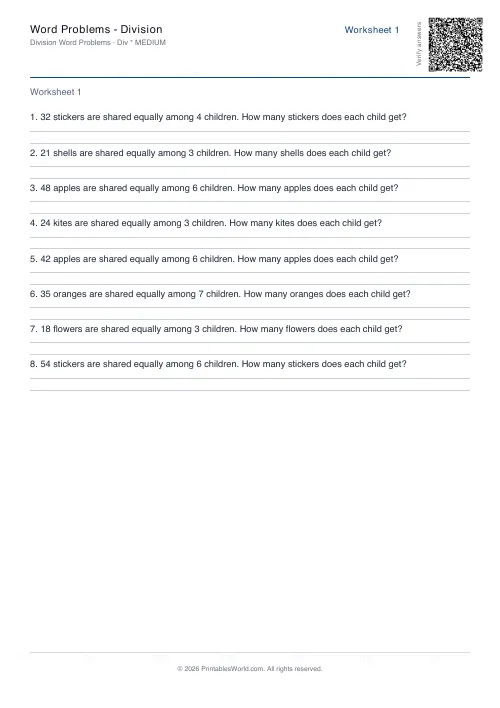 Word Problems: Division