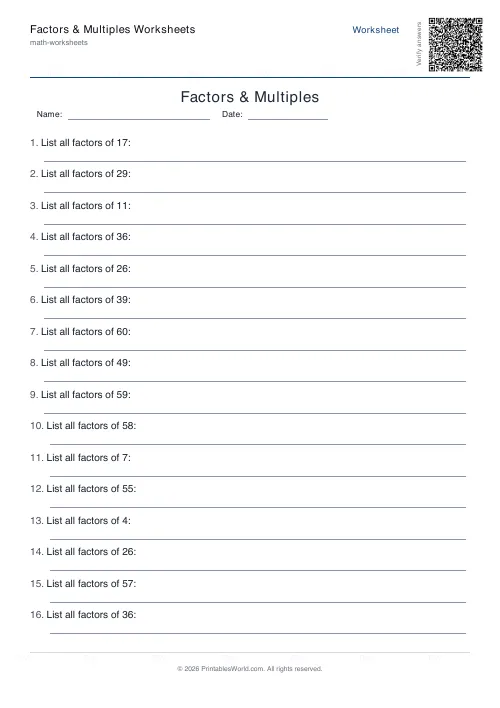
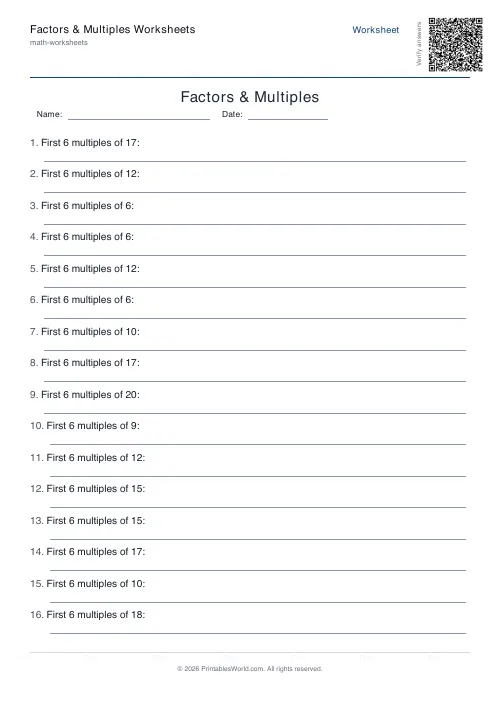
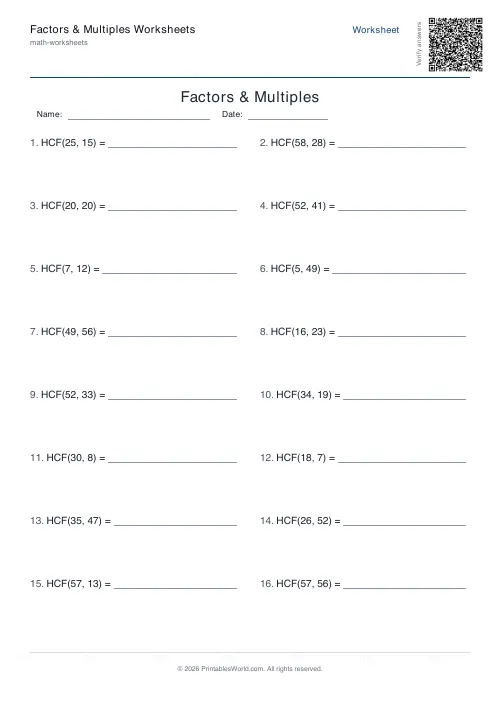
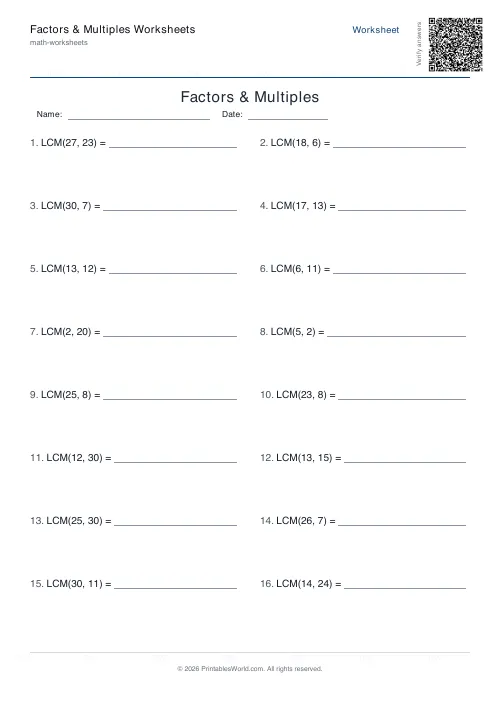
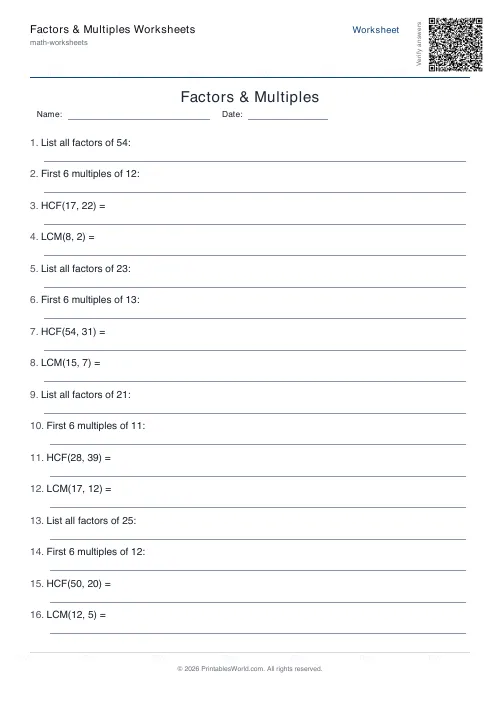
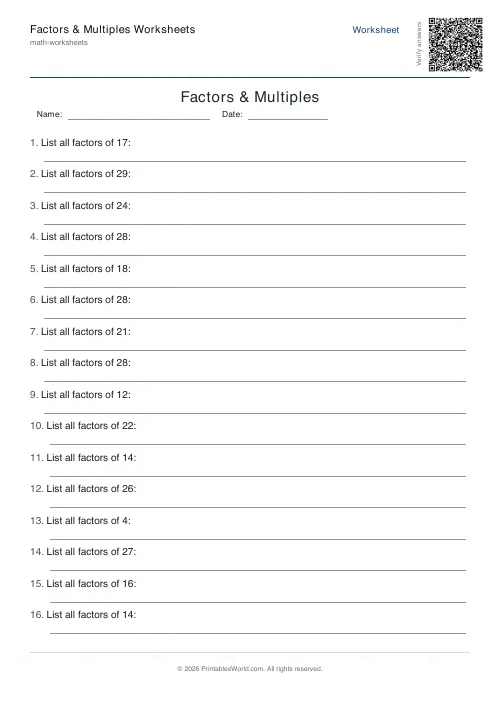
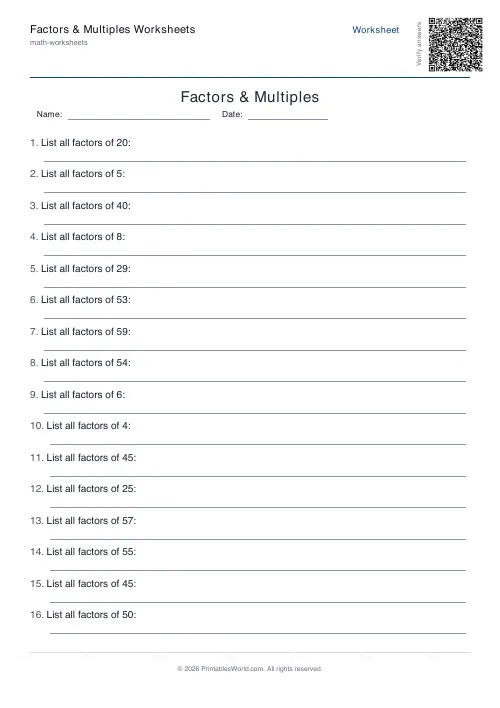
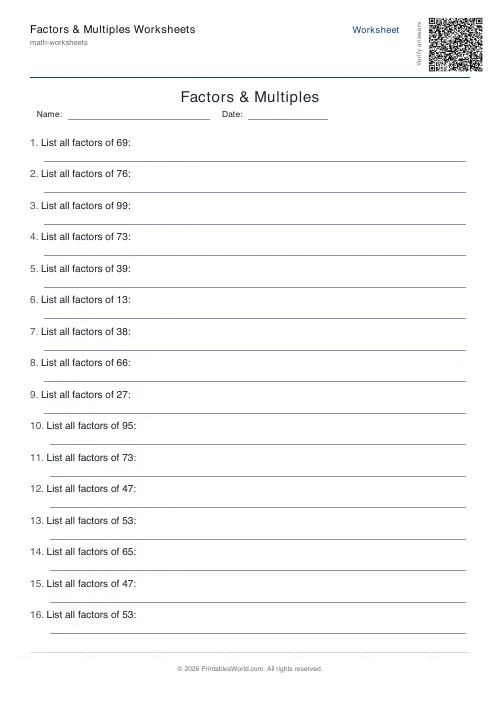
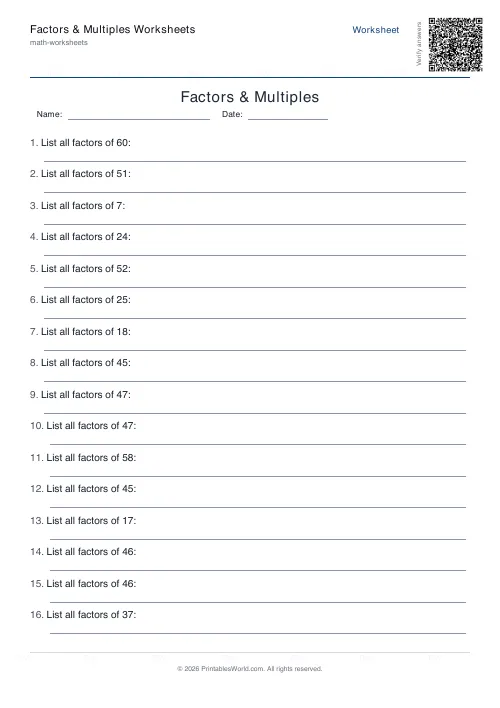
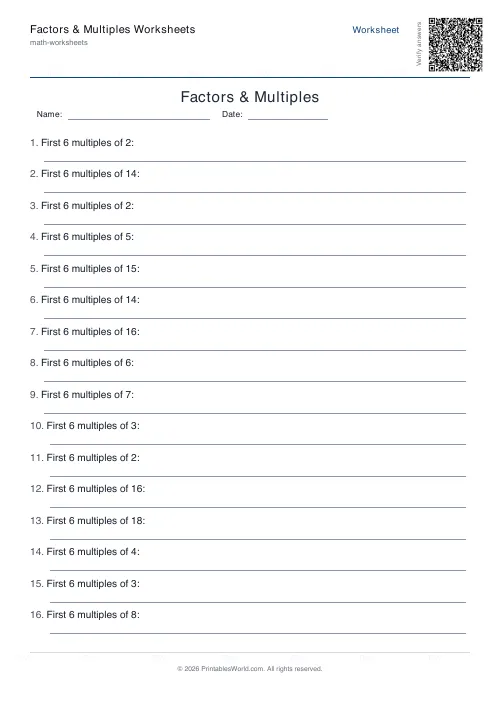
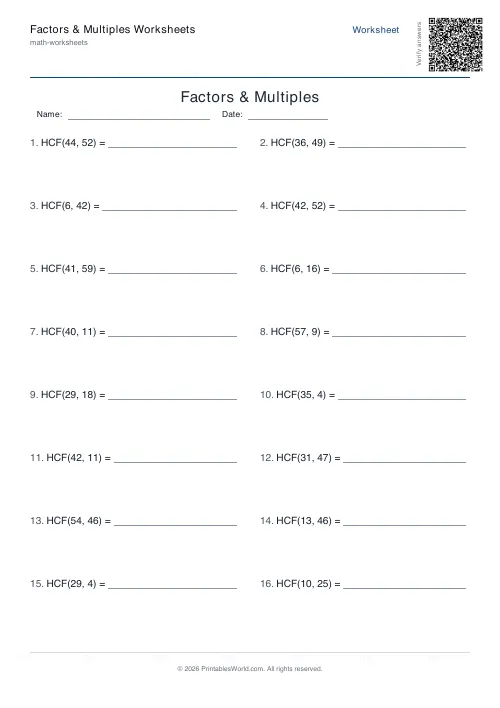
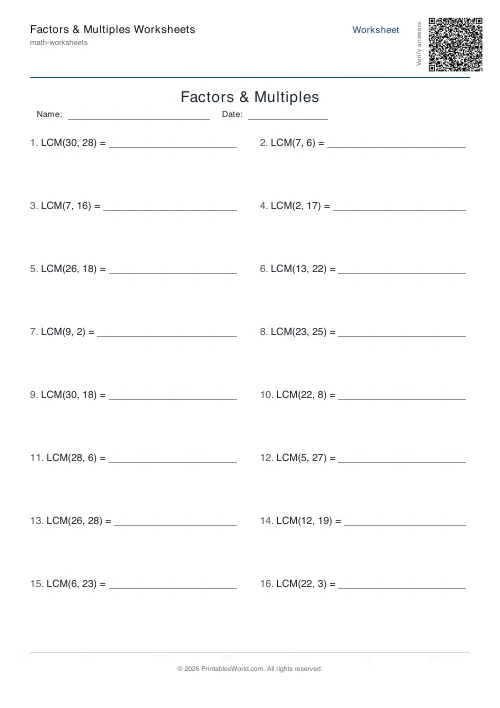
What this tool does
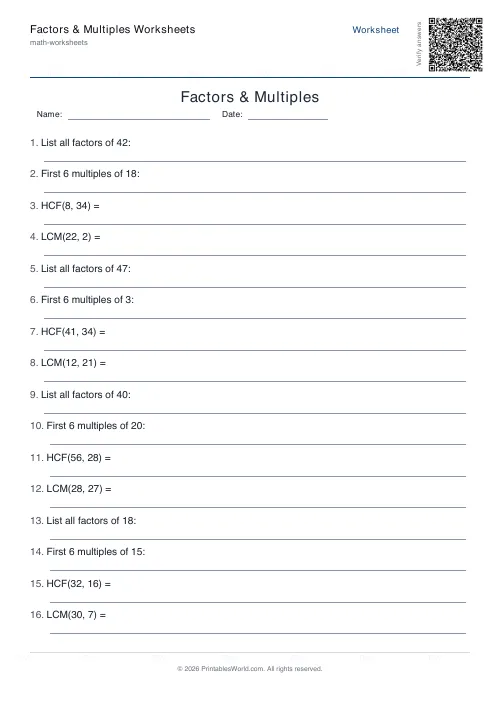
Four question types: list the factors of a number, list its first six multiples, or find the HCF or LCM of a pair. Print one type or a balanced mix.
People also used
Prime Numbers Worksheets Generator
Generate worksheets to identify primes, factorise numbers, or list primes in a range.
Square & Cube Numbers Generator
Printable squares, cubes, square roots and cube roots worksheets with optional answer keys.
Multiplication Table Generator
Create free printable multiplication tables in table or line-by-line format with custom ranges and themes.
Feedback
Spotted something off with this tool?
Four types, one idea
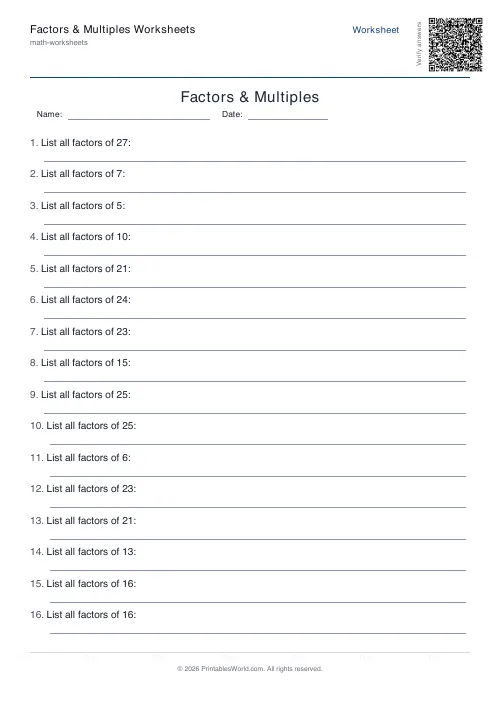
Factors asks you to list everything that divides a number. Multiples asks for its first six. HCF and LCM take a pair of numbers. Mixed balances all four across the sheet.
Sixteen questions by default, numbers up to 60. Both adjustable, answer key included.
Factors go in, multiples go out
The two words get confused for years, and the fix is one sentence rather than a definition.
Factors are smaller than the number and there are finitely many. Multiples are bigger and there are infinitely many. A pupil who has that straight will not write "the factors of 6 are 6, 12, 18" again, which is far and away the commonest error on this topic.
List factors in pairs
The method that stops pupils missing one. For 24: 1 and 24, 2 and 12, 3 and 8, 4 and 6. Then stop, because 5 does not divide and the next pair after that would repeat.
Working in pairs from the outside inwards is systematic and it makes it obvious when to stop. It also quietly demonstrates that a square number has an odd count of factors, the middle pair being one number twice over. Nicer discovered than told.
HCF and LCM
Listing everything out works for small numbers, and it stops working quickly.
Prime factorisation is the method that scales: for the HCF take the primes common to both, at the lowest power; for the LCM take every prime that appears, at the highest. Teach it as soon as the listing method starts producing errors, which is usually somewhere around 36 and 48.
Here is a useful check. HCF × LCM equals the product of the two numbers, every time, so a pupil who has found both can verify both in a single multiplication.
Where it is actually used
Simplifying fractions is the HCF. Adding fractions is the LCM — the common denominator is exactly that, and pupils who find fraction addition mysterious often just have not connected the two ideas.
Beyond fractions: sharing into equal groups, working out when two repeating events coincide, and any question involving tiles or packs or arrangements. The classic buses-leaving-the-station question is an LCM in a coat.
Setting the ceiling
Sixty is the default and it is well chosen — numbers up to 60 have interesting factor structures without the arithmetic becoming the obstacle. Raise it to 100 once the method is secure; go higher only if prime factorisation is being taught alongside.
Related: prime numbers, which is where the reliable method for both comes from.
FAQs
Quick answers
Can I choose how many of each question type appears in mixed mode?
No. Mixed mode cycles through factors, multiples, HCF and LCM in equal rotation, so a 16-question sheet will have four of each type and a 20-question sheet will have five of each.
What happens if I set the maximum number very high?
The generator accepts values up to 200, but LCM answers can become very large (hundreds or thousands) when both input numbers are above 30. For younger learners or quicker exercises, keep the maximum below 60.
How many problems can I fit on one page?
The tool accepts between 4 and 40 problems. Layout and font size adjust automatically, but above 24 questions the text becomes small. For comfortable handwriting space, 12 to 20 problems works best.
Does the answer key show working or just final answers?
The answer key lists final answers only. For factors it shows the complete list (for example 1, 2, 4, 8, 16); for multiples it shows the first six multiples; for HCF and LCM it shows the single numeric result.
Can I print on US Letter paper?
Yes. Every PDF is designed to fit both A4 and US Letter without clipping or scaling. Print directly from your browser or PDF reader with no page-setup changes.
Will the generator avoid repeating the same number?
No. Because problems are randomly generated, the same base number may appear in multiple questions on one sheet. This is normal and does not affect the validity of the practice.
How do I add my school logo or custom footer?
The PDF includes a PrintablesWorld footer and optional QR code. To add your own branding, print the worksheet and photocopy it onto pre-printed school letterhead, or use your PDF editor to overlay a logo before printing.
Related tools
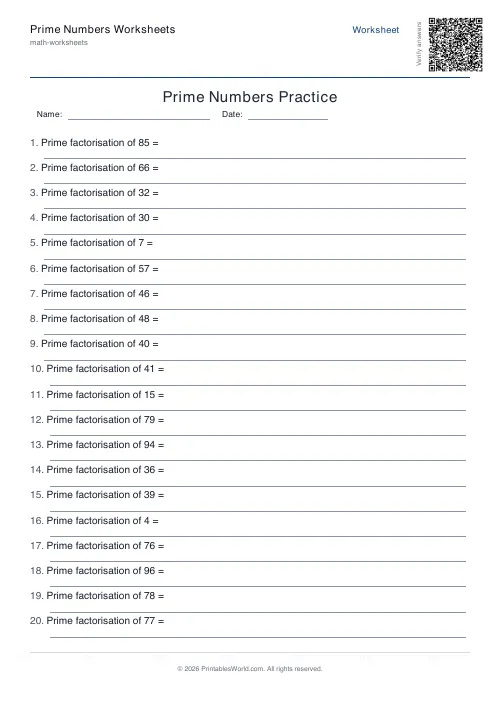
Prime Numbers Worksheets Generator
Generate worksheets to identify primes, factorise numbers, or list primes in a range.
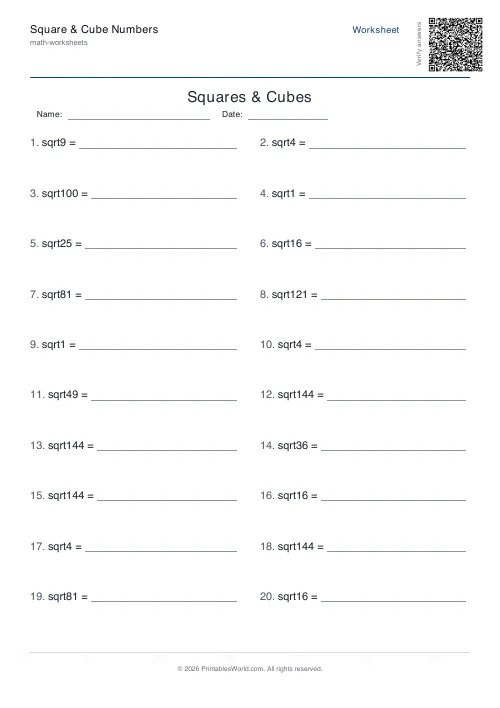
Square & Cube Numbers Generator
Printable squares, cubes, square roots and cube roots worksheets with optional answer keys.
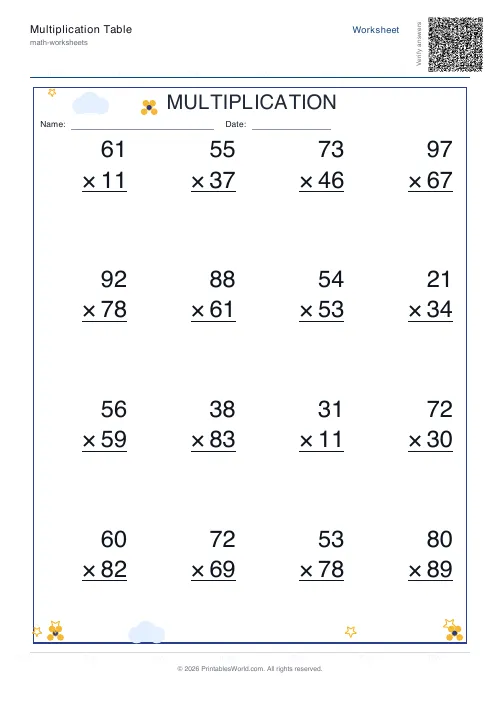
Multiplication Table Generator
Create free printable multiplication tables in table or line-by-line format with custom ranges and themes.
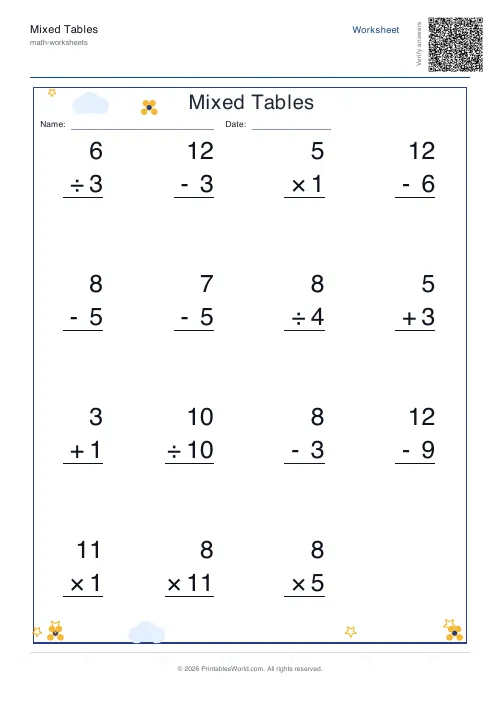
Mixed Tables Generator
Print mixed-operations worksheets combining addition, subtraction, multiplication and division on one page.
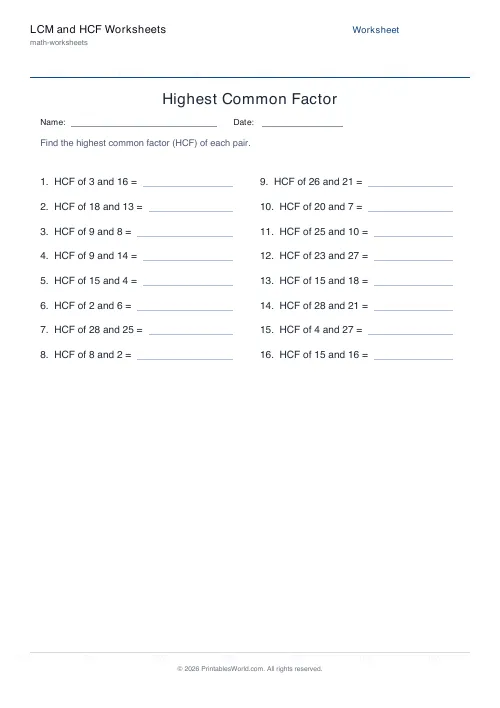
LCM and HCF Worksheets
Find lowest common multiples and highest common factors.
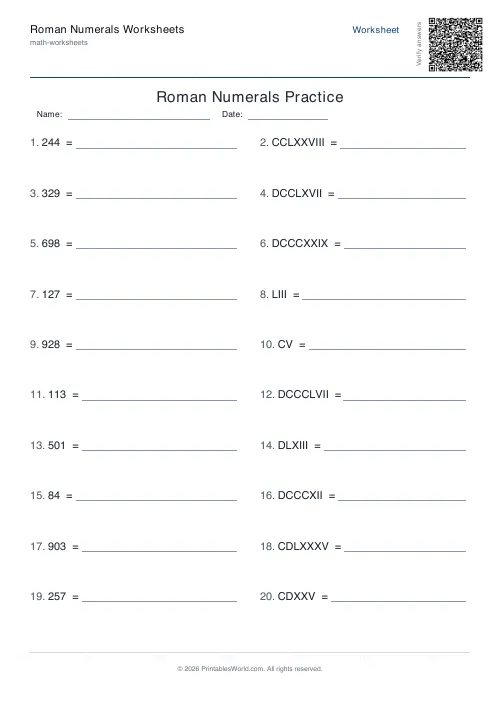
Roman Numerals Worksheets Generator
Generate custom Roman numeral conversion worksheets with adjustable ranges and answer keys.
Further reading
Math Worksheets
How many maths worksheets per day? A parent's guide
The honest answer is less than most parents assume. And the number of questions matters less than whether the session ends well.
5 min read
Math & Numeracy
How to help a child who's stuck on times tables
A simple two week plan to help child with times tables, using short daily practice and free printable multiplication grids you can customise and print.
7 min read
More like this
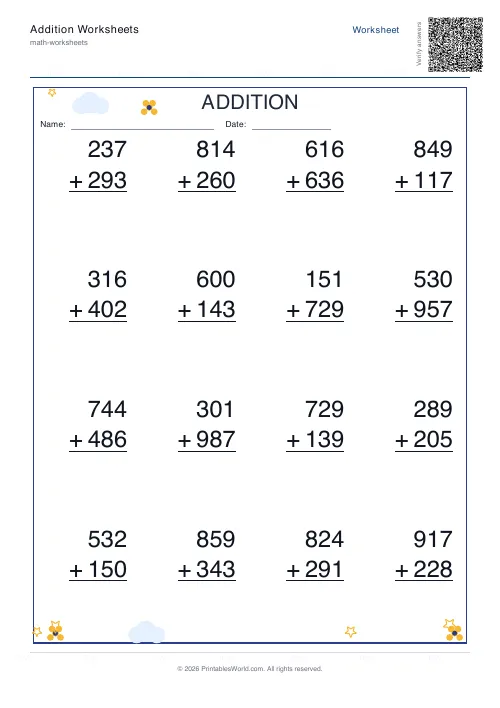 Addition Worksheets Generator
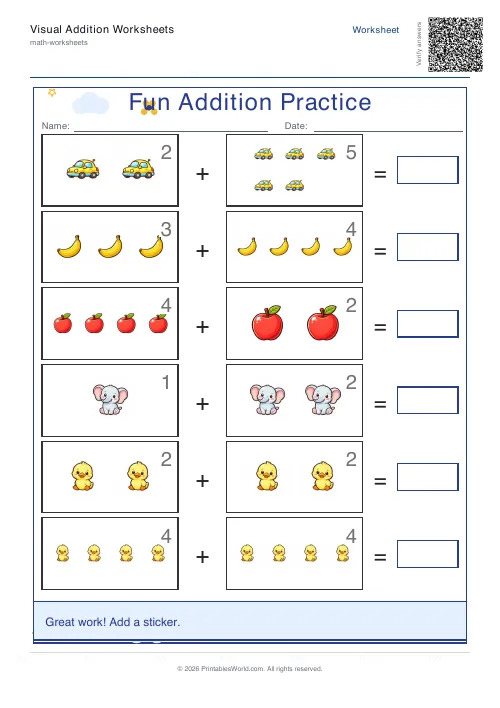 Visual Addition Worksheets Generator
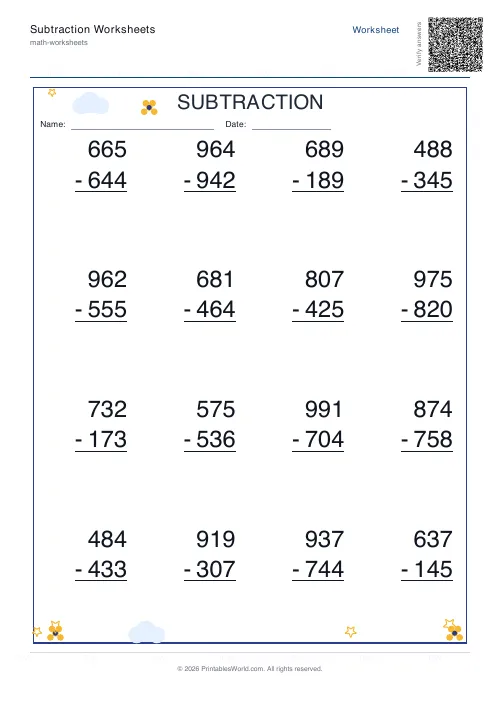 Subtraction Worksheets Generator
- Multiplication Table Generator
- Mixed Tables Generator
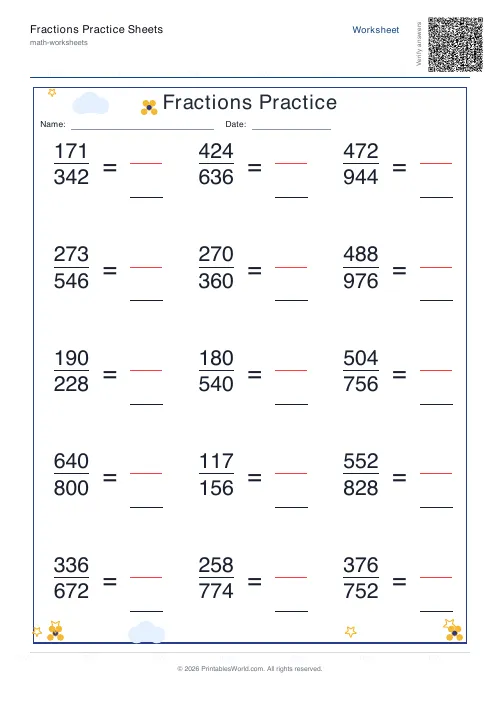 Fractions Practice Sheets Generator
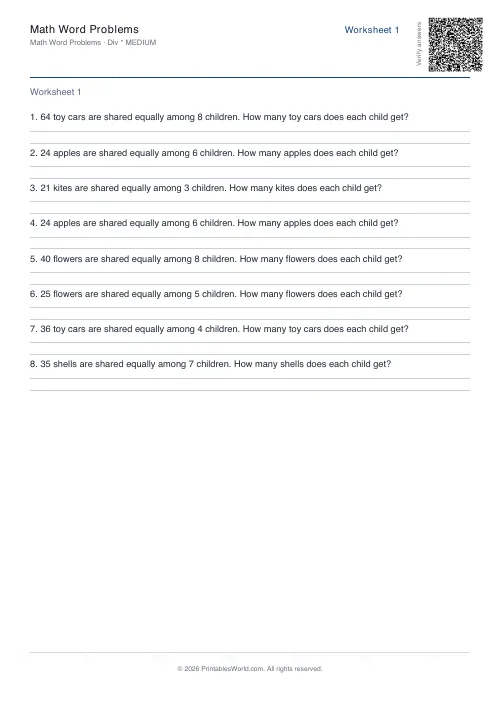 Math Word Problems Generator
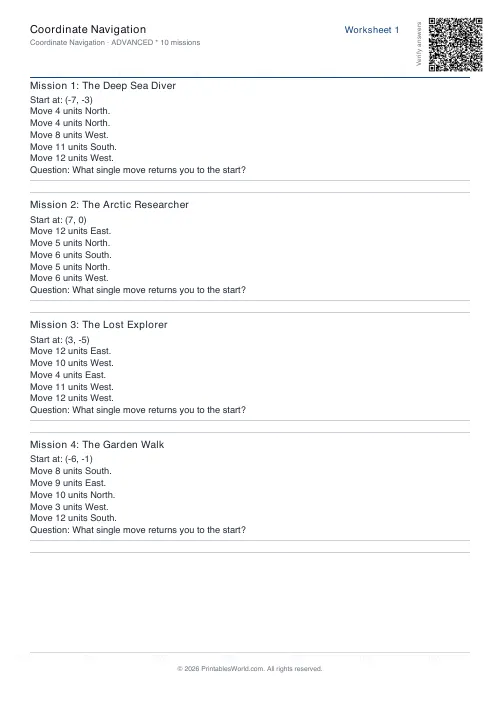 Coordinate Navigation Generator
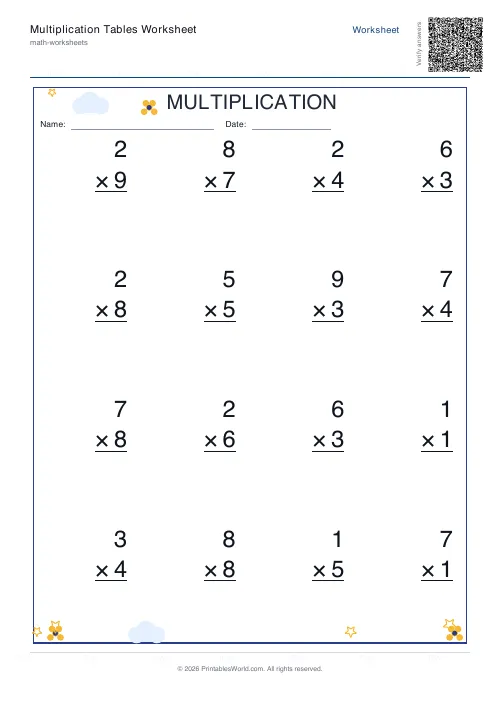 Multiplication Tables Worksheet
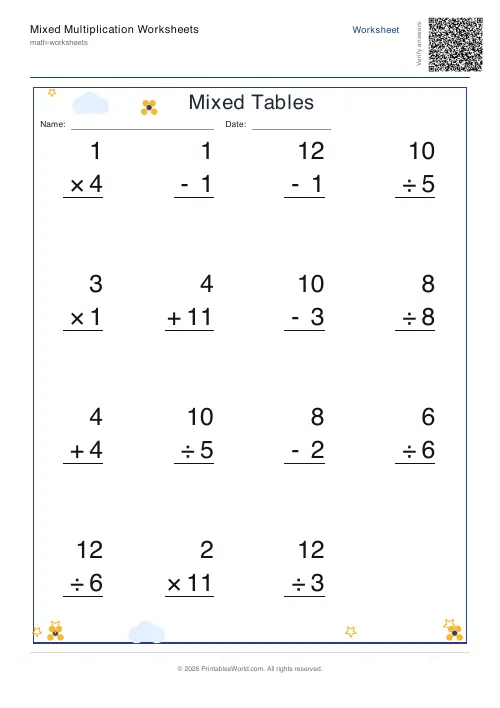 Mixed Multiplication Worksheets
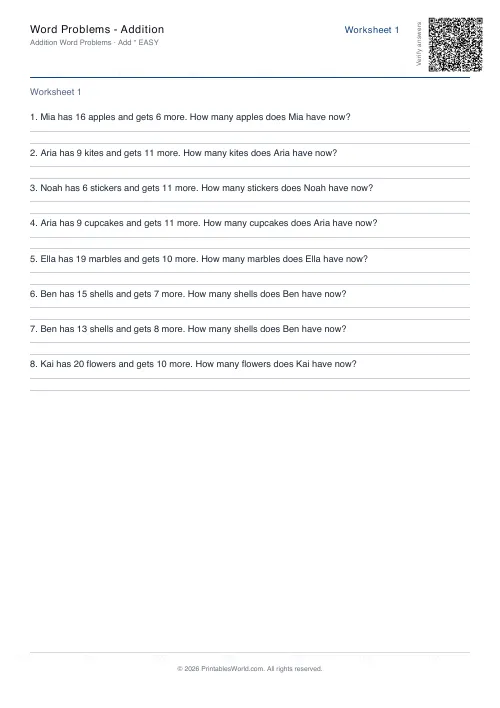 Word Problems: Addition
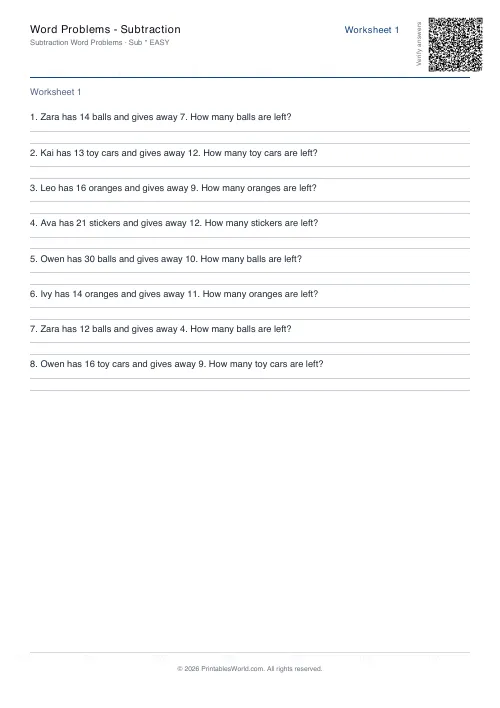 Word Problems: Subtraction
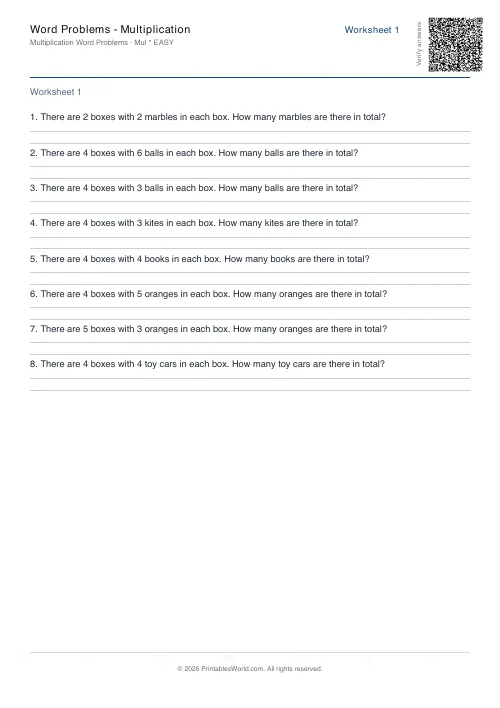 Word Problems: Multiplication
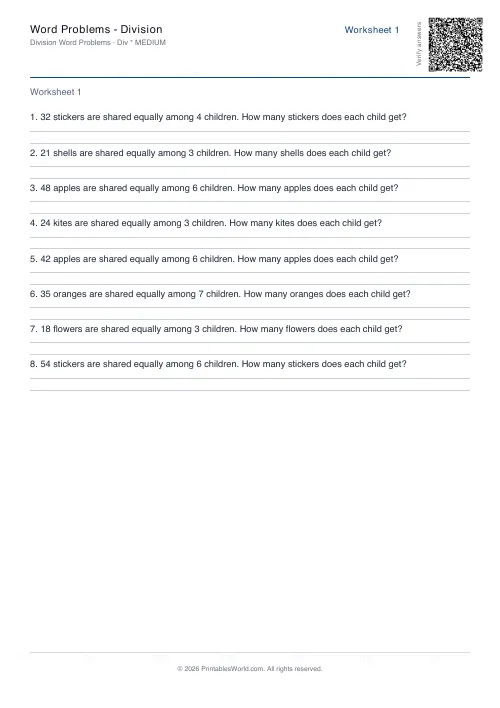 Word Problems: Division