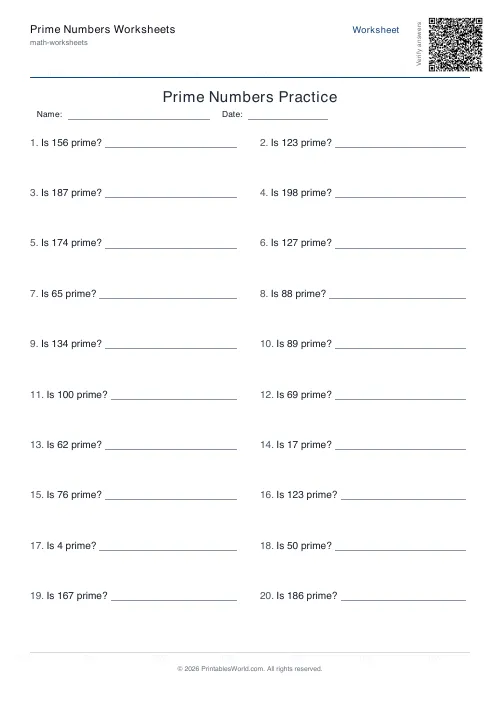
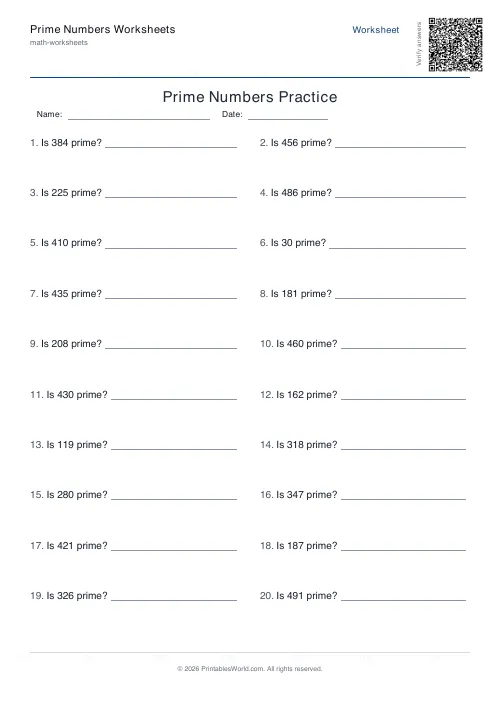
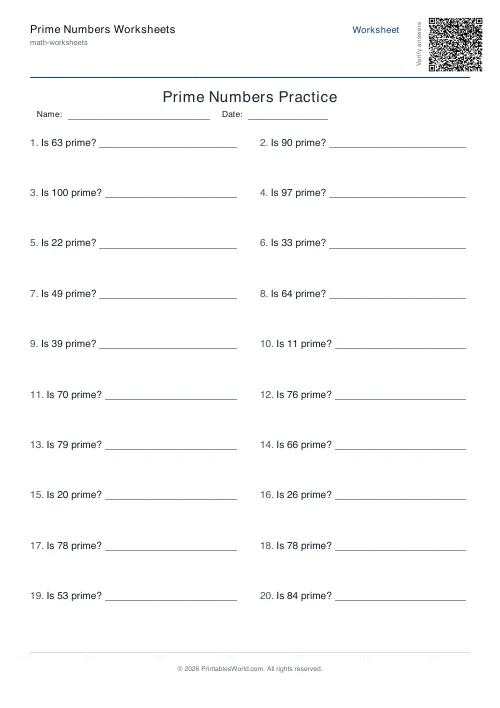
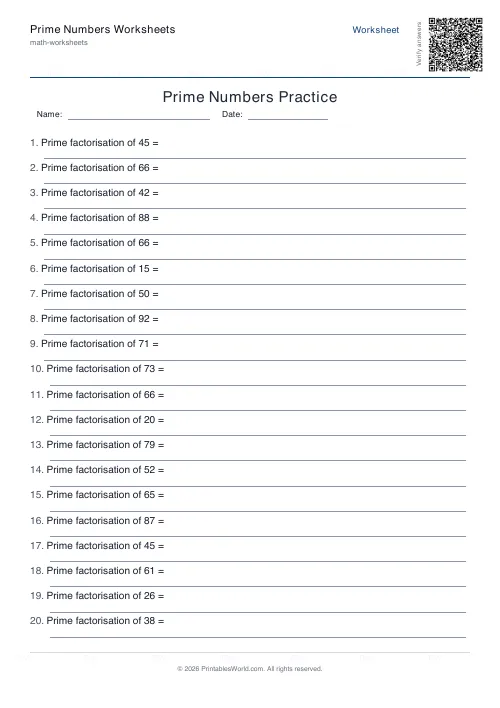
What this tool does
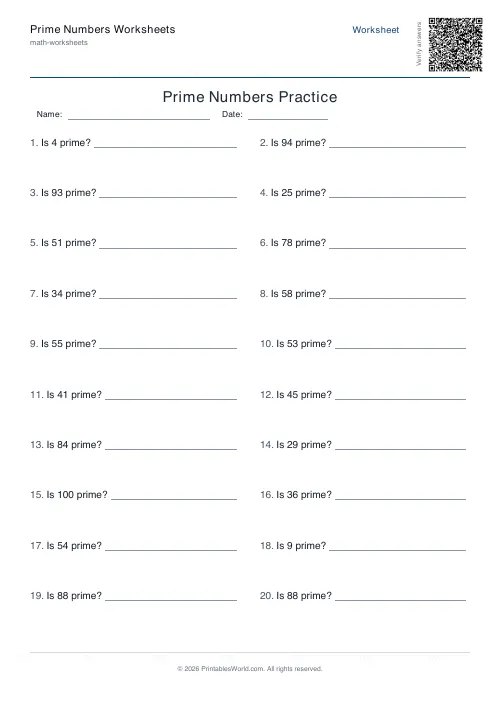
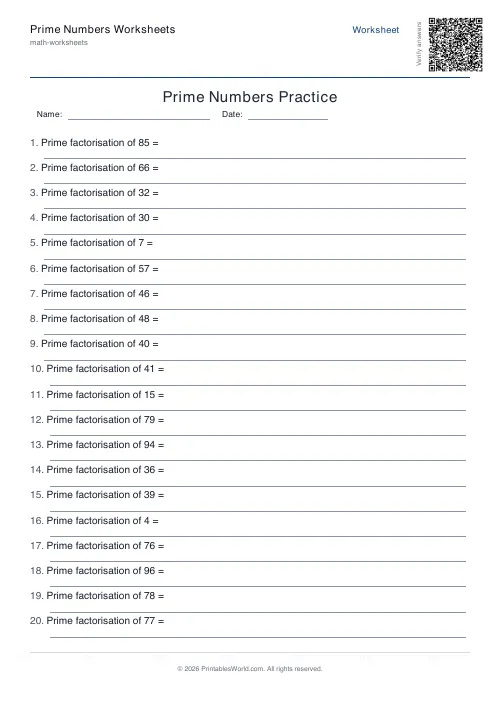
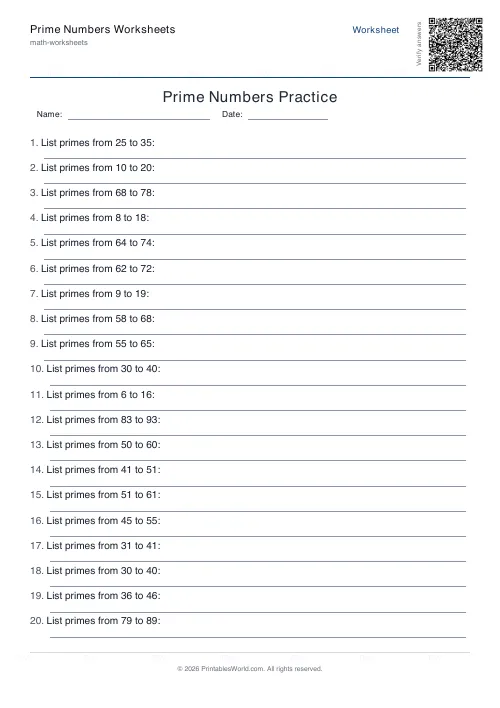
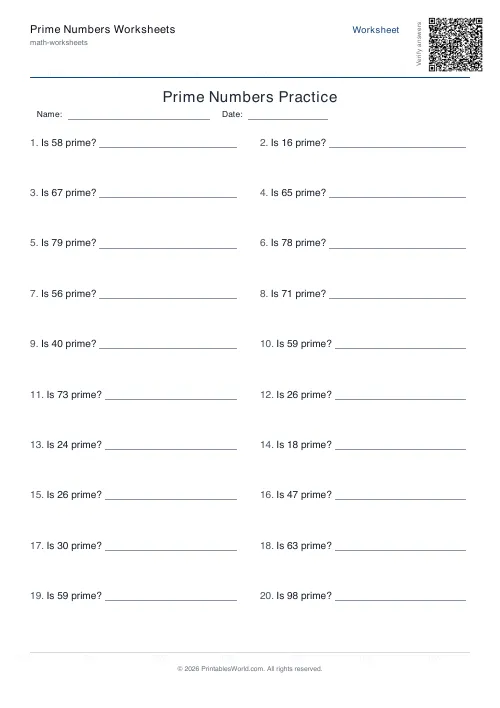
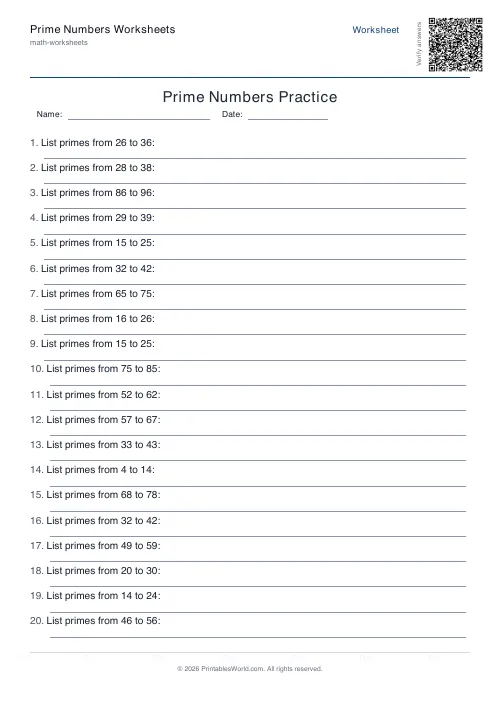
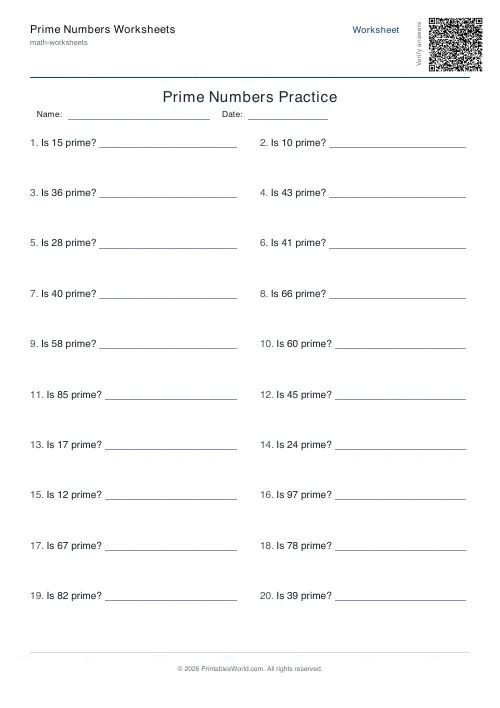
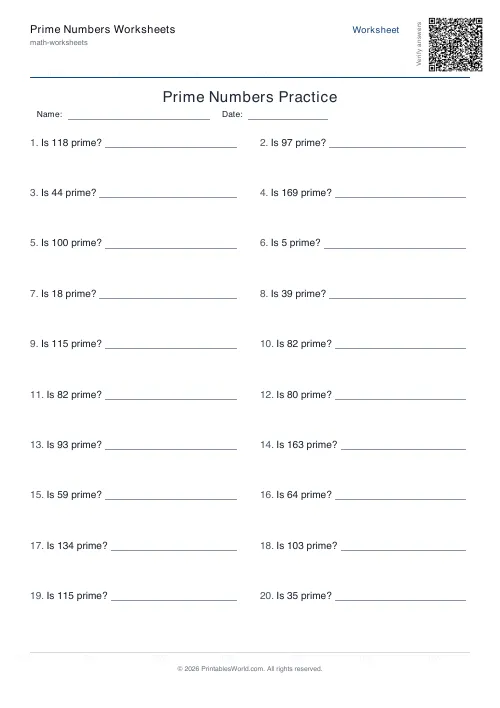
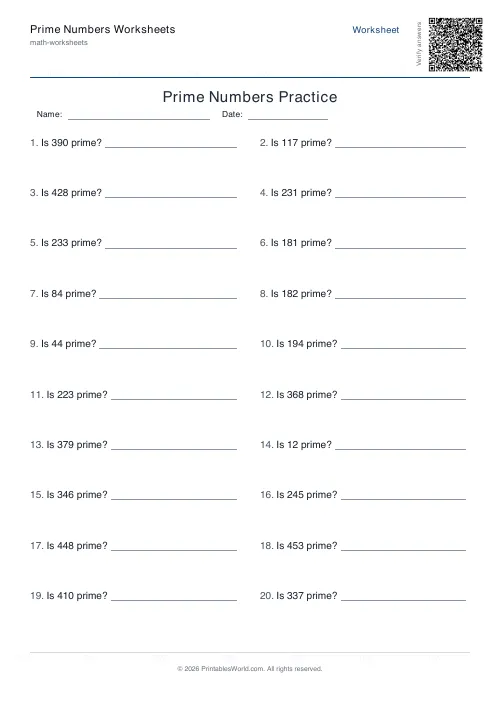
Three kinds of prime practice: decide whether a number is prime, write a prime factorisation, or list every prime in a range. Set the ceiling and the question count.
People also used
Factors & Multiples Worksheets
Generate printable worksheets for factors, multiples, HCF and LCM practice with custom ranges and answer keys.
Square & Cube Numbers Generator
Printable squares, cubes, square roots and cube roots worksheets with optional answer keys.
Mixed Operations Worksheets Generator
One printable sheet mixing +, −, ×, ÷ problems for combined-practice sessions.
Feedback
Spotted something off with this tool?
Three modes
Identify asks whether a given number is prime. Factorise asks for the prime factorisation. Range list asks for every prime between two numbers.
Twenty questions by default with a ceiling of 100, both adjustable.
Which mode when
Identify comes first and is the quickest to mark. It builds the divisibility habits that everything else rests on — even numbers go, digit sums divisible by 3 go, anything ending in 0 or 5 goes, and after those three tests remarkably few candidates are left.
Factorise is the one that matters most later. Prime factorisation is how you find a highest common factor, a lowest common multiple, and how you simplify a surd or a fraction with any confidence.
Range list is the slowest and the best for a lesson starter done as a class. It rewards system over speed, and a pupil who works it by sieving beats one who tests each number in turn.
The definition trips people
A prime has exactly two distinct factors: 1 and itself.
Which means 1 is not prime — it has only one factor — and this is not a technicality invented to annoy pupils. If 1 were prime, every number would have infinitely many factorisations, and the whole point of prime factorisation is that each number has exactly one. Two is prime, and it is the only even prime, which children find suspicious and worth discussing.
Factor trees
The standard method, and the useful property is that it does not matter where you start. Break 60 as 6×10 or as 4×15 or as 2×30, and you arrive at 2² × 3 × 5 every time.
Demonstrating that once, with two different starting splits side by side on the board, does more for understanding the fundamental theorem of arithmetic than stating it does.
Setting the ceiling
A hundred is right for first work: there are 25 primes below it, and the largest number a pupil needs to test against is 7, since anything composite under 100 has a factor of 7 or less.
Raise it to 200 or 500 for stretch, and mention the general rule — you only need to test divisors up to the square root. It converts an intimidating job into a short one, and it is the sort of insight that makes a pupil feel mathematics is on their side.
Related
Factors and multiples is the natural companion sheet.
FAQs
Quick answers
Can I choose which numbers appear in the questions?
No. The generator picks numbers randomly up to your chosen maximum. If you need specific values (for example, only multiples of 10), you will need to edit the PDF manually or use a different tool.
How does the answer key format prime factorisations?
Factors are listed in ascending order, joined by the multiplication symbol (×). For example, 60 appears as 2 × 2 × 3 × 5, not 2² × 3 × 5.
What happens if a range-list window contains no primes?
The answer key will show "none". This can occur with small windows in composite-heavy regions, such as 24 to 26. It is a valid learning moment. Not every interval contains primes.
How many problems fit on one page?
The generator supports 4 to 40 problems. Identify mode usually fits 20 in two columns; factorise and range-list use one wide column and fit fewer (typically 10 to 15) because answers are longer.
Can I adjust the difficulty within a mode?
Yes, by changing the maximum number. A maximum of 20 keeps factorisations simple (mostly 2, 3, 5). A maximum of 200 or higher introduces larger primes and longer factorisations.
Will the worksheet print correctly on US Letter paper?
Yes. The PDF is designed to fit both A4 and US Letter without cropping or scaling. Simply load your paper and print.
Does the generator include a factor tree diagram?
No. Questions and answers are text-only. Students can draw factor trees on scrap paper and then write the final multiplication string on the worksheet.
Related tools
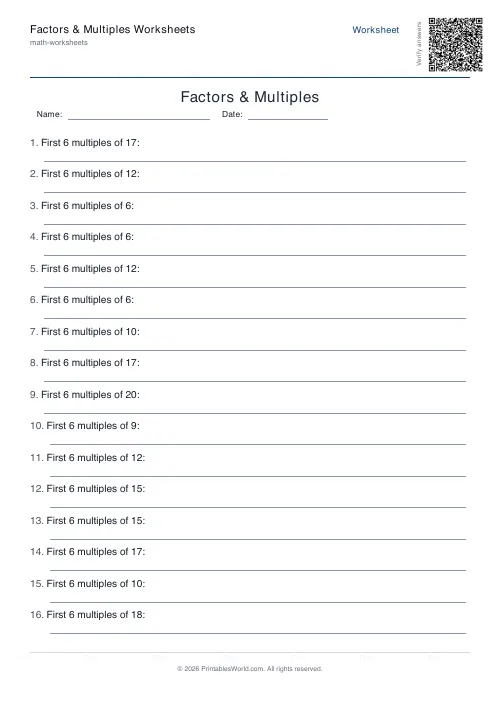
Factors & Multiples Worksheets
Generate printable worksheets for factors, multiples, HCF and LCM practice with custom ranges and answer keys.
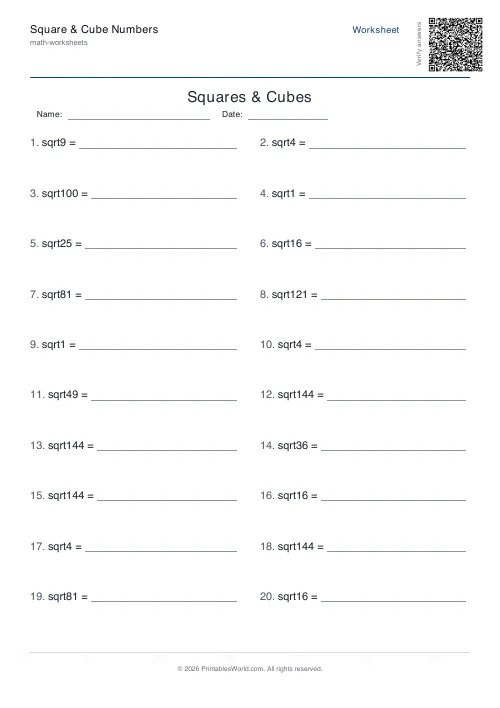
Square & Cube Numbers Generator
Printable squares, cubes, square roots and cube roots worksheets with optional answer keys.
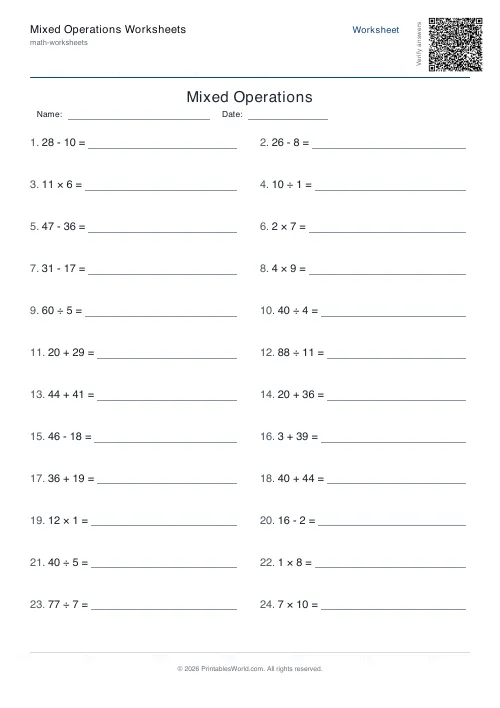
Mixed Operations Worksheets Generator
One printable sheet mixing +, −, ×, ÷ problems for combined-practice sessions.
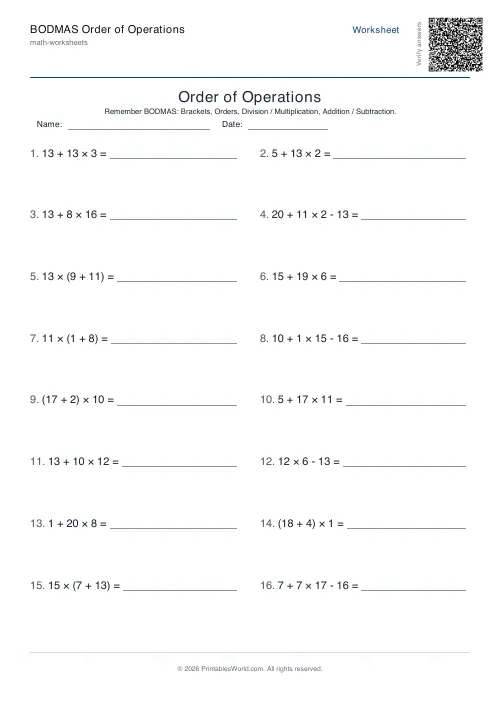
BODMAS Order of Operations Generator
Order-of-operations practice with brackets, exponents and mixed arithmetic.
Further reading
Math Worksheets
Ten frames and number bonds: early maths foundations
A ten frame is two rows of five. That arrangement does something a row of counters cannot. It makes quantities visible without counting, which is where number sense starts.
5 min read
Math Worksheets
Addition strategies: number lines, regrouping and more
Column addition is the destination, not the route. Here are the strategies that come before it, why each matters, and how to tell which one a child is actually using.
5 min read
Math Worksheets
How many maths worksheets per day? A parent's guide
The honest answer is less than most parents assume. And the number of questions matters less than whether the session ends well.
5 min read
More like this
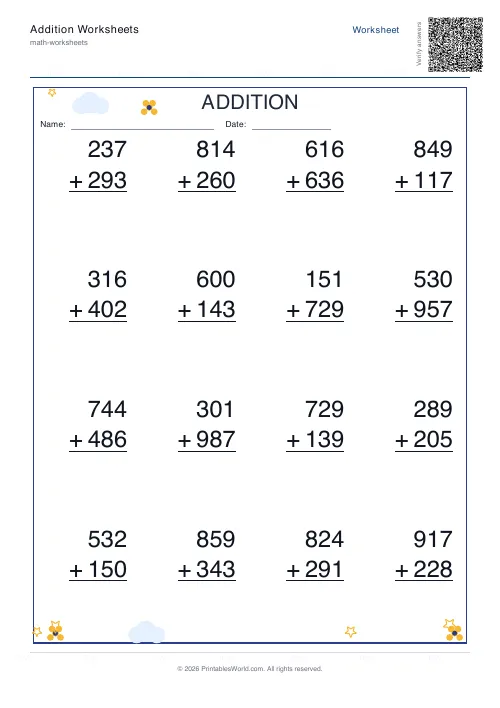 Addition Worksheets Generator
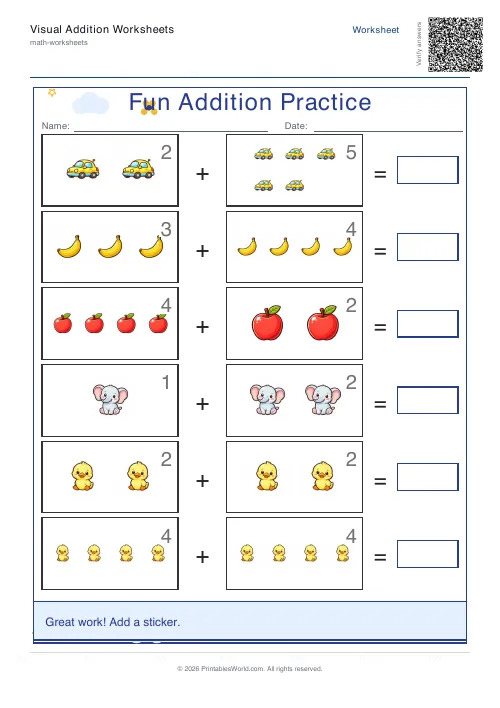 Visual Addition Worksheets Generator
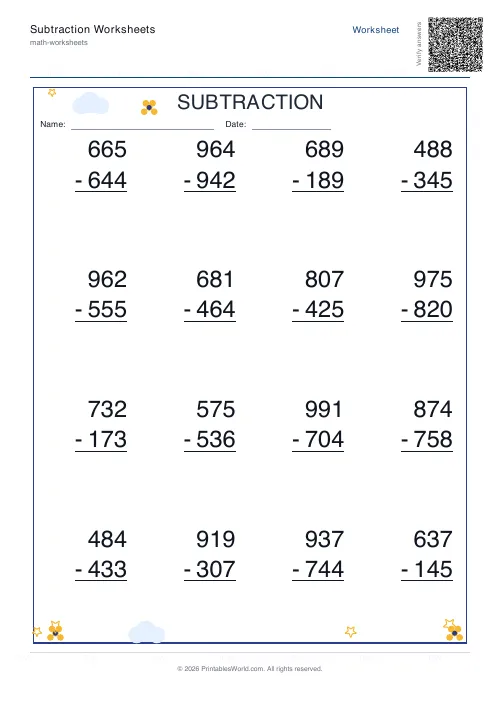 Subtraction Worksheets Generator
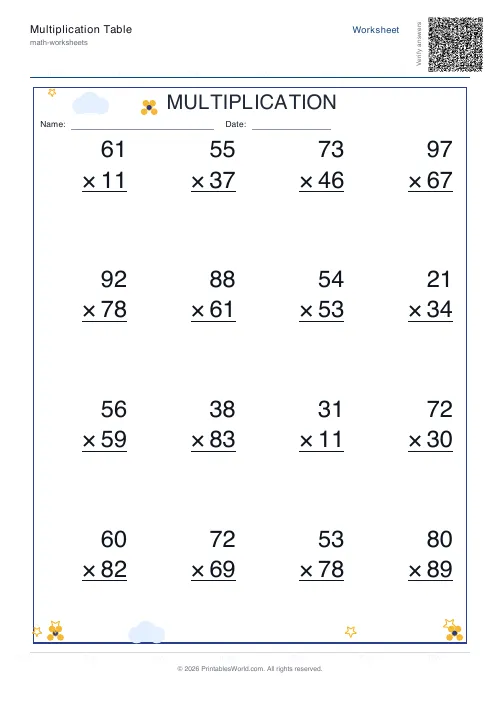 Multiplication Table Generator
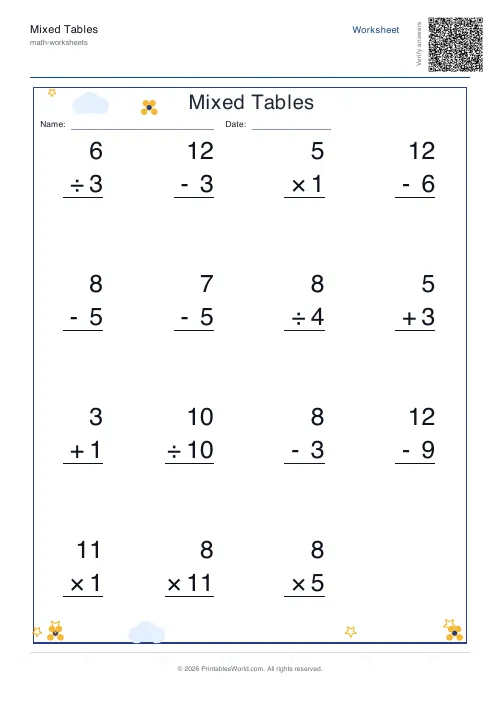 Mixed Tables Generator
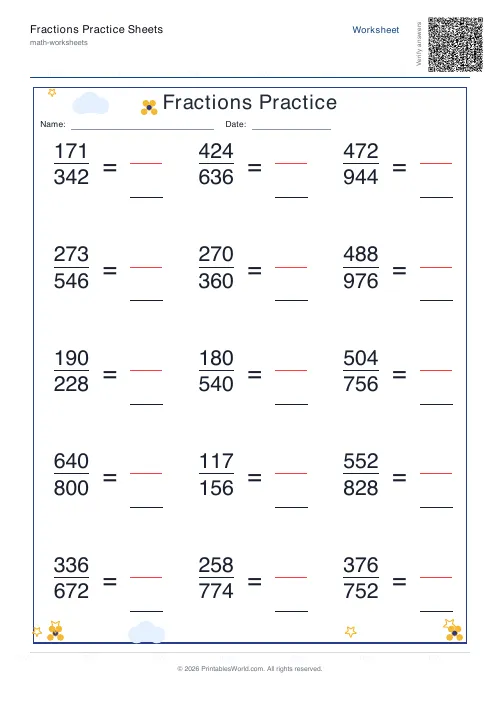 Fractions Practice Sheets Generator
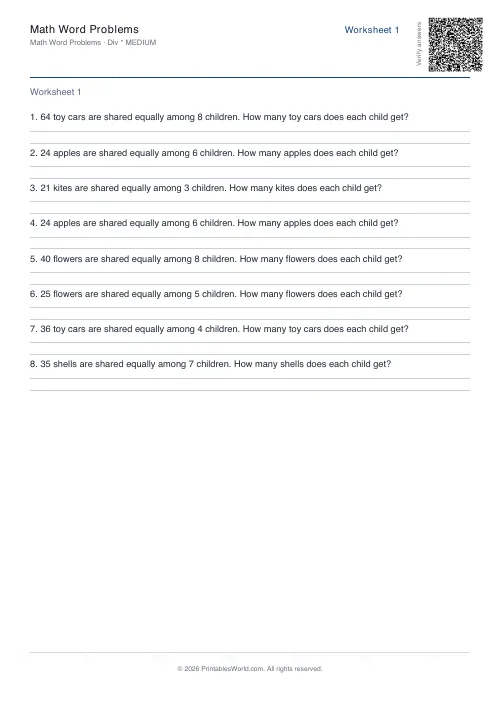 Math Word Problems Generator
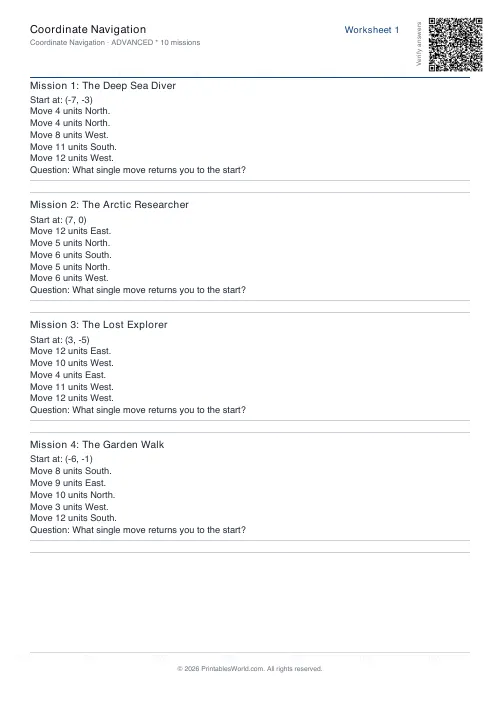 Coordinate Navigation Generator
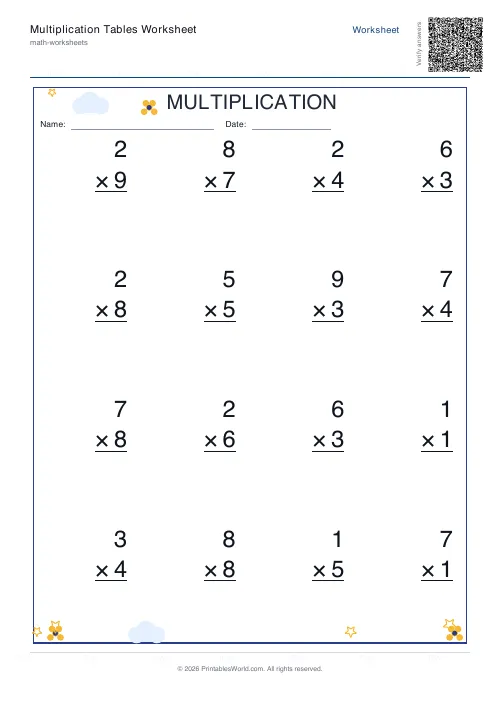 Multiplication Tables Worksheet
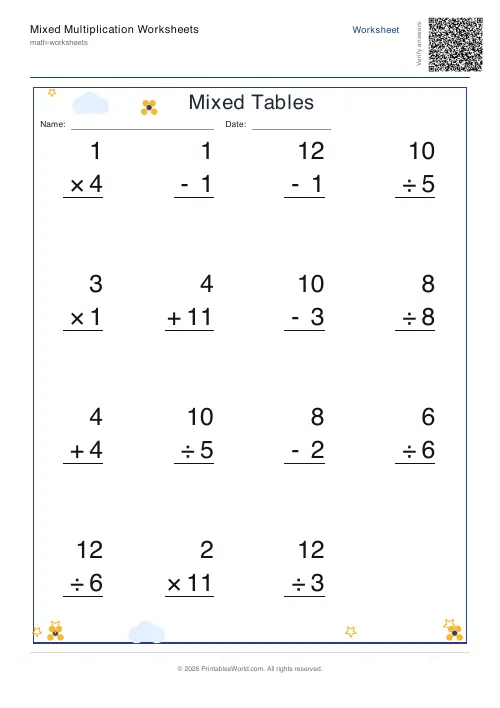 Mixed Multiplication Worksheets
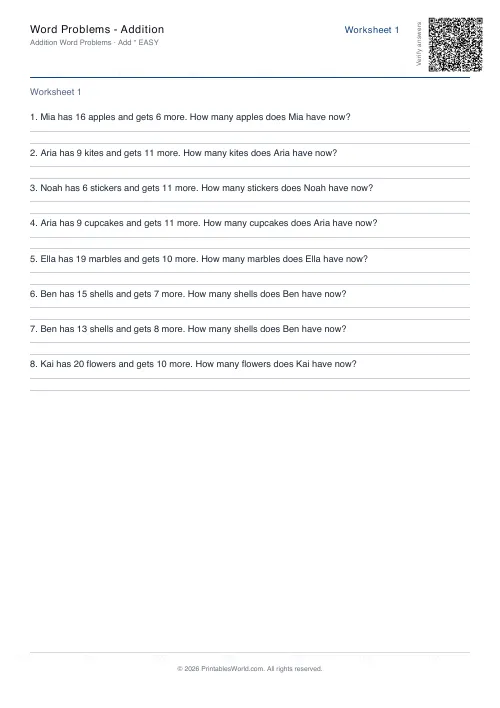 Word Problems: Addition
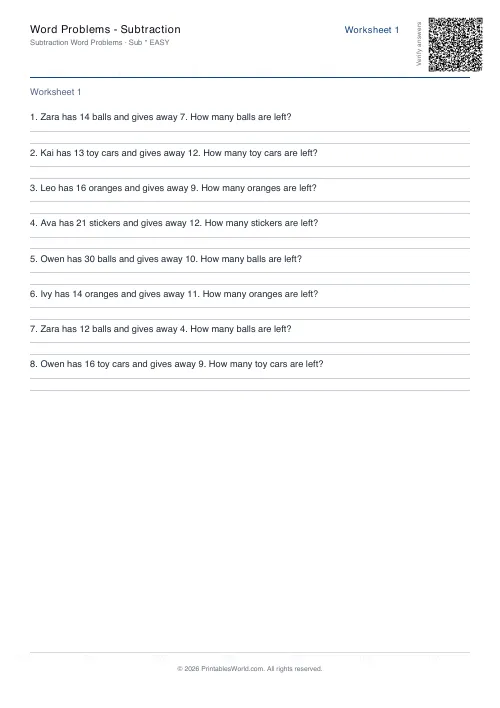 Word Problems: Subtraction
 Word Problems: Multiplication
 Word Problems: Division