What this tool does
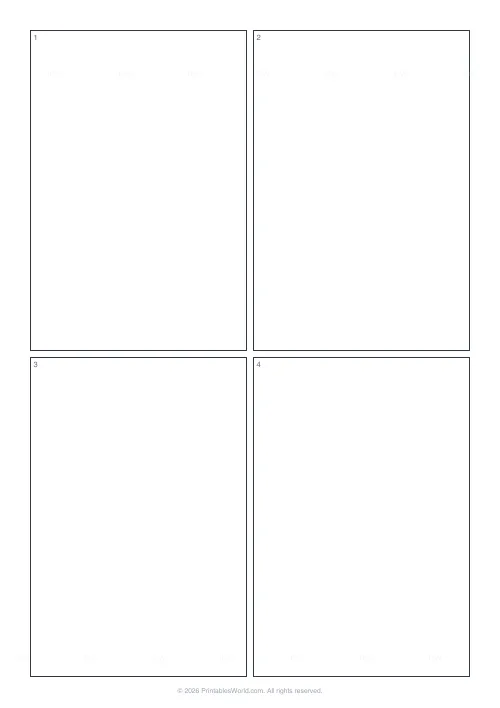
Four equal numbered panels in a 2×2 layout. Blank, so the drawing and the lettering are entirely yours.
People also used
Feedback
Spotted something off with this tool?
Four boxes, numbered, nothing else
A 2×2 grid of equally sized panels with a number in each corner. No speech bubbles, no gutters to fill, no title box.
Four is the classic newspaper strip length and it is a better constraint than it looks.
Why four panels is the useful number
Because it forces a shape. Setup, complication, turn, punchline — that is the structure most four-panel strips land on, and a child given four boxes will discover it without being taught.
Six panels lets the story sprawl. Two is not enough for anything to change. Four is tight enough that every panel has to earn its place, which is the whole discipline of the form.
It is also short enough to finish in a lesson, which matters more than any of the above.
Plan it before drawing
The commonest outcome without planning: panel one is beautiful, panel two is smaller, panels three and four are rushed and the ending has been squeezed into a caption.
Have the four beats written in words first, one line each, before a pencil touches the boxes. It takes two minutes and it is the difference between a strip and a drawing that ran out of room.
The panels are equal on purpose
Real comics vary panel size for pacing — a wide panel slows a moment down, a narrow one speeds it up. That is a genuine technique and it is not what this sheet is for.
Equal panels remove one decision and let the writer concentrate on the sequence. When they are ready for pacing, they can rule their own panels on blank paper, and doing that deliberately is the point at which they have started making comics rather than filling in a template.
Where it is used
Retelling a story in four moments, which is a comprehension task disguised as a drawing task and works far better than a written summary for some children.
Sequencing in science — four stages of a life cycle or an experiment. A visual timeline of a historical event. Instructions, drawn rather than written. And a social story, where the four panels show a situation and a way to handle it.
Also, straightforwardly: a joke. Letting children write jokes is a legitimate use of a lesson and this is the right paper for it.
Settings and printing
Paper size A4 or US Letter. That is the whole configuration.
Print at 100%. Print several — anybody making a strip will want a second sheet for the redraw, and a strip that has been redrawn once is usually a great deal better than the first attempt.
FAQs
Quick answers
How many panels per page?
Four equal panels in a 2×2 portrait layout.
Are the panels numbered?
Yes. A small number sits in the top-left of each panel for reference.
Can I get more panels per page?
Yes. Try the 6-panel or 9-panel comic strip templates.
Will it print on A4?
Yes. A4, US Letter, and US Legal are supported.
Related tools
Comic Strip Template: 6 Panel
Six numbered panels for medium-length comic strips.
Comic Strip Template: 9 Panel
Nine-panel grid. The classic comic book page layout.
Storyboard Template
Six 16:9 frames in a 2×3 grid with caption strips for film and animation.
Genko Yoshi Paper
Japanese manuscript paper for writing kana and kanji.
Manga Panel Template
Pre-ruled manga and comic page layouts with gutters and a bleed guide.
Further reading