What this tool does
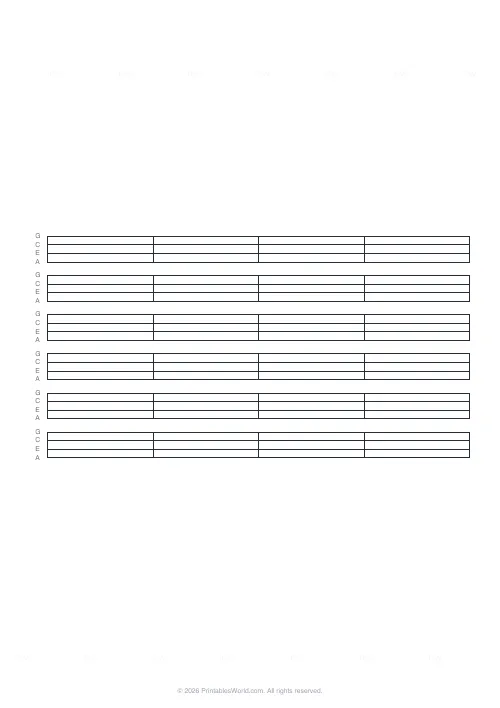
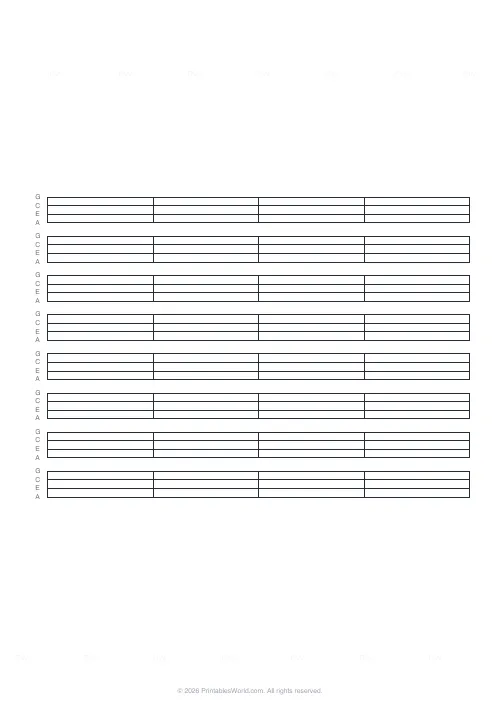
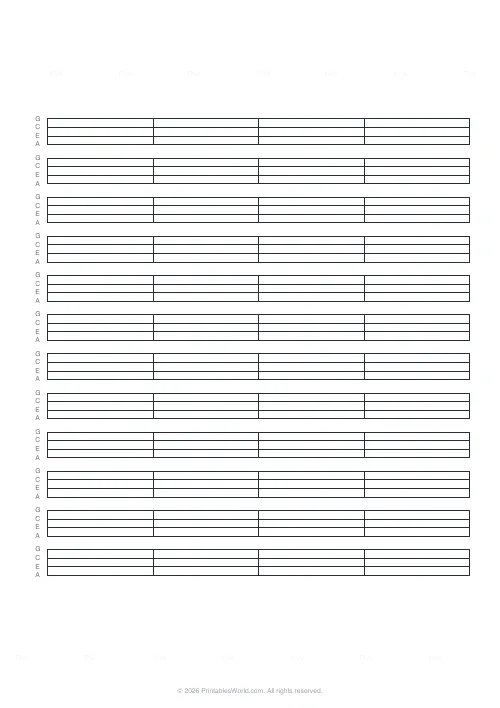
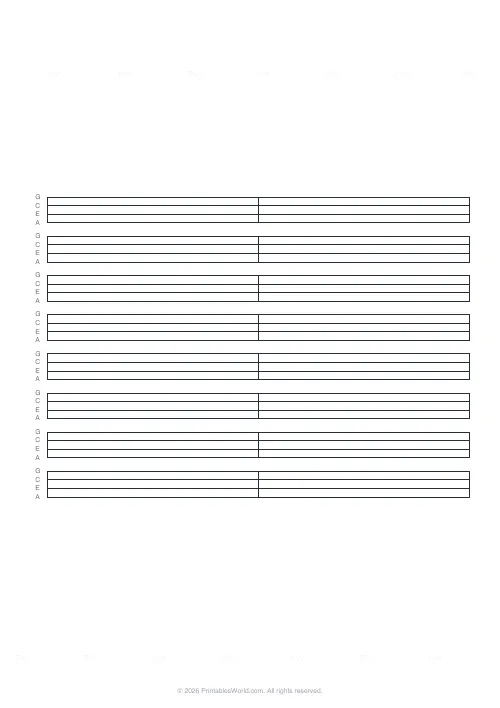
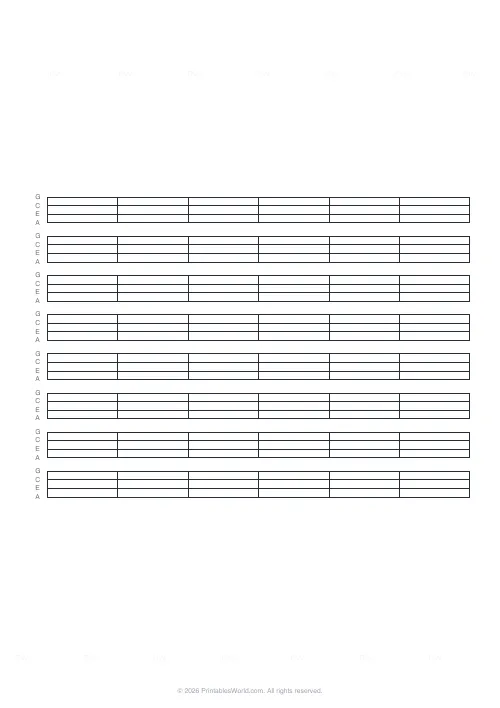
Blank ukulele tab paper: four-line staves labelled G, C, E, A. 3 to 16 staves a page with 1 to 8 measures each.
People also used
Feedback
Spotted something off with this tool?
Four lines, G C E A
Staves of four horizontal lines, labelled from the top: G, C, E, A. Between three and sixteen a page, each divided into up to eight measures.
Sixteen staves gives you a dense working sheet; three gives you room to annotate heavily.
Re-entrant tuning, and why the top line is odd
Standard ukulele tuning is G C E A, and the G is higher in pitch than the C and E below it. The strings do not run low to high.
That is called re-entrant tuning, and it is the reason a ukulele sounds like a ukulele rather than a small guitar — a strummed chord does not rise cleanly from bottom to top, so the voicing has a jangle to it that a linear instrument cannot produce.
For tab it means the top line is the G string, as it would be on any tab, but that string is not your lowest note. Anyone arriving from guitar has to unlearn the assumption.
Reading it
Numbers are frets. Zero is an open string. Stacked numbers are struck together, sequential numbers are played in order.
What tab cannot show is rhythm, which on a strummed instrument is most of the music. Write the strum pattern above the stave — down, down-up, up-down-up, whatever it is — or the sheet records the notes and loses the song.
Chords versus tab
Most ukulele playing is chords, and chords are usually written as diagrams rather than tab. Tab earns its place for the other things: fingerpicked arrangements, melody lines, riffs, and the instrumental break in the middle of a song everybody otherwise strums.
Plenty of players use both on one page — chord names above, tab below for the picked section.
Low-G tuning
Some players swap the G string for a thicker one tuned an octave down, giving a linear low-to-high instrument with a wider range.
The tab is unchanged. The lines mean the same strings and the numbers mean the same frets; only the sound differs. Note which tuning you used at the top of the sheet, because a low-G arrangement played on a re-entrant uke comes out with the bass notes in the wrong octave.
Related
Guitar tab paper for six strings, bass tab for four tuned G, D, A, E, and music staff paper for standard notation.
FAQs
Quick answers
Why are the lines labelled G, C, E, A?
Those are the four ukulele strings in standard tuning, read from the top line to the bottom line of the tab. You write a fret number on a line to show which string to play and where to press.
What do the measure bar lines do?
The vertical bar lines divide each stave into measures (bars) so your rhythm stays organised. You can choose how many measures appear in each stave before you print.
How many staves fit on a page?
You decide. Set the staves-per-page control and the sheet spaces them evenly to fill the whole page, from a few roomy staves to a densely packed sheet.
Is this blank or does it include notes?
It is completely blank. The tool only prints empty labelled staves with measure bars so you can write your own fret numbers, chords, and riffs by hand.
Related tools
Guitar Tab Paper
Six-line guitar tablature paper with string labels.
Music Staff Paper
Five-line stave manuscript paper with selectable staves and clef label.
Blank Piano Keys Template
Printable keyboard diagrams for labelling notes and scales.
Bass Guitar Tab Paper
Blank 4-line bass tablature with G D A E tuning labels and measure bars.
Drum Notation Paper
Blank five-line percussion staves with a drum-clef marker and measure bars.
Further reading