What this tool does
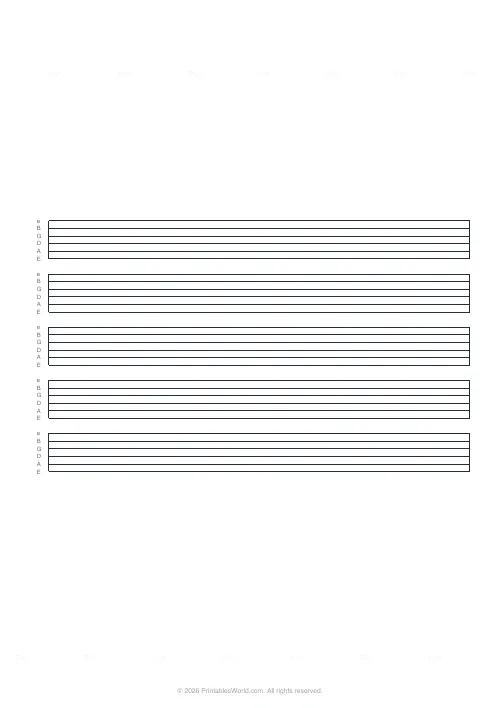
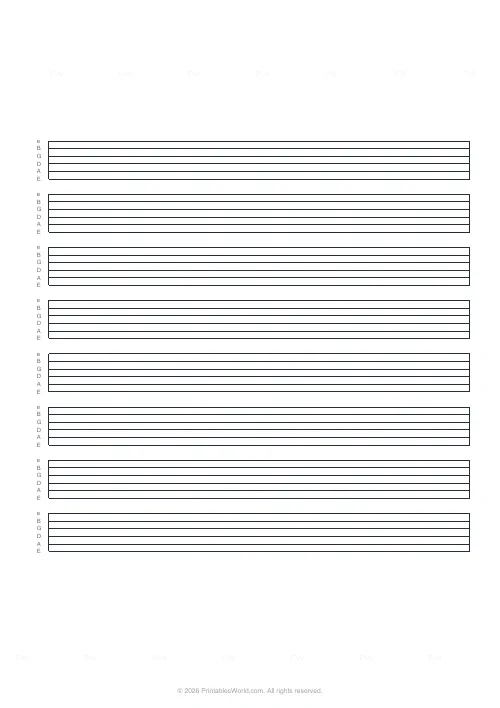
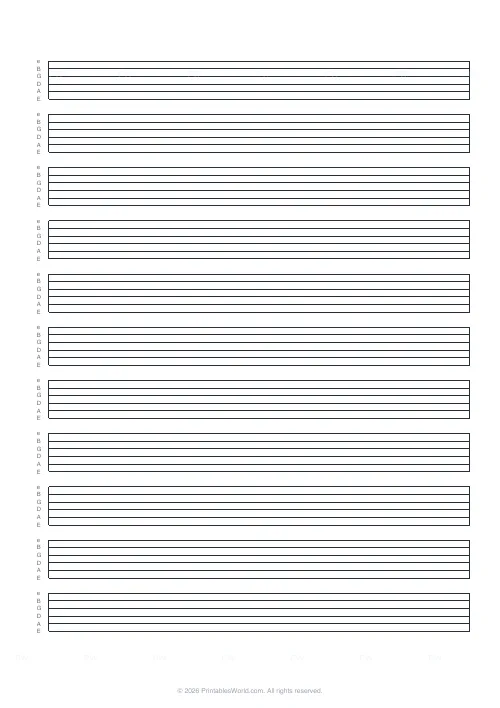
Six-line guitar tablature paper with eBGDAE string labels down the left of every system and a bar line closing each end. Anywhere from four to twelve systems on a page, eight by default. Lines sit 3.2 mm apart, which is enough to write a two-digit fret number between two strings without it touching either.
People also used
Music Staff Paper
Five-line stave manuscript paper with selectable staves and clef label.
Blank Piano Keys Template
Printable keyboard diagrams for labelling notes and scales.
Lined Paper Generator
Generate custom ruled paper PDFs with adjustable line spacing, colours, margins, and primary ruling styles.
Feedback
Spotted something off with this tool?
Six lines, labelled, with room to write between them
Each system is six horizontal lines, the top one for the high e string and the bottom for the low E, with the letters eBGDAE printed down the left so you never lose your place halfway across a page. A bar line closes each end.
The gap is 3.2 millimetres. That number is the whole design: wide enough that a two-digit fret number like 12 or 19 sits cleanly between two strings, tight enough that eight systems still fit a page with space above each one for chord boxes and rhythm marks.
Four to twelve systems, eight unless you change it.
Why paper, when tab software exists
Software is for finished scores. Learning happens with a pencil.
Picking a line out of a recording means pausing every four seconds, playing a phrase back, and scribbling fret numbers before you lose it. Nobody does that in a notation editor, because the editor demands decisions about rhythm and bar length before you have worked out the notes. Paper takes the notes now and the rest later.
Which is why a stack of these ends up used for transcription, for scale and arpeggio patterns, for riff ideas caught on the sofa, for lesson handouts, for practice logs, and for the rough draft of a song that will never be typed up at all.
Choosing the density
Four systems is a lot of white space and it is what you want for slow, detailed work: fingerings, dynamics, counting written underneath, a teacher's annotations in the margin.
Six or eight is the everyday setting. At roughly four bars a system, eight systems is thirty-two bars, which is often a whole verse and chorus on one sheet.
Ten or twelve is maximum density, for capturing riffs quickly or writing out scale positions where you already know the notation will stay simple and nothing needs annotating.
Transcribing a three-minute song
Eight systems a page, three pages. Verse, chorus, bridge, solo.
Write the section name at the top of each page before you start, and use the string-label column on the left as an anchor when you scan back through looking for where the bridge began. Two sheets in, that column is doing more work than you would expect.
Keeping it legible
- A 0.5 mm pencil, or a fine-tip pen.
- Write fret numbers sitting slightly above their line rather than centred on it, so a stacked chord stays readable.
- Rhythmic stems go in the blank space below the system. Never inside it, where they collide with the fret numbers you have just written and make the whole bar unreadable.
- Mark section labels above each system. You are writing this to practise from, and navigation matters more than neatness.
Print at full scale on A4 or US Letter. The system count stays the same on either, and only the width changes to fill the page.
FAQs
Quick answers
How many systems per page?
Choose 4, 6, 8, or 10 systems depending on how much information you need to fit per page.
Are the strings labelled?
Yes. EBGDAE letters at the start of each system.
Will this work for bass guitar?
Bass usually uses 4 lines. This 6-line tab paper is intended for guitar.
Will it print on A4?
Yes. A4, US Letter, and US Legal are supported.
Related tools
Music Staff Paper
Five-line stave manuscript paper with selectable staves and clef label.
Blank Piano Keys Template
Printable keyboard diagrams for labelling notes and scales.
Lined Paper Generator
Generate custom ruled paper PDFs with adjustable line spacing, colours, margins, and primary ruling styles.
Bass Guitar Tab Paper
Blank 4-line bass tablature with G D A E tuning labels and measure bars.
Further reading
Printable Paper
Music manuscript paper: a guide for musicians
The number of staves on a page is not a style choice. It decides how much music fits and how legible it is at a music stand.
4 min read
Printable Paper
Bullet journalling with dot grid paper: a starter guide
The bullet journal was designed to be fast, not beautiful. Here is the original system, why dot grid suits it better than lines or blank, and the four pages you actually need.
5 min read