What this tool does
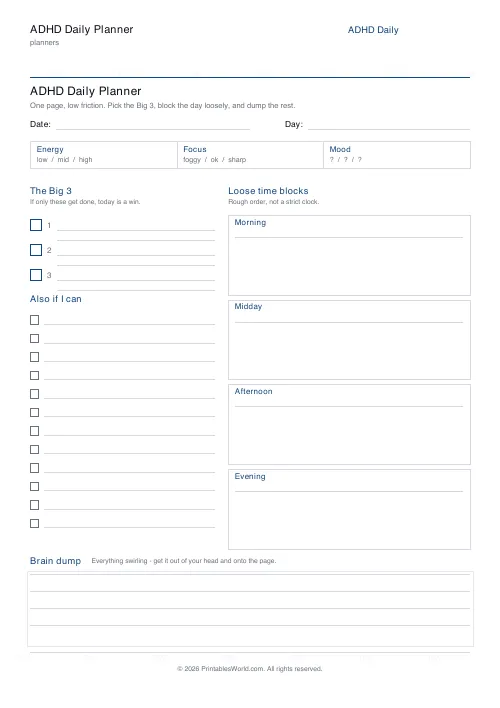
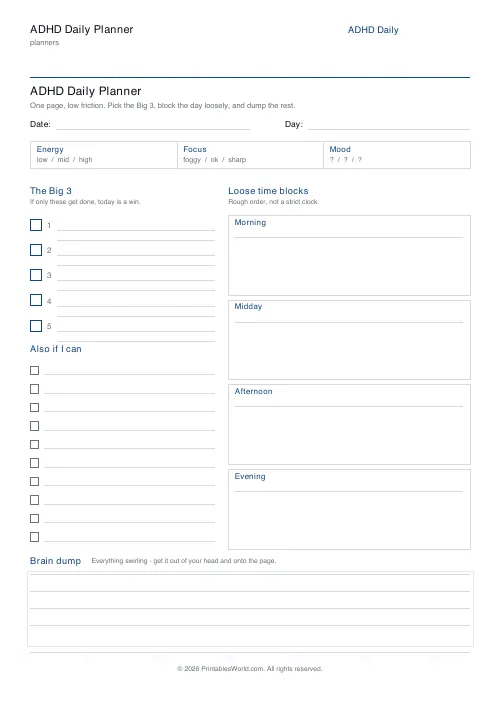
A day planner built for working memory rather than scheduling: a Big 3 must-do list, flexible time blocks instead of clock hours, a brain-dump box and an energy check-in band.
People also used
Feedback
Spotted something off with this tool?
Four blocks, one page
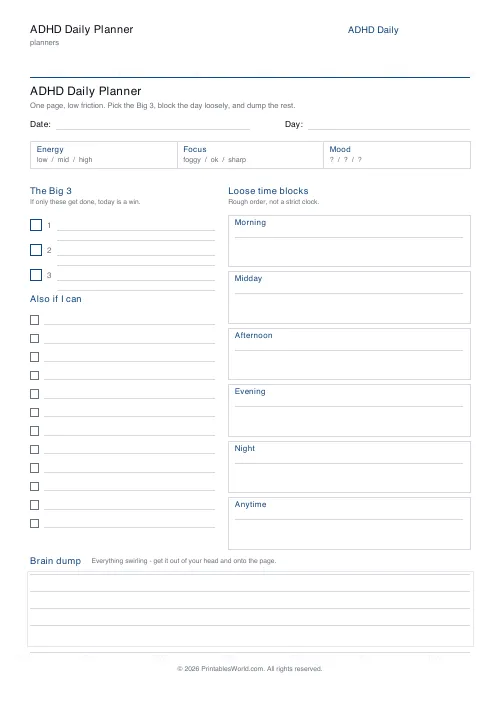
A short must-do list at the top left: the Big 3, or one to five if you prefer. Flexible time blocks run down the right, labelled Morning, Midday, Afternoon, Evening rather than by the clock. A brain-dump box sits across the bottom. A band at the side for energy, for focus, for mood.
The date band, the check-in and the brain dump can each be switched off, and the block count runs from three to six.
Why no hourly grid
Because hourly planners are where ADHD plans go to die.
An hour-by-hour schedule assumes accurate time estimation and reliable transitions, which are precisely the two things that are hard. One overrun at 10am invalidates every row beneath it. By lunchtime the sheet is a record of failure, and it goes in the bin taking the intention with it.
Loose blocks fail more gracefully. A task that slides from Morning to Midday is still in the right place. Nothing cascades, nothing has to be rewritten, and the plan survives the day it was made for.
Three, not thirty
The Big 3 is a hard limit and the limit is the feature.
A twenty-item list is an anxiety generator: everything looks equally urgent, nothing is obviously first, and the list itself becomes the thing being avoided. Three forces a decision about what actually matters today. Anything else that arrives goes in the brain dump, where it is safely written down and explicitly not today's problem.
The brain dump
This is the box that makes the rest usable.
The reason it is hard to start a task is often that six other thoughts are competing for the same attention, and each one has to be actively held because forgetting it feels dangerous. Writing them down releases them. The page holds them now, and the working memory that was holding them is free for the thing in front of you.
Dump anything: tasks, worries, the thing you must not forget to tell someone, an idea that arrived at the wrong moment. It does not have to be tidy, and it will not be.
The energy check-in
Mark it in the morning. Mark it again later.
Over a couple of weeks this tells you when your good hours actually are, which is often not when you assumed, and it is the single most useful thing on the sheet. Once you know it, put the difficult Big 3 item in that block and stop trying to do hard things in the low window.
Practical notes
Print a week at a time and leave them somewhere visible — out of sight is genuinely out of mind, and a planner in a drawer does nothing. Fill it in at the same point each day if you can, but a planner filled in at 11am beats one not filled in at all.
This is a piece of paper, not treatment. It is a scaffold that many people find helps, and it is no substitute for a diagnosis, for medication, or for support from a clinician.
FAQs
Quick answers
How is this different from a normal daily planner?
It drops the rigid hourly grid. Instead of 24 fixed rows, you get a Big 3 must-do list, a few loose time blocks by part of day, an energy check-in, and a brain-dump box. A layout that suits ADHD attention and time blindness better than a strict clock.
What is the "Big 3"?
Your three most important tasks for the day. If only those get done, the day still counts as a win. Capping the list to a handful of items helps avoid the overwhelm that long to-do lists trigger. You can set anywhere from one to five rows.
Can I hide the brain dump or energy check-in?
Yes. Both sections, plus the date band, have toggles. Turn off the ones you do not use and the remaining sections expand to fill the page.
Is it free, and what paper sizes does it support?
It is completely free. Export a one-page PDF in A4 or US Letter and reprint it whenever you need a fresh sheet.
Related tools
Daily Planner
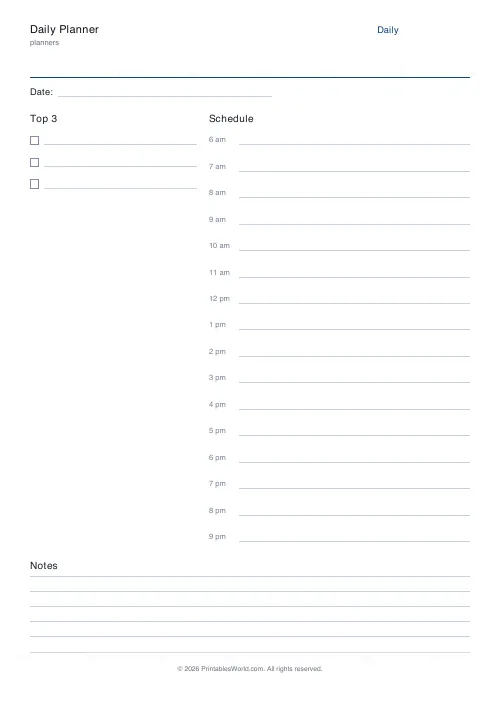
One-page daily planner with priorities, hourly schedule, and a notes strip.
Time Blocking Planner
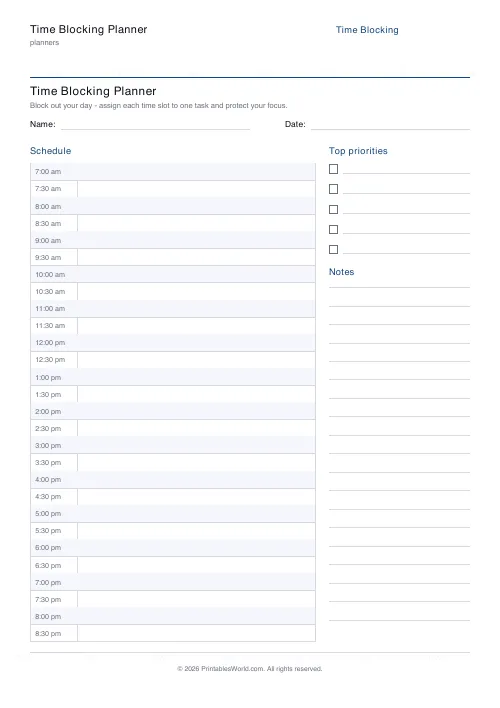
Printable time blocking planner: hourly or half-hourly day blocks, priorities box, notes box.
Weekly Planner
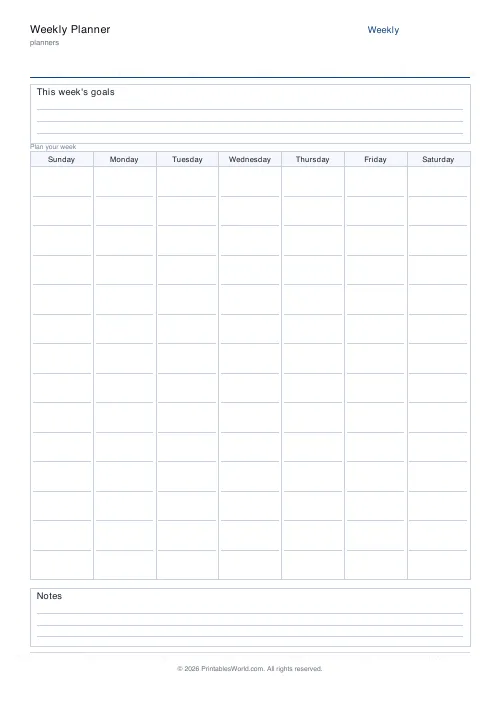
Weekly spread with seven day columns, a goals box, and a notes strip.
Planner Maker: Custom Printable Planner Pages
Build custom printable planner pages with lines, boxes, text and checklists in precise millimetre layouts.
Further reading
Planners
ADHD-friendly planning: systems that work
Standard planners assume you will remember to open them. That single assumption is why they fail for a lot of ADHD brains. And what an ADHD-friendly system has to replace.
6 min read
Planners
How to build a daily routine that actually sticks
Most routines fail in week two, when motivation runs out and nothing has replaced it. The fix is structural: fewer items, fixed anchors, and a plan for the day you miss.
6 min read
Planners
Time blocking for beginners: a complete guide
Time blocking is deciding when each task happens, not just what. Here is how to size blocks realistically, what to do when the day breaks, and why most beginners over-schedule.
5 min read