What this tool does
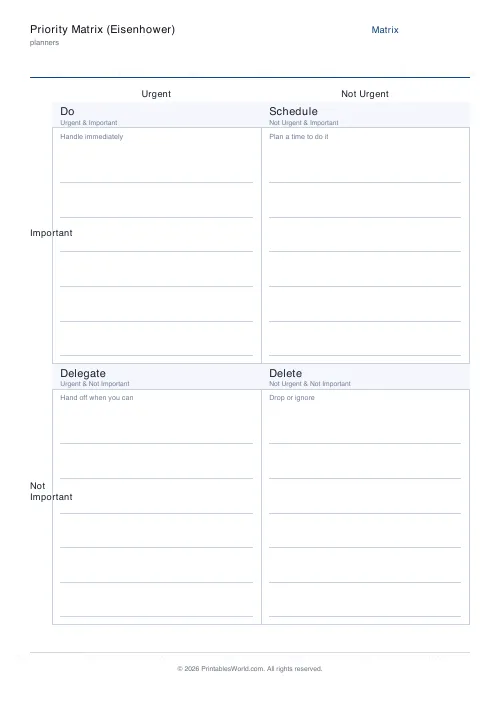
An Eisenhower matrix: four quadrants crossing urgent against important, each labelled with the action it implies. Do, Schedule, Delegate, Delete.
People also used
Feedback
Spotted something off with this tool?
Four boxes, two questions
Urgent or not, along one axis. Important or not, along the other. Every task lands in exactly one of the four, and each quadrant carries the action it implies: Do, Schedule, Delegate, Delete.
Urgent and important are not the same thing
This is the whole insight and it sounds obvious until you sort an actual list.
Urgent means it is making noise now — a ringing phone, a message, a deadline today. Important means it moves something that matters. A great deal of what fills a working day is urgent and not important, and the reason it fills the day is that urgency is loud and importance is quiet.
The quadrant that gets squeezed is important-but-not-urgent, and it is the one containing everything that would prevent next month's emergencies.
What each quadrant actually means
Urgent and important — Do. Genuine crises and real deadlines. If this box is permanently full, something upstream is broken; a life lived entirely here is firefighting.
Important, not urgent — Schedule. Planning, maintenance, learning, relationships, and the tedious admin that turns into a crisis when ignored. This is the quadrant that changes anything, and none of it happens unless it is given an actual time in the week.
Urgent, not important — Delegate. Interruptions, most meetings, most notifications. If nobody can be delegated to, the honest question is whether it needs doing at all.
Neither — Delete. The box people leave empty out of embarrassment. Filling it honestly is the most useful thing on the sheet.
Sort an existing list, do not write a new one
The matrix works as a triage tool on a list you already have. Starting from a blank matrix produces four tidy quadrants that bear no relation to what you actually do.
Take yesterday's to-do list and place each item. The distribution is usually uncomfortable, and the discomfort is the finding.
Named after a remark, not a system
The attribution is to Eisenhower, quoting an unnamed college president: "I have two kinds of problems, the urgent and the important. The urgent are not important, and the important are never urgent."
He did not draw the grid. Stephen Covey popularised it decades later, and it has been drawn on whiteboards ever since.
Settings: a title. A4 or US Letter, printed at 100%.
FAQs
Quick answers
What do the four quadrants mean?
Do (urgent + important), Schedule (not urgent + important), Delegate (urgent + not important), Delete (not urgent + not important).
Is it the same as the Eisenhower matrix?
Yes. This is the classic Eisenhower / Urgent-Important matrix, printed with clear labels in each quadrant.
How many tasks can I write per cell?
Each cell has about six ruled lines; pick short task names so they fit.
Can I use it with a team?
Yes. Print it at A3 (scale up on your printer), or hang it as a shared whiteboard page for stand-ups.
Related tools
Further reading
Planners
Time blocking for beginners: a complete guide
Time blocking is deciding when each task happens, not just what. Here is how to size blocks realistically, what to do when the day breaks, and why most beginners over-schedule.
5 min read
Planners
How to track habits that actually change your life
Habit tracking works because it makes an invisible process visible. It fails when you track too many things, or when protecting the streak becomes more important than the habit.
5 min read
Planners
How to build a daily routine that actually sticks
Most routines fail in week two, when motivation runs out and nothing has replaced it. The fix is structural: fewer items, fixed anchors, and a plan for the day you miss.
6 min read