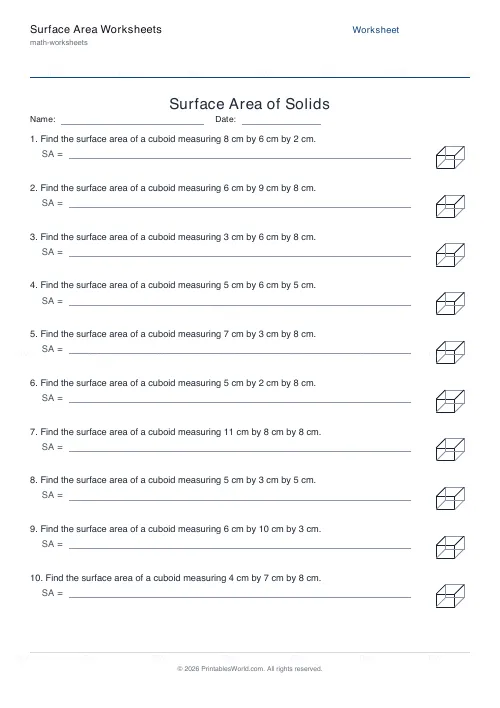
What this tool does
Surface-area practice for three-dimensional solids, with a labelled sketch beside every question. Cuboid mode sticks to rectangular boxes. Cylinder mode brings in π. Mixed blends cuboids and cubes with cylinders and triangular prisms, so the pupil has to identify the solid before choosing a formula. Four to twenty problems a sheet, and an optional answer key that computes every one using π ≈ 3.14.
People also used
Perimeter and Area Worksheets
Generate perimeter and area worksheets for rectangles, squares, triangles, and compound shapes.
Geometry: Angles Worksheets
Print identify, measure, and calculate-missing-angle worksheets with diagrams for every problem.
Coordinates Grid Worksheets
Create printable coordinate grid worksheets with 1-quadrant or 4-quadrant layouts.
Feedback
Spotted something off with this tool?
Three settings, and the third is the assessment
Surface area is the total area of every face of a solid, curved surfaces included. The generator has three modes and they are not just difficulty steps.
Cuboid gives rectangular boxes and one rule: SA = 2(lw + lh + wh). Cylinder switches to SA = 2πr(r + h), which is where π enters the topic. Mixed is the one that tests understanding, because it blends cuboids and cubes with cylinders and triangular prisms on one sheet, so the pupil has to recognise what they are looking at before they can pick a formula. That recognition step is exactly what an exam asks for and exactly what a single-solid worksheet trains out of them.
Every question comes with a small labelled sketch. Four to twenty problems a sheet, ten by default.
The formulas, and why the prisms are tidy
- Cuboid. SA = 2(lw + lh + wh). Three pairs of rectangular faces.
- Cube. SA = 6a². Six identical squares, and the one every pupil gets right.
- Cylinder. SA = 2πr² + 2πrh, which factorises to 2πr(r + h). Two circular ends and the curved side unrolled into a rectangle.
- Triangular prism. Two triangular ends plus the perimeter of the triangle multiplied by the length. The cross-sections here are always right-angled and always drawn from a Pythagorean triple, 3-4-5 and 5-12-13 and so on, so the hypotenuse is a whole number and the final answer does not turn into a decimal nobody can check mentally.
π is 3.14 here, and that might not match your syllabus
Cylinder answers use 3.14 and round to two decimal places, which is the convention in most classrooms and most mark schemes.
If your syllabus uses 22/7, or expects the calculator's π, the cylinder answers on the key will differ slightly from what your pupils produce, and they will notice before you do. Everything else on the sheet is exact. Cuboids come out whole, so do cubes, and so do the prisms, because the dimensions are integers and the triangles are triples.
Two worked ones
A cuboid of 8 cm by 5 cm by 3 cm. The three face pairs are 8 × 5 = 40, 8 × 3 = 24 and 5 × 3 = 15. Add them for 79, double it, and the surface area is 158 cm².
A cylinder with a radius of 4 cm and a height of 10 cm. 2 × 3.14 × 4 × (4 + 10) gives 2 × 3.14 × 4 × 14, which is 351.68 cm². Both appear on the answer key, so a pupil self-marking can see roughly where the arithmetic went astray, and not merely that it did.
Where to start, and when to switch
Teachers
Cuboid mode once area of a rectangle is secure and not before, because surface area is really six area questions wearing a costume. Cylinder mode when π has been met elsewhere. Mixed for revision, and for finding out who has been pattern-matching.
Parents and home educators
Fresh sheets as often as you want them. The sketch does a lot of work for a child who cannot yet hold a solid in their head, and the answer key means you are not recomputing a cylinder by hand at nine in the evening.
Anyone revising
Mixed mode, self-marked. The point is to find out which solid trips you up, and it is usually the prism, because it is the only one where you have to think rather than substitute.
What it does not cover
- Centimetres throughout, answers in cm².
- Triangular prisms have right-angled cross-sections only.
- Twenty problems is the cap, so that every question and its sketch stay legible on a single page.
- No cones. No spheres, and no pyramids. This is prisms and cylinders, which is where most curricula start and stop at this level.
FAQs
Quick answers
Which solids does the generator cover?
Cuboid mode uses rectangular boxes, cylinder mode uses cylinders, and mixed mode blends cuboids, cubes, cylinders and right-triangular prisms. Cones, spheres and pyramids are not included.
What value of π is used for cylinders?
The answer key uses π ≈ 3.14 and rounds to two decimal places. If your syllabus uses 22/7 or the full calculator value of π, the cylinder answers will differ slightly in the final digits.
How is the surface area of a triangular prism calculated?
SA = 2 × (½ × base × height) + (perimeter of the triangle) × length. The cross-sections are right-angled triangles built from Pythagorean triples such as 3-4-5 and 5-12-13, so the hypotenuse and the final answer are whole numbers.
Does each question include a diagram?
Yes. Every problem draws a small sketch of the solid beside the prompt so students can picture the shape. The measurements are stated in the question text.
Can I control the difficulty?
Difficulty follows the mode. Cuboid mode is the most approachable, cylinder mode adds π, and mixed mode is hardest because students must identify the solid before choosing a formula. Dimensions are randomised within sensible ranges each time.
Will the worksheet print correctly on US Letter paper?
Yes. The PDF is designed to fit both A4 and US Letter without cropping or scaling. Load your paper and print directly.
What units are used?
All dimensions are given in centimetres (cm) and all surface-area answers are in square centimetres (cm²).
Related tools
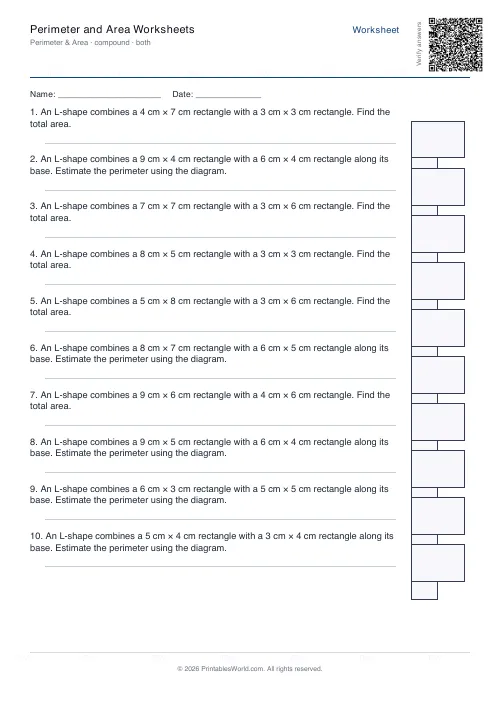
Perimeter and Area Worksheets
Generate perimeter and area worksheets for rectangles, squares, triangles, and compound shapes.
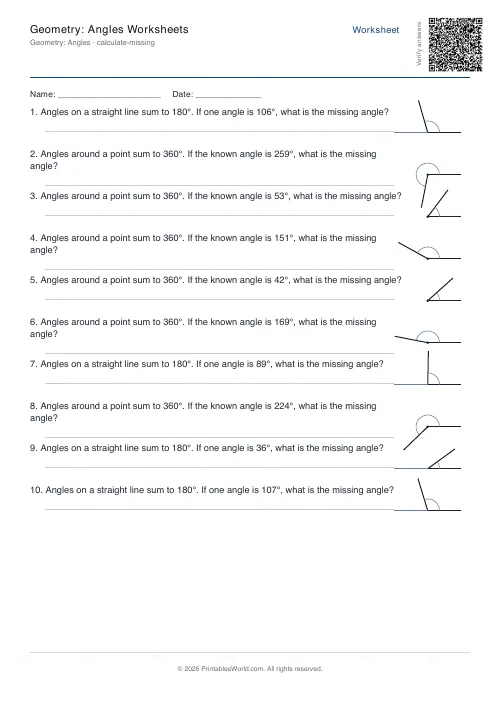
Geometry: Angles Worksheets
Print identify, measure, and calculate-missing-angle worksheets with diagrams for every problem.
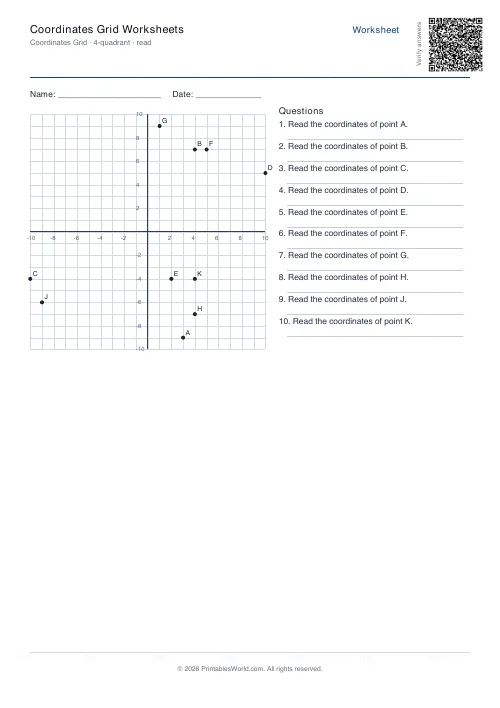
Coordinates Grid Worksheets
Create printable coordinate grid worksheets with 1-quadrant or 4-quadrant layouts.
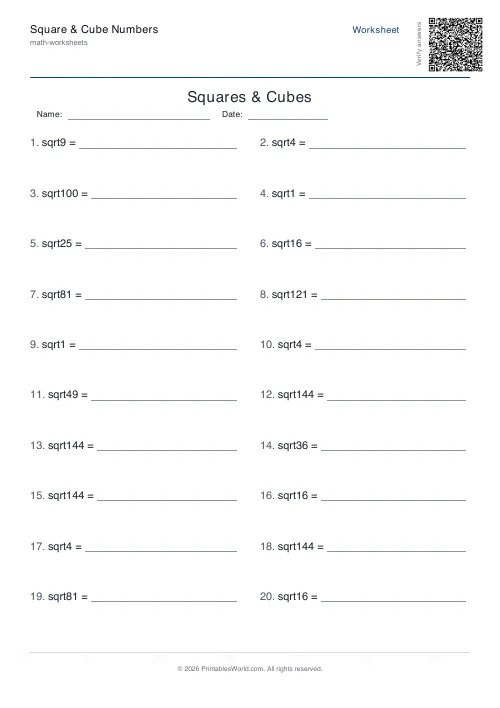
Square & Cube Numbers Generator
Printable squares, cubes, square roots and cube roots worksheets with optional answer keys.
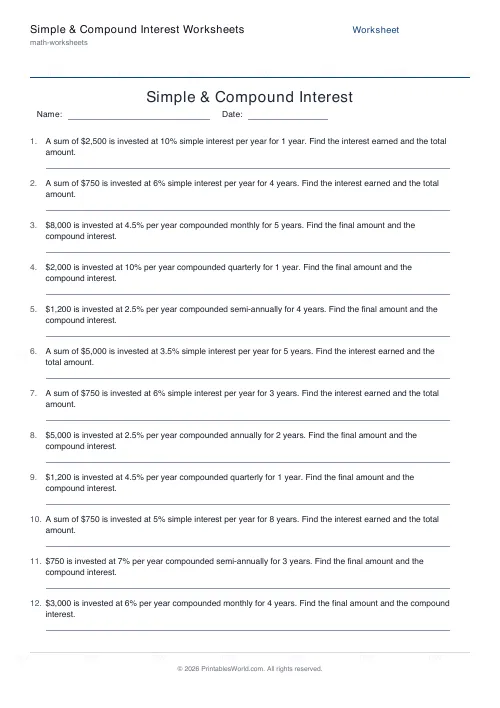
Simple & Compound Interest Worksheets
Generate word problems on simple interest (I = PRT) and compound interest (A = P(1 + r/n)^nt) with worked answer keys.
Further reading
Math Worksheets
How many maths worksheets per day? A parent's guide
The honest answer is less than most parents assume. And the number of questions matters less than whether the session ends well.
5 min read
Math & Numeracy
How to help a child who's stuck on times tables
A simple two week plan to help child with times tables, using short daily practice and free printable multiplication grids you can customise and print.
7 min read
More like this
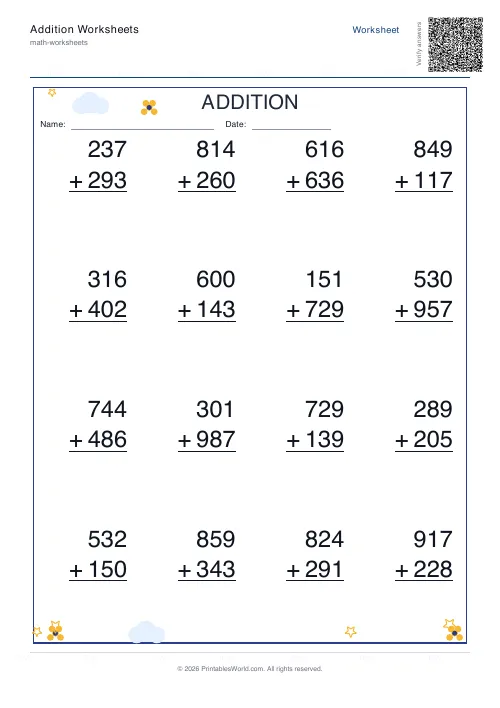 Addition Worksheets Generator
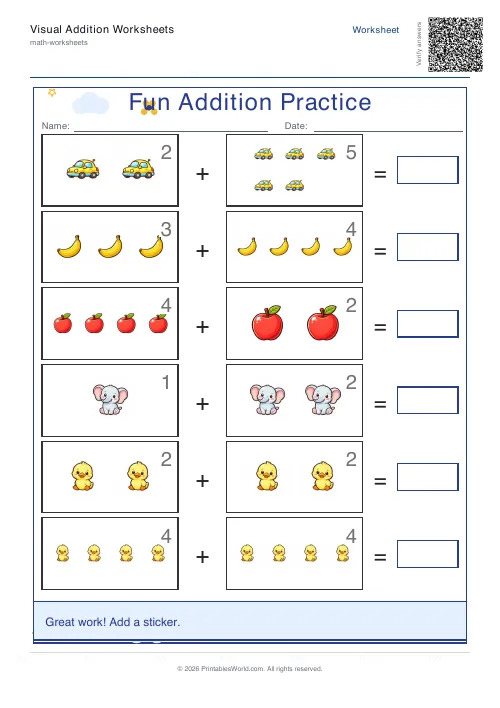 Visual Addition Worksheets Generator
 Subtraction Worksheets Generator
 Multiplication Table Generator
 Mixed Tables Generator
 Fractions Practice Sheets Generator
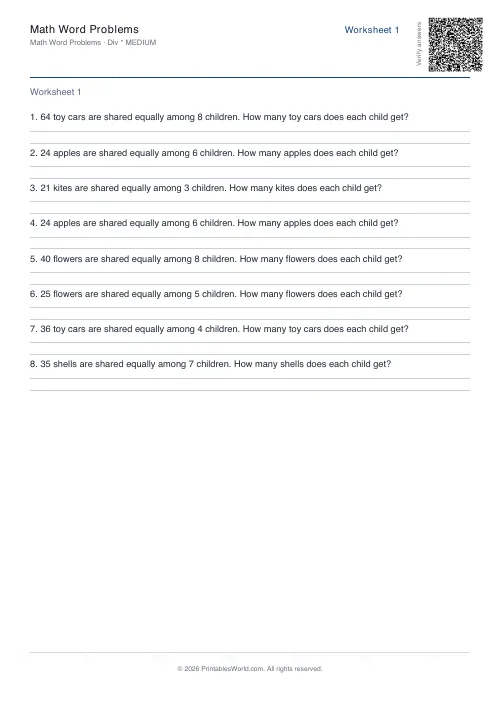 Math Word Problems Generator
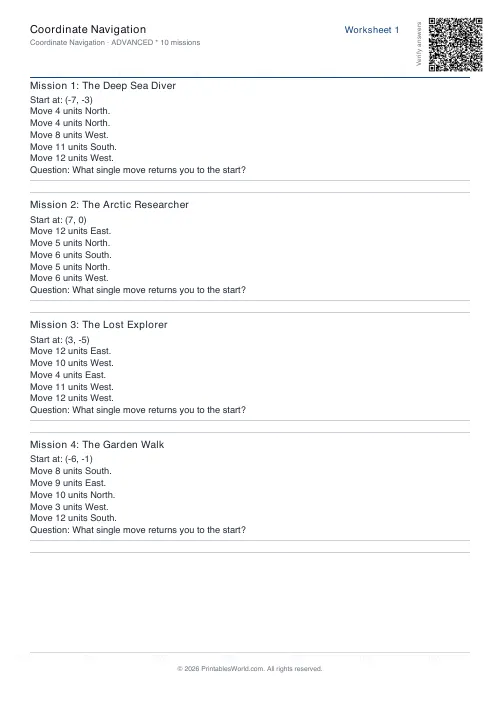 Coordinate Navigation Generator
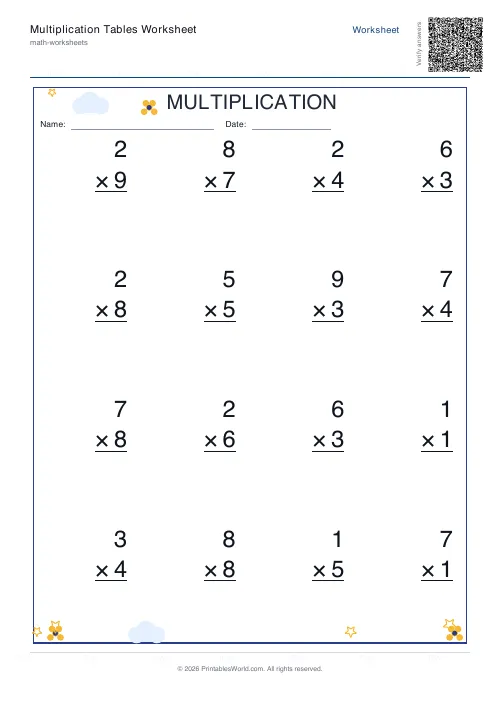 Multiplication Tables Worksheet
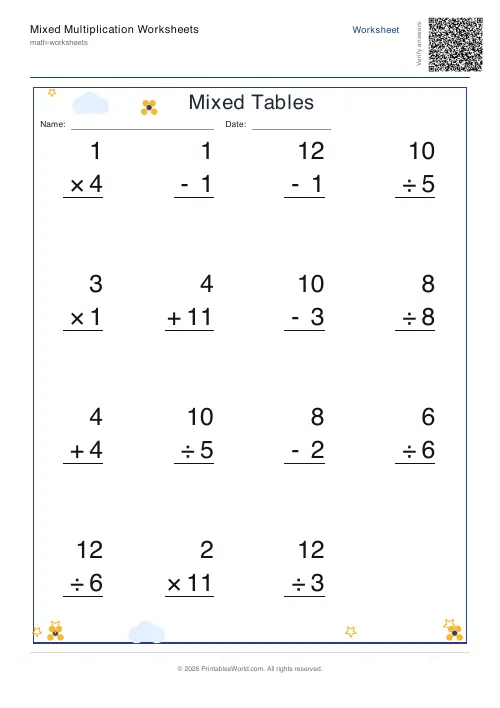 Mixed Multiplication Worksheets
 Word Problems: Addition
 Word Problems: Subtraction
 Word Problems: Multiplication
 Word Problems: Division