What this tool does
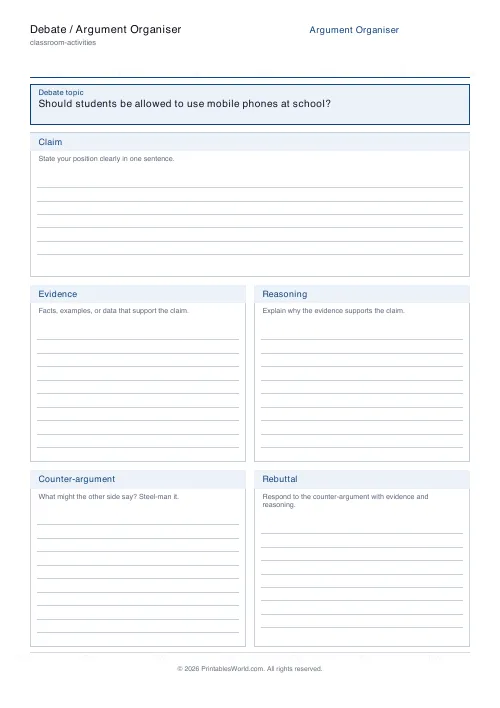
A single-page argument planner running claim, evidence, reasoning, counter-argument and rebuttal. Type the motion at the top and print.
People also used
Feedback
Spotted something off with this tool?
Five boxes, in the order an argument is built
Claim. Evidence. Reasoning. Counter-argument. Rebuttal. The motion goes across the top and each step gets its own labelled space underneath.
Those five steps are the structure of a persuasive essay, a debate speech and a decent letter of complaint. None of it is obvious to anybody who has not been shown it once.
Reasoning is the box everyone skips
Most students go straight from evidence to conclusion, as though the evidence spoke for itself. It never does.
"Phones should be banned. A study found 40% of pupils are distracted by them." Those are two true sentences and there is no argument between them. The reasoning box is where you say why the second supports the first — and being made to write it is where students discover that quite often it does not, or that it supports something weaker than they claimed.
Insist on it. A completed sheet with an empty reasoning box is a sheet that has not done anything.
The counter-argument is not a concession
Students resist this box because naming the other side feels like losing ground. It is the opposite.
An argument that never acknowledges an objection is easy to knock over, because the first person who raises it wins. An argument that raises the objection first and answers it has already dealt with the best thing the other side had. Which is why the rebuttal box comes last rather than the claim — you finish on your answer to their strongest point, not on a restatement of your own.
The useful instruction: write the counter-argument you would find hardest to answer, not the easiest.
Writing a claim worth arguing
It has to be something a reasonable person could disagree with. "Bullying is bad" is not a claim, it is a shared assumption, and a sheet built on it will be empty by the third box.
"Phones should be banned in lessons but allowed at break" is a claim. It is specific, it is contestable, and the counter-argument writes itself — which is exactly what you want.
What is adjustable
A title and the motion. A4 or US Letter.
The default motion is about phones in school, which is there because everyone has an opinion on it. Replace it with whatever the class is actually arguing.
Running a debate with it
Give both sides the same sheet and the same motion. Ten minutes to fill it in, then swap sheets and have each side read the other's counter-argument box.
Worth the lesson on its own, that step. A student who reads how the other side predicted their argument tends to argue better afterwards, and rather more politely.
Print at 100% on A4 or US Letter.
FAQs
Quick answers
What age group is this for?
It suits Key Stage 2 through to A-level. Younger students can use the boxes for simple for/against arguments; older students can plan full essays or debate speeches.
Can I change the debate topic?
Yes. Type your own topic into the box and it prints at the top of the organiser.
What is the difference between counter-argument and rebuttal?
The counter-argument is the strongest point the other side would make. The rebuttal is your response to it, with evidence and reasoning.
Can I use it for essays instead of debates?
Absolutely. The Claim-Evidence-Reasoning structure is the backbone of any analytical essay.
Related tools
Further reading
Classroom Activities
Bingo in the classroom: 10 subjects, one game
Bingo works in almost every subject because the mechanic never changes. Only the call does. Ten variations, and the one rule that turns it from a filler into retrieval practice.
4 min read
Classroom Activities
Back-to-school printables every teacher needs
Sorted by when you will actually need them: the two things to print before the children arrive, the week-one set, and the routines worth establishing while everyone is still compliant.
5 min read