PW PrintablesWorld

Classroom Activities

Hypothesis Worksheet

"If / Then / Because" scaffold for framing a testable hypothesis.

Last updated:

What this tool does

A scaffolded hypothesis-writing worksheet. The page prints three clear boxes — IF, THEN, BECAUSE — to help students frame a testable prediction, with an optional variables block (independent, dependent, controlled) underneath. Works alongside the science experiment log.

Settings

Configure your hypothesis worksheet

IF / THEN / BECAUSE on A4.

Paper size

Preview

Scaffold on the page

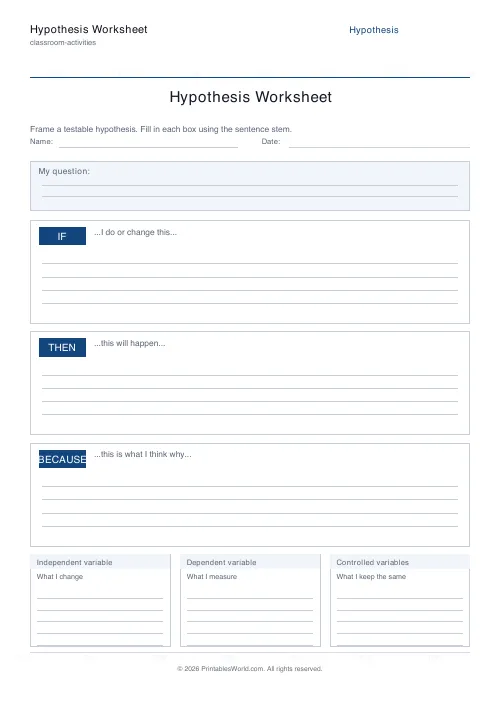
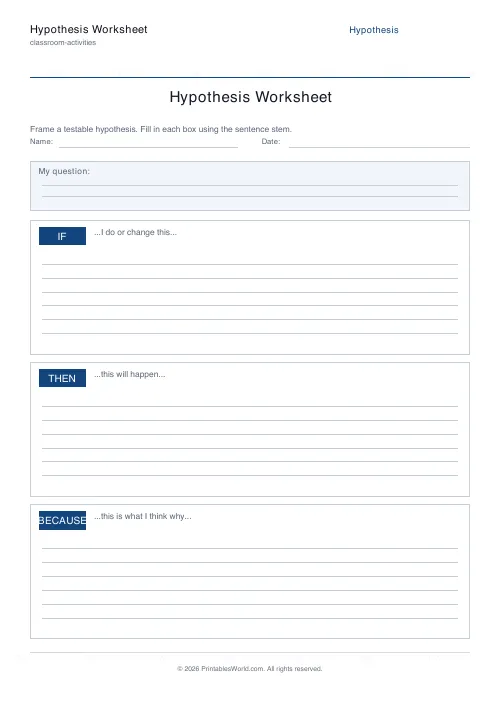
IF…I do or change this…
THEN…this will happen…
BECAUSE…this is what I think why…
Independent
What I change
Dependent
What I measure
Controlled
Kept the same

People also used

Scaffold a Testable Hypothesis with an If / Then / Because Template

Writing a good hypothesis is harder than it looks. This printable hypothesis worksheet gives pupils a three-part sentence scaffold — IF, THEN, BECAUSE — so every prediction is testable and every reason is on the page.

Generate a clean A4 or US Letter PDF with three labelled boxes, an optional variables block underneath, and a brand-consistent header. Works for KS2, KS3, middle school and introductory A-level practical work.

The template is designed for science teachers, tutors and homeschool families who want a repeatable, low-prep way to introduce the scientific method before running a practical.

Why use this hypothesis worksheet?

Pupils often jump from question to experiment without writing down what they expect to see and why. The If / Then / Because scaffold forces them to slow down and commit to a testable prediction. Use it for:

  • introducing the scientific method in primary science
  • working-scientifically lessons in KS2 and KS3
  • fair-test planning before a practical
  • science fair project scaffolding
  • Assessment for Learning starters on prediction
  • homework that primes pupils for the next lesson
  • GCSE and A-level lab notebook prep

Because every pupil writes in the same structure, marking and peer review become faster and more consistent.

What you can customise

The options keep the page focused on the hypothesis itself:

  • Worksheet title: defaults to "Hypothesis Worksheet" but re-word for specific topics
  • Include variables block: three side-by-side boxes for independent, dependent and controlled variables
  • Optional Name and Date fields in the header
  • Paper size: A4 or US Letter
  • Optional prompt text inside each box to remind pupils of the scaffold

Turn the variables block off for a simpler version aimed at younger pupils, or keep it on for GCSE-style fair-test work.

Notes and limitations

  • The scaffold is a writing frame, not an answer key — pupils still need to develop the reasoning in the BECAUSE box themselves.
  • The variables block assumes a single independent variable; for multi-variable investigations, use the experiment log instead.
  • Print at 100% scale so the boxes do not shrink on the page.
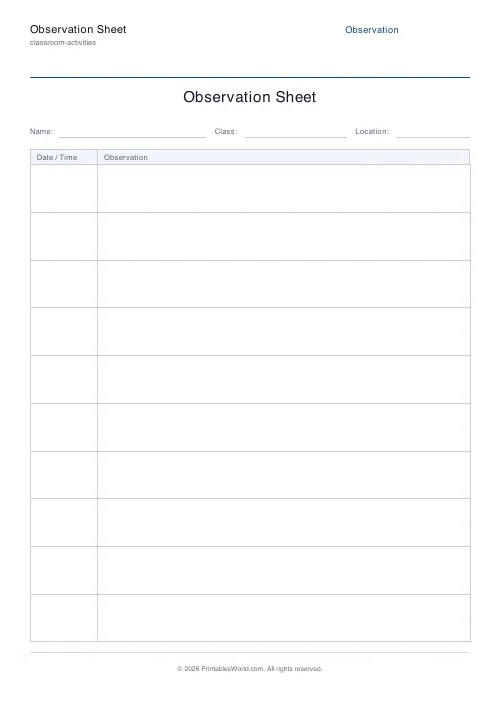
  • Pair with the observation sheet if pupils will record ongoing measurements.

Who this scaffold is for

The worksheet suits anyone introducing hypothesis writing to learners for the first time.

Parents

Handy for home science kits and weekend experiments. The scaffold turns a curiosity question into a structured prediction you can test together.

Teachers

Use as a starter in a working-scientifically lesson, a planning sheet before a practical, or a plenary where pupils revise their hypothesis after the lesson.

Homeschool families

Great for science units that revisit the same scaffold over several experiments so the framework becomes automatic.

Tutors

Use in GCSE and A-level revision sessions to rehearse required-practical planning under exam conditions.

Scaffold options

If / Then / Because only

The simplest version. Best for Years 3–6, EAL learners and any lesson where you want to focus on the logic of a prediction.

Variables block included

Adds three labelled columns — independent, dependent and controlled variables. Best for KS3 and above where fair testing is part of the learning objective.

Optional prompts inside each box

Faint sentence starters — "If I change…", "Then I expect…", "Because…" — remind pupils of the structure without dictating content.

How to use the tool

  1. Type your worksheet title or keep the default.
  2. Toggle the variables block on or off.
  3. Choose whether to include Name and Date fields.
  4. Pick A4 or US Letter as the paper size.
  5. Click Generate Worksheet.
  6. Preview the sample page in the browser.
  7. Download the PDF and print a class set.

Worked example

A Year 7 class is investigating how the length of a pendulum affects its period. The teacher generates a hypothesis worksheet titled "Pendulum Investigation" with the variables block switched on.

A pupil writes: IF I increase the length of the pendulum, THEN the time for one full swing will increase, BECAUSE a longer pendulum has further to travel on each swing and gravity pulls it back more slowly. In the variables block they write: independent variable — pendulum length; dependent variable — time for one swing; controlled variables — mass of bob, release angle, starting position. The class then uses this page as a reference throughout the practical.

Methodology

The engine prints three labelled boxes stacked vertically for the If, Then and Because stems, each sized to fit two or three lines of handwriting. When the variables block is enabled, a three-column table is added below with headers for independent, dependent and controlled variables. The shared branded template handles the page header, footer watermark and QR code so the hypothesis layout stays clean and consistent with every other printable on the site.

Helpful preset ideas

  • Primary: If / Then / Because only, no variables block
  • KS3: full template with variables block
  • GCSE required practical: full template plus Name and Date header
  • Science fair: blank title, variables block on, for project-wide use
  • Cover lesson: generic title so supply staff can use the same sheet

Best ways to use the hypothesis scaffold

  • Model a completed example on the board before pupils attempt their own.
  • Use the BECAUSE box for peer review — swap sheets and check the reasoning.
  • Revisit the worksheet at the end of the practical so pupils compare prediction to result.
  • Collect a class set over a term to show progress in scientific writing.
  • Laminate a class display copy as a permanent reference.

Designed for A4 and US Letter printing

Both paper sizes are supported so schools in any region can print at 100% scale. The engine resizes each box to fit the page while keeping the branded header consistent with the rest of the site's science printables.

Related science and organiser templates

Pair this worksheet with:

FAQs

Quick answers

What is the If / Then / Because framework?

A simple sentence scaffold that forces a testable hypothesis: "IF I change X, THEN Y will happen, BECAUSE …". It makes the prediction explicit and its reasoning visible.

What is the variables box for?

Three side-by-side boxes for the independent variable (what I change), the dependent variable (what I measure) and controlled variables (what I keep the same). Toggle it off for simpler lessons.

Is this suitable for primary school?

Yes — upper primary onwards. Younger students can fill in IF / THEN / BECAUSE only; the variables box is optional for older students.

Does it pair with the experiment log?

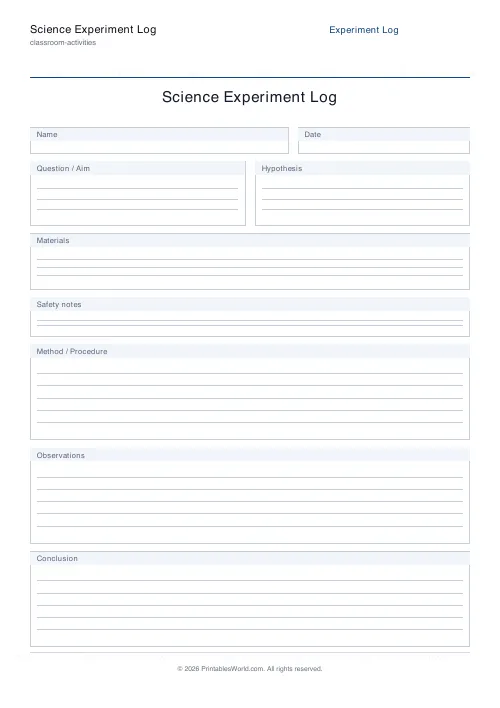
Yes. Many teachers staple the hypothesis worksheet to the front of the science experiment log so students revisit their prediction after collecting data.

Related tools