What this tool does
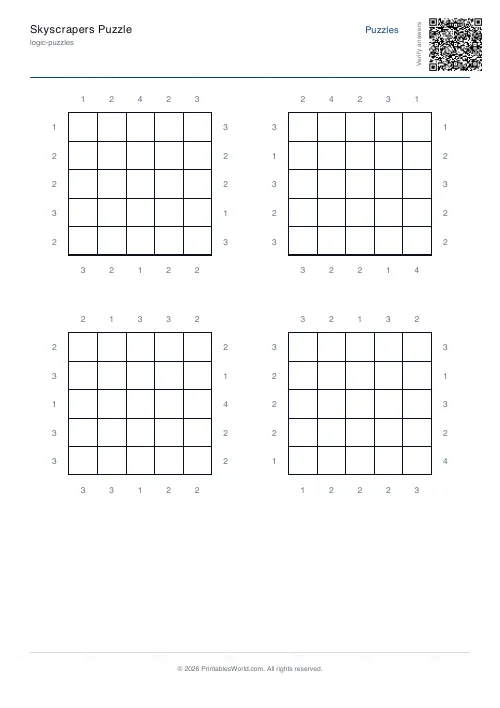
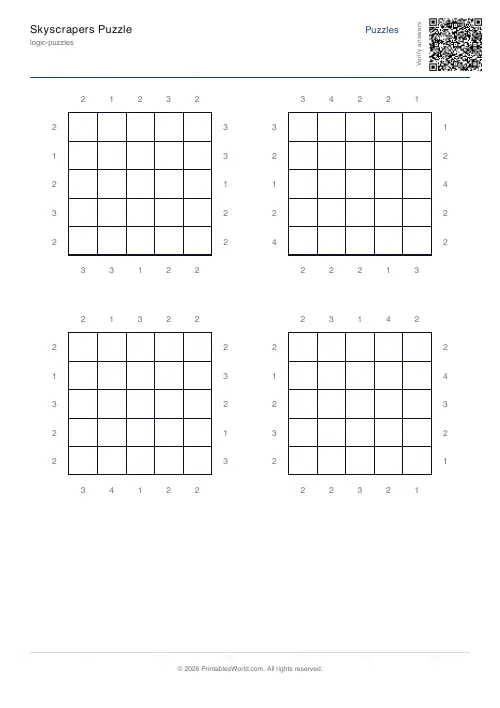
Skyscrapers puzzles on a 5×5 grid. Place heights 1 to 5 so each row and column uses every height once, and the edge numbers say how many buildings are visible looking along that line. One to six puzzles a page.
People also used
Feedback
Spotted something off with this tool?
Skyscrapers: a Latin square you solve by sight lines
Fill the 5×5 grid with the heights 1 to 5 so no height repeats in any row or column. That part is a Latin square, and on its own it would be easy.
The numbers around the outside are what make it a puzzle. Each one tells you how many buildings you would see standing at that edge and looking down the row or column, where a taller building hides everything shorter behind it. A 1 means the nearest building is the 5, because nothing else can be seen past it. A 5 means the row climbs 1, 2, 3, 4, 5 in order — there is only one arrangement that shows five buildings, and finding a 5 on the edge is the luckiest thing that can happen to you.
The clue values and what they give you
- 1 — the 5 sits nearest that edge. One cell, solved.
- 5 — the entire line is determined, climbing 1, 2, 3, 4, 5 away from you, because that is the only order in which all five are visible.
- 4 — nearly determined. Work these immediately after the 1s and 5s.
- 2 — the 5 is second, or close to it. Useful in combination.
- 3 — the weakest clue a 5×5 grid can carry, and usually the last one you reach for.
Beginners tend to start at the top left. Better to scan the whole border for 1s and 5s first, place what those force, and only then work the middling clues against what is left.
What you can set
Two things: how many puzzles go on a page, from 1 to 6, and whether to append the solution page. The grid is fixed at 5×5.
That fixed size is a decision rather than a limitation. At 4×4 the edge clues barely constrain anything and the puzzles solve themselves; at 6×6 and above they get long rather than harder, and six of them will not fit on a page in any readable size. Five is where a Skyscrapers puzzle is a satisfying few minutes, which is what a page of six is for.
Solutions
Turn the toggle on and a separate page prints the completed grid for every puzzle on the sheet.
Where it fits
It suits a maths classroom better than most logic puzzles because the reasoning is explicit: you can say out loud why the 5 must sit at the front of a row clued 1, and a child can follow it. That makes it good for teaching deduction as a method rather than as a knack.
It also travels well. Six puzzles on one sheet, a pencil, and no need to explain the rules twice.
Puzzles are generated fresh every time. Print at 100% on A4 or US Letter.
FAQs
Quick answers
How do the edge numbers work?
Looking from that side, count how many buildings you would see. Taller buildings hide shorter ones behind them.
Why 5x5?
Five heights give a comfortable challenge that still prints cleanly two-up on the page.
How many per page?
Up to six puzzles per page in a two-column layout.
Are answers included?
Yes. Toggle the solutions option for a second page.
Related tools
Further reading
Logic Puzzles
The benefits of logic puzzles for developing brains
Logic puzzles teach deduction and persistence, which are worth having. The claim that they make children generally smarter is weaker than the marketing suggests.
5 min read
Logic Puzzles
Kakuro, killer sudoku and other number puzzles explained
If sudoku has stopped being a challenge, these are the natural next steps. And unlike sudoku, most of them genuinely involve arithmetic.
5 min read
Puzzles & Brain Games
Printable brain games for seniors: a free puzzle pack
A free printable puzzle pack for older adults, with a sample seven-day plan, large-print and easier-difficulty tips, and how to use the Logic Puzzles collection.
7 min read