What this tool does
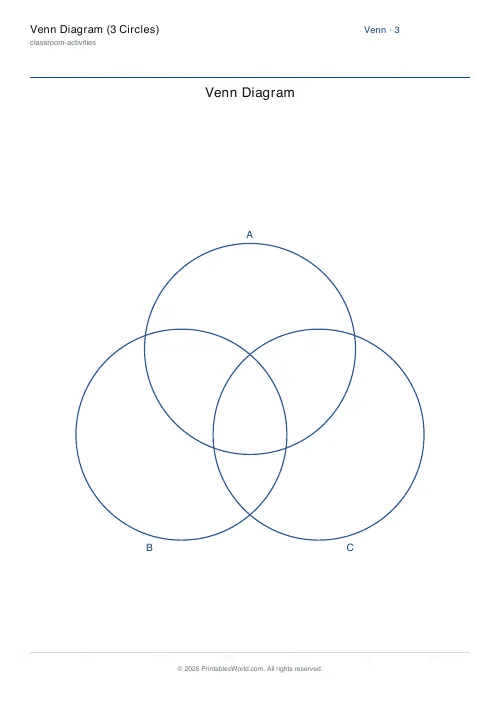
Three overlapping circles in the classic triangle arrangement, with all seven regions visible and your own labels on each circle.
People also used
Feedback
Spotted something off with this tool?
Three circles, seven regions
Three circles arranged in a triangle, each overlapping both of the others, producing seven distinct regions: three that belong to one circle only, three shared by a pair, and one at the centre shared by all three.
Label each circle and add a title. The rest is blank.
Seven regions is a real jump from three
A two-circle diagram is a familiar exercise. Three circles is a different order of difficulty, and it is worth being honest about that before handing it to a class.
Filling it properly means checking every item against three memberships rather than two, and the pairwise regions — A and B but not C — are the ones people get wrong, because it is easy to notice that two things share a feature and much harder to remember to check whether the third shares it too.
The centre is often empty, and an empty centre is a legitimate result. What it usually means is that the three subjects have less in common than the person choosing them assumed.
Choosing three subjects
The requirement is stricter than for two circles: you need something in the centre, and something in each of the three pairwise regions.
Three related things at the same level work best. Three animals from different classes. Three characters in the same book. Three countries, three states of matter, three periods of history.
What fails is three things at different levels — a dog, a mammal and an animal — because those nest inside each other rather than overlapping, and a Venn diagram is the wrong drawing for that. A hierarchy wants a concept map.
How to fill it without getting lost
List every item first, on rough paper. Then take them one at a time and ask three yes-or-no questions of each: is it A, is it B, is it C. The three answers place it in exactly one of the seven regions with no judgement required.
Doing it the other way round — picking a region and trying to think of something for it — is much harder and is how the pairwise regions end up empty.
What it teaches beyond the subject
Set logic, in a form a ten-year-old can handle. The seven regions are every combination of three yes/no memberships except "none of them", and noticing that is a genuine mathematical observation available from a comparison of three books.
It also demonstrates that categories overlap, which is not obvious to children who have been taught mostly to sort things into single boxes.
The options
A title and three labels. Paper size A4 or US Letter.
If the three-way comparison is not working, the two-circle version is usually the right sheet — two things compared properly beats three compared badly.
FAQs
Quick answers
When should I use a 3-circle diagram instead of a 2-circle one?
Use three circles when comparing three related things at once, for example three characters in a novel or three historical figures, so students can map overlaps in any combination.
How are the regions arranged?
The diagram prints with the A circle at the top and B / C at the bottom-left and bottom-right, producing seven distinct regions plus the outside area.
Can I rename the circles?
Yes. Each label is customisable and printed near its circle on the PDF.
Is there a simpler 2-circle version?
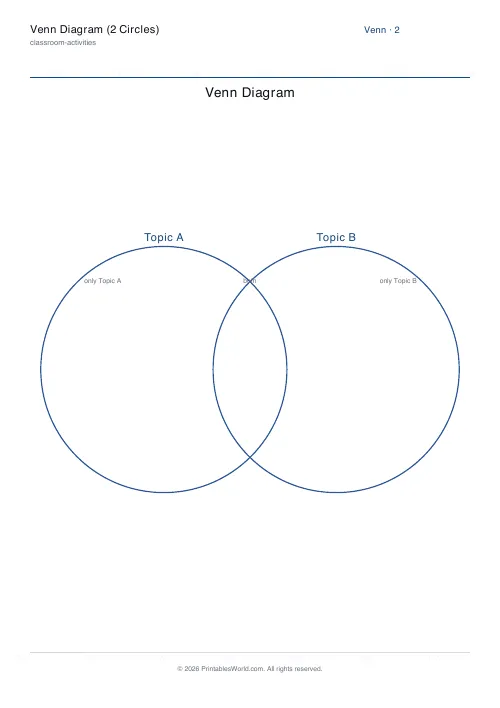
Yes. See the "Venn Diagram (2 Circles)" tool for a two-set comparison.
Related tools