Logic Puzzles
Binary Puzzle — Medium
Medium binary puzzles on 8x8 and 10x10 grids.
Last updated:
What this tool does
Medium binary (Takuzu / Binairo) puzzles on an 8x8 grid by default — switch to 10x10 for more challenge. Six puzzles per page in a print-ready PDF, with optional solutions.
Free downloads
Ready-made Binary Puzzle printables — free PDF downloads
No setup needed — download these print-ready binary puzzles as free PDFs. Each one was made with the generator above, so you can recreate or fully customize any of them.
Binary Puzzle — Easy
Print-ready binary puzzle (Easy) as a free PDF — made with the generator above so you can tweak and reprint.
↓ Download PDF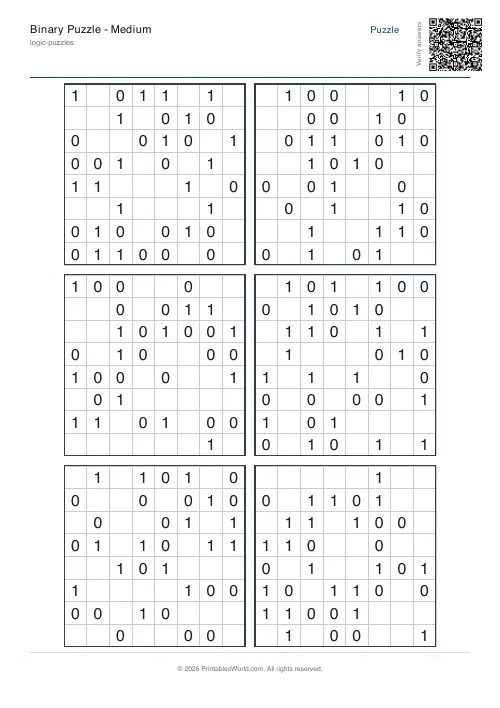
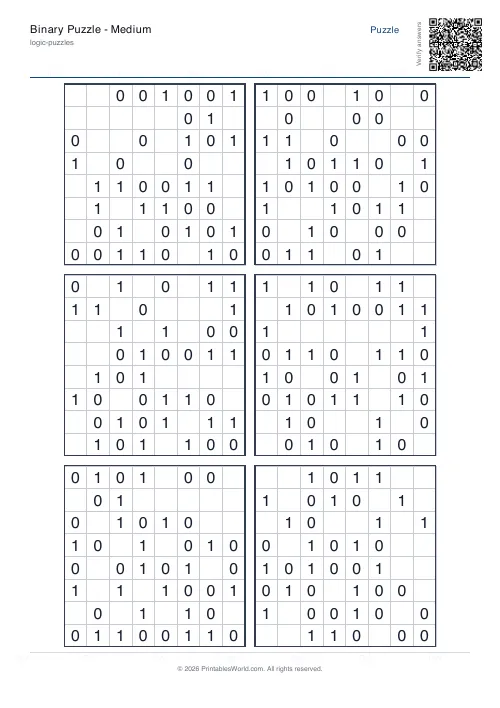
Binary Puzzle — Medium
Print-ready binary puzzle (Medium) as a free PDF — made with the generator above so you can tweak and reprint.
↓ Download PDF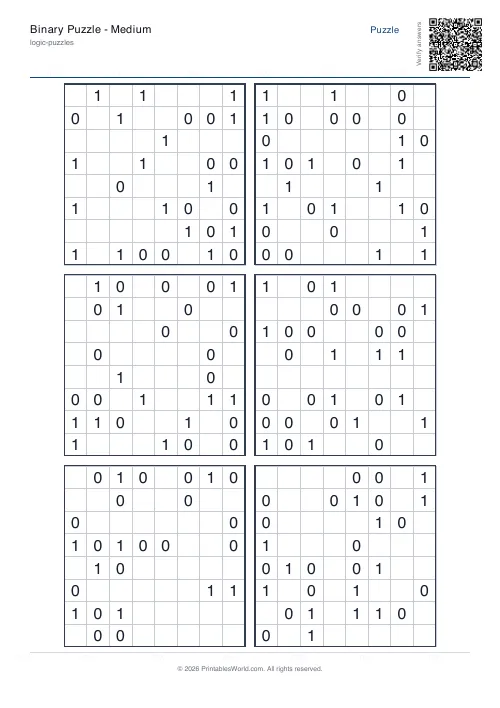
Binary Puzzle — Hard
Print-ready binary puzzle (Hard) as a free PDF — made with the generator above so you can tweak and reprint.
↓ Download PDF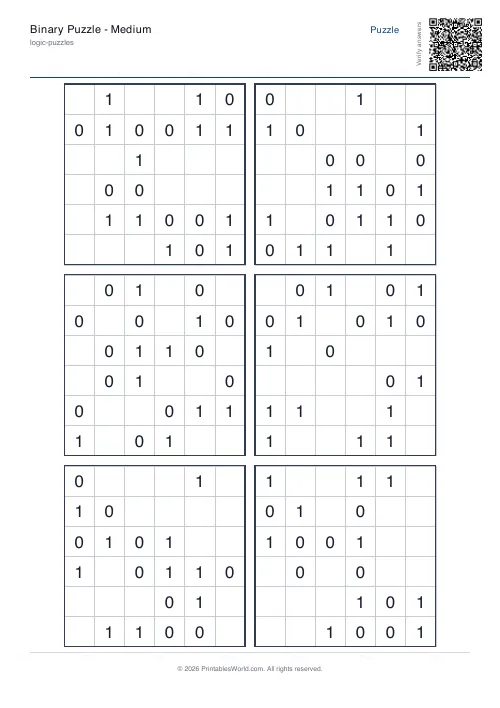
Binary Puzzle — 6x6
Print-ready binary puzzle (6x6) as a free PDF — made with the generator above so you can tweak and reprint.
↓ Download PDF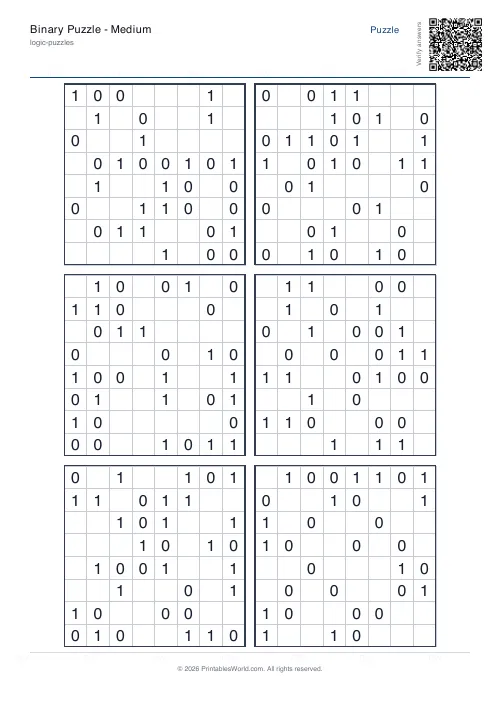
Binary Puzzle — 8x8
Print-ready binary puzzle (8x8) as a free PDF — made with the generator above so you can tweak and reprint.
↓ Download PDF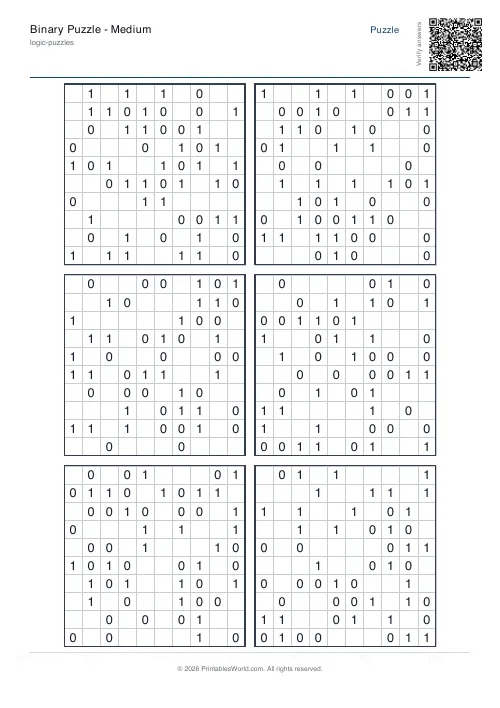
Binary Puzzle — 10x10
Print-ready binary puzzle (10x10) as a free PDF — made with the generator above so you can tweak and reprint.
↓ Download PDF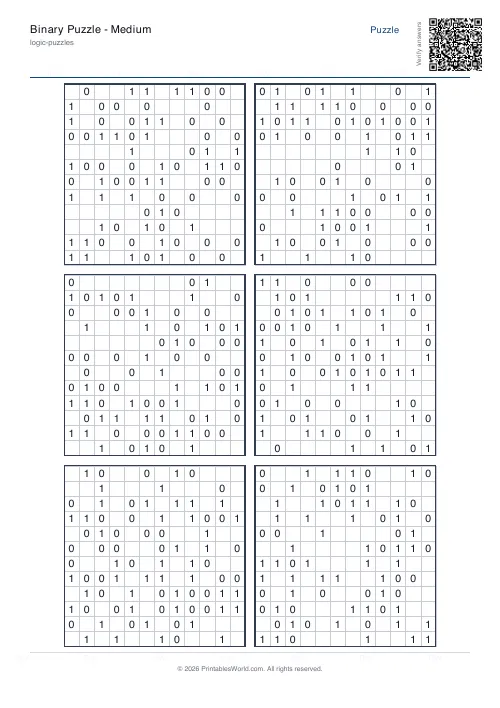
Binary Puzzle — 12x12
Print-ready binary puzzle (12x12) as a free PDF — made with the generator above so you can tweak and reprint.
↓ Download PDF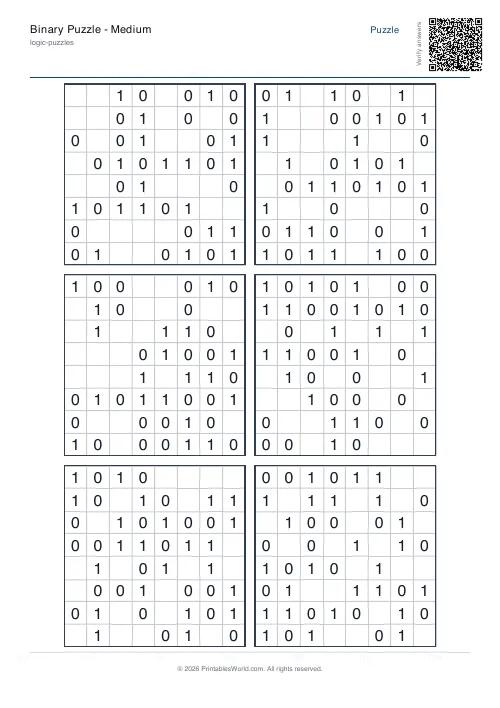
Binary Puzzle — Easy, with answer key
Completed answer key for the Easy binary puzzle — print-ready PDF for fast marking.
↓ Download PDF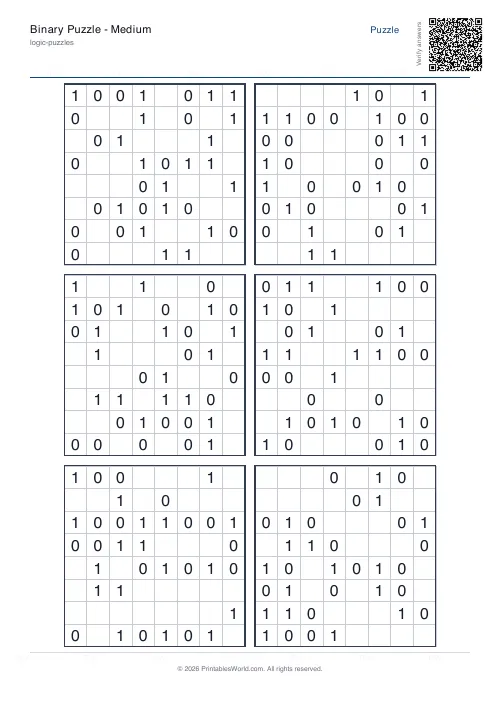
Binary Puzzle — Medium, with answer key
Completed answer key for the Medium binary puzzle — print-ready PDF for fast marking.
↓ Download PDF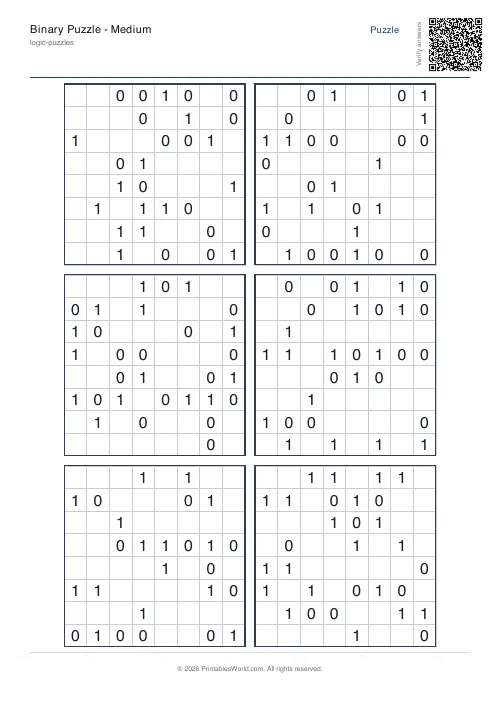
Binary Puzzle — Hard, with answer key
Completed answer key for the Hard binary puzzle — print-ready PDF for fast marking.
↓ Download PDF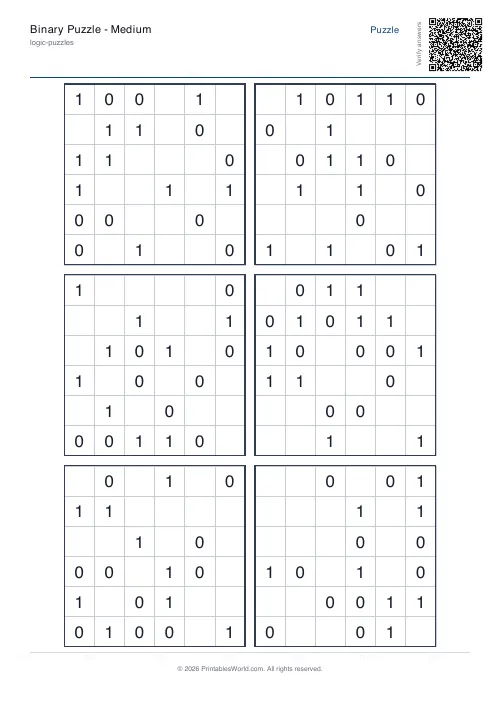
Binary Puzzle — 6x6, with answer key
Completed answer key for the 6x6 binary puzzle — print-ready PDF for fast marking.
↓ Download PDF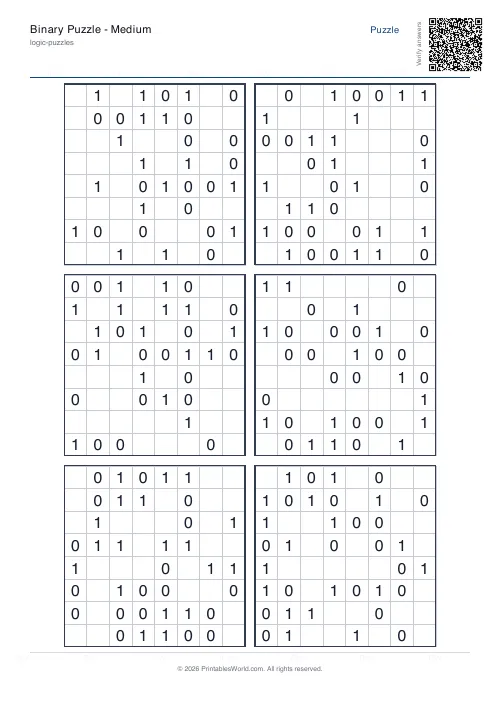
Binary Puzzle — 8x8, with answer key
Completed answer key for the 8x8 binary puzzle — print-ready PDF for fast marking.
↓ Download PDF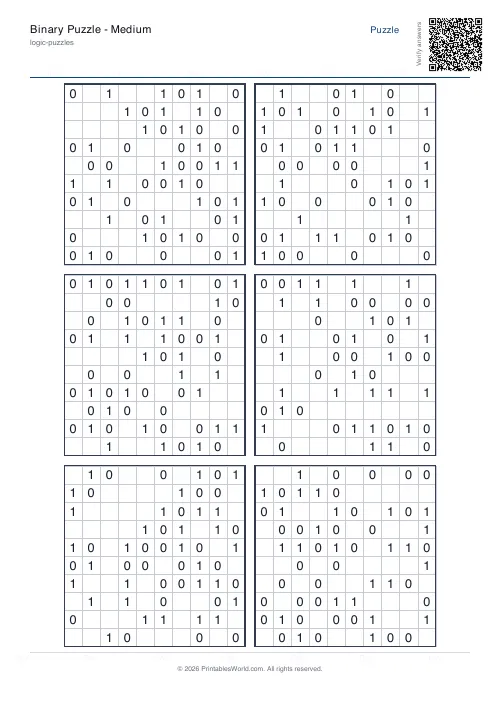
Binary Puzzle — 10x10, with answer key
Completed answer key for the 10x10 binary puzzle — print-ready PDF for fast marking.
↓ Download PDF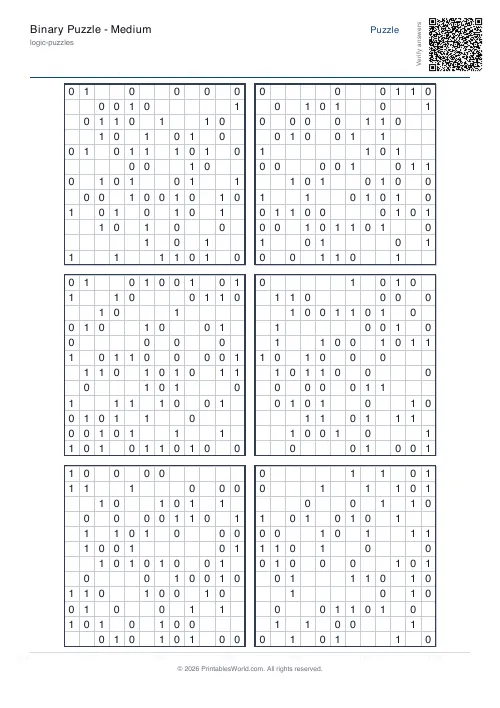
Binary Puzzle — 12x12, with answer key
Completed answer key for the 12x12 binary puzzle — print-ready PDF for fast marking.
↓ Download PDF
Settings
Customize your binary puzzle sheet
Six medium 8×8 puzzles per page on A4 paper.
Grid size
Difficulty
Paper size
Preview
Sample puzzle
One puzzle shown for layout. Your PDF contains six puzzles per page.
People also used
Feedback
Spotted something off with this tool?
Medium Binary Puzzles for Steady Brain Training
Medium binary puzzles (also called Binairo or Takuzu) strike a comfortable balance between the gentle 6x6 beginner grid and the taxing 12x12. The default 8x8 grid fits a satisfying solve into roughly ten minutes, while the optional 10x10 size stretches to fifteen or twenty minutes for solvers who want a longer challenge.
This generator outputs print-ready PDFs in both A4 and US Letter. Six puzzles are arranged per page with plenty of writing space, and you can optionally add a separate solution page for checking answers. Medium binary puzzles are a good quiet-time activity, travel puzzle, or logic warm-up for adults and older children.
Regular binary puzzle practice sharpens pattern recognition, short-range deductive reasoning and the ability to hold several constraints in mind at once. It is the sort of brain training that feels more like entertainment than effort.
How the rules work
Binary puzzles use three rules that apply to every row and column.
- Each row and column contains the same count of 0s and 1s.
- No three consecutive 0s or 1s appear in any row or column.
- No two rows are identical, and no two columns are identical.
With 8x8 grids, every row and column holds four 0s and four 1s. With 10x10, it is five of each. The no-duplicate-row rule becomes more useful at medium size because there are enough cells for near-duplicates to appear.
Who the medium binary puzzle is for
Beginners
If the 6x6 easy grid feels quick, 8x8 is the natural next step. The rules are identical and you already know how to spot forced moves.
Puzzle enthusiasts
Medium binary puzzles scratch the logic itch without demanding a long session. They are a good after-work puzzle or a short break between heavier tasks.
Classroom teachers
Medium grids work well as a silent starter or a finishing-early activity. They also complement maths lessons by reinforcing counting and parity reasoning in disguise.
Parents
Print a page for a plane ride or a waiting room. Older children often enjoy racing a parent through the same puzzle.
What you can customise
- Grid size: 8x8 by default, switch to 10x10 for a longer solve.
- Solutions: include a separate answer page or keep the PDF puzzle-only.
- Paper size: A4 or US Letter PDF output.
Worked example
Suppose an 8x8 row already contains four 0s and two 1s, with two empty cells remaining. Because each row must contain four of each digit, the two empty cells must both be 1s. That single count-based deduction often unlocks several neighbouring cells.
Alternatively, imagine two rows that differ in only one cell. The no-duplicate-row rule tells you the differing cells must in fact differ, which can pin down a digit that looks stuck.
How to use the tool
- Choose 8x8 or 10x10 for the grid size.
- Decide whether to include the solutions page.
- Select A4 or US Letter paper.
- Click Generate to preview the first page.
- Download and print at 100% scale.
Methodology
The generator constructs a complete grid obeying all three binary rules, then removes cells down to a minimum set of starting clues that still lead to a unique solution. Medium puzzles sit between the easy and hard presets in terms of clue density. Each new puzzle is freshly generated, so printing a second batch gives you a different set of grids.
Tips for solving
- Keep a running count of 0s and 1s in each row and column. When one count reaches its maximum, the remaining cells are forced.
- Look for pairs. A pair of matching digits means the cells on either side are the opposite digit.
- Look for sandwich clues. A gap between two matching digits must be the other digit if filling it would create three in a row.
- Compare nearly-complete rows and columns to avoid duplication.
Designed for A4 and US Letter printing
The PDF layout works without adjustment on both A4 and US Letter. Six puzzles per page is the default so the grid lines stay thick enough to be readable after photocopying.
How medium compares to other sizes
The easy 6x6 preset is the fastest to solve and often finishes in four or five minutes. Hard 12x12 puzzles demand careful candidate tracking and can stretch past half an hour. The medium 8x8 and 10x10 presets sit in between, giving you enough cells for the logic to feel meaty without the heavy setup cost of a 12x12.
If you solve one medium puzzle a day for a fortnight, you will find the patterns start to jump out at first glance. That kind of steady brain training reinforces pattern recognition in a way that occasional marathon sessions cannot.
Why binary puzzles are a great logic workout
Unlike Sudoku, binary puzzles require no arithmetic. The rules are purely about parity, adjacency and uniqueness, which makes them accessible to younger solvers while still offering plenty of challenge for adults. Deductive reasoning is the only skill in play, and the narrow set of rules means progress feels crisp and definite.
Related logic puzzles
FAQs
Quick answers
How big are the grids?
The default is 8x8; switch to 10x10 in the size selector for a longer solve.
What logic is involved?
Counting 0s and 1s, avoiding three in a row, and looking for forced moves where one digit cannot fit.
How many puzzles will I get per page?
Six per page, sized for either A4 or US Letter.
Can I include the solutions?
Yes. Use the solutions toggle to add a second page with the completed grids.
Related tools
More like this
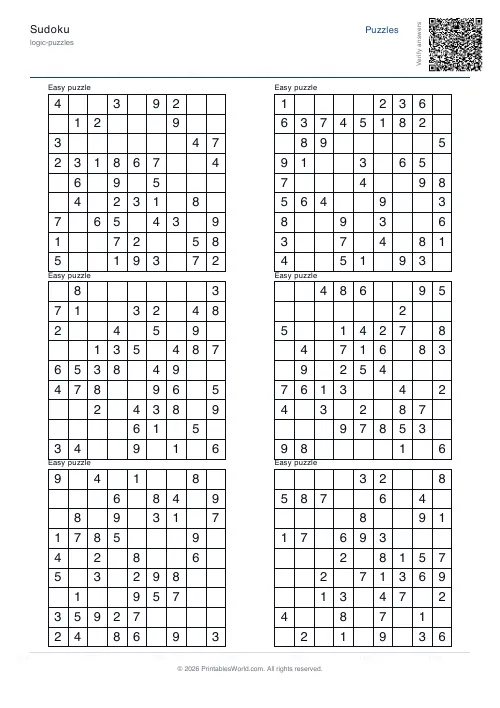 Sudoku Generator
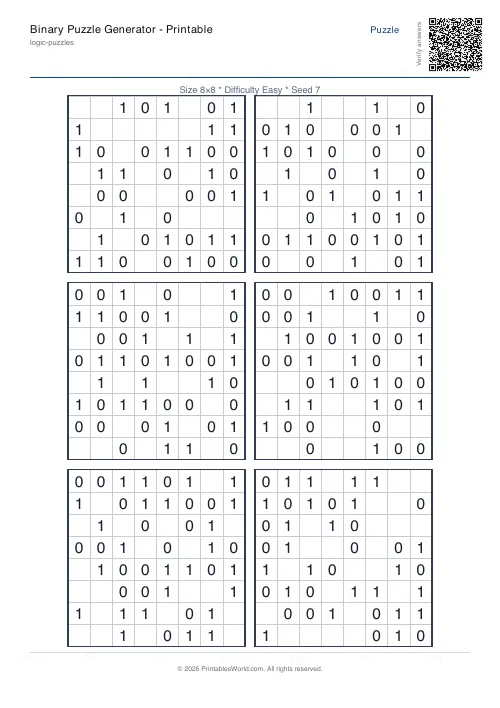 Binary Puzzle Generator — Printable
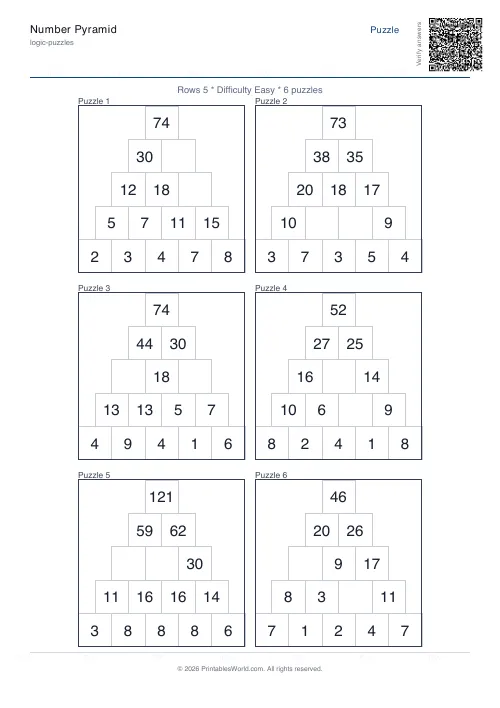 Number Pyramid Generator
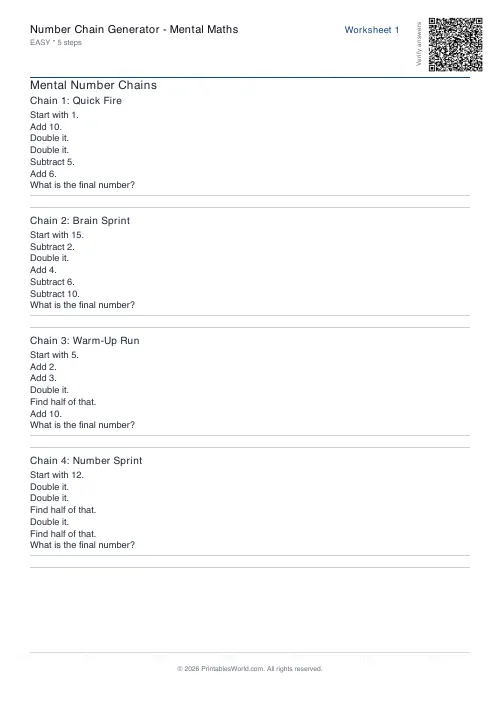 Number Chain Generator — Mental Maths
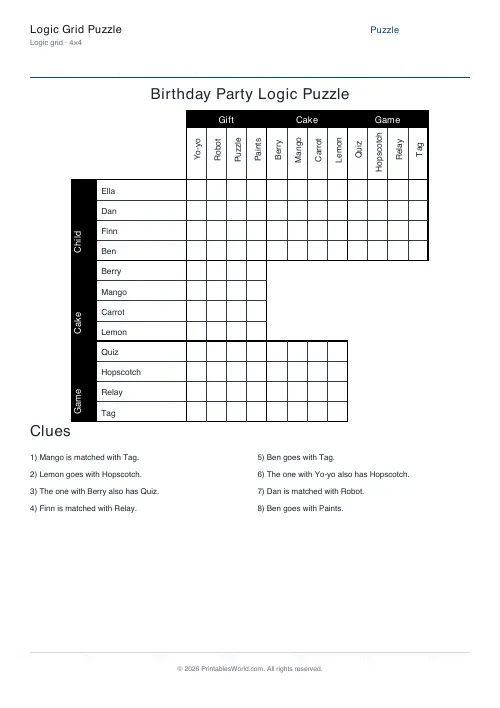 Logic Grid Puzzle Generator — Printable
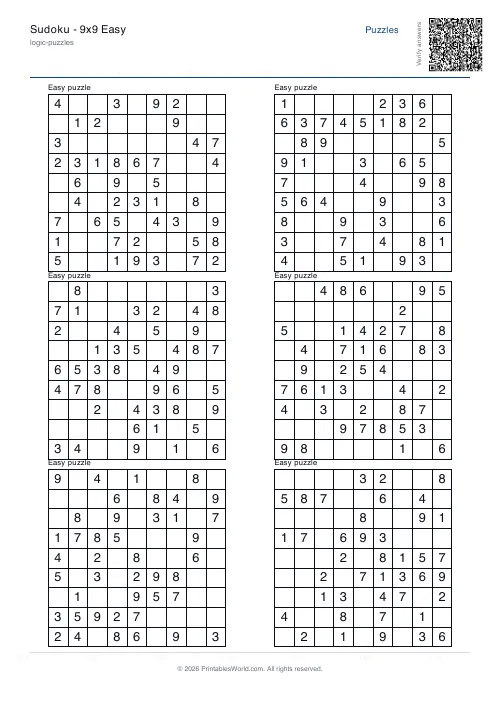 Sudoku — 9x9 Easy
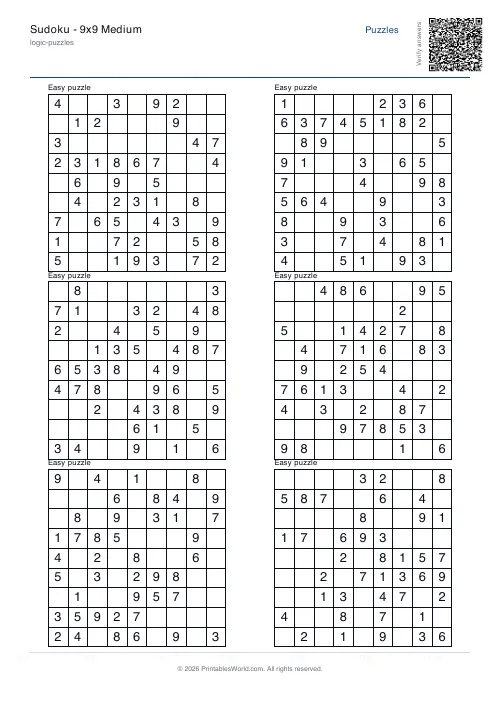 Sudoku — 9x9 Medium
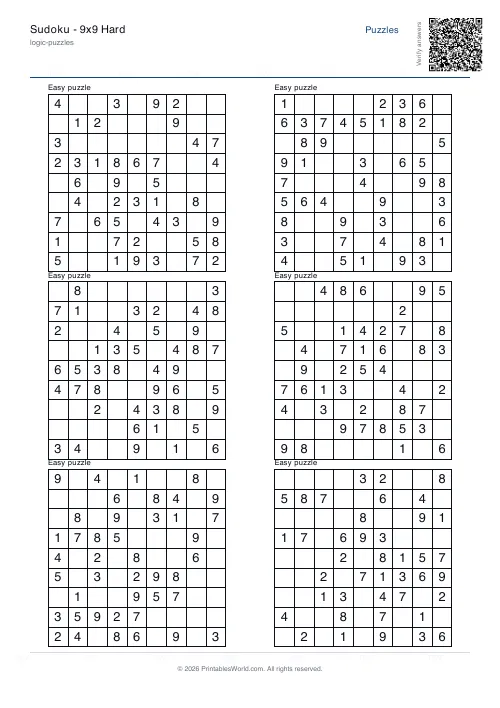 Sudoku — 9x9 Hard
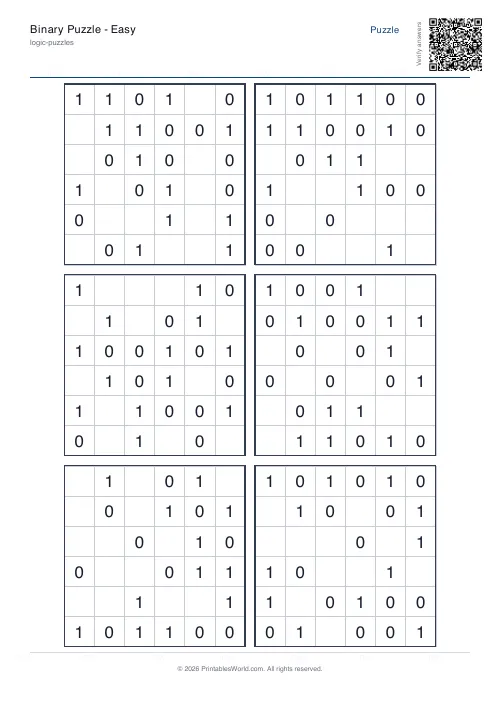 Binary Puzzle — Easy
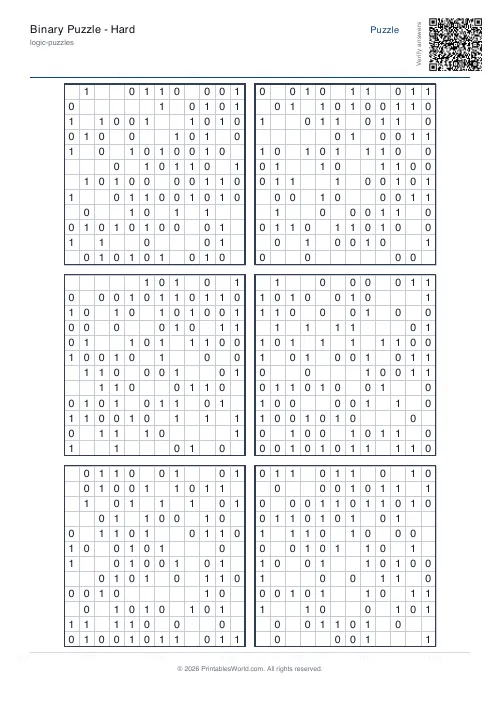 Binary Puzzle — Hard
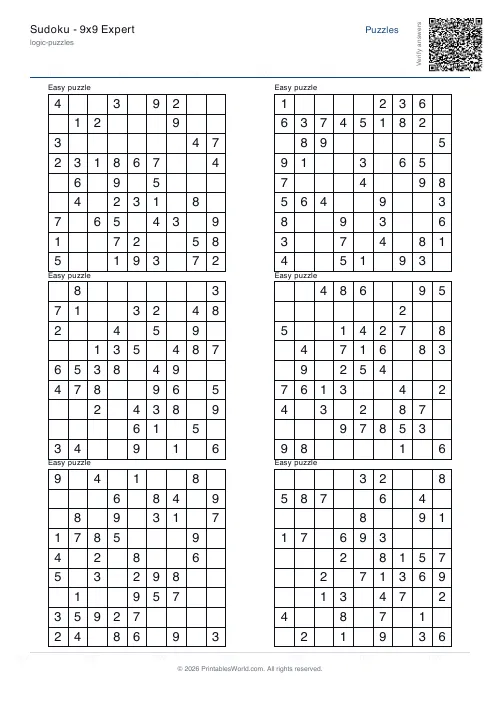 Sudoku — 9x9 Expert
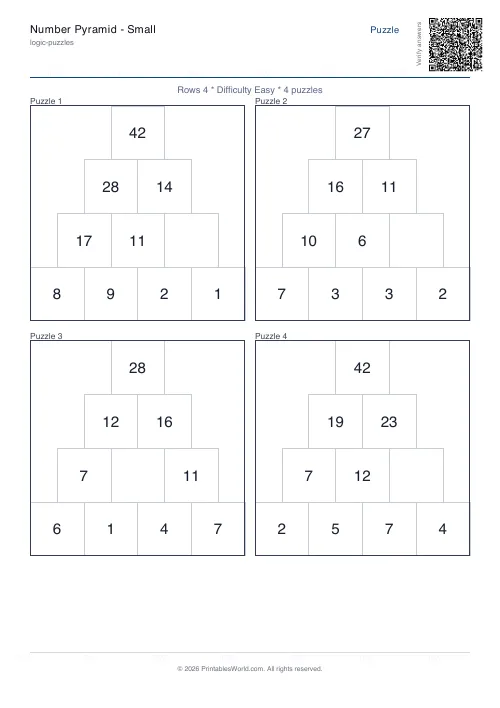 Number Pyramid — Small
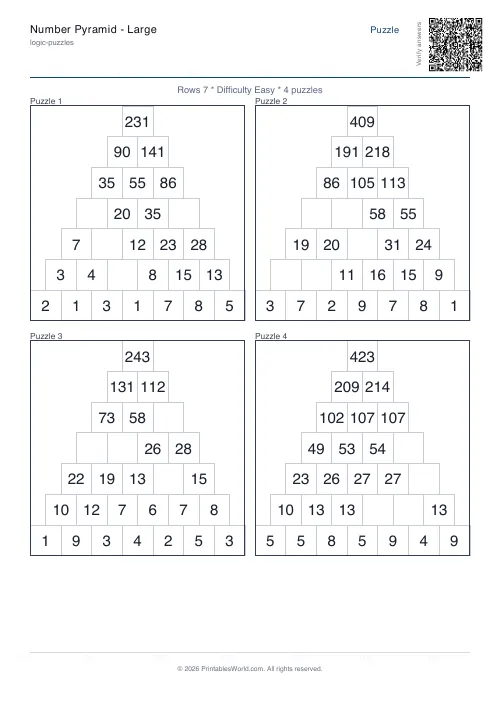 Number Pyramid — Large
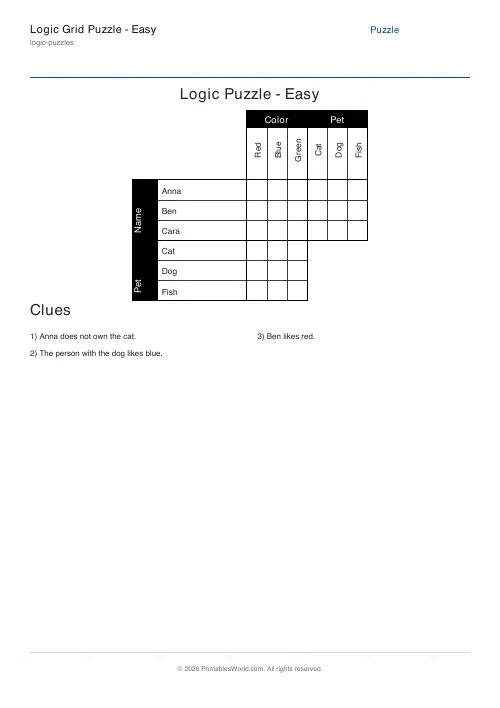 Logic Grid Puzzle — Easy