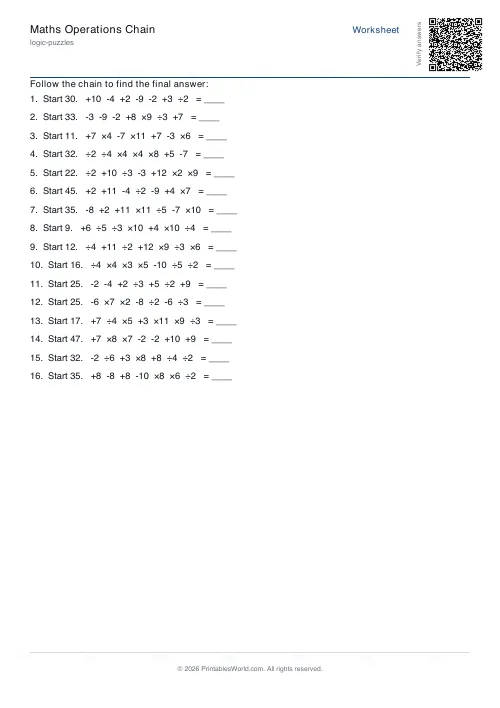
What this tool does
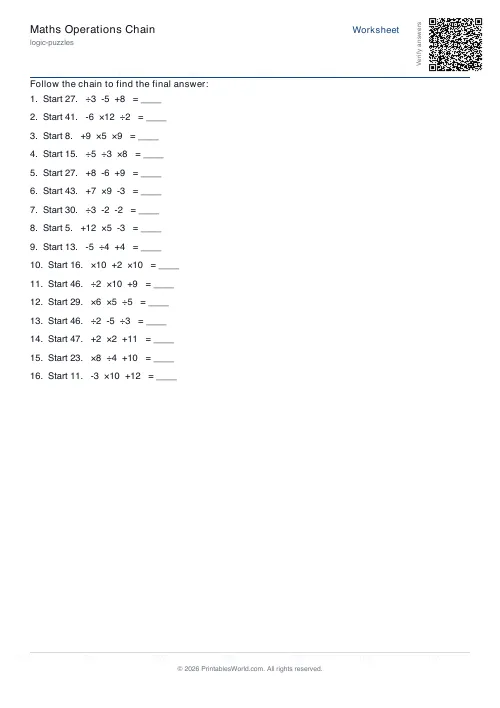
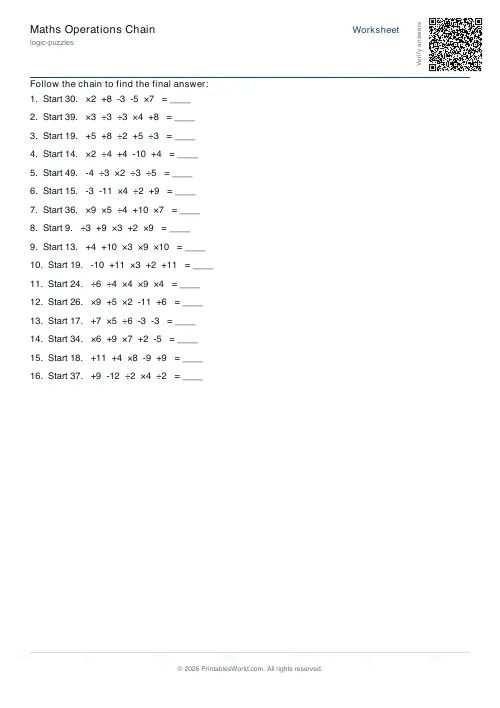
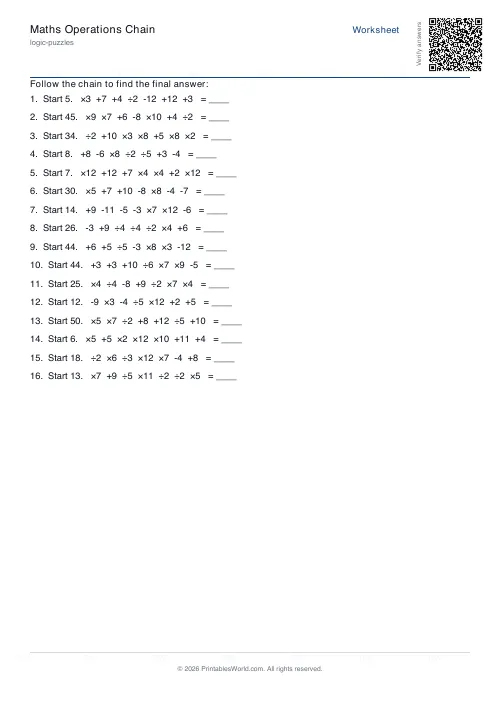
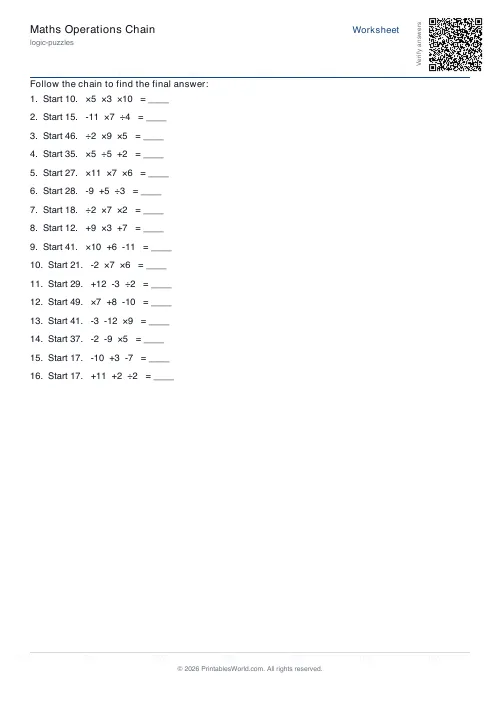
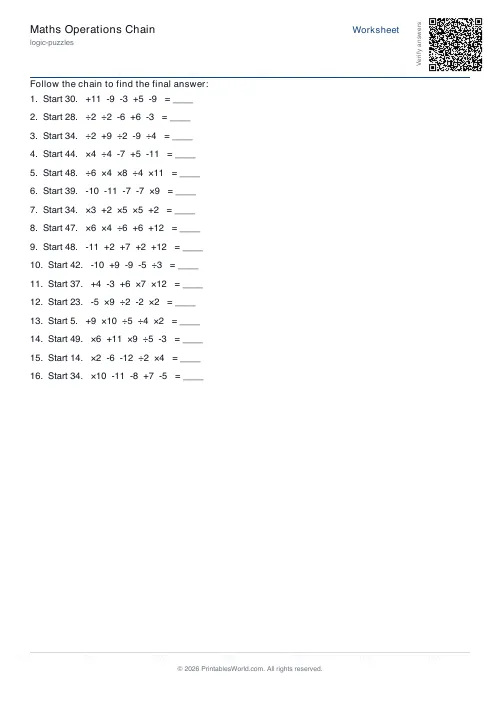
Single-line mental-arithmetic chains. Each row starts with a number and runs through 3 to 8 operations before a blank for the answer. Divisions always come out whole and nothing exceeds 999. Eight to 30 chains a page.
People also used
Number Chain Puzzle
Connect numbers in sequence following arithmetic rules through a grid.
Number Pyramid Generator
Create printable addition pyramid puzzles with adjustable rows, difficulty, and optional answer keys.
Number Chain Generator: Mental Maths
Print mental-maths number chains with custom difficulty, length and answer keys.
Feedback
Spotted something off with this tool?
Operation chains: one line, several steps, one answer
A chain looks like this: 34 − 7 × 3 ÷ 3 + 12 = ___, worked strictly left to right, one step at a time. Not BODMAS. The point is holding a running total in your head while the next operation arrives, which is a different skill from evaluating an expression.
Each row is one chain and the sheet is dense — sixteen by default, up to thirty. That density is deliberate: chains are quick individually, and a sheet with six of them is over before a class has settled.
The two settings
- Chains per page, 8 to 30.
- Steps per chain, 3 to 8. Three is a warm-up. Eight is a genuine working-memory load, and the failure mode changes: pupils stop making arithmetic errors and start losing the running total instead.
The answer key toggle prints every chain's final answer on its own page.
The arithmetic is constrained so the sheet stays usable
Chains are generated with three rules built in, and each exists because of what happens without it.
Divisions always come out whole. A divisor is only used when it divides the running total exactly, so no chain ever produces a fraction or a decimal mid-flight. Without this, a single unlucky division turns a mental-arithmetic exercise into long division on scrap paper.
Nothing goes above 999. A multiplication that would push the running total past three digits is rejected and a different operation is used instead. This keeps every intermediate value writable in the space available and keeps the arithmetic mental.
Nothing goes below 1. Subtractions that would take the total to zero or negative are skipped, so the sheet suits primary pupils who have not met negative numbers.
Starting values sit between 5 and 50, and each operand between 2 and 12 — times-table territory, so the individual steps stay recallable and the difficulty lives in the sequence rather than in any one sum.
How to run it
Mentally, if you can. The whole value of a chain is the running total held in the head; a pupil who writes each intermediate result down is doing five separate sums and getting five separate sums' worth of practice.
For a class that cannot yet do that, start at three steps and let them write. Move to four when the errors stop, then five. The step count is a working-memory dial, and it is worth turning slowly.
Marking
Only the final answer is printed on the key, which is the honest reflection of the exercise — a chain is right or it is not.
When a pupil is consistently wrong, though, the useful diagnostic is to sit with them and ask for the running total after each step out loud. The step where it diverges tells you whether the problem is a fact they do not know or a total they cannot hold, and those need completely different help.
Print at 100% on A4 or US Letter. Every sheet is fresh; the seed reproduces one exactly.
FAQs
Quick answers
How is this different from "number chain"?
Number Chain prints each operation as a sentence ("Add 3", "Double it"). Maths Operations Chain compresses each chain to one line for higher density.
How many chains per page?
Up to 30, depending on chain length.
Are answers included?
Yes. Toggle the answer-key option for a separate page of final values.
What operations are used?
+, −, ×, ÷. Divisions are always whole-number compatible.
Related tools
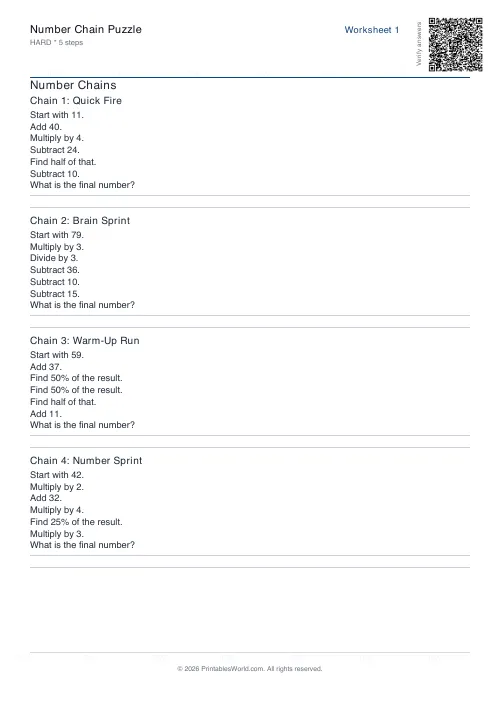
Number Chain Puzzle
Connect numbers in sequence following arithmetic rules through a grid.
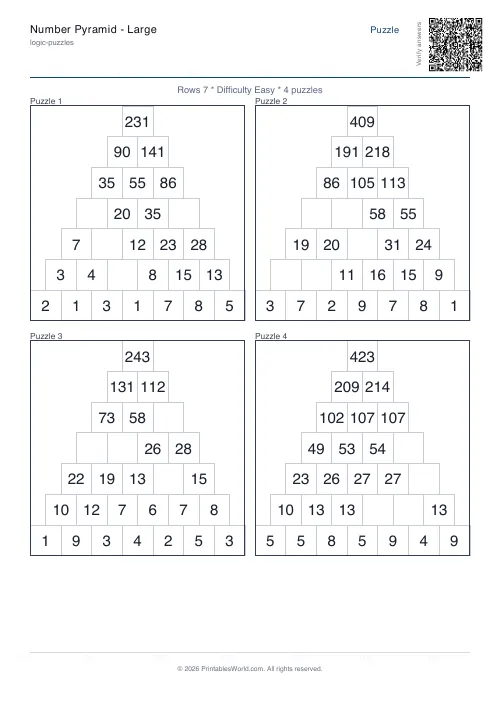
Number Pyramid Generator
Create printable addition pyramid puzzles with adjustable rows, difficulty, and optional answer keys.
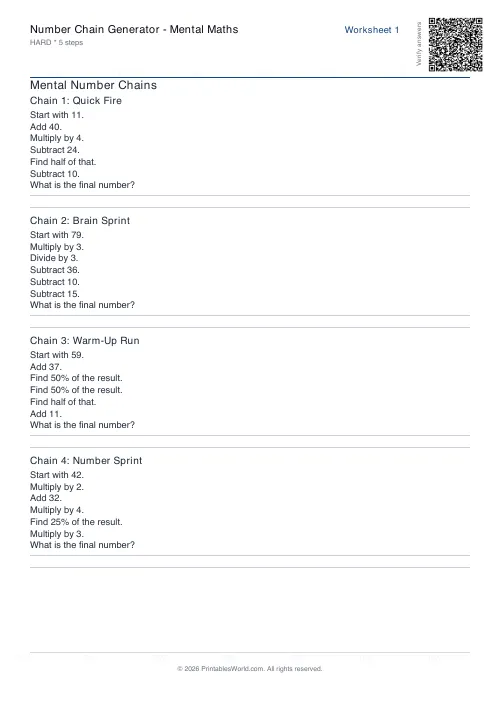
Number Chain Generator: Mental Maths
Print mental-maths number chains with custom difficulty, length and answer keys.
Further reading
Logic Puzzles
How to solve Sudoku: a beginner's step-by-step guide
Four techniques, learned in order, solve almost every easy and medium Sudoku: scanning, the last free cell, pencil marks and naked pairs. Here is each one with a worked example.
6 min read
Logic Puzzles
Kakuro, killer sudoku and other number puzzles explained
If sudoku has stopped being a challenge, these are the natural next steps. And unlike sudoku, most of them genuinely involve arithmetic.
5 min read