What this tool does
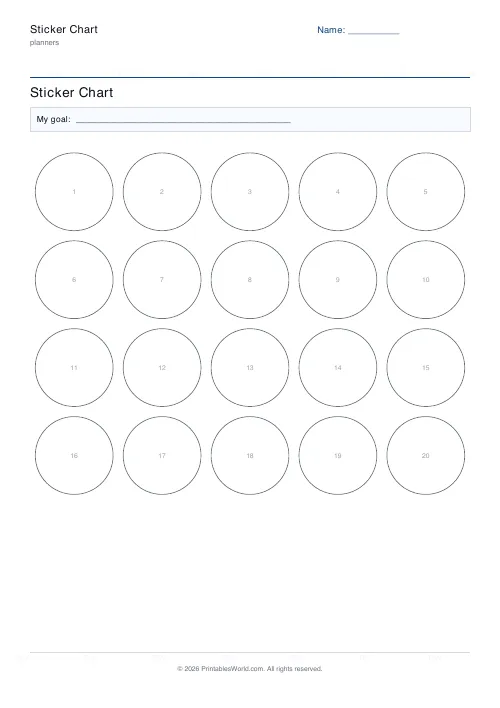
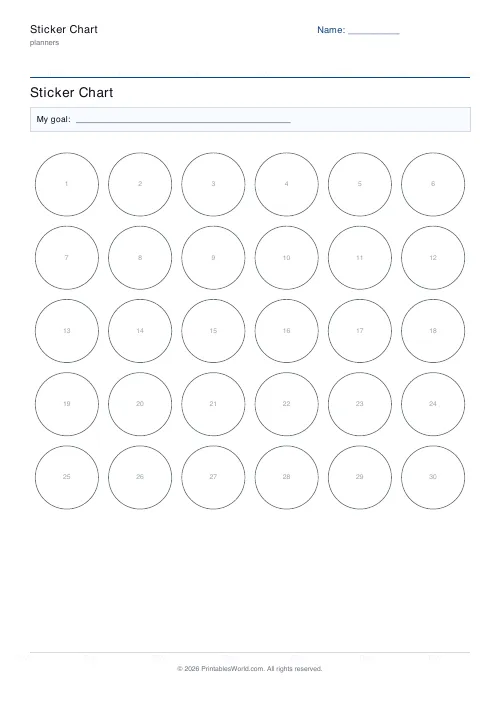
A chart of numbered circles sized for standard reward stickers. Twenty to forty slots, with the child's name and the goal printed at the top.
People also used
Feedback
Spotted something off with this tool?
Numbered circles, and a goal at the top
Type the child's name and what they are working towards, choose how many slots, and print. Each circle is numbered and sized for an ordinary reward sticker.
Twenty to forty slots.
Slot count is the promise you are making
Forty stickers is a long way for a four-year-old. At one a day it is six weeks, and six weeks is well past the horizon a young child can hold a goal across.
Twenty at one a day is three weeks, which is about the limit for a preschooler and comfortable for a six-year-old. If you want a bigger reward at the end, use twenty slots and give two stickers for the harder days rather than printing forty.
The chart should finish while the child still cares about it. A chart abandoned at slot twenty-six has taught the opposite of what it was for.
Name the goal specifically
The goal line is not decoration. A chart with "being good" written on it cannot be earned, because nobody can tell when they have done it.
"A sticker each night I stay in my own bed" can. So can "one for each morning we leave the house without a fuss". The child needs to know, at the moment it is happening, whether this counts — and so do you, or the chart becomes a negotiation.
Give the sticker immediately
The delay between the behaviour and the sticker is doing most of the work, and shorter is dramatically better with young children.
A sticker handed over at bedtime for something that happened at breakfast has largely lost its connection to the thing. Keep the sheet and the stickers accessible enough that it can happen on the spot.
Never take one back
The single rule that matters, and the one that gets broken when a parent is tired.
Removing an earned sticker as a punishment converts the chart from something to work towards into something to lose, and children respond to that very differently — the chart becomes a source of anxiety and, fairly quickly, something they refuse to engage with. Whatever happened, the stickers already on the sheet were earned.
Know when to stop
Sticker charts work well for a specific, short-term behaviour and badly as a permanent system. Once the behaviour is established, take the chart down and say why — "you don't need this any more" is the right ending.
If a chart is not working after a fortnight, the problem is usually the target rather than the child. Make it smaller.
Settings: a title, the child's name, the goal and the slot count. A4 or US Letter at 100%.
FAQs
Quick answers
How many sticker slots can I include?
Pick between 20 and 40 slots. The grid adjusts automatically so the page stays tidy.
What size of stickers fits the slots?
Standard small stickers (about 15–20 mm) sit nicely inside each circle.
Can I print without a goal?
Yes. Leave the goal blank and the chart will print a blank line to fill in by hand.
Is the chart reusable?
Laminate it after printing and use a whiteboard marker if you would like to wipe and re-use.
Related tools
Further reading
Planners
Chore charts that motivate kids (without nagging)
Most chore charts fail for the same three reasons. Here is what to put on one by age, whether to attach money, and how to stop being the person who remembers everything.
5 min read
Planners
Study planning for exams: a student's complete guide
A revision timetable is only as good as what goes in the slots. Here is how to build one backwards from the exam date, and which study methods the evidence actually supports.
5 min read