What this tool does
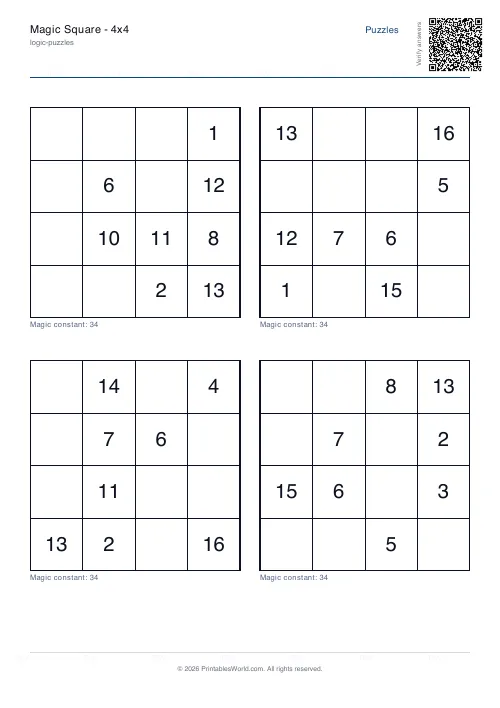
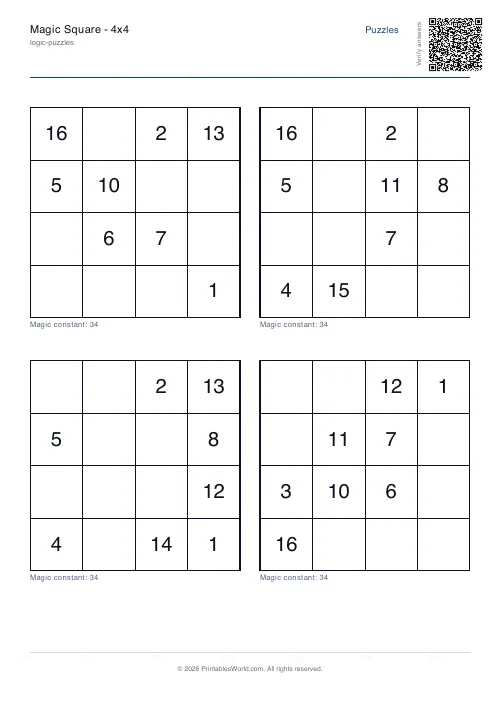
4×4 magic squares from the Dürer arrangement, rotated or reflected. Fill the blanks so every row, column and both diagonals total 34. Up to eight squares a page, blanks checked to leave exactly one answer.
People also used
Feedback
Spotted something off with this tool?
4×4 magic squares, magic constant 34
Sixteen cells, the numbers 1 to 16, every row and column and both main diagonals adding to 34. Some numbers are given; you supply the rest.
The arithmetic behind 34 works the same way as it does at 3×3: 1 to 16 total 136, four rows share it, 136 ÷ 4 = 34.
The square this is built from
The starting arrangement comes from Dürer's engraving Melencolia I, cut in 1514. It is famous partly for a small joke: the two middle cells of its bottom row read 15 and 14.
Each puzzle rotates or reflects it at random, so the squares on a page differ from each other while sharing the structure underneath. That is worth mentioning to an older class: the same square, looked at from four sides and through a mirror, is eight squares.
Four by four is a genuine step up
The 3×3 square has one solution, which is what makes it tractable by pure reasoning. There are 880 essentially different 4×4 magic squares, so knowing one gets you very little.
The shortcuts do not transfer. There is no "the middle is always 5" here. You work the lines instead: a row with three numbers forces the fourth, then a column opens, then a diagonal, and you keep going round until the square closes. Slower. Much more like real deduction.
How the blanks are chosen
One at a time, with the square re-solved after every removal and the number put back if a second valid completion appears.
Without that step, a heavily blanked 4×4 is usually ambiguous. Removing 14 of 16 cells at random produced more than one valid answer every single time in testing, and 12 of 16 did so in more than half of cases. Since the sheet prints one answer key, an ambiguous puzzle means a correct solver being marked wrong.
So a request for 14 blanks typically yields 12. The puzzle you get is the hardest one that still has a single answer.
The controls
Squares per page from 1 to 8 (four fits comfortably), the number of blanks, the solutions page, and a seed. A4 or US Letter.
Eight blanks takes most adults a few minutes. Twelve is a long sit.
A note for anyone teaching it
The productive question is not "what goes here" but "which line has only one cell missing". A solver who scans for the nearly-complete line finishes; one who works left to right from the top gets stuck at the third cell and stays there.
Print at 100% on A4 or US Letter.
FAQs
Quick answers
Why is the magic constant 34?
Each row in a standard 1-16 magic square sums to (1+16)×4/2 = 34.
How many blanks?
Default 8 of 16 cells; the engine clamps to 1-14 inclusive.
Can I get an easier version?
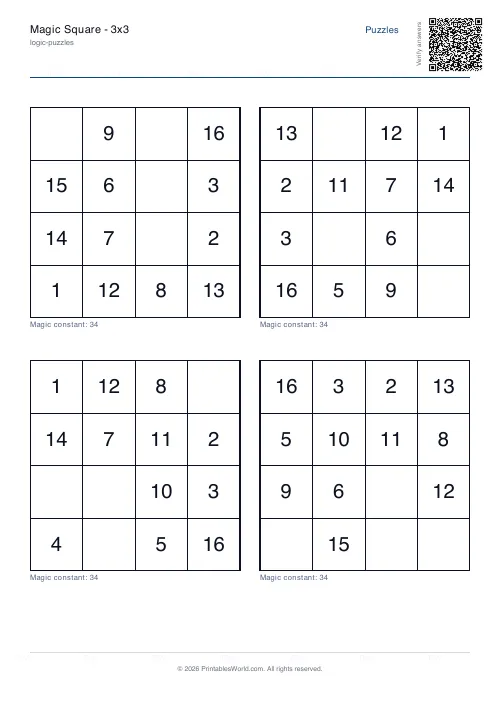
Try the 3x3 magic square first.
Are answers included?
Yes, toggle the solutions option for a second page.
Related tools
Further reading