What this tool does
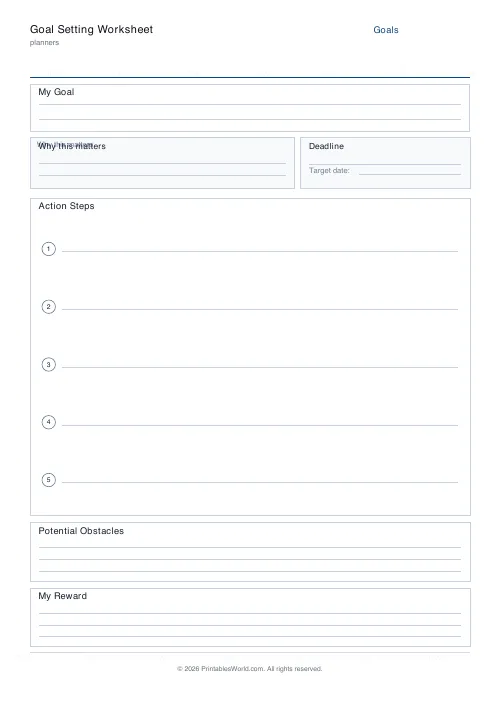
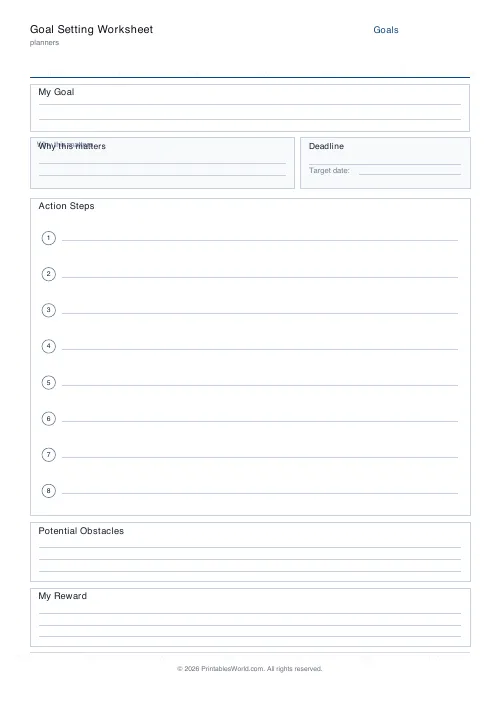
A one-page worksheet that turns an ambition into a plan: the goal, why it matters, a deadline, and three to ten numbered action steps.
People also used
Feedback
Spotted something off with this tool?
Goal, reason, deadline, steps
The goal goes at the top, then a space for why it matters, a deadline, and a numbered list of the actions that will get you there. Three to ten steps.
That sequence is the sheet's argument: a goal without a reason gets abandoned, and a goal without steps is a wish.
The "why" box is not padding
It is the field people skip and the one that determines whether the sheet still means anything in six weeks.
A goal you cannot justify to yourself is one you will drop the first time it is inconvenient, and most abandoned goals were somebody else's idea in the first place — a thing you felt you ought to want. Writing the reason down is how you find that out in February rather than in November.
Write it for yourself rather than for a reader. "Because I am sick of being out of breath on the stairs" is a better entry than anything that sounds like a mission statement.
Steps have to be actions, not milestones
The commonest failure on this sheet is a list of smaller goals dressed as steps.
"Get fitter" is a goal. "Lose half a stone" is a milestone. "Walk to work on Tuesdays and Thursdays" is a step, because it says what you will physically do and when. If a step does not contain a verb you could perform this week, it is not a step yet.
Three real steps beat ten vague ones, which is why the count starts at three.
The deadline should be uncomfortable
Not impossible, but close enough that it changes what you do this month.
A goal with a deadline a year out produces no action for eleven months. If the real horizon is genuinely that far, set the deadline for the first milestone instead and print another sheet when you get there.
Print it and put it somewhere
A goal sheet in a folder has done nothing. The value is entirely in being looked at, which means a wall, a door, or the inside of a notebook you open daily.
Review it monthly. Crossing off a completed step is the part that keeps the sheet alive, and rewriting a step that turned out to be wrong is not failure — it is what the sheet is for.
Setting it up
A title and how many steps (three to ten). A4 or US Letter, printed at 100%.
One goal per sheet. A page with three goals on it is a page where none of them gets the steps it needs.
FAQs
Quick answers
How many action steps should I list?
Five to ten is the sweet spot. Fewer than five and your plan is too vague; more than ten and each step probably needs its own page.
Why include obstacles on the same page?
Research on "implementation intentions" shows that naming likely obstacles in advance makes you far more likely to follow through when they appear.
What goes in the reward box?
Anything genuinely motivating that you will only give yourself once the goal is done. A meal out, a book, a day off, a small purchase.
Is this for adults or students?
Both. The fields are generic enough for a Year 9 term goal, a new-year resolution, or a quarterly work objective.
Related tools
Further reading
Planners
How to pay off debt faster with a payoff tracker
One method costs less; the other is easier to stick to. Here is how to choose between them honestly, and why a visual tracker changes the odds either way.
5 min read
Planners
ADHD-friendly planning: systems that work
Standard planners assume you will remember to open them. That single assumption is why they fail for a lot of ADHD brains. And what an ADHD-friendly system has to replace.
6 min read
Planners
Study planning for exams: a student's complete guide
A revision timetable is only as good as what goes in the slots. Here is how to build one backwards from the exam date, and which study methods the evidence actually supports.
5 min read