What this tool does
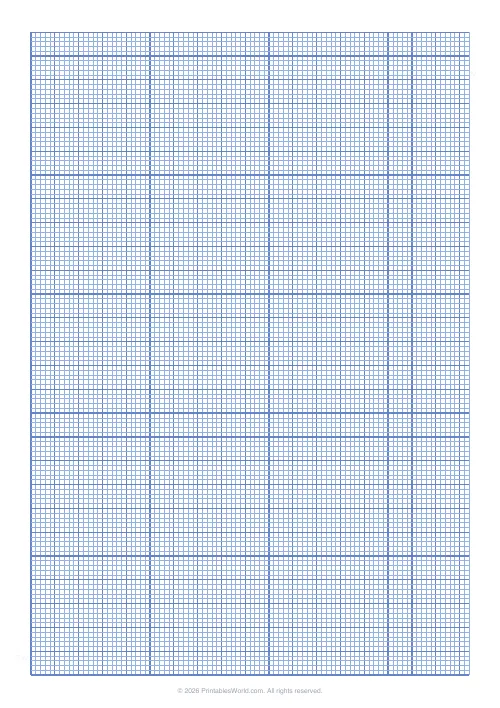
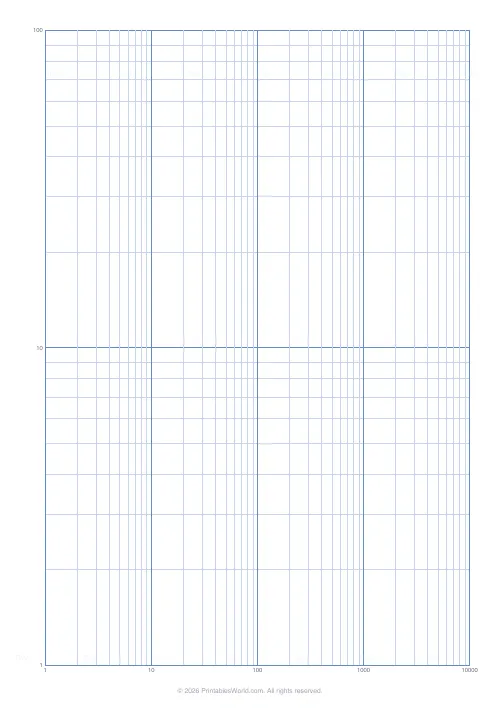
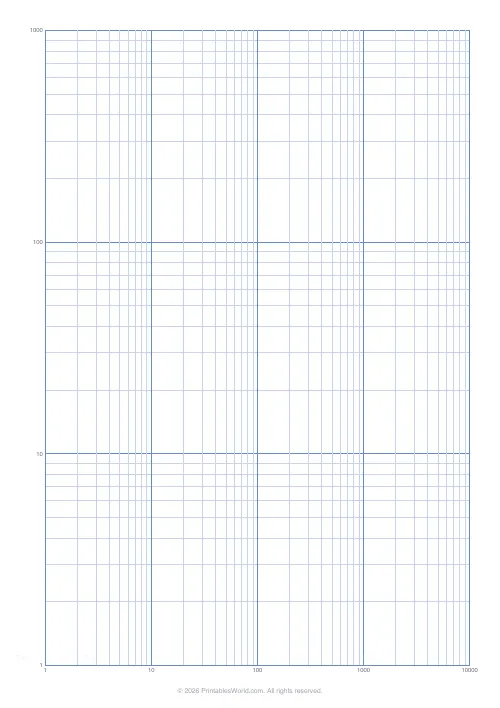
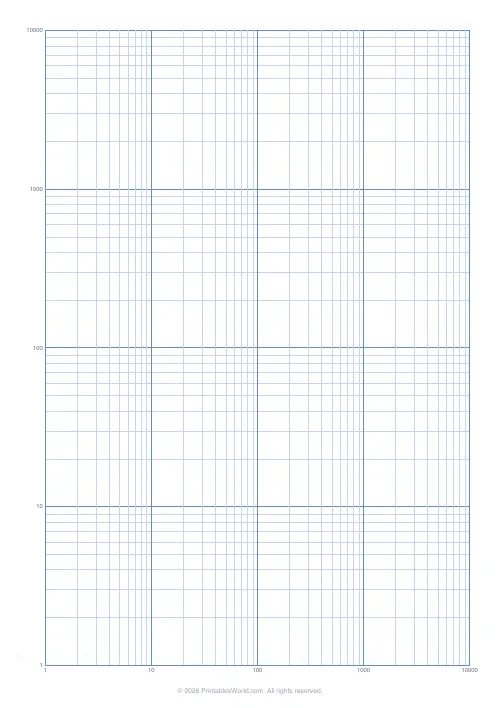
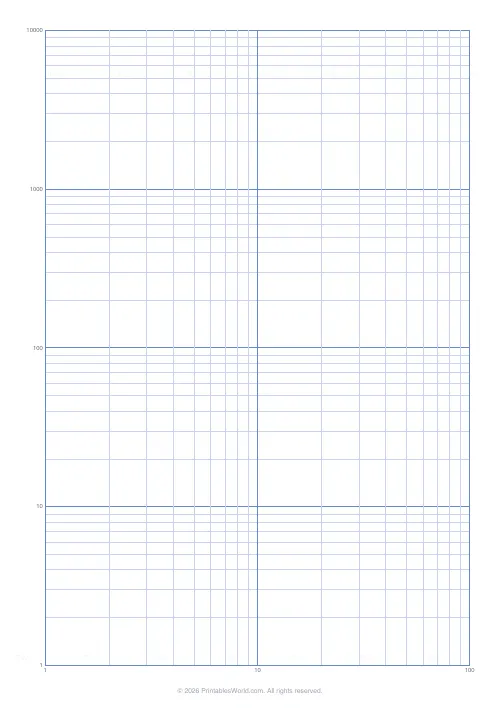
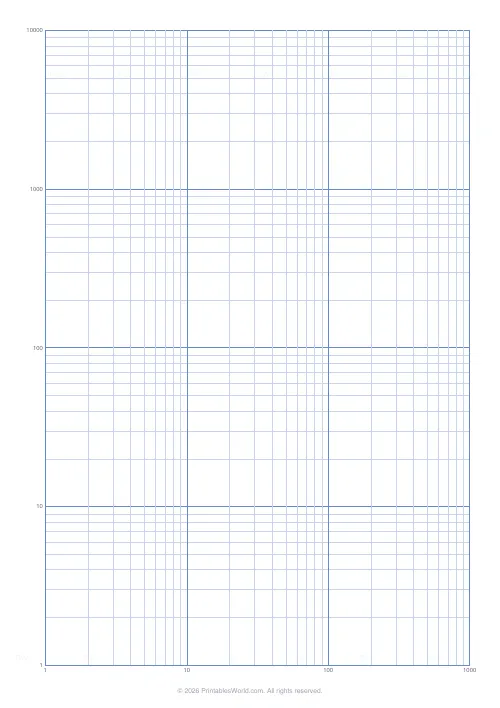
Graph paper with both axes logarithmic. Set 2 to 6 decades on each independently; power laws plot as straight lines.
People also used
Feedback
Spotted something off with this tool?
Both scales logarithmic
Each decade — 1 to 10, 10 to 100, 100 to 1000 — occupies the same distance on both axes, with the minor lines inside each decade crowding towards the top of the block.
Four decades each way by default, and the two axes are set independently, so a 6×3 sheet is available if that is what your data wants.
What it straightens
A power law: y proportional to x raised to some power. On log-log paper, every such relationship is a straight line, and the slope of that line is the exponent.
That is the reason the paper exists. Reading an exponent off a straight line with a ruler is easy; extracting one from a curve by eye is not, and this converts the second problem into the first.
The distinction from semi-log
Worth being precise about, because reaching for the wrong sheet wastes an afternoon.
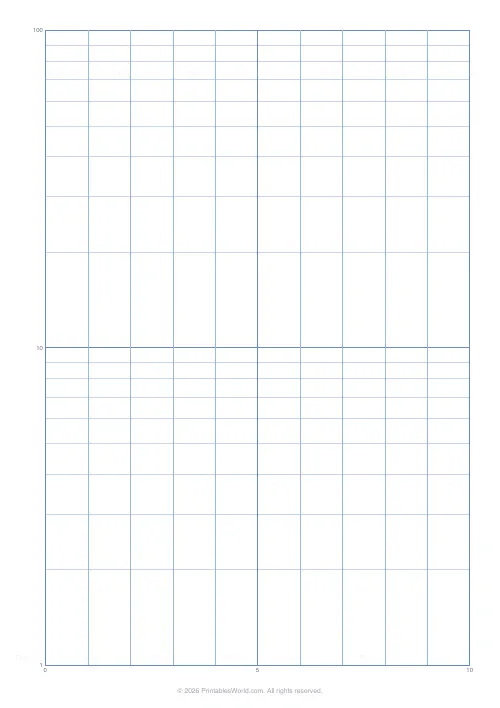
Semi-log — one log axis — straightens exponentials, where the quantity multiplies by a fixed factor per unit time. Bacterial growth, compound interest, radioactive decay.
Log-log — both axes — straightens power laws, where one quantity scales as a power of another. Neither straightens the other's data, and a curve on one is the signal to try the other. That test is itself informative: it tells you which kind of process you are looking at.
Where power laws turn up
More places than most people expect. Kepler's third law relating orbital period to distance. Drag against velocity. Metabolic rate against body mass, which follows a famously non-obvious exponent. Earthquake frequency against magnitude. City sizes, word frequencies, income distributions.
Engineering uses it constantly for frequency response, where both the frequency range and the gain span several orders of magnitude and nothing else would fit on a page.
Choosing the decades
Count the orders of magnitude your data spans on each axis separately, then add one for headroom.
The two axes rarely want the same number, which is why they are set independently. Readings from 1 to 500 on one axis and 0.01 to 100 on the other need three and four respectively, and forcing both to four wastes a third of the sheet.
Reading the slope
Measure it in decades, not in centimetres. A line rising two decades vertically over one decade horizontally has a slope of 2, and the relationship is y proportional to x squared.
Print at 100% on A4, US Letter or US Legal, and see semi-log paper for the single-log case.
FAQs
Quick answers
When should I use log-log paper?
When both variables span several orders of magnitude, or when you want a straight-line plot of a power law y = a·xⁿ.
How many decades does it span?
Choose 2–6 decades on each axis. Default is 4×4.
Are minor grid lines included?
Yes. Log-spaced minor lines at the 2.9 multiples of each decade on both axes.
Will it print on A4?
Yes. A4, US Letter, and US Legal are supported.
Related tools
Further reading