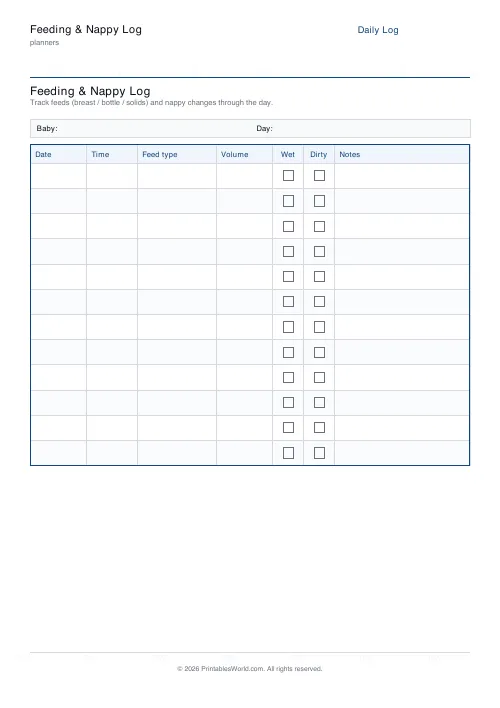
What this tool does
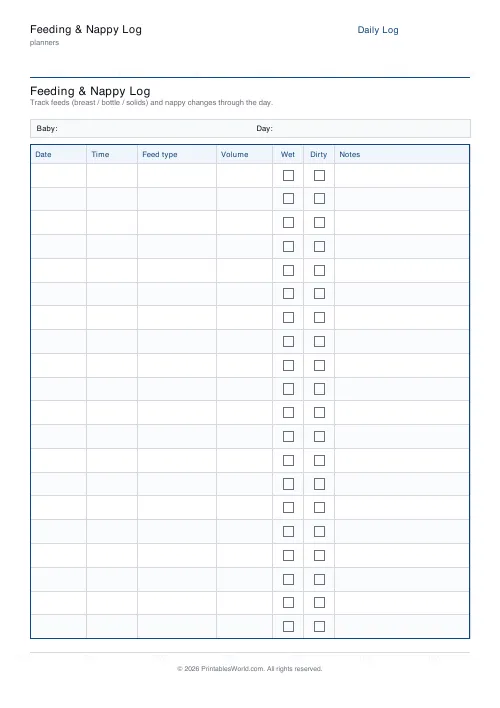
One row per feed or change, with the date and time, what kind of feed it was, how much, tick boxes for wet and dirty, and a notes column. Twelve to twenty rows.
People also used
Feedback
Spotted something off with this tool?
A row per event
Date and time. What kind of feed it was — breast, bottle, solids. How much. Then tick boxes for wet and dirty, and space for a note. Twelve to twenty rows a sheet.
What this is actually for
Two things, and the second is the one nobody mentions.
The first is answering questions from a health visitor, midwife or GP. "How often is she feeding?" and "how many wet nappies yesterday?" are asked constantly in the early weeks, and they are close to impossible to answer accurately from memory on four hours of sleep. A sheet answers them in two seconds and answers them correctly.
The second is handover. In a house with two parents, or a grandparent helping, or a night shift, the log is the only thing that reliably tells the next person what has already happened. Far more arguments are caused by "did you feed her at four?" than by anything on the sheet.
Nappy counts matter more than the feed times
Output is the measure everybody actually uses, because it is the one that tells you whether enough is going in.
Wet nappies in particular. The rough guidance in most countries is that a newborn's wet count rises over the first week and then settles at around six or more heavily wet nappies a day, but the numbers vary by age and by source, and the point of the log is to have the real figures to hand rather than to check them against a rule you half-remember.
Tick as you go. A count reconstructed at bedtime is a guess.
Write down the odd ones
The notes column is for anything that was not routine: a feed refused, an unusual colour, a long gap, a change in how they seemed.
Individually those are nothing. In a row, they are a pattern, and it is a pattern you will not be able to describe from memory when somebody asks. This is the column that turns a log into something a clinician can use.
Stop when you no longer need it
Most families log obsessively for a few weeks and then stop, and stopping is correct. Once feeding is established and everybody is confident, the log has done its job.
Keep going for longer if a health professional has asked you to, if weight gain is being monitored, or if you are trying to identify something specific — a reaction, a pattern of unsettled evenings. Otherwise, put it away without guilt.
Settings and a caution
A title and how many rows (12 to 20). A4 or US Letter, printed at 100%. Print a stack and keep them with a pen where the feeding happens.
This is a record sheet and not medical guidance. If anything about the feeding or the weight or the nappies is worrying you, talk to your midwife, health visitor or doctor, and take the sheet with you when you do.
FAQs
Quick answers
How many entries fit on a page?
Pick anywhere from 12 to 20 rows. 16 is a good default. Enough for a busy newborn day without shrinking the rows.
What do I write in the Feed type column?
Whatever matches your day: B (breast), BM (expressed), F (formula), S (solids), or the full word if there is space.
Do I need to fill in every column?
No. Leave Volume blank for breastfeeds, tick Wet and/or Dirty when you change a nappy, and use Notes only when something stands out.
Is this useful at the paediatrician?
Yes. A couple of completed sheets give a clear picture of feeding and nappy patterns, which is often the first thing clinicians ask about.
Related tools
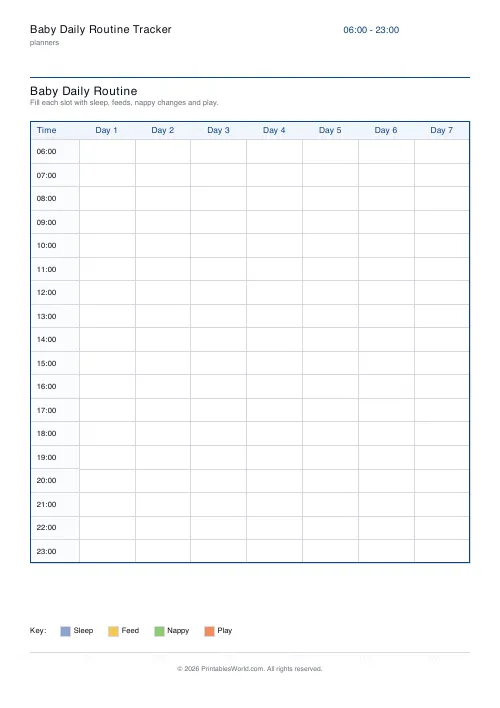
Baby Daily Routine Tracker
Printable hour-by-hour baby routine grid for sleep, feeds, nappy changes and play.
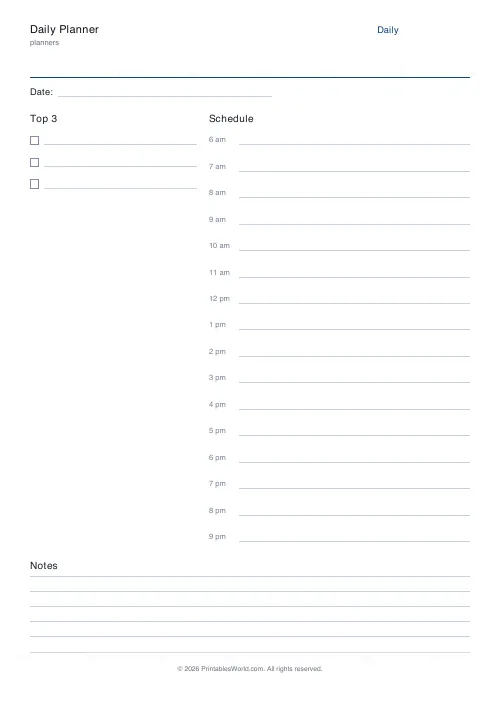
Daily Planner
One-page daily planner with priorities, hourly schedule, and a notes strip.
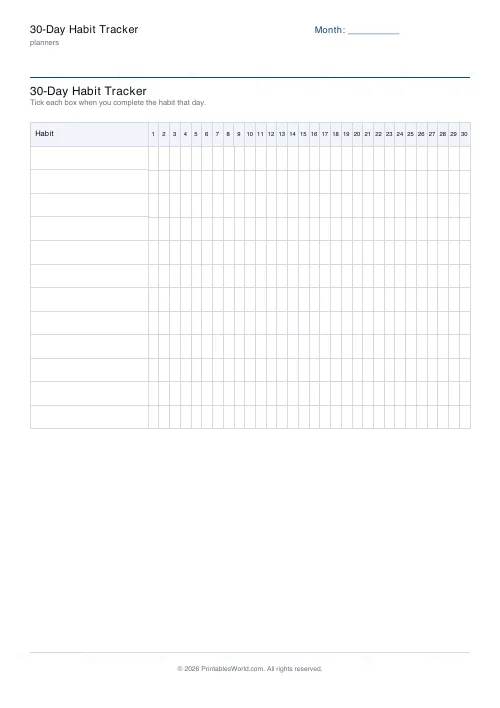
30-Day Habit Tracker
A printable 30-day habit grid to tick off every morning. One row per habit.
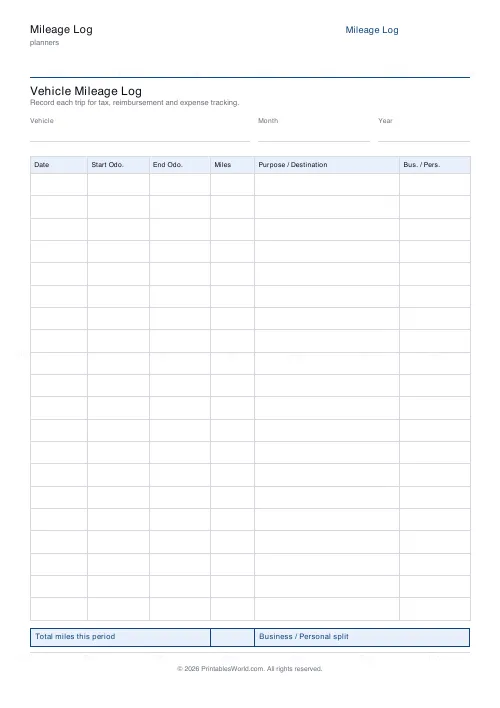
Mileage Log
Printable vehicle mileage log for tax, reimbursement and expense records.
Further reading
Planners
Baby's first year: tracking sleep, feeds and milestones
Tracking helps most in the early weeks and can become a burden after them. Here is what is genuinely worth logging, why, and when to stop.
5 min read
Planners
Time blocking for beginners: a complete guide
Time blocking is deciding when each task happens, not just what. Here is how to size blocks realistically, what to do when the day breaks, and why most beginners over-schedule.
5 min read
Planners
Meal planning 101: save time and money every week
A weekly meal plan saves money mainly by changing how you shop. Here is a thirty-minute method, the shortcuts that keep it going, and the mistake that ends most plans in week three.
5 min read