PW PrintablesWorld

Printable Paper

Polar Graph Paper

Concentric circles and radial spokes for polar coordinates.

Last updated:

What this tool does

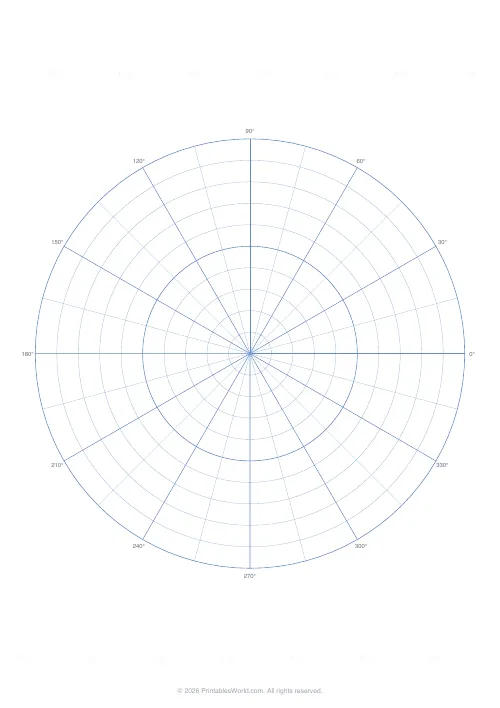
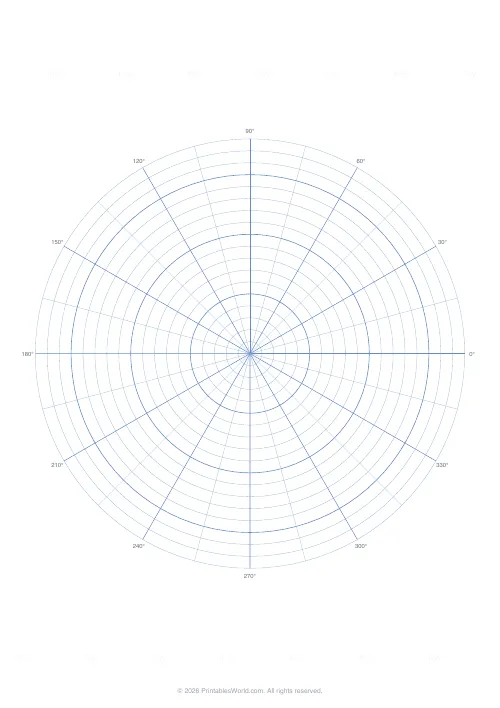
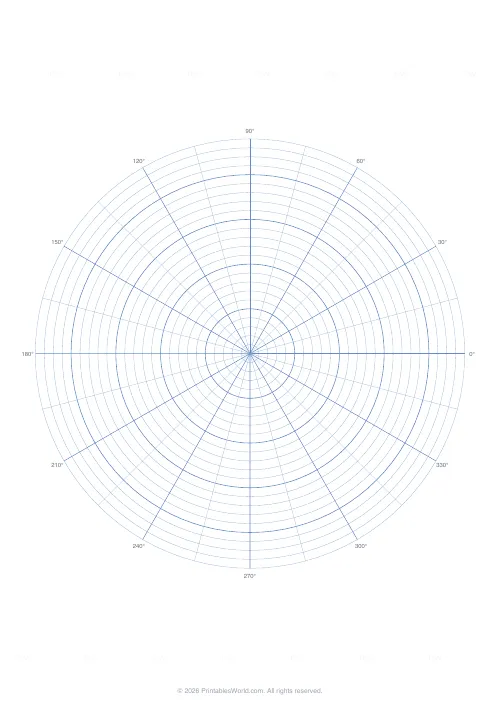
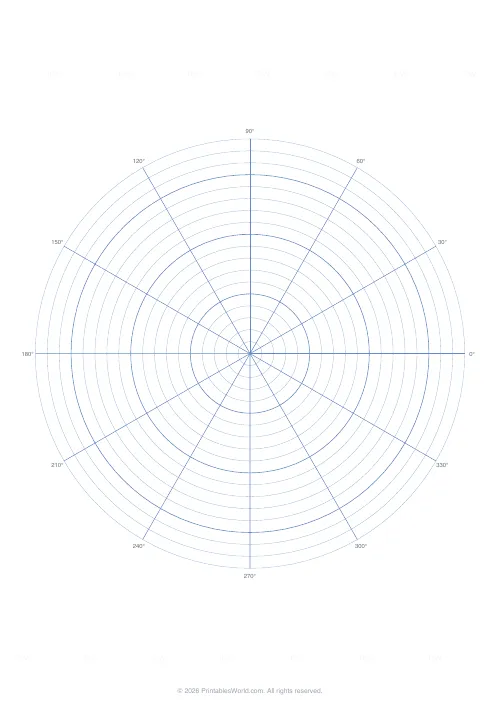
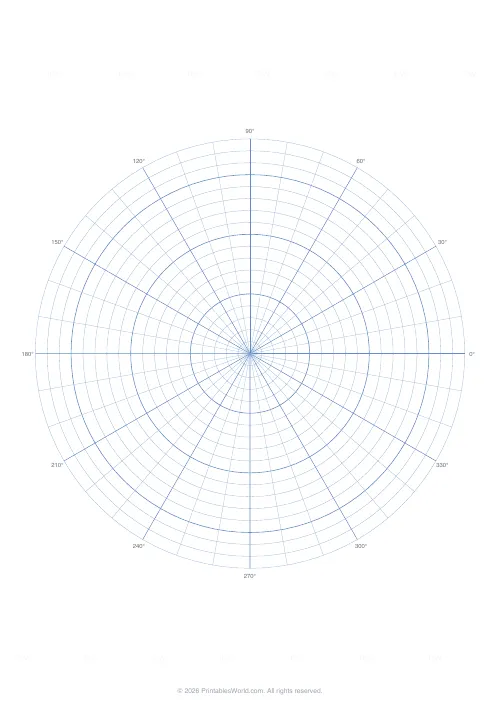
Polar coordinate graph paper. Concentric rings and radial spokes labelled every 30°. Configurable ring count and spoke count for the level of detail you need.

Settings

Configure your polar graph paper

18 concentric rings and 24 radial spokes.

Rings

Spokes

Paper size

Preview

Sample sheet

On-screen mock of the layout. The PDF prints at exact millimetre spacing.

People also used

Printable Polar Graph Paper for Trigonometry and Circular Plots

A clean, printable polar coordinate grid — concentric circles radiating from a central origin, crossed by radial spokes labelled every 30 degrees. Use it to plot polar functions, sketch antenna patterns, hand-draw complex-number diagrams, and work through circular-symmetry problems.

You can choose how many rings and spokes to draw, so the sheet matches the resolution of your data. Output is a single-page PDF in A4 or US Letter, ready to print at full scale on any home or office printer.

Because polar paper is not always carried in stationery shops, a clean printable version is the most reliable way to get a properly scaled polar grid for maths homework, lab reports, or engineering sketches.

Why use polar graph paper?

Any data with circular symmetry is easier to plot and read on a polar grid than on a conventional Cartesian one. Polar paper is used for:

  • plotting polar functions such as r = sin(θ) or r = 1 + cos(θ)
  • sketching rose curves, cardioids, and limaçons
  • drawing complex numbers in the complex plane
  • antenna radiation patterns and directivity plots
  • wind roses and navigation bearings
  • mechanical engineering cam and gear profiles
  • astronomy star-trail sketches

Students find it easier to grasp polar coordinates when they plot by hand on paper rather than watch a computer animation — the physical rotation through the angles anchors the concept.

What you can customise

  • Number of rings: 6, 12, 18, or 24 concentric circles
  • Number of spokes: 12, 16, 24, or 36 — chosen so angle divisions are clean
  • Paper size: A4, US Letter, or US Legal

Twelve rings with 24 spokes is a balanced default: each ring represents a single unit on the radial axis, and the spokes are labelled every 15 degrees. For finer plots, pick 18 or 24 rings and 36 spokes.

What the template contains

The grid is drawn as a set of concentric circles sharing a common centre on the page, crossed by radial spokes that run from the origin to the outer circle. Angle labels sit just outside the outermost ring and mark every 30 degrees of rotation. The ring count determines how many radial units are available — with 18 rings you can plot r-values from 0 to 18 without scaling.

The origin sits at the centre of the page, with the 0-degree spoke pointing right, following the standard mathematical convention.

Who this paper is for

Students

Plot polar functions from coursework, sketch complex-number Argand diagrams, and check by hand what a computer-drawn curve should look like.

Teachers

Print polar sheets for trigonometry and pre-calculus classes. Hand-plotting is often the fastest way for learners to understand what angles in radians actually mean.

Engineers and hobbyists

Sketch antenna gain patterns, cam profiles, and any other rotation-based diagram.

Navigators and surveyors

Use the 360-degree ring to plot bearings and compass directions without hand-drawing the concentric circles yourself.

How to use the template

  1. Choose how many rings you need for your radial range.
  2. Choose how many spokes you want for your angular resolution.
  3. Pick your paper size.
  4. Click Generate.
  5. Download the PDF and print at 100% scale.
  6. Plot points by reading an angle from the spoke labels and a radius from the ring count.

Worked example

Suppose you are plotting the polar function r = 2 + 2·cos(θ) — a classic cardioid. Pick 6 rings and 24 spokes, which give you a working radius of 0 to 6 and an angular resolution of 15 degrees. Calculate r for each spoke angle — for θ = 0°, r = 4; for θ = 90°, r = 2; for θ = 180°, r = 0; and so on.

Plot each point by counting outward along the correct spoke to the right ring, then join them smoothly. The heart-shaped cardioid emerges, with its cusp at the origin and its maximum radius at the 0-degree line.

Methodology

The grid is generated as vector geometry so circles and spokes print as perfectly smooth lines at any print size. Ring spacing is kept uniform — each ring is the same radial distance from its neighbours — so the radial axis is linear. Spokes are drawn at the exact angles defined by the spoke count, so the angular scale is uniform too.

Labels sit outside the outer ring to keep the plotting area clean. Print at 100% scale and disable "fit to page" so the ring spacing prints accurately, which matters if you want to measure radii with a ruler.

Designed for A4 and US Letter printing

The polar grid fills a square area centred on the page, so the outer ring touches the margin on whichever side is shorter. On A4 the circle is slightly larger than on US Letter because A4 is a narrower-taller page. Both paper sizes produce the same ring count and spoke count — only the absolute radius in millimetres differs.

Tips for plotting on polar paper

  • Write θ in either degrees or radians, but pick one and stick with it across the plot.
  • For negative r values, plot the point on the opposite spoke — many polar curves rely on this convention.
  • Use a pencil for the first pass, then ink once the curve shape is clear.
  • Label key features — petal tips, cusps, and asymptotes — with their angle and radius.
  • Overlay a thin Cartesian grid in pencil if you need to read (x, y) values from a polar point.

Related printable paper templates

You may also find these related printable-paper tools useful:

FAQs

Quick answers

What is polar paper used for?

Plotting polar functions, complex numbers, antenna patterns, and any data with circular symmetry.

How many rings should I pick?

12 for sketches, 18 for general work, 24 if you need fine radial resolution.

Are angles labelled?

Yes — every 30° around the outer circle.

Will it print on A4?

Yes — A4, US Letter, and US Legal are supported.

Related tools